



Anyone asking Arizona wing Anthony Dell’Orso if he or any of his teammates are healthy enough to play in an upcoming game might not get an answer.
At least that’s what the Australian wing indicated when asked if he’d ever been pressured by gamblers to give inside information, the reason the NCAA says teams will now be required to submit public player availability reports for NCAA Tournament games.
“When you’re at this stage, everyone kind of wants a bit of knowledge, and it gets hard to differentiate what their actual agenda is,” Dell’Orso said. “A lot of people, some are generally interested. Some are looking for an alternative motive for whatever reason.
“It’s almost too hard to tell. You’ve just got to be a normal person and kind of keep your information to yourself, keep things pretty level headed.”
Arizona coach Tommy Lloyd, saying the injury report requirement is about protecting gamblers and sportsbooks who have invested in the game, says the pressure from gamblers isn’t an issue with his players and that they are well-versed on the implications.
“We talk to our guys about it all the time,” he said.
The Big 12 announced in August that it would publicly post player availability reports for all conference games in football, men’s basketball and women’s basketball, as have several other conferences.
Then, on Thursday, the NCAA announced that men’s and women’s programs would also be required to submit player availability reports before NCAA Tournament games. It said it would then post those reports publicly, thus potentially reducing the amount of available inside information.
Both the Big 12 and NCAA said the reports must be filed the night before games, and the NCAA added a requirement to update them again two hours before tipoff of NCAA Tournament games.
In the Big 12, teams will be required to classify players as “available,” “game-time decision,” or “out,” while the NCAA says players will be assumed to be available unless listed as “questionable” or “out.”
Saying it is committed to protecting athletes’ well-being and “competition integrity from sports betting influences,” the NCAA said the reports would reduce the betting-related pressure, solicitations and harassment players receive over their playing status.
NCAA president Charlie Baker said in a statement that he applauded the Division I men’s and women’s basketball committees for taking “such important action” by approving the requirement.
“Implementing player availability reporting is a major step to increasing student-athlete protections by alleviating pressures for the enhancement of their college experience,” Baker said.
But Lloyd says not issuing player availability reports is what protects players. Like many coaches, Lloyd has normally declined to provide detailed injury information since taking over the Arizona program in 2021-22.
While some coaches withhold injury information to throw off their opponents’s scouting efforts, Lloyd says he isn’t trying to “be secretive or tricky.” Under multiple coaching staffs, Arizona has been known to withhold injury information to keep it from NBA scouts so as not to hurt a player’s draft stock, or to keep an opponent from knowing where a vulnerable body part could be targeted physically during games.

Arizona center Motiejus Krivas sits on the sideline wearing a boot on his left foot before the start of the game against UCLA at the Footprint Center in Phoenix, Dec. 14, 2024.
“I have no problem, if we had an agreement amongst coaches, calling coach X the night before a game and saying, ‘Hey, (number) 13 is not going to play tomorrow because he sprained his ankle. Just want you to know, as a gentleman, so you have a little opportunity to prepare your team,’” Lloyd said. “Then he tells me, ‘Hey, yeah, 12 for us is a little banged up. He ain’t gonna play.’
“I have no problem sharing that information with our opponents. To me, that’s a respect for competition, but that’s not why we’re doing it. … I don’t want to be a driving force or an opinion on this thing, but I just don’t want the kids to get caught up in it and (others) act like we’re protecting the kids when we’re not.”
Lloyd isn’t often outspoken on issues around the game, but this one appeared to touch a nerve, coincidentally in the days leading up to the Wildcats’ regular-season opener against Florida in Las Vegas, of all places.
Lloyd said sarcastically that if the spirit behind instituting player injury reports was to protect players then “let’s just add more prop bets,” and expressed concern about who this was really benefiting.

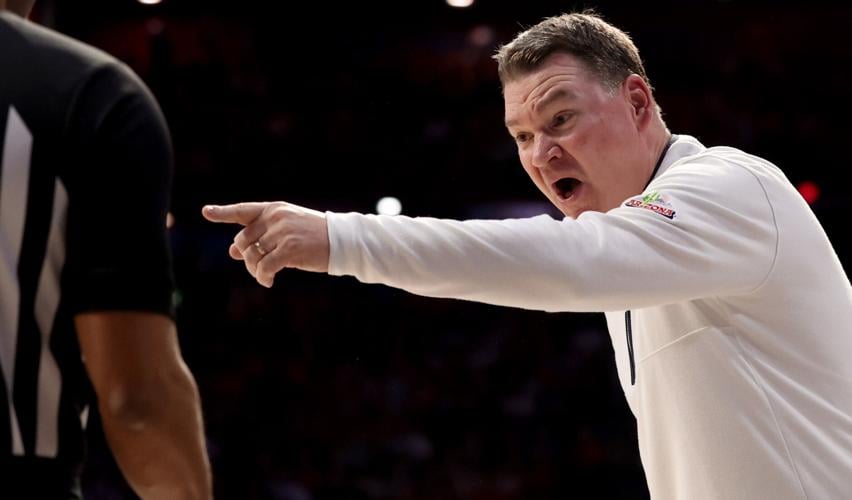
Arizona coach Tommy Lloyd has some words with one of the officials after the Wildcats didn’t get a call on an offensive set in the second half against Texas Tech on Saturday, Feb. 8, 2025, at McKale Center.
“They’re not protecting the players. What they’re doing is they’re protecting their financial interest, an investment in their sports,” Lloyd said. “They’re trying to protect the gamblers. They’re trying to protect the bookies. That’s what they’re trying to protect.
“This is solely because betting sponsorship is becoming a huge part of everything, and everyone wants a piece of it. They’re trying to get more friendly, for the books, the casinos.
“That’s it. There’s no other way to put it. I have no problem doing it, but I think we all have to just be honest with why we’re doing it.”
While player availability reports will add to teams’ pregame routines for a season that begins Monday, the NCAA’s playing rules oversight panel approved several on-the-court changes.
Among them:
- Coaches’ instant replay challenge
At any point in the game, coaches have one challenge in which they can ask officials to review out-of-bounds calls, basket interference calls or whether a secondary defender was in the restricted-arc area.
Teams must have a timeout to request an instant replay challenge. If it is successful, coaches will be given one more challenge over the rest of the game, including overtime, but they cannot challenge any other calls if their appeal fails.
Lloyd wasn’t a fan.
“That rule’s crazy,” he said. “We have a limited number of timeouts to begin with. And so if you use one in the first five minutes of the game, you don’t have one in the rest of the game? To me, that’s crazy.”
Officials can initiate video reviews of basket interference/goaltending calls and restricted arc plays in the last two minutes of a game and into overtime, but can only look at out-of-bounds calls when a coach requests it via a challenge. Officials can voluntarily look at replay for timing or scoring errors, shot-clock violations, and to see if a player is taking a 3-pointer or 2-pointer.
- A change to the continuous motion rule
An offensive player who ends a dribble going toward the basket and is contacted by a defender can pivot or complete the current step and finish the field goal attempt. Previously, players received field goals only when fouled while shooting.
- A hit to the groin can generate a Flagrant 1 foul
Previously, contact to the groin was only assessed either as a common foul (inadvertent) or a serious Flagrant 2 (intentional and excessive, resulting in ejection).

