


Thanks to a new Arizona law, booster-funded NIL deals that Wildcat basketball players signed before restrictions arrived last spring aren’t subject to public-records requests and thus remain sealed from fans and media.
And the exact amounts of school-paid salaries Arizona players are receiving also remain opaque because UA has declined to specify its revenue-sharing percentages, as have many schools because of competitive concerns — namely, that another school may be offering its basketball players more or less than a peer school.
So all that’s known for sure is that Arizona has confirmed it will dish out the $20.5 million maximum to its programs collectively, and how much the school would pay its men's basketball players if it followed industry averages.
According to Opendorse, an NIL advisory firm and platform that analyzed collective, collegiate and commercial deals and budgets through late June, power conference schools are handing an average of 20.3% of their $20.5 million maximum to men’s basketball for 2025-26.
That translates to a $4.16 million budget for power conference men’s basketball programs, and it’s possible, considering UA’s historical emphasis on basketball, that the school could be paying even more.
Braly Keller, Opendorse’s director of collegiate services and insights, said Opendorse is aware that some schools may be “placing a higher emphasis” on revenue sharing for sports that are traditionally strong, such as basketball, baseball, hockey or even Olympic sports at some colleges.
Keller also said local market dynamics, coaching philosophy and school choices also play into how a school splits up the money.
“It would be distributed across starters, rotation players and potentially even backups depending on how a school structures its allocations,” Keller said.
But even if UA is distributing just the average of $4.16 million to men’s basketball, here’s how it could break down, according to Opendorse data. The firm estimates starters receive about 80% of a position group total.
(NOTES: The first figure after each position is a total for the entire position group, including all starters and reserves, based on Opendorse industry averages. All specific player estimates are based solely on Opendorse’s reported industry averages, and were not received from UA sources; UA is not releasing player compensation information.)
Guards: $2.21 million (53.2% of the men’s basketball total). Under Opendorse estimates, starting guards Jaden Bradley and freshman Brayden Burries would be expected to divvy up $1.77 million, with more possibly headed Bradley’s way because he is a fourth-year player and the Wildcats’ leader.

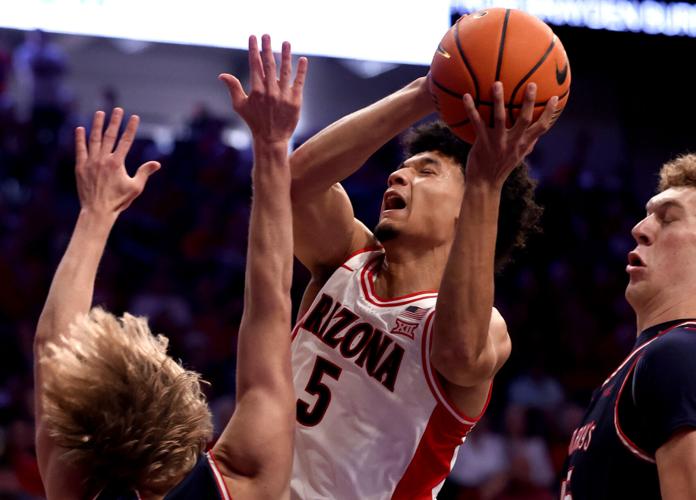
Arizona guard Brayden Burries tries to twist his way to score through Saint Mary's guard Liam Campbell, left, and center Andrew McKeever during the second half of their exhibition game, Oct. 18, 2025, in Tucson.
Dividing up that much would mean both players could each be making more than a standard $636,000 two-way contract between the NBA and G League, plus whatever contract they reached in NIL earnings before the House settlement was approved. Under the House settlement, all NIL deals worth more than $600 are subject to a clearinghouse, but those completed last spring before it was approved were unlimited.
“The concept of 'front loading' payments— stacking collective payments prior to the approval of the House settlement and subsequent July 1 cap year—was not just a theoretical possibility,” Opendorse wrote in its 2024-25 annual report. “The data proved it.”
Bradley tested the NBA draft last spring but signed a contract in April in the event that he returned to Arizona, suggesting his deal was quickly negotiated.
If Opendorse estimates applied, UA would also be distributing a total of about $442,000 to backup guard Evan Nelson, but it's likely the school could be shifting some "guard" funds to a wider group that includes wings and forwards.
Forwards: $1.55 million (37.3%). Projected starters Anthony Dell’Orso and Koa Peat would split $1.24 million in revenue share funds if UA followed Opendorse averages, with backups such as Ivan Kharchenkov and Dwayne Aristode likely to divvy up the remaining $310,000.
However, this estimate is complicated at UA because the Wildcats group power forwards, such as Peat and Sidi Gueye in the post group, along with centers such as Motiejus Krivas and Tobe Awaka, while Dell'Orso is among the forwards who are considered wing players.
Kharchenkov also had leverage as a professional German Bundesliga player who had signed a three-year deal through 2026-27 with Bayern Munich.
Centers: $395,200 (9.5%). If Krivas was considered the starting center, after Awaka played the role last season while Krivas was mostly injured, he would command $316,000 under Opendorse’s industry averages. But Awaka is expected to start or play a major reserve role at both post positions, so he may be likely to receive at least as much as Krivas.

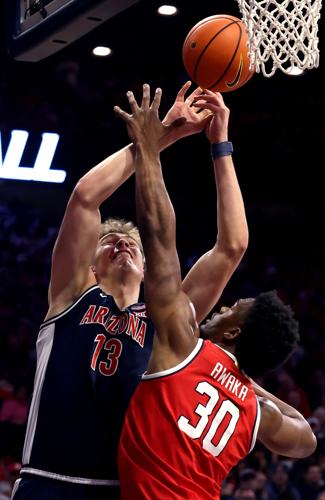
Arizona forward Tobe Awaka (30) gets an arm in trying to stop Arizona center Motiejus Krivas (13) during the annual Red-Blue Showcase, Oct. 3, 2025, at McKale Center.
Most likely, Krivas, Awaka and Dell’Orso are all receiving at least mid-six-figure amounts. Instead of testing the transfer portal to see if they could earn even more elsewhere, all three joined Bradley in signing contracts with Arizona in April to return this season.

