


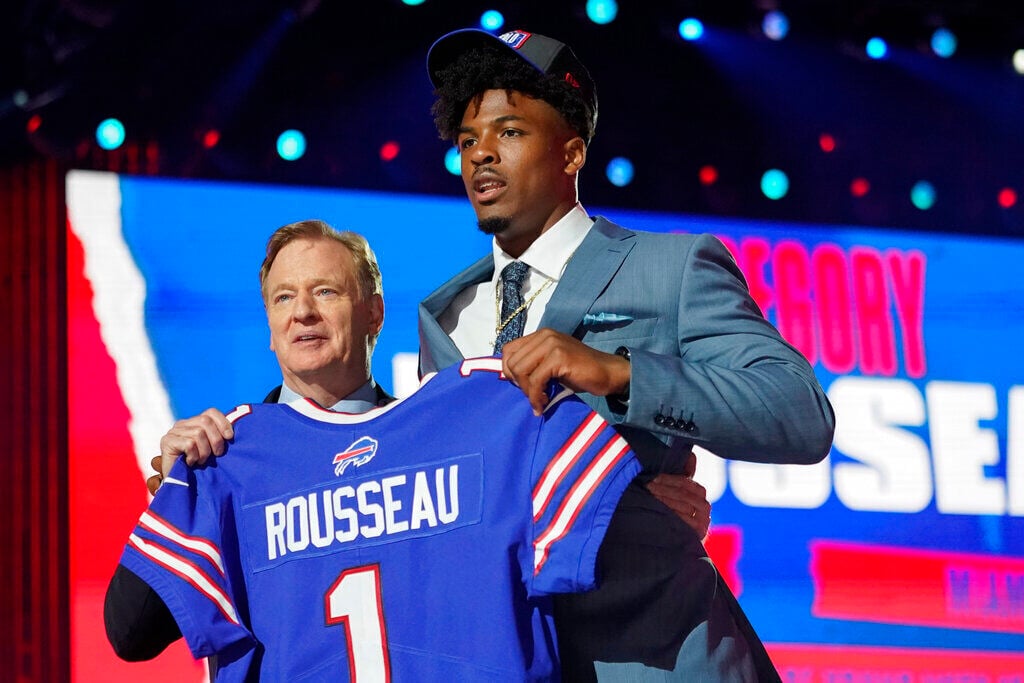
The Buffalo Bills got the position right.
In making former University of Miami standout edge rusher Greg Rousseau their first-round pick in the NFL draft Thursday night, the Bills look to have put some much-needed teeth into their pass rush.
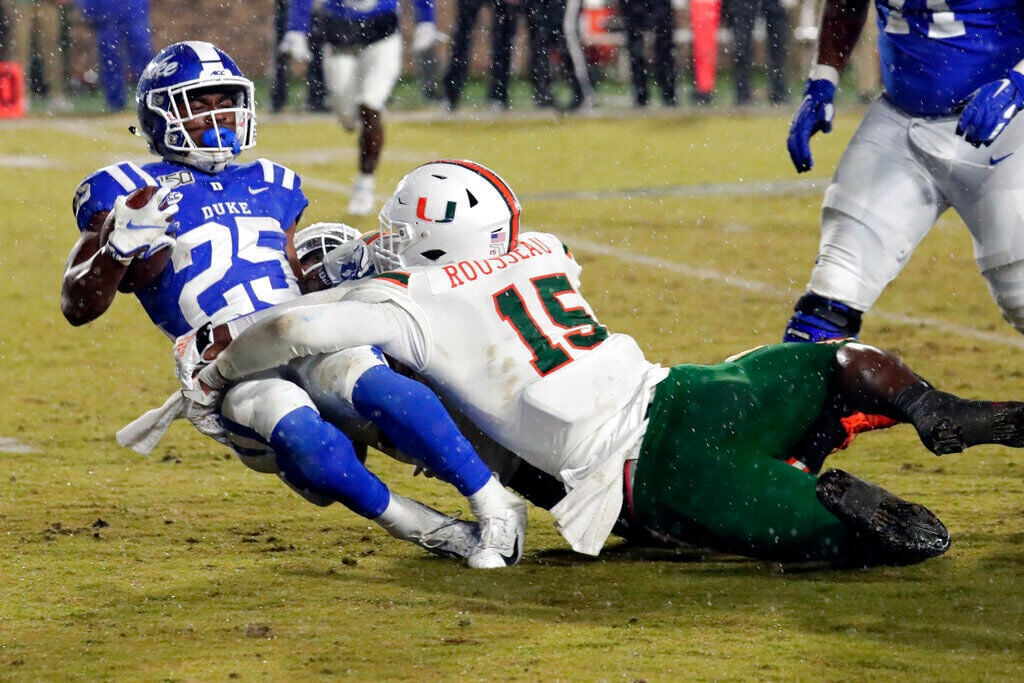
Here are five things to know about Miami (Fla.) edge rusher Gregory Rousseau, selected by the Buffalo Bills in the first round, 30th overall, on Thursday.
Even if he doesn't start, Rousseau, selected 30th overall, could factor into the Bills' defensive front on a rotational basis. The team also sees him as having the versatility to play inside as well as outside.
"Anytime you can affect the quarterback, and you saw two teams in our division (New England and the New York Jets), take new quarterbacks, we definitely wanted to add there at the right time," General Manager Brandon Beane told reporters. "And we're really excited about Greg."
"It's a blessing they believed in me," Rousseau told reporters on a web call from the draft in Cleveland.
Quarterbacks dominated the first half of the draft, with five going in the first 15 picks. Here’s how the second round may play out Friday night.
That's saying plenty, because Rousseau, who is 6-foot-6 and 266 pounds, played only one full season of college football in 2019 and then opted out of the 2020 campaign due to the Covid-19 pandemic.
"I know he opted out this year," Beane said. "But this was a player that we thought, had he not opted out, he (still) came off 15.5 sacks in 2019. That was kind of really his first year of playing college football."
And he has a Western New York connection.
Rousseau said his parents lived in Buffalo in the mid-1990s and his older brother, Marvyn, who is in the U.S. Coast Guard and stationed in Memphis, was born in Western New York.
Greg, who was born in South Florida, said he already knows plenty about the Bills and their fans.
Plenty of spots remained to be filled on the roster as the NFL conducts the second and third rounds of the draft Friday night.
"(Hall of Famer and former Hurricane) Jim Kelly, the whole nine yards," he said. "They've got a Miami connection for sure."
With 15.5 sacks in 13 games in '19, Rousseau led the Atlantic Coast Conference and ranked second in the nation. He also had 54 tackles, including 19.5 for loss, and seven quarterback hurries.
As a true freshman in 2018, he played only two games before suffering a season-ending ankle injury.
The Bills see him as a raw and developing athlete.
"This guy played wide receiver," Beane said. "He was more of a skilled player growing up and is just still growing into his body. When he got those sacks, he played in the 240s, maybe 245, 246. He's added 20 pounds since then. He'll continue to grow into that. ...
“He’s a prototype size. You can’t coach size, length, get-off and things like that. He’s got all of that,” Beane said. ”He uses his get-off and length to affect the passer, whether it’s just engulfing or he had plays where he got the sack because he’s being blocked and reaches around and causes a fumble. .... He needs to improve his counters and things like that. But again, a one-year player, he’s got a knack for getting to the quarterback.”
Rousseau's decision to opt out didn't bother the Bills, because their research showed he's a "great kid who was well-raised."
During the team's pre-draft video conversations with him, Beane said, it was evident Rousseau "stayed in touch with his teammates. He was still watching tape. He was removed, but he was still hanging in there. He didn't want to (opt out), but that was a decision he decided to make and we understood anybody that opted out."
The first half of the first round of the NFL draft went reasonably well for the Buffalo Bills, even though their three AFC East rivals had prime picks.
Rousseau said he trained the whole time he was out of football last year.
"I didn't really take any time off," he said. "So I feel like I'm gonna be ready. I'm just ready to come in and just prove I'm there for a reason and earn the respect of my teammates and my coaches.
"I'm just ready to get up there, give it my all, and just show what I'm made of."
Two other edge rushers who were frequently mentioned as possibilities for the Bills to pick at No. 30 – Penn State's Jayson Oweh and Washington's Joe Tryon – were taken by Baltimore and Tampa Bay with the next two choices, respectively.
Beane said Rousseau could potentially form the core of the defensive line with A.J. Epenesa, who was selected in the second round last year. Beane called Rousseau and Epenesa "future starters" along with Daryl Johnson, who was drafted in 2019.
Jerry Hughes, 32, and Mario Addison, 33, are in the final year of their contracts.
Beane noted that Rousseau will have "two of the best in the business" to learn from.
There are other areas that make plenty of sense for the Bills to address, at least from a depth standpoint, through the balance of the draft.
They could use a cornerback to compete for the starting spot opposite Tre'Davious White. One player at the position that some speculated would fall to the Bills because of his injury history (he's still recovering from back surgery) was Virginia Tech's Caleb Farley, but the Tennessee Titans chose him at No. 22.
The Bills could use a tight end. They could use a defensive tackle.
Running back was widely discussed as a position the Bills could fill, though incumbents Devin Singletary and Zack Moss are satisfactory. One player that some draft prognosticators projected to be available at No. 30 was Clemson's Travis Etienne, but he went to the Jacksonville Jaguars at No. 25.
The selection reunites him with former Tigers teammate, quarterback Trevor Lawrence, who the Jaguars made the top overall choice.
Picking up a running back on the second or third day, or even as an undrafted free agent, would probably make more sense.
Though the Bills have seemingly done plenty to address the offensive line in free agency, it would hardly be a surprise if they landed one before the draft ends.
The Bills have six picks left through the final two days of the draft.
They have two choices Friday night in rounds two and three. The second-round selection is 61st overall, while the third-rounder is No. 93.
"Friday is a very fun draft day," Beane told reporters before the draft. "It's probably a more exciting day than Day 1, in a lot of respects. You're still hoping to get two players – maybe they're starters, maybe they're not – but you're hoping they're vital contributors. If not immediately, then through their career, depending on who they're backing up and what position it is.
"So, it's very important for us to hit on those. We try not to take crazy risks in those rounds. Maybe you take more of your risk later on a height-weight-speed guy, or this guy's been a lower-school player, and you feel like his best football's ahead of him once you get him here and things like that."
On Saturday, the Bills don't have a fourth-round pick, which they gave up as part of last year's trade to acquire wide receiver Stefon Diggs from the Minnesota Vikings.
They do have a pair of fifth-round choices. The first, at No. 161, was what they received from the Raiders in 2019 in exchange for wide receiver Zay Jones. The second fifth-round pick is 174th overall.
The Bills also have a sixth-round selection, 213th overall, and a seventh-rounder, No. 236, which they received from Carolina as part of a 2018 deal that sent offensive lineman Marshall Newhouse to the Panthers.
"That's what's cool after Round 1, is seeing what's been taken off the board, and looking at what's there as you enter Friday," Beane said. "Do we start calling and asking, ‘Do we want to start moving up? Is our board starting to get cleaned out?’ Or are we going, 'Man, there's a lot of guys here. We can really be patient and get a guy, or even move back and pick up a later pick?'"

