


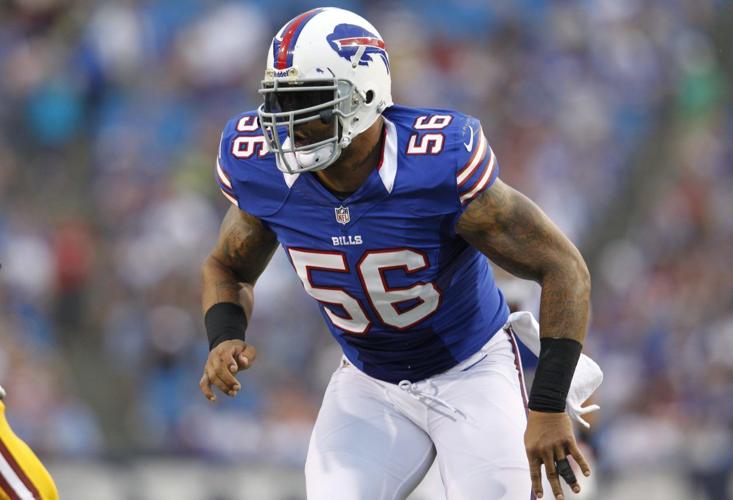
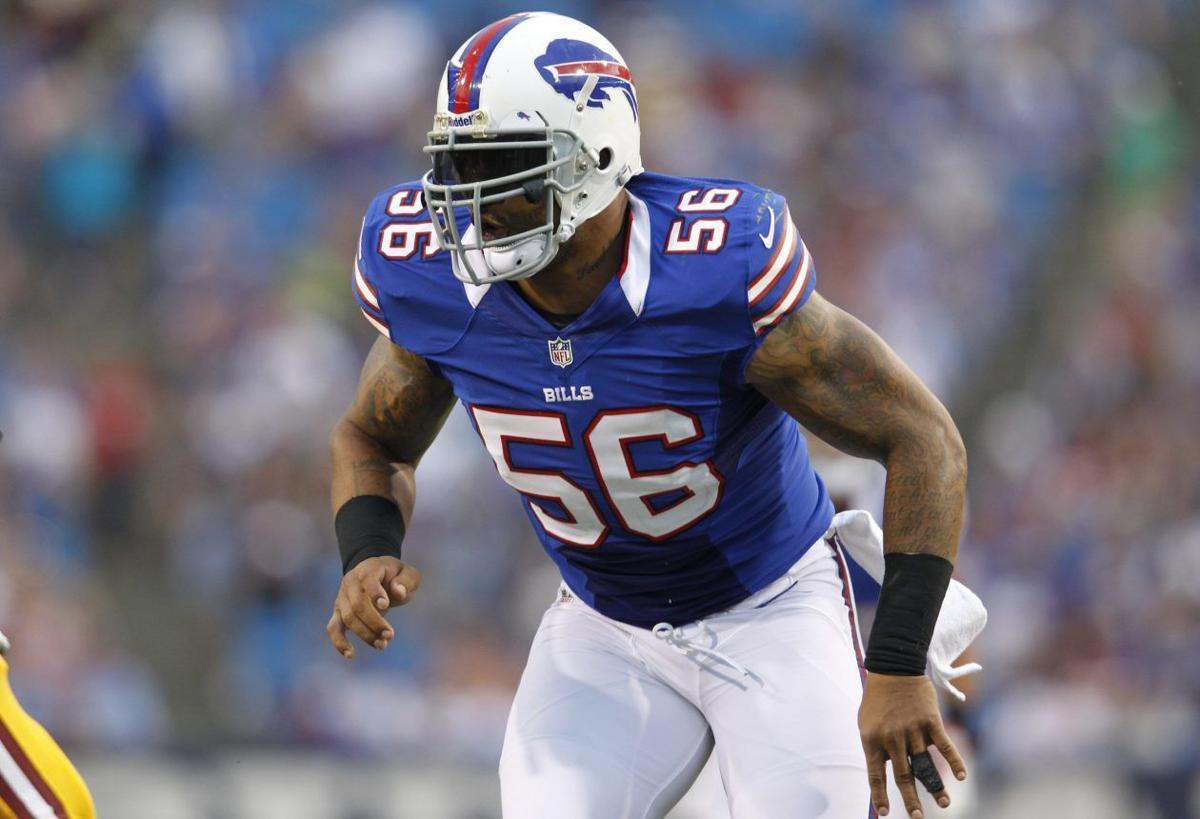
Shawne Merriman makes no attempt to hide the fact his loyalties are with the team for which he spent the first five and a half of his eight seasons as an NFL linebacker.
“My heart's always going to be with the Chargers,” he told The Buffalo News this week by phone from Los Angeles. “I'm a Charger until the day I die.”
It makes sense, given that San Diego was where Merriman began his career in 2005 as a first-round draft pick from Maryland and that he enjoyed all his success in the league with the Chargers until they waived their three-time Pro Bowler midway through the 2012 season.
But Merriman also feels a strong attachment with the Buffalo Bills, who face the Los Angeles Chargers on Sunday at Bills Stadium. Despite having been with them for only two-and-a-half losing and mostly injury-filled years, he has fond memories.
“Playing in Buffalo was a privilege, because you don't get a chance to see a fan base like that,” Merriman said. “And I got a chance to experience another organization, another locker room. It was very family-oriented out there, man. I loved that.”
Of course, he will be happy to see the Chargers win, but he said the football fan in him would be equally happy “to see a competitive football game with guys just getting after each other, period. And as long as that's happening, you're like, ‘Man, I'm satisfied this day.’ ”
In the latest edition of One-on-One Coverage, The News spoke with Merriman about his time with the Bills and Chargers, his thoughts on the current editions of the teams, his diverse sporting interests that also include mixed martial arts and auto racing, and how he intertwines the three sports he follows closely on his “Lights Out” podcast on Fox Sports Radio.
Buffalo News: Your time with the Bills was an up-and-down experience, to say the least, beginning with the season-ending Achilles injury you suffered in your first practice.
Shawne Merriman: I had a partial tear my Achilles in 2009. It started to tear a little bit, then a little bit more. By the time I got waived by the Chargers, I had a 30% or 40% tear in my Achilles, which the (Bills) knew about. I said, "Man, I've been playing on it, but it's not right, I'm not me. And the thing is going to tear at some point."
I was kind of running around like a pirate for a year. No one got a chance to really know about it because I just crossed it out. It was painful and some days, in the mornings, I couldn't walk, and I had to get a warm shower just to walk straight because my Achilles was so inflamed when I got up.
I want to compare this to what's going on right now like with Klay Thompson (of the Golden State Warriors). You see he had the knee injury, then he came back and what's first thing he tears? He tears his Achilles. That was what happened with me. I got to a point where I was overcompensating. I was trying to come back from a knee injury (he had suffered with the Chargers) so much, I was putting so much pressure on my other leg.
Coming to the Bills, I just had so many big aspirations because I knew that, if you play well in Buffalo, one thing that's going to happen is the fans are going to love you. And I went out there and, literally, one of the first practices, I suffered an extra little tear, and that was pretty much it. Honestly, I wish there was something I could have done to have the surgery earlier. Nobody would fix it. They almost, in a sense, wanted it to completely tear before they did anything.
BN: In January of the next year, the Bills gave you a contract extension. But the Achilles never fully cooperated, you landed back on the injured-reserve list in 2011 and then you were waived in training camp in 2012.
SM: I got pretty much healthy, but an Achilles injury, you don't get back healthy for nine to 12 months to be 100%. You see Kevin Durant and all these guys that tear their Achilles, they're gone for four years before they try to put them back out there. So, right at that nine-month mark, I started to feel good, but I wasn’t myself. I came to camp, and my Achilles would swell up and my knee would swell up after a week and a half of practice. I knew that (the release) kind of was coming because they had Kyle Moore and they were paying him a lot less. I knew they might actually have to make a move because of what I was getting paid that year and I just wasn't back to myself.
It was tough for me because I knew I was coming right around the corner (to full recovery). I was able to at least practice every single day and make it through practice with no complaints and no big problems. But I was probably a little bit more torn up leaving Buffalo than I was the Chargers because when I talked to Chan Gailey, Chan was literally in tears when he when he told me. I was, too. I was just like, “Man, I'm just starting to kind of get over that hump. I need like another month before I really feel confident in pushing off of this thing and turning it and twisting and bursting without it being the mental part of it. I was getting there.”
BN: And the Bills would give you yet another chance when they re-signed you in mid-October of 2012.
SM: When they let me go, I went down to Miami and I was training with Pete Bommarito. I was determined to get this thing at least back to where I could go out and play without any problems. I spent a month or so, working out with Pete, and I finally felt close enough to myself again. And that's when I got the call from the Bills to come back. I was so thankful, man, to get that call because I knew that I was close enough to being bad where I could make some noise again.
BN: When you retired after that 2012 season, was there a greater sense of closure, just because you were able to get an opportunity to finish out feeling healthier than when you got to Buffalo?
SM: Actually, there were a couple things that gave me closure. If you go back and watch the very last game I had there, against the Jets, it was probably my best game I had there, period, where I had an all-around complete game. I was explosive, getting after the quarterback. I think it had six or seven tackles. I started to feel like myself again a little bit.
Doug (Whaley), the GM, came in and he said, "Man, that was awesome. We want you to come back." And at the time I told him that I was thinking about coming back and I wanted to, but I had to really think about what I wanted to do. My dad, who I wasn't close with for almost 20 years I didn't see, came to our game against Jacksonville. I went through a period where I didn't talk to my dad from maybe age 10 until I retired. That gave me closure, too.
The Bills had gotten rid of the coaching staff, which was another big thing. I was like, "Man, I just got back on the field, I started feeling like myself again and then you have another coaching staff coming in that was probably going to want me to do something else." So, at that point, I was done. I was kind of at peace with my decision. I was ready to move on to other things.

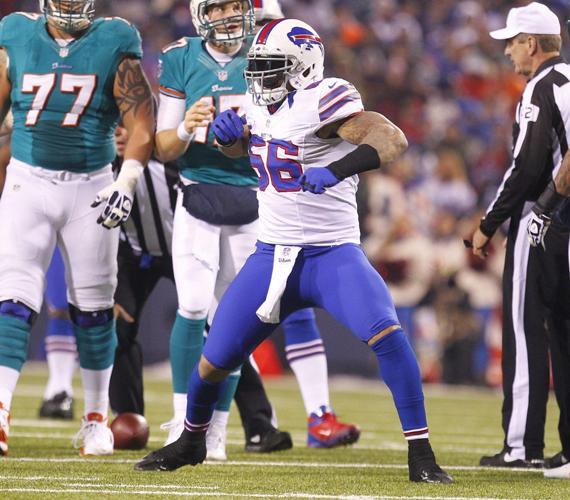
Bills defensive end Shawne Merriman celebrates a sack of Dolphins quarterback Ryan Tannehill during the fourth quarter of a 19-14 Bills victory in 2012.
BN: How much fun are you having with the podcast?
SM: The thing about the podcast and why I love it is because I've been fortunate being in so many different fields. Obviously, playing in the NFL, having a college career in Maryland, but also over the last 12 years, I've probably been at 20 different NASCAR tracks, maybe more if you include the short tracks. I've also been training MMA for the past 14 years. So, I get a chance to bridge all this together on the podcast and bring in different guests. I've had Joey Logano. I've had Chase Elliott after he just won the (2020 NASCAR Cup Series) championship. I just had Tyron Woodley, who's a multiple champ with the UFC.
BN: How did your involvement with MMA come about?
SM: Through Jay Glazer of Fox Sports. I grew up boxing. I have family members who were professional boxers growing up. So, on the East Coast, where I grew up, in Maryland and D.C., boxing was huge. But MMA wasn't. So, Jay convinced me that MMA would help me with football. I said, "OK, cool. If it's going to help with my hand-eye coordination and explosion and being able to open hips and my endurance and stuff. I'll try anything to be a better football player.”
And it did. My first day coming into the gym with Jay Glazer, Randy Couture was there, along with Tyron Woodley. I also trained with a couple of football players, Richie Incognito and Clay Matthews. I just really fell in love with the sport. I started to get really good at the boxing. I started learning jiu jitsu after I retired. I love combat sports.
BN: How helpful was that training while you were playing?
SM: You're going against some monsters out there, so you have to be able to use your strength and leverage in being able to bend the corner. I would advise a lot of defensive players – cornerbacks, defensive tackles, outside linebackers – and offensive linemen to really pick up some type of combat sport. Not to spar or fight; you don't want to get anybody hurt. But to pick up the hand speed and the hand-eye coordination, the hand placement, all those things that are so important.
BN: And now you have your own MMA venture, Lights Out Xtreme Fighting.
SM: Yes, and that takes up most of my time. We're on hiatus right now because of the pandemic. We'll be starting up at some point. We got picked up by Fox Sports regional television networks back in May. We're really excited about that.
BN: How did you get involved with auto racing?
SM: In 2008, I went out to be the grand marshal for the Spring Cup series in Fontana, Calif. I had been watching NASCAR on TV growing up. I knew about Dale Earnhardt, some of the bigger guys, but I didn't know about the sport. I just watched it on TV. I had no idea about the excitement and adrenaline rush that was there at the track. I got to the track in 2008, and I've never left the sport since. Jimmie Johnson invited me down to his pit and Richard Petty's group had me out to the Richard Petty Driving Experience (which, for a fee, allows adults to drive or ride in a NASCAR race car at one of many speedways throughout the country). And after that point, I just stuck around the sport.
In 2017, I actually teamed up with Jesse Iwuji, who's one of two African Americans in the sport, and I became a car owner and the team owner of his on the Can-Am Series. For two years, I spent a lot of time at tracks, sometimes until midnight in drivers' meetings and owners' meetings. I love the sport.
BN: What are your biggest takeaways from your Charger years?
SM: We had a confidence about us that we wanted to dominate. That was our attitude. That was what we preached. And I can tell you that, sometimes the competition in practice was a little bit harder than the game, because we really, really got after each other. The cat's out the bag about Philip Rivers and how much he talks. Not even in a bad way. People around the NFL love to talk with him and get in these back-and-forth, sparring matches with him because he's just that type of player, he's fun.
You could imagine, every day in practice, it was a completely competitive practice. Sometimes, depending on who we were playing, it was more competitive than the games because we didn't want the offense or defense to win. Especially when Marty Schottenheimer was the coach. He was more of a defensive-minded coach and the defense that we had would beat the offense every day. And then Norv Turner came and there was more of an offensive mindset. So, the offense had to win every day and we just weren't going to let that happen. It was fun, man.
BN: What do you make of this current Bills team?
SM: Let's take it back to when I went there. They were 0-7. You always look at those teams like, "Man, these guys (stink), these guys are terrible." And then I get in that locker room and I meet Fred Jackson and Kyle Williams and all these other guys. And I was like, "How in the heck could you be 0-and-anything? I mean, it doesn't make any sense."
So, you always had a feeling, with the teams they had the '90s and some of the teams they had there with (Takeo) Spikes and some of the other guys, they had good teams there. And you almost had a feeling at that time that, sooner or later, it was coming. Then, they got a Josh Allen and you knew, as soon as they got Stefon Diggs, that they were going to be able to turn it around. And it's happening. So, when everybody's shocked and making noise about Buffalo around the country, I'm like, "If you looked at it, they've been on the brink for years."
You can't help but think that this game Sunday is just going to be a great game. Obviously, I support the Chargers. I still talk great things about the Bills, too. I can't bag on my boys out there. But at that point, you want to see a great football game, because I'm a fan of the game in general.
BN: What are your thoughts on the season Justin Herbert, the Chargers' rookie quarterback, is having?
SM: What they're doing with him and Keenan Allen and Mike Williams and Hunter Henry, they have some pieces there that, no matter what their record is, they're going to keep everybody in tune. Their record is not displaying what they could be. I mean, they lost three or four games within six points. Unfortunately, they’ve got to look back after the season and say, "Man, we really blew this one up because we had something there. We just didn't finish some football games."
And when you look at this week coming up, it's like, man, you're looking at Josh Allen and you're looking at Justin Herbert. You're looking at what the NFL is going to be for the next five or 10 years.

