

The Arizona Cardinals’ offseason priority list is clear.
With the Kyler Murray era likely over, their most important need is at quarterback. Entering 2026 with Jacoby Brissett entrenched as the starter would signal another rebuilding year to a fanbase unlikely to accept that proposition.
They also need multiple reinforcements along the offensive line, including a right tackle.
Like quarterback, that’s a premium position. Finding an above-average tackle outside of the first round of the draft is rare.
Acquiring help at those two spots will leave the Cardinals with few resources to use on their defense, which saw major investment in both free agency and the draft last year. The problem: That defense now ranks 20th in DVOA, which adjusts for strength of schedule. Only five teams are allowing more points.

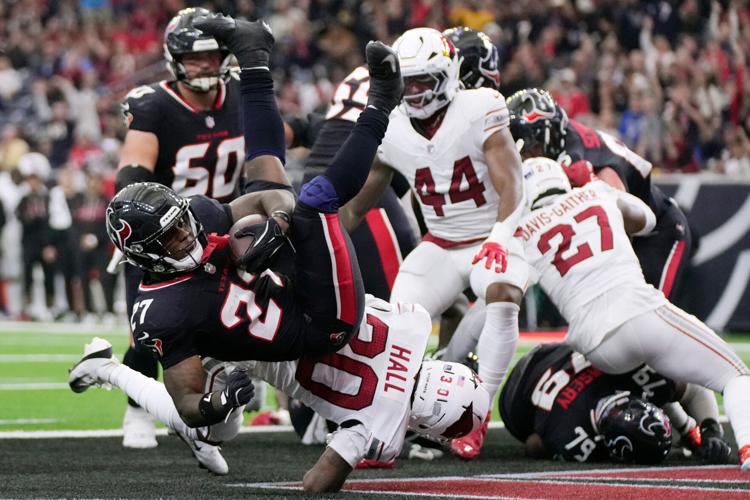
Houston Texans running back Woody Marks (27) scores a touchdown as Arizona Cardinals cornerback Darren Hall (30) arrives late for the tackle during the first half, Sunday, Dec. 14, 2025, in Houston.
So, can the defense be fixed in one offseason? Their tape from last weekend’s 40-20 loss to the Texans showed why that might be possible — and why it might not be.
Misfires in free agency
Against the Cardinals, Texans quarterback C.J. Stroud averaged 9.0 yards per attempt, his most in nearly two years. Immediately after the game, head coach Jonathan Gannon pointed to the Cardinals’ struggles with their zone distribution.
The next day, he explained what that meant.
“When we’re supposed to hit a hook, and we chase a shallow, and they throw the ball to the hook, that’s zone distribution,” Gannon said. “Gotta do that better.”
Gannon didn’t say it, but he was clearly referring to a third-and-6 rep from linebacker Akeem Davis-Gaither.
On the play, the Cardinals were in cover-2, with Davis-Gaither playing the hook zone along the right hashmarks. But as a receiver ran a shallow crossing route underneath, Davis-Gaither attached himself to that route, even though Baron Browning already had it covered. That left tight end Dalton Schultz wide open in Davis-Gaither’s initial zone for a 16-yard gain.
Afterward, Davis-Gaither looked to the sky and shook his head, realizing his own mistake. But it wasn’t his only issue in coverage against the Texans.
On one play later in that drive, the Cardinals ran a coverage that they used multiple times in this game. The defense was in a cover-3 zone, except with Will Johnson in man-to-man against Nico Collins, as a mechanism to negate the Texans’ star receiver.
With Collins running a deep route, Davis-Gaither needed to recognize the vacated space underneath — unless it was a busted coverage from Johnson, which seems unlikely, given that the Cardinals repeatedly used this coverage against Collins. Instead, Davis-Gaither was late to react and allowed a first down.
Davis-Gaither was not the only Cardinals’ player to struggle in coverage against the Texans, but this has been a trend all season. Per Pro Football Focus, his 40.5 coverage grade ranks 42nd among 47 linebackers with at least 300 coverage snaps.
Under Gannon and general manager Monti Ossenfort, the Cardinals have never invested more than $5 million per year in an inside linebacker or drafted one in the top three rounds.
This offseason, the Cardinals might have to break their own mold and spend up on the position. That would also allow them to move Mack Wilson back to the role in which he excelled last year. Meanwhile, cutting Davis-Gaither would save $4.7 million and incur just a $1.5 million dead cap hit.
The Cardinals have also gotten inconsistent production from their defensive line, another problem area that showed up against the Texans. Arizona is now allowing 4.5 yards per carry, the seventh most in the league.
“It starts with mode of play,” defensive coordinator Nick Rallis said. “The thing that can stop anything, whether you have the perfect call up or the worst call up, is guys changing the math up front.”
One play early on was particularly revealing. Walter Nolen — their first-round pick and a rare bright spot when healthy — blew past the left guard. But on the other side of the line, Dalvin Tomlinson was moved backward by a double team, and Dante Stills was sealed outside by a tight end.
Stills is a solid rotational run stopper, but Tomlinson has struggled since signing a two-year, $29 million deal in the offseason. His pressure rate is down from 11.4% to 3.7%, and he hasn’t been effective enough against the run.
He’s also not alone. Former first-round pick Darius Robinson has been the league’s worst interior defensive lineman, per PFF’s grading. His pressure rate is 1.7%.
The Cardinals can save $9.4 million by cutting Tomlinson, but, unlike at linebacker, their problems run deeper. If Calais Campbell retires, the Cardinals would be left with just Nolen as an above-average producer at the position, thanks to free agent signings and draft picks that have not yet worked out.

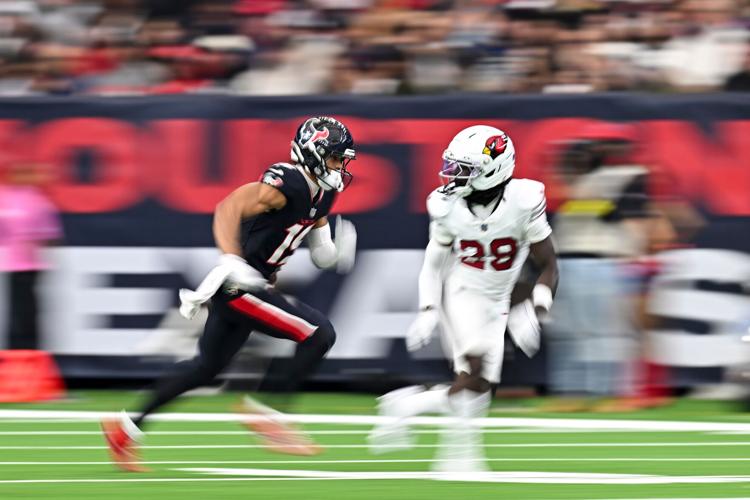
In this photo taken with a slow shutter speed, Houston Texans wide receiver Xavier Hutchinson (19) runs a route as Arizona Cardinals cornerback Denzel Burke (29) defends in coverage during the first half, Sunday, Dec. 14, 2025, in Houston.
Cardinals need more from top players
Even if the Cardinals can improve their defensive line and linebacker groups in free agency, they’ll need internal growth in the secondary.
Some of that will come with health. At cornerback, Will Johnson, Garrett Williams and Max Melton have each missed five games, while Starling Thomas V tore his ACL in training camp.
But the Cardinals also need more from their secondary when healthy. Namely, they need Budda Baker back to his best. Last season, Baker was a game-changing presence. He erased teammates’ mistakes. He blew up run plays. He got after the quarterback. He was a menace on the back end.
This year, the defense has often missed that element. That showed up against the Texans, as Baker was partially responsible for Houston’s two biggest plays of the game, a 57-yard touchdown pass to Collins and a 50-yard run by Jawhar Jordan.
This season, Baker’s missed tackle rate is up from 14.8% to a career-high 18.5%, per PFF. He’s also made just 24 stops (tackles that constitute a failure for the offense), down from 55. And as a pass rusher, his pressure rate is down from 27.5% to 19.4%.

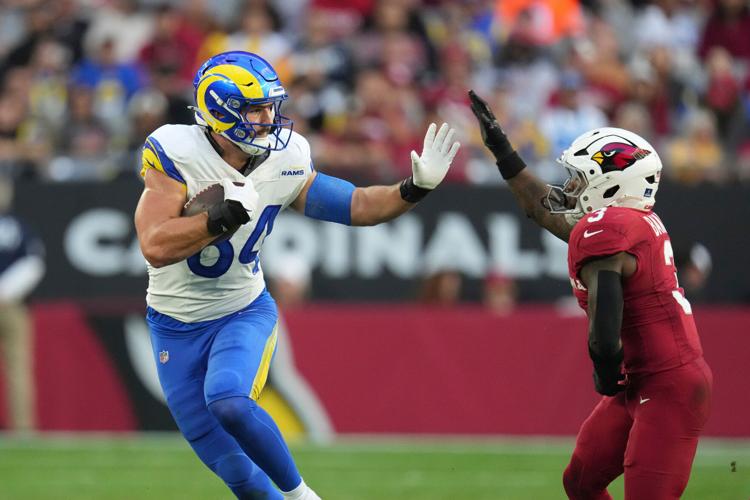
Los Angeles Rams tight end Colby Parkinson, left, runs with the ball against Arizona Cardinals safety Budda Baker (3) during the first half, Dec. 7, 2025, in Glendale.
The Cardinals also need Williams back to last year’s form, when he was one of the game’s emerging nickel corners. He’s dealt with both a knee injury of his own and injuries to teammates that have forced him to bounce between multiple roles. Partially as a result, he hasn’t shown the same elite reaction skills that he did a year ago.
The Cardinals would also benefit from Johnson emerging as a true number one cornerback on the outside. He’s shown flashes of elite play, with his reaction time in zone coverage and stickiness in man coverage. No rookie cornerback has more pass breakups than Johnson’s eight.
But one issue that has shown up in the past few games is Johnson’s physicality at the point of attack.
Every cornerback gets beaten occasionally. But take one slant route against reserve receiver Xavier Hutchinson. Johnson wasn’t able to contest the pass or tackle Hutchinson after the completion. Instead of a short gain on first-and-15, the Texans picked up a first down.
“It’s OK if they catch some balls away from your leverage,” Gannon said. “But you’ve gotta contest them and tackle them.”
Then, there’s the matter of upgrading at linebacker and defensive tackle.
None of it is impossible. But to become the top 10 unit that they envisioned, the Cardinals will need to hit on their acquisitions and player development in a way that they did not in 2025.

