



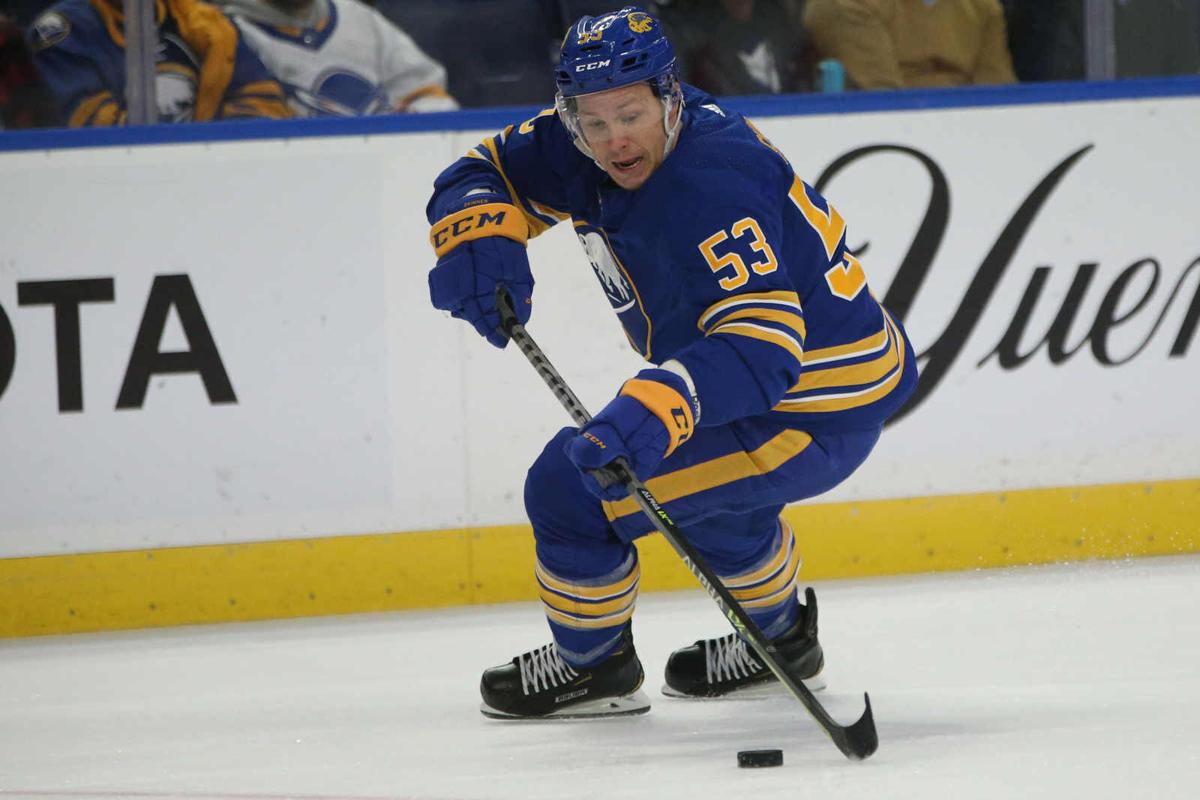
SUNRISE, Fla. – With Victor Olofsson darting toward the net during practice Wednesday afternoon, Jeff Skinner held the puck in the right circle to freeze goalie Dustin Tokarski and made a perfect saucer pass over a defender’s stick blade.
Olofsson was there at the top of the crease for the easy redirect goal, earning stick taps from teammates in FLA Live Arena and leading Skinner to raise both arms in celebration. While the Sabres (8-11-3) won only three of 14 games in November, Skinner showed glimpses of what he accomplished before signing an eight-year, $72 million contract with Buffalo in June 2019.
His six even-strength goals in November were tied for sixth in the National Hockey League, and he has nine points in his last nine games. With eight goals and 15 points in 22 games this season, he’s already surpassed his totals from 2020-21.
“For Skinner, this is a new normal for him, I believe, because of the work and habits he’s putting in,” coach Don Granato exclaimed after a two-goal game by Skinner on Monday.
But if the 29-year-old winger is encouraged by what he accomplished last month, he’s not showing it. When asked Wednesday about his recent success, Skinner credited his linemates, Tage Thompson and Olofsson, and made it clear his only focus is winning more games.
“Your job as a player is to help your team win and we’re in a bit of a rut right now, so you just try to keep working through it,” Skinner said.
Thompson leads the Sabres with 10 goals and Olofsson has evolved into one of their top forwards, but neither is the club’s highest-paid player. Skinner holds that distinction with a $9 million cap hit through 2026-27 – including a $10 million salary for his season – and his no-movement clause means it’s likely he will be in Buffalo when this team is expected to contend.
If the Sabres are going to succeed, they’ll need Skinner to be a reliable player now and in the future. So, his 30-goal, 26-assist pace through a quarter of the season is noteworthy, even if he made it clear that he didn't want to talk about himself.
“You try to score goals to help win games, so that’s the bottom line,” said Skinner. “But for me, it’s obviously a big part of my game and a big part of my job to produce offensively. Recently, I think as a line and also personally, we’re doing a better job of that and we want to keep that up. We want to keep this rhythm and do the little things that are helping us produce.”
Since the outset of training camp in September, Granato has boasted about Skinner’s attention to detail and practice habits. Even when Skinner wasn’t scoring, Granato expressed confidence that goals would follow. It’s clear during most shifts how the coaching change has benefited Skinner. He has the puck on his stick more and, unlike the days under former coach Ralph Krueger, the Sabres don't look like they're skating in quicksand every night.
They’re attacking the weak side in the neutral zone, using precise passes and creativity to create space, and, in the case of the Thompson line, forechecking effectively to earn second opportunities. In Granato, Skinner has a coach who understands his skill set.
Krueger was determined to make Skinner change his game, no matter how much the forward accomplished during his first nine seasons in the NHL. Since 2010-11, Skinner ranks seventh in even-strength goals (218), despite totaling only 16 in 74 games under Krueger.
Skinner isn’t a perfect player. He’s never been known to be the best defensive forward on his team and isn’t always consistent on the forecheck. Krueger had Skinner on the ice for more defensive zone starts and took him off the power play.
The change to Granato has brought out the best in the Sabres, Skinner included.
“He wants to play aggressive, he wants to play up-tempo and more so for our group, it’s the style that’s more suited for us,” said Skinner. “We have a lot of guys who can skate, a lot of young guys who are hungry and don’t really want to sit back. They want to utilize the speed they have. It’s where I try to fit in as a piece of the puzzle. Being part of the team is trying to fit into the system and the system is more geared toward our team’s makeup and strengths.”
Skinner has delivered consistent play and more ice time has followed. He has three games of 20-plus minutes after having only six during Krueger’s time as coach. Skinner ranks second among all Sabres forwards in 5-on-5 ice time and leads the team in individual shot quality in those situations, according to NaturalStatTrick.com. His shooting percentage is 12.5%, inching closer to the 14.9% of shots he converted during the career-high 40-goal season in 2018-19.
Skinner’s arrival in a blockbuster trade from Carolina in August 2018 was former General Manager Jason Botterill’s first significant move to try to fix the Sabres’ 5-on-5 game. Three years later, the club is finally producing in those situations, ranking 10th in the league in 5-on-5 scoring (43). Buffalo needs to generate more quality chances – it ranks 30th in shot quality at 5-on-5, according to Evolving-Hockey.com – but Skinner’s play is a significant development in the Sabres' quest to build a winner.
“There’s more clarity for him on how he’s going to accomplish things, how he’s going to be successful, score his next goal, make his next play,” Granato said of Skinner. “So, he’s very forward focused. As a consequence, he doesn’t dwell on anything. If there’s a mishap or a hiccup, he’s, ‘I have clarity on how I’m gonna get my next chance, how I’m going to create a next chance, how we’re going to work together as a unit of five.’ To me, that’s part of the root of his confidence and obviously the work ethic is the other component that’s significant in that.”

