


RALEIGH, N.C. – As Buffalo Sabres center Casey Mittelstadt crouched to take the opening faceoff in front of 18,680 fans Saturday night, a banner hung high above the PNC Arena ice to honor the Stanley Cup run in 2006 that transformed North Carolina’s Triangle from an exclusively basketball-obsessed region into a burgeoning hockey market.
Images from the Carolina Hurricanes’ rise to champions that spring are scattered throughout the building. The Eastern Conference finals series win over the battered and shorthanded Sabres is memorialized with a photo on a pillar in the 100 level. A smattering of photos are on the walls of the hallway leading to the press box, where Sabres general manager Kevyn Adams watched his club endure another difficult loss.
On one wall, a 31-year-old, playoff-bearded Adams is shown smiling in the Cup-winning photograph following Carolina’s Game 7 win over Edmonton on June 19, 2006. He’s wearing an "A" on his red Hurricanes sweater to signify his role as an assistant captain and holding his right index finger up while posing alongside his teammates. In another photograph, he has both arms raised in jubilation as the fans serenaded the state’s first professional sports champions on home ice.
“Obviously, the ’06 team is special for me and everything we were able to accomplish was amazing,” reflected Adams, now 47 and in his second season leading hockey operations for the Sabres, a franchise whose 10-year playoff drought is tied for the longest in league history.
Memories and experiences from all that occurred behind the scenes during the Hurricanes’ championship run have molded the way Adams is trying to build a winner in his hometown of Buffalo. For the four seasons leading up to the Cup celebration, Adams witnessed how leadership and the personalities in the dressing room can help a hockey team overcome the difficult moments it encounters in an 82-game season. Those experiences shaped how Adams views the imperfect science of building a contender and provides context behind the culture-shaping decisions he made last summer.
“For me, the culture in the locker room that we build is really important,” Adams told The Buffalo News last week. “The young core that we’re excited about and that we’re building moving forward, they have to be guided, too. They have to have people they can turn to and, ‘OK, here’s an experience he can share with me.’ It’s really powerful. Maybe it doesn’t, right away, pay off, but there are guys that will leave an impression for years to come.”
'By design'
The Hurricanes’ championship elixir was concocted through the franchise’s first eight seasons in Carolina. A roster was already in place when the club moved from Hartford ahead of the 1997-98 campaign, but general manager Jim Rutherford wanted to strengthen the culture off the ice. Slowly, Rutherford added talented players with notable leadership qualities, beginning with Gary Roberts in August 1997.
Ron Francis, a two-time Stanley Cup champion with Pittsburgh, arrived as a free agent the following offseason. The came franchise great and current head coach Rod Brind’Amour, a rugged center who owned the Flyers franchise record for consecutive games played.
A series of important moves followed to provide the Hurricanes with more experienced NHL players who led vocally or by example, including a trade with Florida in January 2002 for Adams, an emerging depth center who could provide secondary scoring and help on the penalty kill, and shutdown defenseman Bret Hedican.
“It was all done by design,” Rutherford said over the phone. “They were definitely targeted as players for what they can do on the ice, but what they can also do for the organization. It’s going to pay off when you lose a game you don’t feel you should or you start to slide. You know you’re going to have a little bit of a slide, but if you have too many of them or you lose six or seven in a row, those are the guys that are quietly working the room telling the other guys, ‘It’s OK, keep going the same way. We’ll get the breaks and come out of it.’ ”

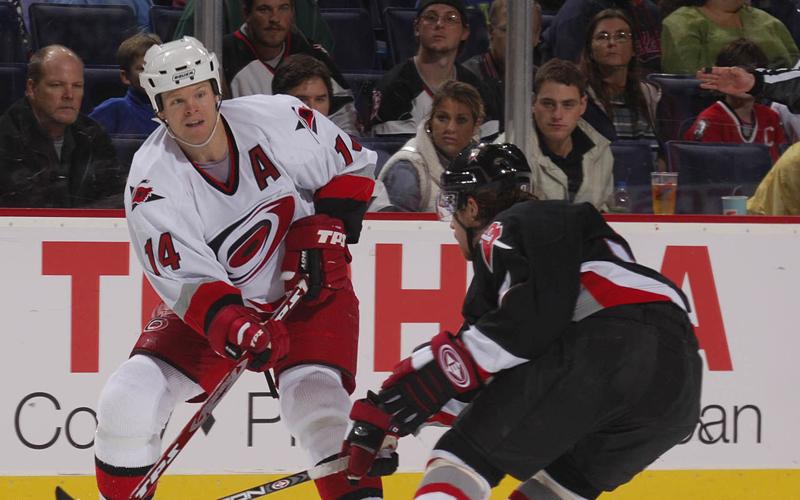
Carolina Hurricanes' Kevyn Adams puts a pass over Sabres' Derek Roy during a game on Nov. 9, 2005, at HSBC Arena. (Mark Mulville/News file photo)
When Adams arrived in Carolina, he was immediately struck by Brind’Amour’s relentless work ethic and gravitated toward his new teammate’s ability to lead. Adams and Hedican, who made it to the Stanley Cup final with Vancouver in 1994, didn't need much time around the personalities in the veteran-laden Hurricanes dressing room to see what Rutherford and his players were building.
"I know the expectation was how can I train harder than the next guy?" Hedican said. "And it went right down the line. … Phenomenal group of guys. I think when you have good leadership, your top player, your captain and your top leadership group don’t point the finger at other players."
The Hurricanes reached the Stanley Cup final that spring, falling to the Hall of Famer-filled roster of the Detroit Red Wings in five games. Injuries, underperformance and depth issues caused the Hurricanes to tumble in the standings the following season, as they finished last in the league with a 22-43-11 record.
Adams, though, gained valuable experience in an elevated role in 2002-03. The lessons learned from those many difficult nights shaped the future champions and helped Adams build the confidence to become one of several key figures in a dressing room that received reinforcements over the two years that followed.
“Kevyn was a good team player before he came to Carolina,” Rutherford said. “That was part of bringing him here. Those players like him don’t always feel comfortable speaking up, but you can feel comfortable that they’re going to fit in and you’re not going to have to worry about them. He did that right from the start. He played his role extremely well on the ice. That’s another part of that, guys accepting what their role is and not looking for more.”
Forging bonds
Nobody picked the 2005-06 Hurricanes to accomplish much. The franchise had missed the playoffs in consecutive seasons after its run to the Cup Final. A number of leaders from the '02 team were gone, including Francis and Martin Gelinas. Captained by Brind'Amour, the 2005-06 roster had more young, impressionable players who lacked experience, most notably Eric Staal, Justin Williams and Andrew Ladd.
Before Peter Laviolette’s first camp as Hurricanes coach began in 2005, Adams and Brind’Amour reflected on how close their teams were in NCAA hockey and wondered how that could be replicated in Carolina. College players spend countless hours together at the rink and in the gym. They often eat and live together.
How can an NHL team build similar bonds, albeit in different circumstances, the duo wondered?
Laviolette was a guiding force at the outset. Determined to build a family atmosphere around the team, he had everyone in the organization – players, coaches and staff – take a day away from the rink to go through a zipline course. There were team gatherings for Monday Night Football, and Laviolette often invited players to have their children skate on the ice after practice. Meanwhile, when at the arena, Brind’Amour was quietly instilling a message that the club’s goal to win a championship was bigger than any one person in the room.
“We developed this cohesive group and got to know each other’s kids, wives, girlfriends,” said Adams, who played parts of 10 seasons in the NHL. “The more you care about someone away from the rink, the more you’re going to care about them when you are on the ice. It was a really powerful thing that started to develop there. … It was really special, and I learned so much on and off the ice that year that I carry with me now, for sure.”
Progress
A dressing room full of Hurricanes were still catching their breath from perhaps their worst performance of the season in Game 6 of the Stanley Cup Final when Brind’Amour, then a man typically of few words, tried to refocus his teammates after they lost consecutive games that allowed Edmonton to even the series in June 2006.
“Guys, this is the greatest thing that can happen.’ ” Adams recalled Brind'Amour saying. “’Now we get to go home and win in Game 7. When you’re a kid on the pond, did you ever think about winning the Stanley Cup in Game 6? You always thought about winning in Game 7.’ … There was such a confidence that we got on the plane and thought, ‘We’re going to do this.’ ”
The Hurricanes hoisted the Stanley Cup after a 3-1 victory over the Oilers in Raleigh, cementing the legacy of a roster that also included Mark Recchi, Cory Stillman, Ray Whitney, Eric Cole, Matt Cullen, Glen Wesley, Mike Commodore and Aaron Ward.
“There was a lot of love in that room for one another and love and respect,” Hedican said. “I don’t think you get to the Stanley Cup finals without that love and respect.”
The off-ice dynamics in Carolina influenced how Adams approached his job in Buffalo. When longtime franchise cornerstones Rasmus Ristolainen, Sam Reinhart and Jack Eichel didn't want to stay for the long term, Adams added players with a reputation of bringing invaluable personality traits, such as Robert Hagg and Mark Pysyk.
When Eichel was finally traded, the Sabres acquired Syracuse-area native Alex Tuch, a player whom Adams knew would embrace the challenge in Buffalo and is a proven playoff performer.
Another emphasis was people who want to prove they can perform at a high level in the NHL after having lesser roles elsewhere, including Vinnie Hinostroza and Craig Anderson. Every move was vetted by Adams’ staff as much for on-ice talent as for what the player would be like in the dressing room.

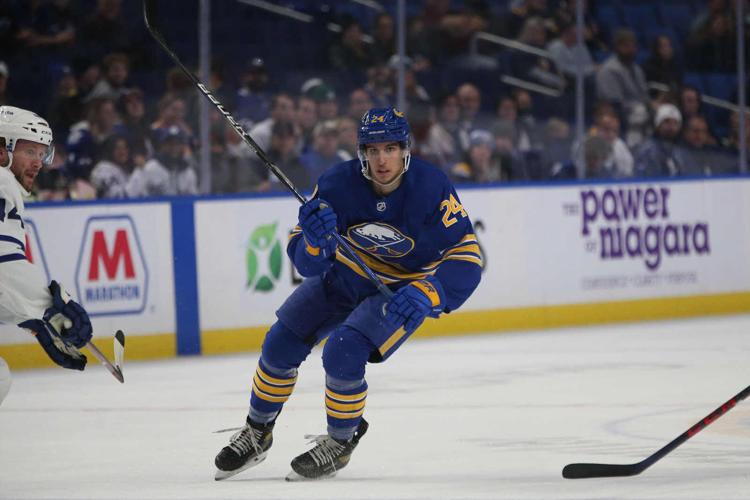
Buffalo Sabres center Dylan Cozens (24) during the first period at KeyBank Center, Saturday, Nov. 13, 2021. (Derek Gee / Buffalo News)
The progress is noticeable to Adams during every Sabres practice. Coach Don Granato’s preference to run competitive-based drills has brought enjoyment, pace and improvement to a young team. There are group celebrations after small-area, 3-on-3 games, and friendly trash talk.
"You can’t fake that," said Adams. "Anytime you get up every day and you’re excited to go to work and you care about the people you’re going there with, it’s a big deal. For these guys to have that and build that is really important. It's exciting to see."
When Mittelstadt was sidelined with an injury for 21 games, teammates often stopped by to check on him and hang out. The Sabres’ young players routinely gather away from the rink to watch football or hockey on TV. Mittelstadt, Rasmus Dahlin, Tage Thompson and Dylan Cozens are among the prominent core players taking ownership of how the team will function behind the scenes, much like Adams and Brind’Amour did that offseason before history was made in Carolina.
“I think this is the closest team we’ve had since I’ve been here, for sure,” Mittelstadt said. ”By quite a ways, I would say. A lot of us have played together in Roch and played together here. We’ve had a couple new guys who have slipped right in, and it’s gone well. Obviously, there are some things that we can clean up in our game, and we’re going to go through some learning curves. We’re just going to keep moving forward, keep playing hard and try to take some steps.”

