


The Buffalo Sabres' attendance reports frame the 2021-22 season as the ugliest in franchise history at the gate, a blot on the organization that raises a huge whats-going-on-here response from scouts and media visiting from around the NHL.
The numbers have been terrible so far, leaving the Sabres no choice but to look ahead to the potential for much more activity in the seats in their remaining 14 games in KeyBank Center, in spite of the team's continued struggle in the standings.
Rick Jeanneret Night (April 1 vs. Nashville) and the returns of Jack Eichel (March 10 vs. Vegas) and Sam Reinhart (March 7 vs. Florida) all figure to move the attendance needle. The team is also hoping for good numbers on Fan Appreciation Night (April 29 vs. Chicago in Jeanneret's final call), Kids Takeover Day (March 6 vs. Los Angeles) and April matinees against Florida (April 3) and the New York Islanders (April 29).
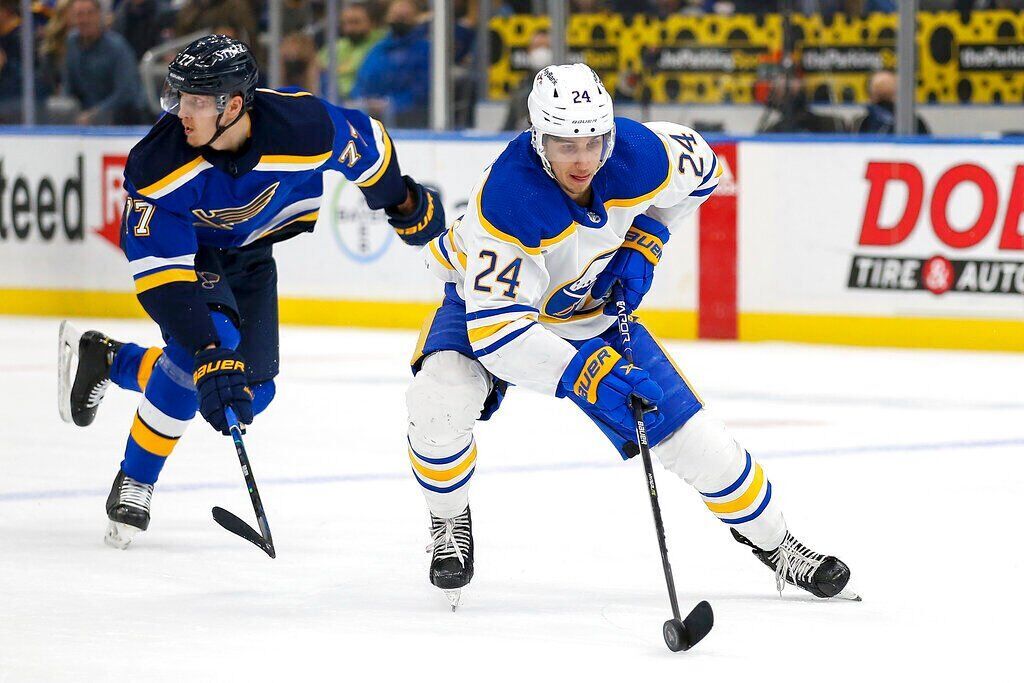
The performance was another display of the mettle in the Buffalo dressing room and a snapshot of what the club can do against the league’s elite, Lance Lysowski writes.
"As we look at the back half of the year, there's some good opportunities to engage with our fans," said John Durbin, senior vice president for marketing and business strategy of Pegula Sports and Entertainment. "With RJ Night coming up and celebrating his career. With Fan Appreciation Night, which would also be the last game that he calls, and is usually a big event for for everybody to engage with fans. We have a couple opportunities for kids. ... It's an opportunity for people to come out and see some of the players that will be the next generation of Sabres."
An unprecedented mix of circumstances has led to more people saying no to that opportunity than ever before. The numbers are ghastly to review:
• The Sabres are averaging just 8,657 tickets sold per game in the 19,070-seat arena for their 26 home games thus far, and in-house crowds have been far fewer than that some games. That's last in the NHL by nearly 3,000 tickets a game among U.S. teams, who have not had Covid-19-related attendance restrictions placed on them, as their Canadian counterparts have.
The average in 2019-20, the most recent season that fans were in the building, was 17,167 – so the club has lost essentially half its ticket base in less than two years. A season ticket base that was at or more than 16,000 for a decade, and as recently as 2017, has dropped by nearly two-thirds to around 6,500 this season.
• The only time the Sabres have averaged fewer than 10,000 for a full season was their inaugural year of 1970-71, when the average was 9,721. And even that came with a huge caveat: Memorial Auditorium did not yet have its orange balcony seats added. The roof was raised and that iconic level went on the building that summer, prior to the team's second season.
It should be noted they might make the 10,000 mark this season only on a technicality: The March 13 Heritage Classic in Hamilton, Ont., against the Toronto Maple Leafs is actually a Buffalo home game, so a crowd in the 40,000 range will be factored into the Sabres' numbers.

What happened in Vegas the last four years (three Western Conference finals appearances, one Stanley Cup final appearance) doesn't stay there. It's the experience Alex Tuch can lean on to try to replicate with the team he grew up loving as a kid outside of Syracuse.
• The last time an NHL team averaged fewer than 10,000 fans per game in a season with no restrictions was in 1999-2000, when the New York Islanders brought in an average of 9,748 to the Nassau Coliseum. Carolina averaged fewer than 10,000 in 1997-98 and 1998-99, when its games were played in Greensboro, N.C., roughly 80 miles from Raleigh, while PNC Arena was under construction.
The Sabres are likely to post the lowest figure by an NHL team for games in their building since the 1990-91 Minnesota North Stars averaged 7,838 in the Met Center in Bloomington, in a season where a below-.500 team that won just 12 of its first 48 games made a stunning run to the Stanley Cup final.
• Other years Buffalo struggled at the gate were 1982-83 (average of 12,894), 1986-87 (13,181), 1995-96 (13,738), and the 2002-03 bankruptcy season (13,776). None of them approach this season's level.
The Sabres averaged at least 18,000 fans per game every season from 2006-07 through 2017-18 – even during the two tank seasons – and missed that mark by only 92 fans per game in 2018-19. But this season, they've sold more than 10,000 tickets for just three games. There are 14 NHL teams averaging at least 17,000 tickets sold per game this season, and 17 playing to at least 87% capacity.
The Sabres are selling just 45.4% of their seats, far less than any other American club. Arizona is next, but well more than Buffalo at 67.6%.
A strange brew of trouble
It's obvious what factors are at work here. An NHL-record 11th consecutive year out of the playoffs is mostly responsible for cratering the season-ticket count. Single-game sales follow a dynamic pricing model that can leave tickets out of many fans' reach, even as faceoff approaches and you would ordinarily think prices on unsold seats might drop. And, frankly, some people are still not comfortable being in an indoor arena with strangers in Covid-19 times.
But there are also key Sabres-centric issues. The trades of popular former stars Eichel and Reinhart were major moves for the future that alienated many fans in the present. The closed Canadian border and testing requirements have kept the club's 1,200 Canadian season ticket holders and other fans from north of the border from having their normal presence in the building. And state vaccine mandates have angered some fans, especially since they can't bring unvaccinated children over age 5 to games.
The rise of the Omicron variant after the start of the season made the Canadian border a season-long problem for the Sabres that no one anticipated.
"We're looking forward to having an opportunity to re-engage with fans who were unable to come into the building," Durbin said. "Time will tell in terms of what that looks like, and in the building how that actually translates. We're just really excited to have the opportunity to engage with those fans again, to give them the opportunity to come see the Sabres live.
"We can really only control what we can control. And we know that we've got work to do to improve the experience that we provide. We're extremely appreciative of the fans who have been showing up. It's been great to have them in the building. Having the wave break out at games organically, pretty consistently, has been fun to see."
ST. LOUIS – Inside the hanger at Montreal Saint-Hubert Longueuil Airport late Wednesday nigh…
Durbin cited the Jan. 22 Youth Hockey Day against Philadelphia and Feb. 19's Kids Day game against Colorado as among his top moments of the season thus far with heavily engaged crowds.
"Both of those games were awesome to have, and a really good experience that we're working to create for every game," he said. "And that's really what we're aiming for in the future."
The condition of the 26-year-old arena, which is in line for a major renovation, remains a talking point among fans, and so do Delaware North's high concession prices. But the food and beverage will generally always taste better when they're tied to a winning team.
Forbes has previously reported the Sabres had an operating loss of $10.9 million in 2019, the last time a full season was played. Several NHL sources insist that number was too low. And that was at a time when attendance was double what it is now. While the team has cut back on player and staff payroll, it is realistic to think the franchise could be losing double or triple that amount this season and that a tight internal salary cap for player payroll will be necessary until attendance starts to rebound.
League is quiet on Buffalo
Asked by The News about the Sabres' attendance woes at the NHL All-Star Game earlier this month in Las Vegas, NHL commissioner Gary Bettman deflected the issue and put his trust in owners Terry and Kim Pegula.
"I have complete confidence in the Pegulas' ownership of the Sabres," Bettman said. "Sometimes, franchises get to a place where lots of things aren't working the way that they had hoped. But I have no reason to doubt their commitment to the Sabres or to Buffalo.
"They'll turn it around. The good news is they're committed to Buffalo and they have the resources to do it."
Past experience with Bettman shows that when he tiptoes around a topic, his concern over it is at a level to which he wants to deal with it internally. When he openly expresses concern, like with arena issues in places such as Long Island, Arizona or Calgary, is an indication that Bettman feels a situation is serious.
In this case, longtime Sabres observers feel the club can make a quick turnaround at the gate next season with the addition of prospects such as Owen Power, Jack Quinn, JJ Peterka and Ukko-Pekka Luukkonen. It's been easy to find social media posts all season from fans that say they're waiting until Power, the No. 1 overall pick in July from Michigan, and Quinn are on the team before they start buying tickets again.
The Sabres have started a 25-member Fan Council among season ticket-holders to discuss many of the above issues and have been doing "exit interviews" with fans postgame about their game-night experience. Through the Fan Council, the Sabres have been planning non-game events surrounding the team for their most loyal fans during the season and in the offseason, and have discussed multiple areas of the ticketing process such as seating relocations, ticket exchanges and payment plans.
"We're really taking it as an opportunity to just learn what we can be doing better and hearing directly from them and seeing how we can improve," Durbin said. "Especially those factors that are outside of our control, once they stop being factors working against us, we want to make sure that we're delivering a top-notch experience for our fans."
Sabres attendance since 1999-2000
Season GP Total Avg Cap%
2021-22 26 225,103 8,657 45.4
2020-21 Limited fans-four games
2019-20 35 600,858 17,167 90.7
2018-19 41 734,237 17,909 93.9
2017-18 41 761,104 18,563 99.8*
2016-17 41 743,819 18,141 95.1
2015-16 41 762,223 18,590 97.5
2014-15 41 761,809 18,580 97.4
2013-14 41 761,767 18,579 97.4
2012-13 24 455,290 18,970 99.5
2011-12 41 760,558 18,550 99.9
2010-11 41 756,568 18,452 98.7
2009-10 41 759,695 18,529 99.1
2008-09 41 759,798 18,531 99.2
2007-08 41 817,956 19,950 109.4**
2006-07 41 766,290 18,690 100.0
2005-06 41 692,329 16,886 90.3
2004-05 Lockout season
2003-04 41 626,903 15,290 81.8
2002-03 41 564,827 13,776 73.7
2001-02 41 705,468 17,206 92.0
2000-01 41 731,438 17,839 95.4
1999-00 41 736,155 17,955 96.0
Source: ESPN.com and Buffalo News research
* includes crowd of 41,821 for Winter Classic game in Citi Field counted as a home game.
** includes crowd of 71,217 for Winter Classic game in Ralph Wilson Stadium.
NHL teams with fewer than 10,000 fans per game
(Since 1990)
2021-2022 Buffalo 8,658
1999-2000 NY Islanders 9,748
1998-1999 Carolina 8,187*
1997-1998 Carolina 9,106*
1994-1995 Ottawa 9,879*
1990-1991 Minnesota 7,838
* Played at alternate sites while current arenas were under construction.
** Does not include 2021-22 Ottawa figure, which includes no-fan games.
Source: Hockeydb.com and Buffalo News research

