


The ongoing draft debate inside the hockey operations offices at KeyBank Center revolves around the Buffalo Sabres’ selection at first overall.
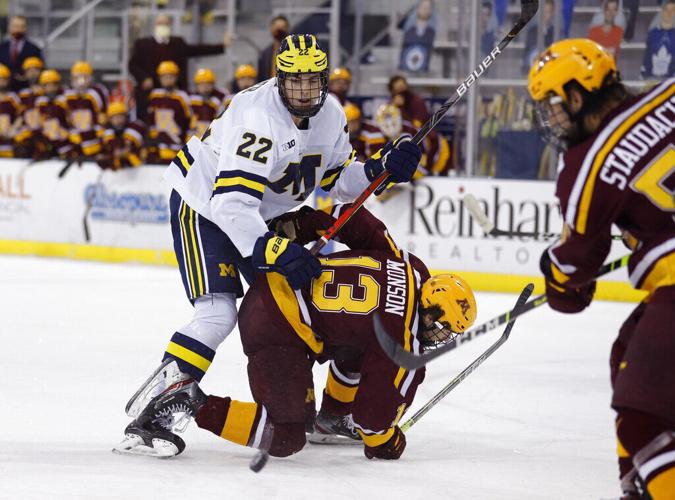
Owen Power, a 6-foot-6 defenseman from the University of Michigan, is the consensus top prospect in this draft and the presumed No. 1 pick when Sabres General Manager Kevyn Adams announces the selection July 23 on ESPN.
Adams, along with Associate General Manager Jason Karmanos and the Sabres’ scouting staff, has scrutinized every area of Power’s game since Buffalo was awarded the first pick through the draft lottery last month.
The Sabres have the benefit of being able to rewatch Power’s shifts from each of his 26 games as a freshman with the Wolverines and the 10 he appeared in for Canada at the IIHF World Championship from May 13-22.
However, information is more scarce on many of the draft-eligible prospects this year, particularly for those who will be considered by the Sabres with their nine other selections in the seven-round, two-day event.
While Power was among the top young draft prospects to compete against their own age group amid the Covid-19 pandemic, many were limited to on- and off-ice training because the Ontario Hockey League never launched a season. Others uprooted their lives to play against much older professionals in Europe.
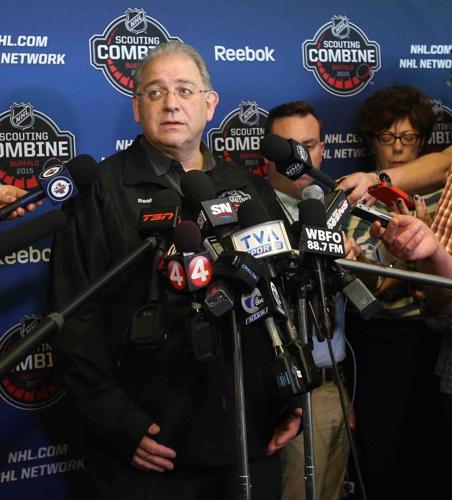
“The scouting world got turned upside down,” Dan Marr, director of NHL Central Scouting, told The Buffalo News.
The on-ice development of many prospects was impacted by restrictions to combat the spread of the virus, as positive Covid-19 tests wreaked havoc on the schedules of every active league and players couldn’t train as they normally would. This has caused the NHL’s 32 teams to rethink how they evaluate talent in this unusual year, which likely will impact their draft rankings.
“It’s challenging, but I equate it to bad ice for a hockey game,” Karmanos told reporters in May. “Everyone is playing under the same conditions. It is very different than usual. I feel badly for the kids that haven’t been able to play this year. … It’s been a difficult situation for everybody to deal with and, certainly from a scouting point of view, it presents challenges.”
Diamonds in the rough
The Sabres weren’t operating under the same conditions. Though Adams and his staff were forced to work around the lack of recent information on some prospects, the organization had fewer scouts than usual after the dismissal of former General Manager Jason Botterill and 21 other hockey operations employees in June 2020.
At the start of the 2020-21 season, Adams had 11 people on a scouting staff that handled amateur and professional evaluations, compared to 22 working for Botterill, not including his two assistant general managers.
Under Adams this season, the Sabres did not have full-time scouts based in Ontario, the Western Hockey League, Finland or Russia. They have since added two scouts – one in the United States and a part-timer in Western Canada – and reconfigured the scouting staff, with Jerry Forton ascending to director of amateur scouting. Karmanos, who owns three Stanley Cup rings from his front office work with Carolina and Pittsburgh, joined the Sabres in April. The club recently hired Sam Ventura to run its analytics department.
While a scout wasn’t needed for live viewings of games in Ontario, it’s important to have someone in place who has connections with coaches in the area and knowledge of a prospect from prior years. With the OHL season canceled, teams evaluated some draft-eligible prospects based on games from the 2019-20 season. They also spoke to individual skill coaches to get a better idea how the player has developed since the OHL last played a game in March 2020.
“There's going to be so many misses this year,” predicted Josh Wrobel, a Toronto-based skills coach whose clients include Sabres prospect Jack Quinn and former Buffalo defenseman Brandon Montour. “I've talked to a few NHL teams that have reached out to me saying, ‘Who are you seeing developing along the same process as someone like Jack Quinn?’ They're asking for my insight based on how these prospects have been practicing. They haven't been playing games. So, it's just crazy that I never in a million years would think that I'm getting calls from scouts asking how guys are training. … I don't know if the process is working for them because I haven't been able to see them translate into games. I have a good idea, but I don’t know for sure without games. I think there's going to be some late-round diamonds in the rough this year, for sure.”
The lack of an OHL season, and the Western Hockey League’s decision to play a 24-game regular-season, impacted a prospect’s ability to make a meteoric leap the way Quinn did during his draft-eligible season.
Quinn, a 19-year-old winger, was projected by many scouts to go in the third or fourth round after he totaled only 12 goals during his first full season with the OHL’s Ottawa 67’s in 2018-19. A 40-goal improvement allowed Quinn to skyrocket up draft boards, leading to his selection eighth overall by the Sabres in October 2020.
A 16-month gap forces teams to do additional homework or make an educated guess on how a specific prospect would have developed if this was a normal year.
“Jack is the perfect example,” said Craig Button, TSN’s director of scouting and a former NHL general manager. “There are going to be players with the potential of Jack Quinn that are going to be selected in this draft. They're just not going to be selected eighth overall because there's no way that teams would have had the opportunity or the players have the opportunity to show that improvement, that significant jump up. … (After watching Quinn before the shutdown in March 2020), I had every confidence that he was a good, top young player. But without him showing you that and without you being able to watch, it's hard to make those leaps.”
Video as a tool
Fans cringed in June 2020 when Sabres owner Terry Pegula mentioned during the news conference following Botterill’s firing that the club’s scouting staff needed to use more video to supplement its evaluations of draft-eligible prospects.
After all, the Sabres’ foray into video scouting under former General Manager Darcy Regier led to some underwhelming selections. But every NHL team was forced to rely on more video during the Covid-19 pandemic, as scouts were unable to cross borders to attend games and clubs halted travel out of an abundance of caution.
This forced teams to rely on sometimes grainy, difficult-to-view footage from arenas around the globe, as one Western Conference scout told The Buffalo News.
“I don’t care what anyone says, you can’t rely on video to prepare for the draft,” the scout said. “It’s too unpredictable from rink to rink. The camera angles make it difficult to view the areas of the ice you need to see. And even the highest quality video doesn’t account for what you’re missing away from the puck. Some video feeds are completely unwatchable.”
Marr, who led central scouting's efforts to build its thorough prospect rankings, called video scouting “not consistent” because the quality of footage varies based on the league and rink. Marr explained that video was particularly useful when evaluating goaltenders because you get to see the play develop before there’s a shot on net, but it can be challenging for defensemen and forwards. The camera typically follows the puck, which can eliminate important details. For example, scouts don’t get to see if a defenseman is communicating with his partner before either is near the puck or if a forward is backchecking.
Video was particularly essential for the Sabres when scouting European players, as they only had two scouts – Frank Musil in Czech Republic and Anders Forsberg in Sweden – based on the continent.
“That does impact your evaluation, but again, it was the best tool that we had available,” Marr said when asked about video scouting. “So, it was maximized. Typically, I would tell you that you will go to the game live and then you would go back and watch a certain player’s shifts, just to confirm that you saw what you were looking for or you didn't see what you were hoping to see. … This year was almost the opposite, where in most cases, you need to watch the player on video before you ever got to see him play live. Some of our guys never made it to the game. I would say only maybe a third of our staff saw players live. It was difficult for us and it was difficult for the club scouts.”
Adjusting
When Ontario government officials refused to soften restrictions to allow junior hockey to be played, some of the OHL’s top draft-eligible prospects had to pursue less-than-ideal options to continue their development.
Mason McTavish, a center ranked by central scouting as the draft’s No. 2 North American skater, and Brennan Othmann, a talented winger projected to go in the top 10, joined EHC Olten in Switzerland’s top professional league. Defenseman Brandt Clarke, a training partner of Quinn’s who is expected to be drafted high next week, joined HC Nove Zamky in Slovakia.
This wasn’t an option for less heralded prospects because of European clubs' limited amount of imports. Top-tier prospects also benefited from playing in the IIHF Under-18 World Championship, an event heavily attended by NHL scouting staffs, including the Sabres, because it was held in Frisco, Texas.
Power and his Michigan teammate, Matthew Beniers, competed at the IIHF World Championship in Latvia against NHL players, providing teams with a better idea of how close each prospect is to making an impact against professionals.
“Yeah, it hurt a lot,” said Othmann. “I was very fortunate to play in Switzerland and the Under-18s and be successful in both of those. But honestly, I feel bad for my peers around me. I had lots of buddies I played with and played against, and they can't showcase themselves. That's just disappointing for them and for me to hear that.”
With mid- to late-round prospects needing to solidify their draft stock, a showcase event not sanctioned by the NHL was held at the end of May in Erie, Pa. Though scouts surveyed by The News were impressed by the sponsor-driven effort to organize the event, industry sources said the quality of hockey was average because it was the first peer-against-peer competition in months for many of the players.
It remains to be seen how teams will view OHL prospects who aren’t as highly regarded as McTavish, Othmann or Clarke. It’s possible scouting staffs will rank NCAA or United States Hockey League prospects higher because, aside from Covid-19 pauses or shutdowns, those prospects had uninterrupted seasons that provided either live viewings or better video. There’s also questions about prospects from the Western Hockey League because someone like Dylan Guenther, the No. 5 North American skater, played only 12 regular-season games for the Edmonton Oil Kings.
“I was sitting at home for a long period of time where other countries and other players were able to play and kind of continue to get better through a normal season,” said Guenther, who stayed sharp by playing games in the Alberta Junior Hockey League last fall. “I was unable to do that and I had to find ways to continue to get better and work on my game that even sometimes weren’t on the ice. The rinks closed probably in November, December, right before the WHL season started. Those were definitely tough times, and I had to continue to just kind of push and find ways to do stuff off the ice that would translate to on-ice play."
Guenther, though, benefited from representing Canada at the Under-18 championships, an event that Button said will hold more weight than it would in a typical year.
“You don't have a choice but to weigh it more greatly,” Button said. “If you don't, then what are you basing it on? It was a significant tournament. It was a competitive tournament. Lots of good players were there.”
Every NHL team is working to strengthen the confidence they have in their respective prospect rankings. The process is impacted by a second consecutive year without the NHL Scouting Combine, which was held annually in Buffalo from 2015-19. The event – which includes medical and fitness testing, and in-person interviews – will return to Western New York when the league can safely hold the event in the future, said Marr.
Without the combine, NHL Central Scouting, with the assistance of former team trainers and doctors, assisted clubs in gathering a complete medical history on prospects. In-person interviews were replaced by chats over videoconference call.
Equipped with 10 draft choices, Adams needs to strengthen the prospect pipeline for the Sabres, whose 10-year playoff drought is tied for the longest in NHL history. The first step is accurately projecting how teenagers, many of whom haven’t competed against their peers in 16 months, will develop over the next five to 10 years.
Even McTavish, Othmann and Clarke went 13 months between their last OHL game and the Under-18 world championships.
“That's 13 months of critical, critical development time, that the players haven't been able to show you what they are capable of and have not been able to demonstrate their capabilities and potential,” Button said. “And teams haven't been able to see it. So, now you go back in time, but there's still a gap there. That gap can't be closed.”