



As Quincy Craig busted through Kansas’ defensive line for a big gain — then did it again for the go-ahead touchdown — we were all thinking the same thing:
Why didn’t the Wildcats do this earlier? Why don’t they run the ball more?

It’s a more complicated subject than you might think — and a perfect topic for the latest edition of “Cats Stats” as Arizona prepares to face No. 25 Cincinnati on Saturday.
Let’s begin with the concept of offensive “balance.” What does that term really mean? Half passes, half runs? Maybe a 55-45 split?
UA offensive coordinator Seth Doege believes his offense is balanced, despite some numbers that suggest otherwise. (We’ll dive into those shortly.)
In fact, Doege explained, it was that sense of balance that enabled the Wildcats to run the ball so well on their final offensive possession against the Jayhawks — and to average 9.3 yards every time a running back took a handoff in that game.
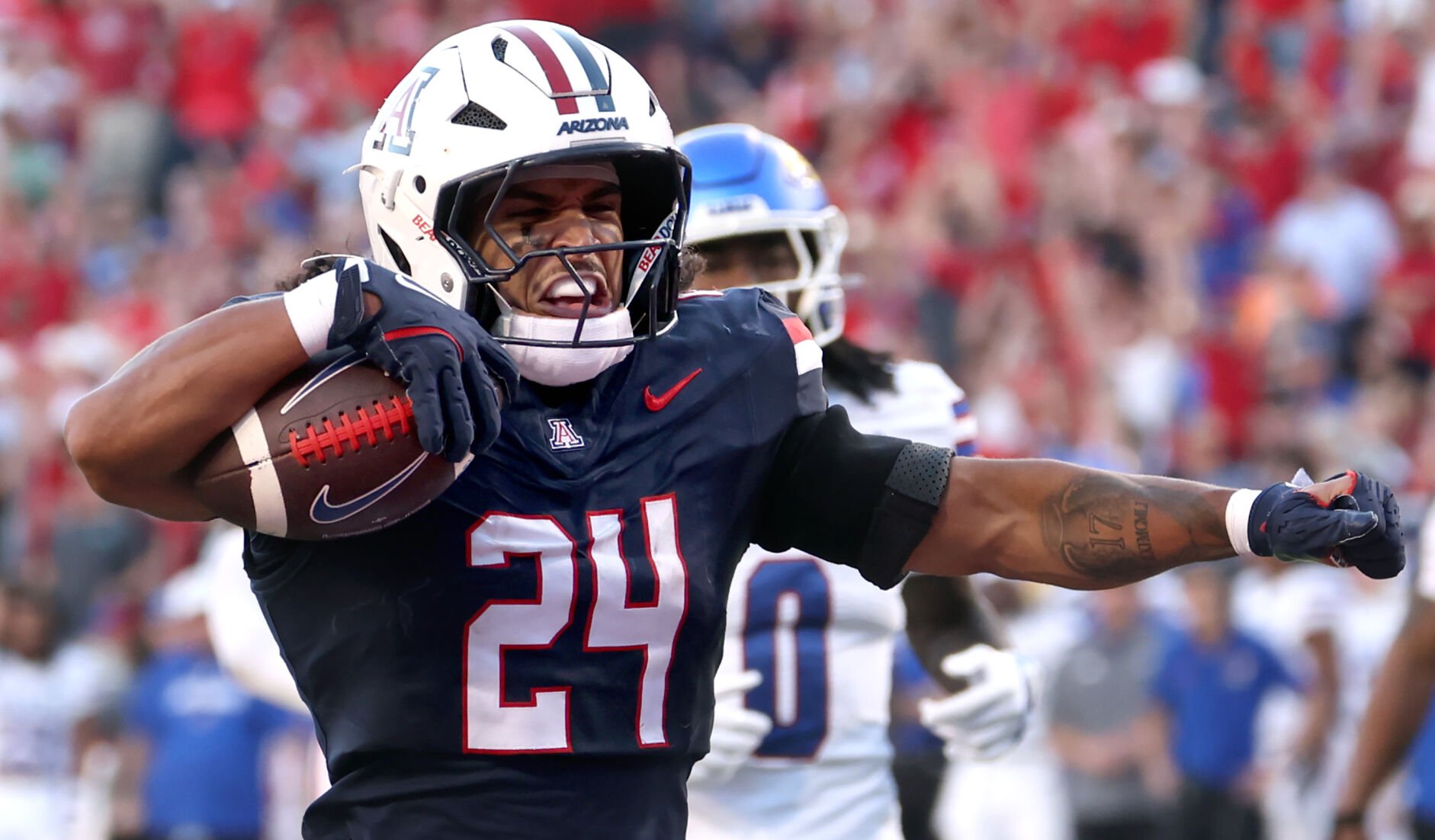
Arizona running back Quincy Craig gallops into the end zone practically untouched to notch the winning score in the final minute of the game against Kansas, Nov. 8, 2025, at Arizona Stadium.
“We’re able to run the football because we’re balanced,” Doege said. “That number (9.3 yards per carry) is that way because you’re able to throw it. If you’re just running it, they’re going to load the box. That number is not going to be the same.”
The setup
Doege’s reasoning is sound, his approach logical. Unless you’re just physically superior than your opponent — which Arizona is not, most of the time — you’re always trying to set something up on offense. Runs can set up play-action passes. Passes — especially out of spread formations — can set up runs.
Before that final drive, which consisted of five running plays and three passing plays, the Wildcats had run 52 total offensive plays. Thirty-six were pass plays — 28 pass attempts, five sacks and three scrambles by quarterback Noah Fifita. (Hat tip to Pro Football Focus for separating scrambles from designed QB runs.)
Only 16 of those plays were designed rushing attempts, or 30.8%. Even for Arizona — one of the most pass-heavy teams in the Big 12, as we’ll illustrate below — that was extreme.
Doege said the “advantage run numbers weren’t there” vs. Kansas. In other words, the “box” — the area between the tackles near the line of scrimmage — was populated to the point that passing made more sense than running.
Countless factors go into those decisions, including — but not limited to — personnel, matchups and what Doege called “feel of the game.”
“What are they going to give us?” Doege said. “Are they giving us easy throws? Are we protecting well? All that comes into mind when it comes to whether or not you should run it or throw it. And then, at the same token, I got a special quarterback, so I’m not just gonna take the ball out of his hands either.”
Doege didn’t take it out of Fifita’s hands until the very end. Two of the plays on the final drive were quarterback runs, which gained 11 and 9 yards. That’s one way to shift the box numbers in your favor. When the quarterback runs, a running back can serve as a blocker. When a QB hands the ball off, he usually just stands there as the play unfolds.

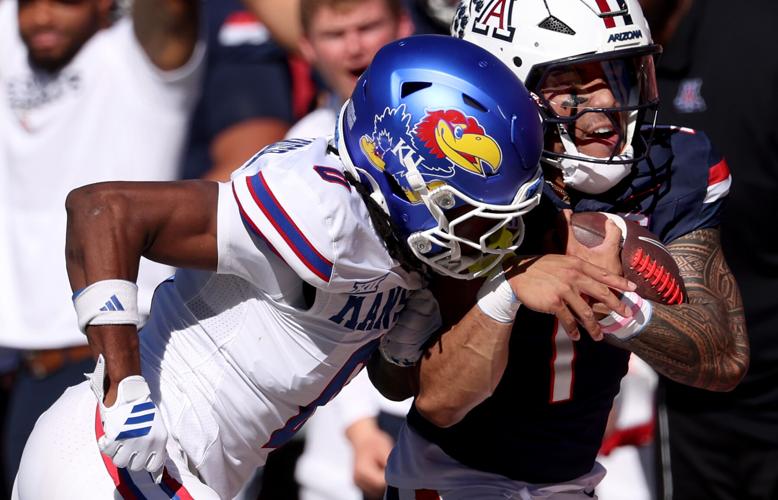
Kansas cornerback Austin Alexander (0) delivers the hit to keep Arizona quarterback Noah Fifita (1) from tiptoeing along the sideline and into the end zone during the first quarter of their Big 12 game Nov. 8, 2025, at Arizona Stadium.
‘True’ running rate
Fifita is running the ball more than he ever has. Arizona is running more than it did last season. But last season, few teams in the nation had fewer rushing attempts than the Wildcats. Only two, in fact. When you frequently trail by double figures and lack an offensive identity beyond “throw the ball to T-Mac,” that’s what happens.
Adjusting for sacks and scrambles — shifting both from rushing to passing attempts — Arizona ran the ball just 36% of the time last year. That figure is 42.4% this year — still low compared to the Wildcats’ peers in the Big 12 Conference.
Not surprisingly, Rich Rodriguez-coached West Virginia leads the league with a “true” rushing rate of 57.7%. Utah is next at 55.4%.
Arizona ranks 13th, ahead of Colorado (42%), TCU (41.3%) and Baylor (39.2%).
Is that a bad thing? Not necessarily. Arizona, Baylor and TCU rank in the top seven in the Big 12 in scoring and in the top eight in total offense. (Colorado is 15th out of 16 in both categories.)
Doege, who comes from an “Air Raid” background, emphasized that he doesn’t go into any game or season with a set ratio in mind. It’s all about moving the ball and scoring points by any means necessary.
“Figuring out where our best matchups are,” he said. “Figuring out where can we execute, where are their weaknesses, where can we attack, where can Noah be his best.”
Doege’s DNA
The score and circumstances also play a role. Arizona’s three highest true rushing rates this season came against Hawaii (51.8%), Weber State (49.3%) and Colorado (58.7%) — three blowout victories for the Wildcats. Arizona’s lowest rushing rate (29.2%) came against Iowa State — the Wildcats’ lone one-sided loss this season.
Another way of looking at a team’s commitment to the run game is whether they stick with it when losing. We looked at run rates when trailing by 1-14 points this season. (These are raw rushing attempts, as the “situational” stat splits do not sift out sacks and scrambles.) Whether it’s percentage of total plays (9%) or rushing plays (18%), Arizona ranks 12th in the Big 12.

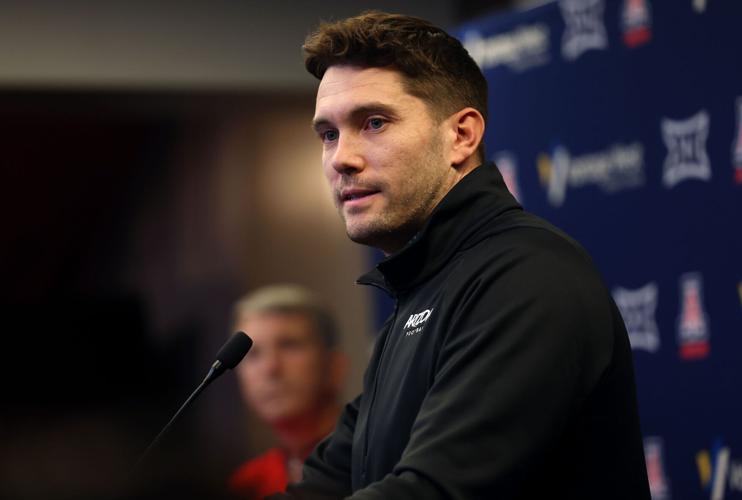
Seth Doege, the new offensive coordinator for Arizona football, speaks during a press conference at Arizona Stadium, Dec. 13, 2024.
If you’re wondering whether this apparent statistical imbalance is a product of Doege’s DNA — he played quarterback under Mike Leach — there isn’t enough evidence to make that case.
Doege had one previous stint as an offensive coordinator, at Marshall last year. The Thundering Herd had a true rushing rate of 54.2%. As Doege explained shortly after he arrived in Tucson, he had to adjust to his personnel. He had a skilled dual-threat quarterback in Braylon Braxton.
Would we like to see Arizona run the ball a bit more? We would. Why? A) The Wildcats have a talented stable of backs; B) their offensive line has struggled in pass protection at times; and C) it would alleviate some of the pressure — physical and psychological — on Fifita.
But if the bowl-bound Cats keep winning, it’ll be hard to complain.

