




Since 1963, the first year Arizona played baseball as a member of the Western Athletic Conference, the Wildcats have gone to the College World Series in consecutive years two times.
In both instances, Arizona quickly exited the first year before winning the national championship the next year. The second time it happened, in 1985-86, the Wildcats’ on-field leader was an upperclassman named Chip Hale.

Michael Lev is a senior writer/columnist for the Arizona Daily Star, Tucson.com and The Wildcaster.
Now the coach at his alma mater, Hale was asked about that possibility after Arizona was ousted from the CWS on Sunday.
“I like that. I like the way that went,” Hale said. “Obviously we didn’t like ‘85. It was tough. Same deal. We lost a really close game. Then we didn’t play very well against Stanford.
“Yeah, let’s get back here and see if we can repeat what we did in ‘86 in 2026. But it’s so hard to get here. There’s seven teams left now, and I wish them all luck. They’re great teams.
“We’re sorry that we’re not going to be playing anymore. But it’s baseball.”

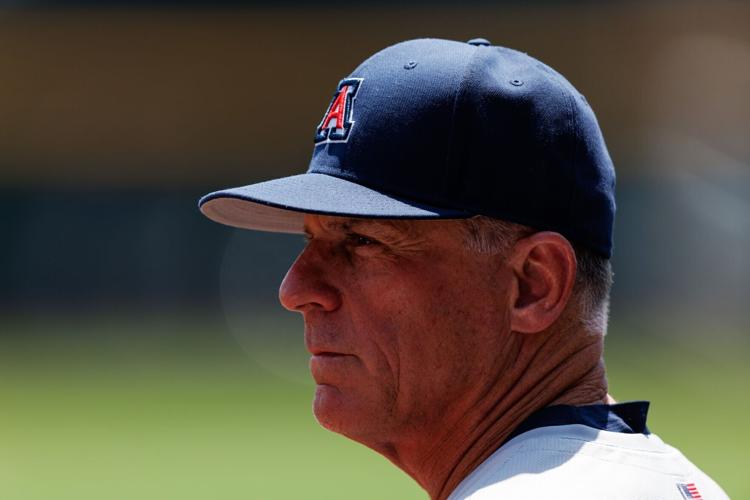
Arizona coach Chip Hale looks out of the dugout before Game 5 of the Men’s College World Series at Charles Schwab Field in Omaha on Sunday.
Recent history suggests that Arizona is not the type of program that will make annual odysseys to Omaha. But starting in 2012, the Wildcats have qualified for the CWS every fourth time the NCAA Tournament has been contested. The vast majority of programs would take that in a heartbeat.
Hale kept that pattern going this season, his fourth on the job. He led Arizona to the CWS with a roster consisting almost entirely of players he and his staff recruited. He proved, definitively, that he indeed is cut out for the college game, the unsightly ending notwithstanding.
Although the program clearly has positive momentum — and could/should return a potentially stellar starting rotation — it’d be a stretch to project a return trip to Omaha in 2026.
College baseball is more competitive — and unpredictable — than ever. While Arizona and its fellow CWS participants have been locked in on making the most of 2025, those who were eliminated earlier have been mining the transfer portal for 2026 and beyond. For example: South Carolina has 12 portal pickups already; Arizona has two (pitchers Patrick Morris and JT Drake).
Lineup changes
The next month or so will provide some clarity about Arizona’s ’26 roster. I expect Brendan Summerhill, Mason White, Aaron Walton and Adonys Guzman to be drafted and go pro. Combined with the departures of Tommy Splaine and Garen Caulfield — both out of eligibility after distinguished four-year UA careers — the Wildcats stand to lose two-thirds of their ’25 lineup.
Third baseman Maddox Mihalakis also is draft-eligible, but it seems more likely than not that he’ll be back. I can envision Mihalakis in a senior-leader role similar to what Splaine and Caulfield fulfilled this season. That would also offer a redemption arc for Mihalakis, whose ’25 finale wasn’t his best.
Another potentially intriguing infield piece is Frenchman Mathis Meurant, who had a meaty role early in the season before ceding the full-time third base job to Mihalakis. Meurant profiles as a plus shortstop with enticing tools. He was generating draft buzz early in the year, but it’s hard to image an MLB team investing a high pick on him with such a limited sample size at the Division I level.

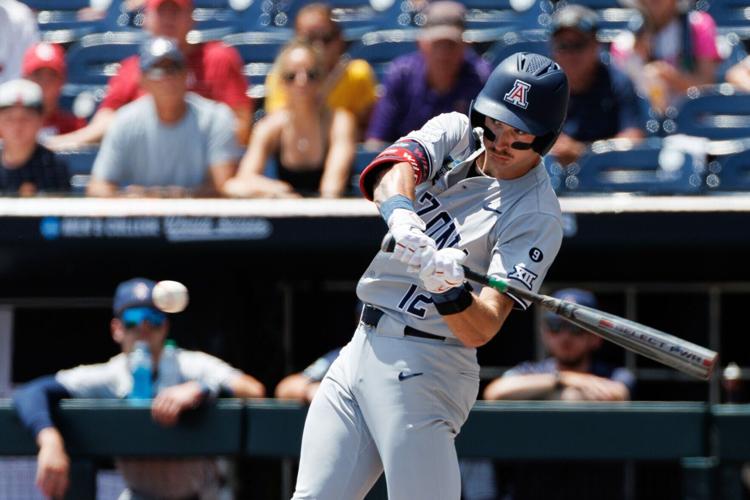
Arizona's Easton Breyfogle (12) connects during the second inning in Game 5 of the Men’s College World Series on June 15, 2025, at Charles Schwab Field in Omaha, Nebraska.
Easton Breyfogle and Andrew Cain enter next season as juniors with professional upside. Breyfogle, who can play any outfield position, just needs to stay healthy after battling leg injuries the past two seasons. Cain, via Ironwood Ridge High, needs to settle in at a position. First base is the likeliest destination.
Arizona probably will add one or two transfers who’d be projected to start, although that hasn’t been the team-building model under Hale. This year’s lineup featured just two transfers, Guzman and Walton. The UA redshirted several promising freshmen this season and has another batch on the way.
This remains a developmental program, even in the NIL/transfer-portal era. Hale isn’t looking to turn over the roster every offseason (although there has been more churn on the pitching side). That might explain the every-four-years pattern and why Hale and his staff thought they had an Omaha-caliber club when the team first gathered last summer; the bulk of the lineup consisted of juniors and seniors.
Aces in the hole

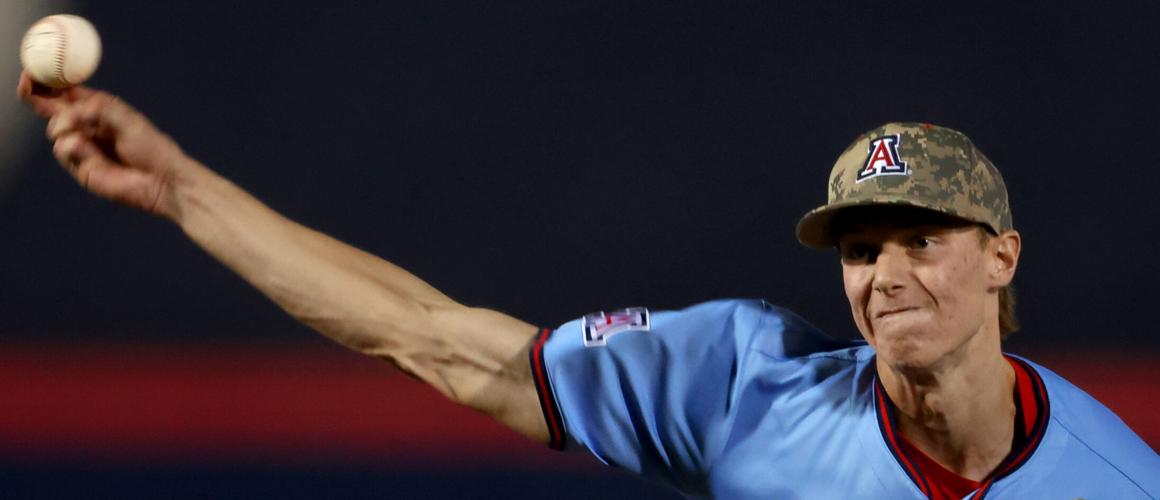
Arizona starter Owen Kramkowski deals against Oklahoma State in the fourth inning on April 12, 2025, at Hi Corbett Field.
Pitching will be the hallmark of the 2026 Wildcats — assuming key personnel and coaches aren’t poached.
Pitching coach Kevin Vance is a key figure in this equation. As I’ve written previously, he’s a coveted assistant, whether it’s for another pitching-coach job or, possibly, the head-coach job at San Diego State. The UA administration needs to do right by him with a multiyear extension and a pay raise. I’m sure Hale, who has one year left on his deal, has made that abundantly clear.
Getting a chance to further develop the likes of Owen Kramkowski and Smith Bailey is undoubtedly an enticement. Both are potential aces and high-round picks whose best ball is ahead of them.
Left-hander Mason Russell didn’t have the freshman year many expected, but the talent and stuff are off the charts. I heard he was in a good place by season’s end; it’ll be interesting to see how he fares in the uber-competitive Cape Cod League this summer.

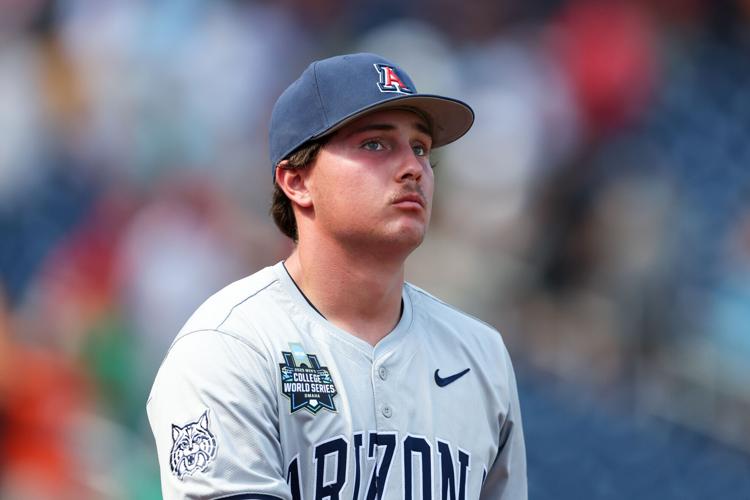
Arizona’s Tony Pluta reacts after the Wildcats were defeated by Louisville in Game 5 of the Men’s College World Series at Charles Schwab Field in Omaha on Sunday.
Arizona conceivably could bring back NCBWA Stopper of the Year Tony Pluta as well. Pluta is draft-eligible and had a fantastic junior season. But MLB organizations place so much emphasis on physical traits and radar readings. Pluta is a standout in many regards — in the classroom, in the weight room — but he’s generously listed at 5-foot-9 and tops out around 94 mph. It sounds ridiculous, but that’s below average by current MLB standards. So we’ll see.
It would stink if the scenes we saw at the end of the game Sunday were the lasting images of Pluta in a UA uniform. He sat alone on the bench in the top of the ninth inning, looking shellshocked after he and the Wildcats unraveled in the bottom of the eighth.
Pluta has been a model student-athlete during his three years at Arizona. He deserves a better ending than that.

