




The most important matchup of college football’s postseason isn’t Texas A&M vs. Miami (Fla.) in the CFP.
It isn’t BYU vs. Georgia Tech for the right to chomp on a massive Pop-Tart on national TV.

Michael Lev is a senior writer/columnist for the Arizona Daily Star, Tucson.com and The Wildcaster.
It’s meaninglessness vs. memory-making.
The M&M’S Bowl, if you will.
As the College Football Playoff ascends in importance, sucking up more and more oxygen and airtime, it has diminished the significance of bowl games. That’s hardly a revelation. But it feels different this year. And by that, I mean worse.
Players are still entering the transfer portal — and presumably opting out of bowl games — despite the window being pushed back to January. Again, nothing new.
Teams opting out isn’t new either ... but it usually isn’t 8-4 teams. Or 10-2 teams.
Those are the records of Iowa State and Notre Dame, respectively. They elected to not participate in bowl games for entirely different reasons. But there is a common thread:

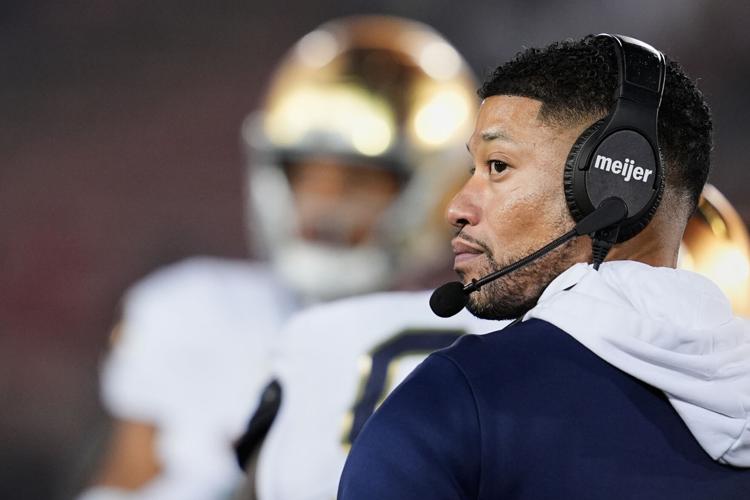
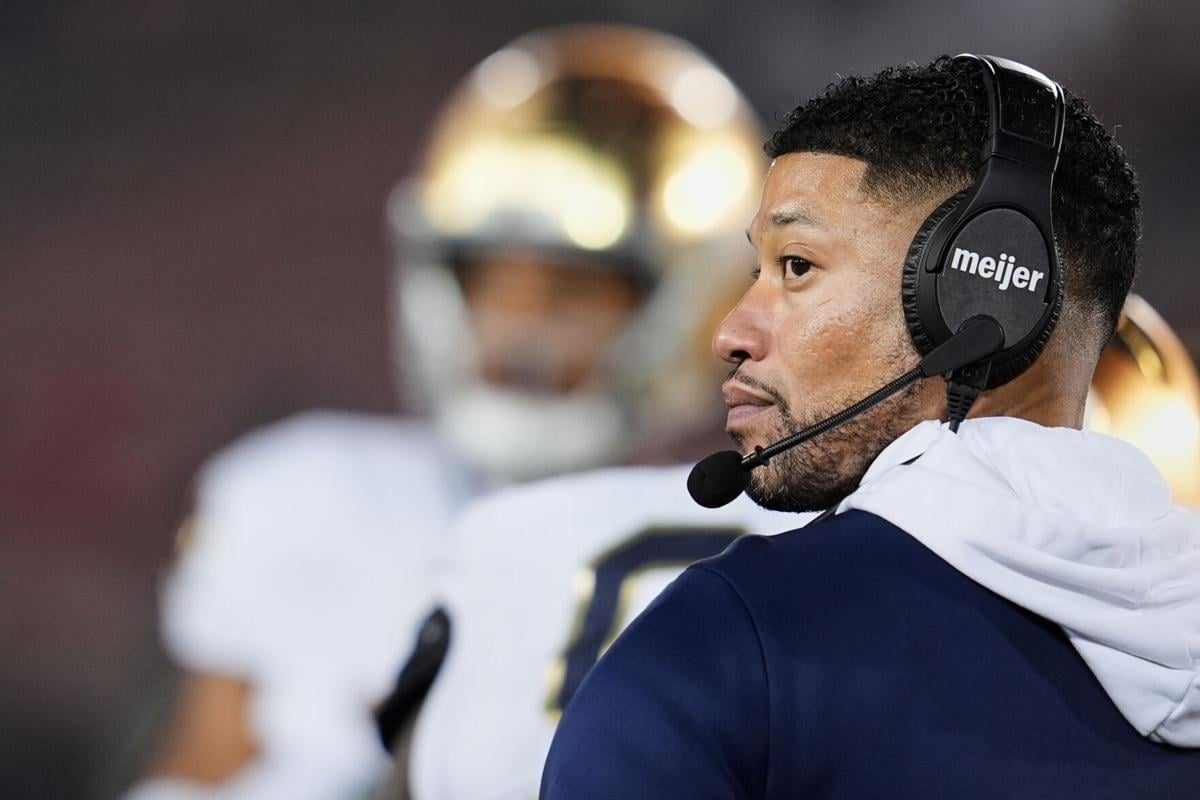
Notre Dame head coach Marcus Freeman stands on the sideline during the second half against Stanford, Nov. 29, in Stanford, Calif.
The games they could have participated in are considered — by many — to be meaningless exhibitions.
This isn’t untrue if they’re viewed solely through the lens of the CFP. Winning the Pop-Tarts Bowl — which reportedly would have been Notre Dame’s destination after it was excluded, wrongly, from the CFP — gets you a delicious dessert. But it has no impact on the national championship.
College football has become all about, or at least too much about, the Playoff. The reality is, even if the CFP were to expand to 16 teams (an inevitability at this point), college football still would have the smallest percentage of its constituents competing for the national championship.
This sport always has been about so much more than that. But it’s easy to forget that when so much of the discourse is about the Playoff.
Defenders of Notre Dame’s decision will cite the meaninglessness of it all. Why should the Fighting Irish put their players at risk just so ESPN can get better ratings?
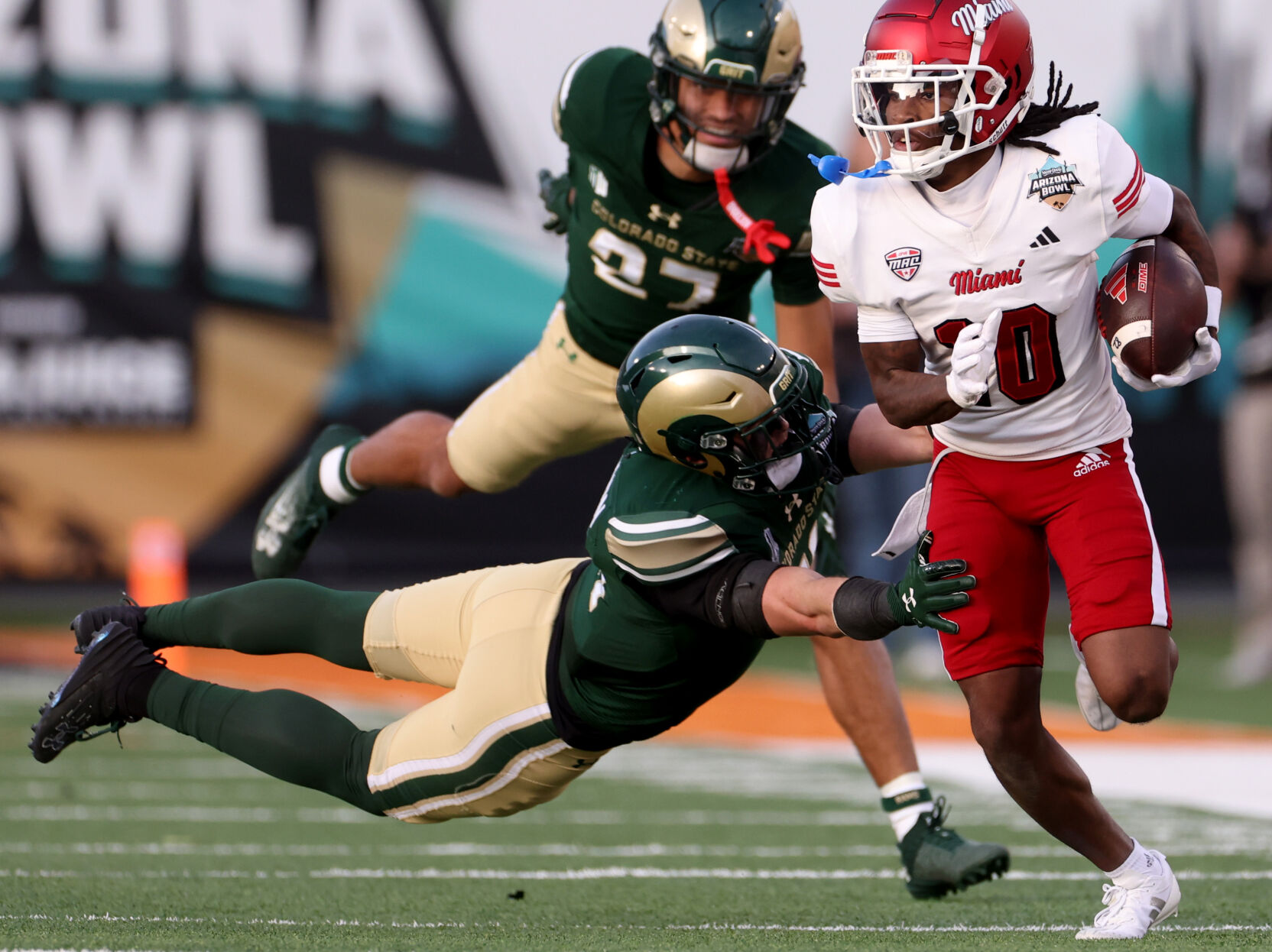
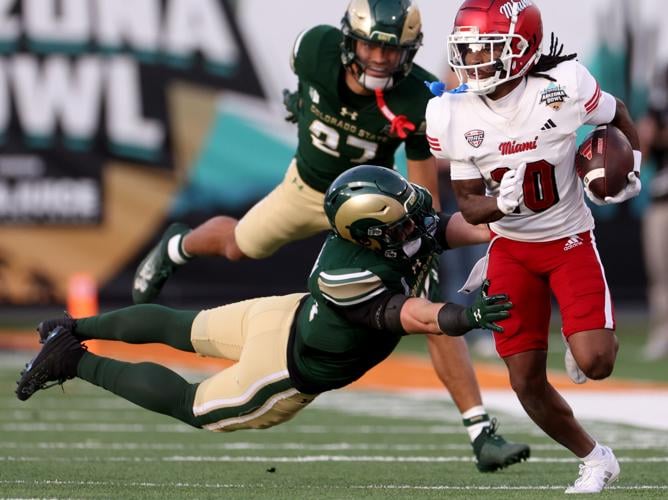
Miami (Ohio) wide receiver Kam Perry, right, squirts out of the grip of Colorado State defensive back Henry Blackburn, getting the RedHawks into the red zone in the third quarter of the Arizona Bowl, Dec. 28, 2024, in Tucson.
Here’s a better question: What are they missing out on by not playing?
‘Life’s too short’
Chuck Martin was an assistant at Notre Dame before becoming the head coach of Miami (Ohio). His RedHawks will face Fresno State in the Snoop Dogg Arizona Bowl presented by Gin & Juice by Dre and Snoop on Dec. 27 at Casino Del Sol Stadium.
Martin met with the media earlier this week to talk about the Arizona Bowl and the state of his program. He gave an impassioned plea for players to participate in bowl games — before news trickled out that two of his top players, receiver Kam Perry and defensive end Adam Trick, were planning to enter the portal.
Martin likely knew this was going to happen. Such is life for Group of Five schools in the portal/NIL era.
“We're gonna have kids that are gonna leave," Martin said. "That's just part of college football."
Martin dubbed this season as "the big transition year” for Miami before quickly correcting himself: “Probably every year is gonna be a big transition year from now on.”
Martin noted that college football no longer has a “slow lane.” For too many, it’s all about seizing the next opportunity. Something gets lost amid all those transactions.
“We don't take anything for granted,” Martin said. “Playing in a bowl game is an amazing experience. It always has been. This one's even more amazing. But (it’s) another opportunity to play football.
“How do you not want to play football? How do you not want to be in a bowl game? How do you not want one more game together? How do you not want to just coach again? How do you not want to just play again?
“For me, it's still the love of everything. Some kids are going to opt out of the bowl game. I guess I get it. There's agents telling them, ‘Well, if you get hurt, you're going to lose this.’

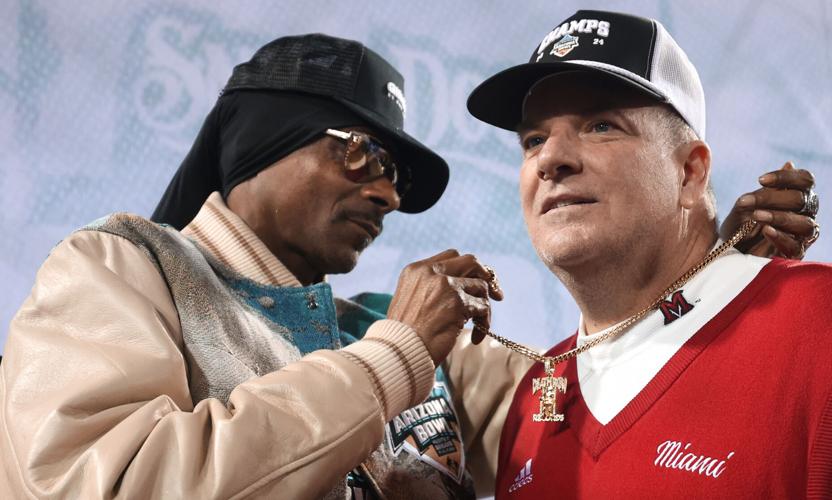
Snoop Dogg puts a necklace on Miami (Ohio) head coach Chuck Martin during the ceremony following the RedHawks’ 43-17 win over Colorado State in the Arizona Bowl on Dec. 28, 2024, at Arizona Stadium.
“I don't know what tomorrow brings. Life's too short. You got an opportunity to go play football or coach football. If you love it, how do you ever pass up that opportunity? It's mind-blowing to me. People see it differently.
“You got a game on Dec. 27, you play a football game. There's no guarantees on Jan. 3 you're gonna be on this Mother Earth. I'm not passing up anything.”
One could argue that Miami’s situation is nothing like Notre Dame’s. Any team from the MAC should and usually does appreciate the opportunity to play in a bowl game. Notre Dame, meanwhile, is one of college football’s true bluebloods — and truly got screwed by the system this year.
But again, there’s a common thread: Every bowl game is a chance to make memories.
One last time
If Martin had his way, FOMO would trump NIL. No argument here.

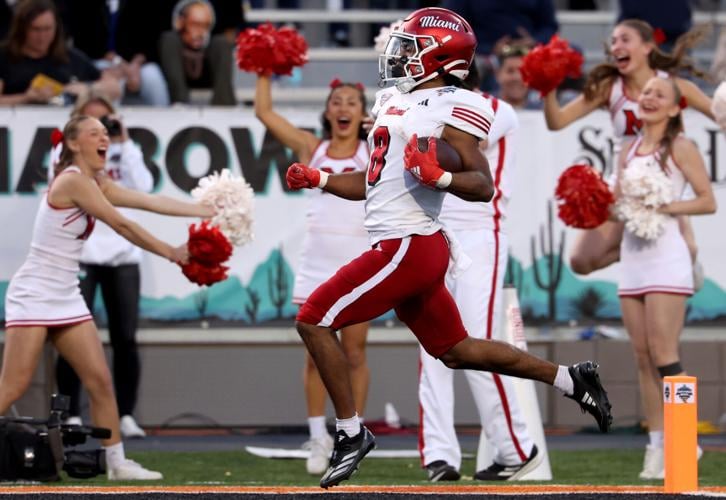
Miami (Ohio) running back Kevin Davis cruises into the end zone after breaking off a long run nearly untouched in the third quarter against Colorado State in the Arizona Bowl, Dec. 28, 2024, in Tucson.
“You're gonna miss a memory, I'm telling you,” Martin said. “You don't know what that day brings. There's gonna be an MVP of the game. What if Kevin Davis decided he wasn’t gonna play?”
Kevin Davis was a seldom-used backup running back who was pressed into duty in last year’s Arizona Bowl because of injuries. He ended up rushing for a career-high 148 yards and two touchdowns in his final college game. He also shared the postgame stage with Snoop Dogg.
Miami honored 21 players on its Senior Day this year. For almost all of them, the Arizona Bowl will represent their last chance to participate in an organized football game.
That idea wasn’t lost on Martin’s counterpart, Fresno State coach Matt Entz.
“For a number of our players ... it might be the last game that they ever get to play in,” Entz said. “As a program and as a football team, we need to make sure that our seniors continue to have an unbelievable ending to their Bulldog experience, a valued experience.
“I think we have competitive young men. We have competitive coaches. It doesn't matter if you're playing Ping-Pong or checkers, they're going to want to beat you.”
Even at a place like Notre Dame — which had 39 players on opening-week NFL rosters, tied for fifth most among college football programs — the vast majority of players do not play beyond college. Less than 2% of all NCAA football players make it to the NFL, according to the league and other research.
Players reportedly had a say in the opt-out decisions made by Notre Dame, Iowa State and Kansas State — which, like ISU, is going through a coaching transition.
I’m guessing that particular piece of data wasn’t presented to them.
“What are we doing with our lives?” Martin said. “These are opportunities that you don't get back. We're so worried about the next opportunity, we forget about what's right in front of us.”

