




As I begin to walk to my car from the Pima Community College athletic facility, Aztecs softball coach Rebekah Quiroz asks if I need to refill my water bottle.
Bear in mind, this is an almost entirely downhill jaunt of no more than five minutes. It’s maybe 85 degrees — Tucson cool.

Michael Lev is a senior writer/columnist for the Arizona Daily Star, Tucson.com and The Wildcaster.
Raymond Suarez, Pima’s sports information director, is walking with me. Quiroz reminds him to hydrate.
It already had become clear during conversations with Quiroz, her staff and one of her players that she isn’t just a softball coach. That final interaction clinched it.
Quiroz is a mom through and through. Specifically, she is the matriarch of the Aztec softball family.
The degree to which she cares — and inspires others to care — is perhaps the biggest reason the Pima program is flourishing.
Quiroz’s Aztecs are 39-12, 26-6 in the highly competitive Arizona Community College Athletic Conference. At one point this season, they won 26 games in a row.

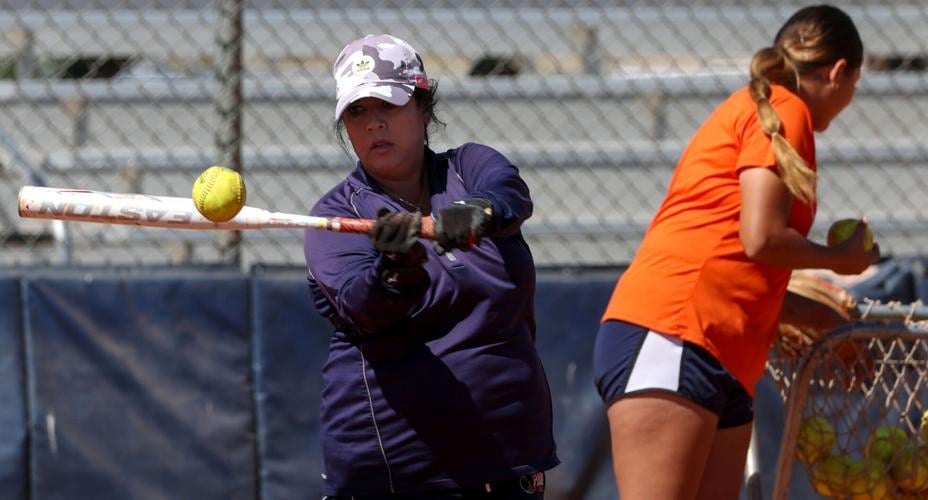
Rebekah Quiroz, head coach of the Pima Community College softball team, hits to her team during practice at the PCC West Campus softball field.
Pima is set to open play in the double-elimination Region I, Division I Tournament on Friday morning against Arizona Western College at Eastern Arizona College in Thatcher. The Aztecs are the No. 2 seed in the four-team event. The host Gila Monsters are No. 1. The winner will advance to Nationals. Pima last made it that far in 2013.
The coach of that team was Armando Quiroz, Rebekah’s father. She succeeded him six years ago. Now he’s back in the dugout as one of her assistants.
Some programs claim to be families. Pima softball truly is one.
“We eat together, we win together, we lose together,” Rebekah Quiroz says. “Everything here is done together.”
I visited Pima this week seeking to find out what was behind the softball team’s upward trajectory. The Aztecs’ win-loss records the past four years depict a clear ascent: They’ve gone from 10-20 to 21-25 to 36-24 to 39-12.

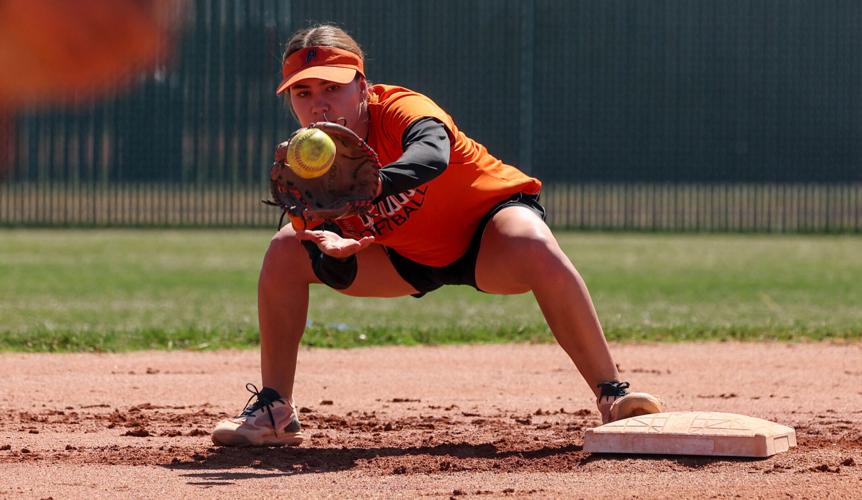
Sophomore infielder Camila Zepeda catches the ball during practice at Pima Community College on Tuesday, May 7, 2024. Zepeda, a Tucson High School grad, was named ACCAC Player of the Year, becoming the first Aztec softball player to win the award since 2010.
It’d be easy to explain that rise at a four-year school on a four-year rebuilding plan. Pima, like all junior colleges, turns over its roster every two years (if not annually).
“I have a really good answer,” Quiroz says. “We’re keeping the local kids home.”
Pima lists 25 players on its roster. Fifteen are from Tucson. That doesn’t include the ones from Benson, Marana, Oracle, Rio Rico, Sahuarita, San Manuel and Willcox.
Some transferred to Pima from out-of-state schools. Some came directly from area high schools. All are enjoying the perks of playing in their hometown.
“Keeping that family dynamic has been really huge for this program,” Quiroz says. “We do a lot of things as a family. We go out to dinner. We invite the families. I want them to feel like it’s home even when they’re with me.”
The Aztecs’ best player, Camila Zepeda, prepped at Tucson High. The sophomore second baseman was named ACCAC Player of the Year after batting .488 with 16 home runs and 61 RBIs in 164 at-bats. She is the first Aztec to be so honored since 2010.

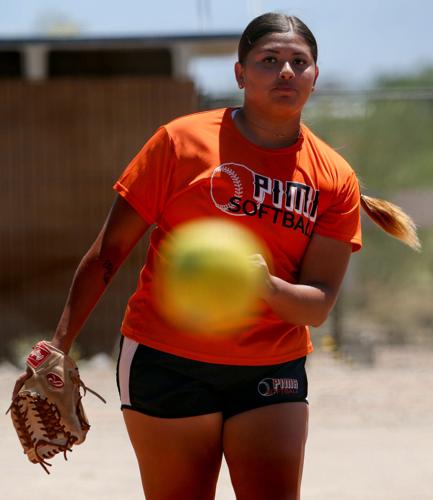
Freshman Jazmyne Waddell throws a pitch during practice at Pima Community College Tuesday afternoon. Waddell was one of six Aztecs to earn All-ACCAC honors this season.
Five others earned All-ACCAC recognition, and four are from Tucson-area high schools: Pitcher Jazmyne Waddell (San Manuel), outfielder/catcher Talia Martin (Mountain View), outfielder Aubrey Marx (Cienega) and catcher Mallory Zylinski-Wrobel (Sahuarita).
Team chemistry doesn’t just happen, and it’s arguably harder to create when the players are local and aren’t living together in dorms or apartments. Zepeda and her fellow sophomores promote that sense of unity via the team group chat: They invite their teammates to hang out at the pool, go out to eat or get drinks at Dutch Bros.
“I feel like that really helped bring us closer,” Zepeda says. “We’re just always together.”
Zepeda says this year’s team has a different energy about it. And Quiroz, Zepeda says, is unlike any coach she’s had before.
“I’ve always seen her as another mother figure,” Zepeda says. “I’ve honestly gotten really close to her. I never thought that I’d have that much trust or that much of a good relationship with a coach.”

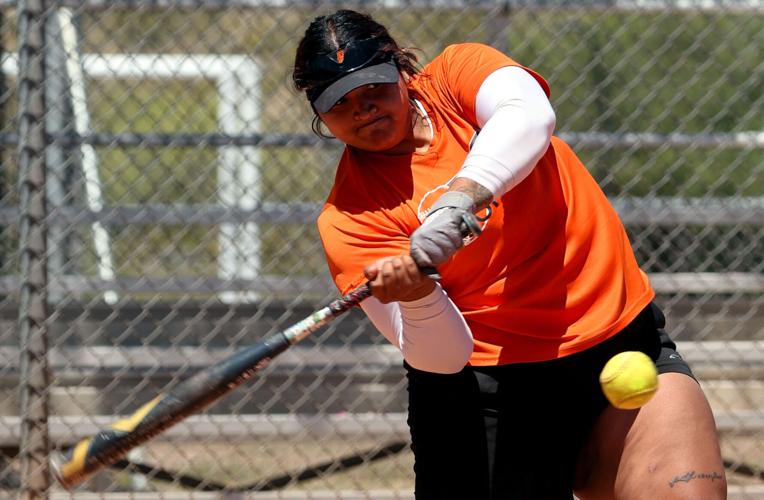
Sophomore infielder Kayla Miranda hits the ball during practice at Pima Community College on Tuesday.
Quiroz learned the value of team building and bonding from three coaching titans: her father, a Pima County Sports Hall of Famer who led Flowing Wells High — where Rebekah starred as a player — to three state championships before winning 501 games over 11 years at Pima; Stacy Iveson, a Catalina High grad who coached Salpointe Catholic to a state championship, Pima to two NJCAA titles (Quiroz was her assistant for one of them) and served as an assistant for three University of Arizona national-championship squads; and Mike Candrea, aka the GOAT.
Quiroz played just one year under Iveson at Pima, but that year made an indelible impression: Quiroz knew she wanted to be an Aztec for life.
“She’s Arizona family, she’s local,” Quiroz said of Iveson. “Representing your community, representing your family, representing where I came from was so important to me. That’s what I want these girls to feel like when they step on the field.”
Quiroz went from Pima to the UA and was part of the Wildcats’ program at the peak of its power. She learned an invaluable lesson from Candrea that’s especially applicable in junior college: “Stop using the word ‘sacrifice’ and start using the word ‘investment.’ ”

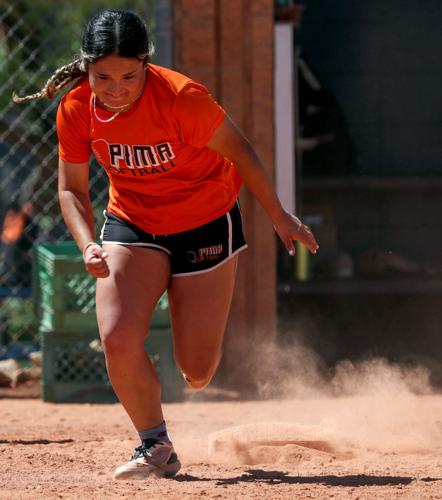
Pima Community College sophomore outfielder Gabriella Salazar runs to second base during practice Tuesday.
Junior-college coaching is the opposite of glamorous. Quiroz doesn’t have an administrative assistant to handle travel arrangements and other logistics.
“Junior college is a grind,” she says. “And I’m here for it.”
Quiroz says she’s had job offers from other schools. She could have become an assistant at an NCAA Division I program or a head coach at a DII.
“That would have been great for my résumé,” Quiroz says. “But my babies are still very young.”
Quiroz didn’t want to disrupt her family at home. She is a single mom to Ivan, 10, and Elijah, 8. Her investment is widespread.
“Being a mom, being a head coach, trying to keep 25 girls happy — you know how nearly impossible that is,” Quiroz, 42, says. “The biggest challenge is just making sure that I’m getting enough rest to do my job in the office, do my job even more on the field and then go home and have enough for my kids.
“That is the hardest part about the job. But it definitely makes me stronger at the end of the day.”

'Representing your community, representing your family, representing where I came from was so important to me,' Pima Community College softball coach Rebekah Quiroz says. 'That's what I want these girls to feel like when they step on the field.'
Her father helps her with all of the above. Rebekah had been Armando’s top assistant before he stepped down in 2018. He was ready to move on, and she was ready to move up.
Armando remained his daughter’s biggest supporter — and perhaps her biggest critic.
“He’s still hard on me like he was when I was playing,” says Rebekah, adding that she appreciates her father’s honesty.
She decided it would be beneficial to have that “old-school expectation, that winning expectation” in the dugout again, so she officially brought Armando back as a volunteer coach last year. She says the experience has been “amazing.”
I asked Armando how the two of them get along.
“Probably not very well,” he said with a laugh. “I’m an alpha. She’s an alpha. Sometimes we clash. But at the end of the day, we come together.”
It’s what families do.

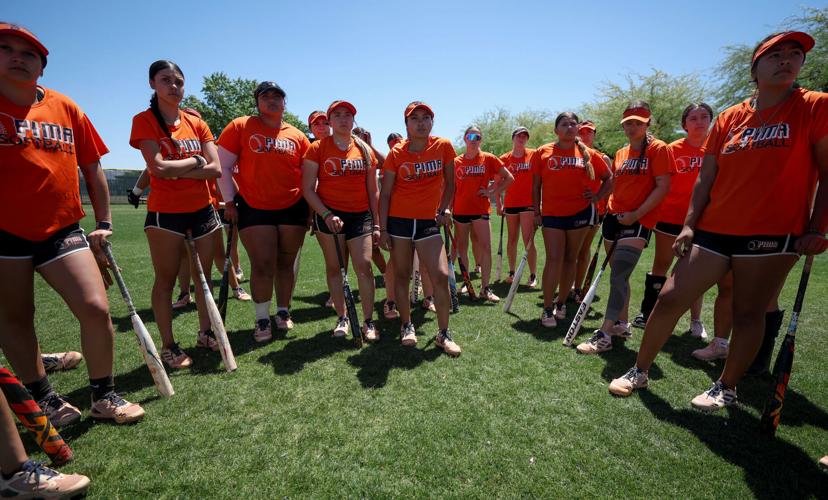
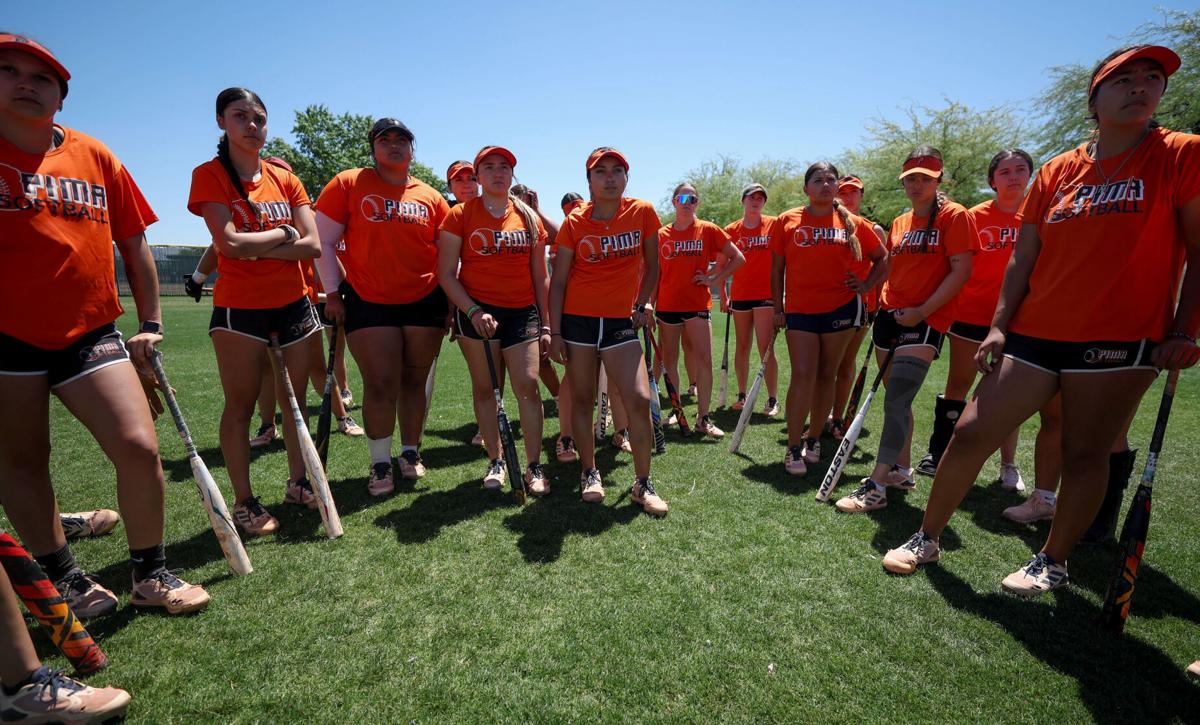
Pima Community College softball players listen as head coach Rebekah Quiroz talks about their upcoming playoff games. The Aztecs are thriving under Quiroz, who promotes a family atmosphere within the program.

