


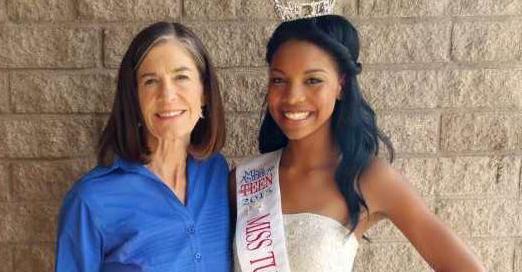


Jack the rescue dog broke the ice between Cynthia Dean and the child she volunteered to represent as a Court Appointed Special Advocate.
When Dean met Dimon Sanders, the girl was about 9 years old and didn’t care much for this older woman suddenly interested in her.
In the year it took to build trust, they cruised dog parks and Dimon played on monkey bars.
Not long before they met, Dimon, 17 now, had entered Pima County’s foster-care system.
For five years, Dimon said she saw 35 people bounce in and out of her life. But not Dean.
Dean was there to stay.
“Since you’re court-appointed, your job is to be the eyes and ears of the court and judge …” Dean said. “You’re just there to make sure the needs of the child are met.”
Court Appointed Special Advocates are volunteers appointed to the case of an abused or neglected child in the foster-care system. CASA volunteers get to know a child and understand their needs, whether those are personal, educational, therapeutic or medical. They attend court hearings and write reports for the judge that advocate the best interests of the child. They also attend monthly family team meetings that include case workers, parents and other relevant individuals.
“Judges say they love having CASAs on the case because they get a complete and total picture of what’s going on …” said Jill LaBrie, the CASA program recruiter. “It brings in a much more personal touch, and they are definitely those mama and papa bears fighting for kids to make sure they get what they need and deserve.”
At the end of July, the county had about 225 CASA volunteers serving about 260 kids. With 3,300 children in the Pima County system at the end of June, that means roughly 7 percent of kids had advocates, LaBrie said.
For Dimon, having an adult stick around made all the difference.
“I would have turned out differently if I didn’t have her,” Dimon said just days before boarding an Orlando-bound plane to represent Arizona in Miss America’s Outstanding Teen competition. “There would have been more behavioral issues than what I had when she was my CASA. She was consistently checking in on me and making sure I was getting my homework done and making sure I was staying positive.”
Dimon became the first African American teen to win Miss Arizona’s Outstanding Teen competition in June — a victory for a girl once ashamed of her story. Now she uses her platform to tell others about the difference a dedicated adult can make in the life of a child.

Dimon Sanders represented Arizona in the Miss America's Outstanding Teen competition.
Dean began volunteering as a CASA in Arizona about eight years ago, following three years doing similar work in Florida. She’s also a peer coordinator, mentoring new volunteers coming into the program.
“Even though a lot of what we do is hard emotionally, it’s never as hard as what the kids have been through emotionally,” said Dean, a retired teacher. “That’s my fallback when things get discouraging. There was a point with Dimon when it was a low point, and I thought, ‘Who will adopt this child with behavioral issues at age 13?’ That’s what my heart was saying, but my head was saying, ‘We’re not going anywhere. We’re going to stick with this one.’”
Besides wandering dog parks with Jack, the two often dined at Twist & Shout 50’s Diner in Green Valley.
“Sitting across from someone with a BLT and a sundae is a bit of an icebreaker,” said Dean, who was also CASA to Dimon’s biological sister.
During the course of their court-appointed relationship, Dimon moved between foster and group homes. Several adoptions fell through.
Dimon met Apache Sanders when the Raytheon engineer visited Mansfeld Middle School as part of community outreach with the National Society of Black Engineers.
Dimon’s counselor at school knew the teen’s story and Apache’s husband, Joshua Sanders. He knew the family wanted to adopt.
“And that was the start of it,” Apache said.
Slowly, Joshua and Apache Sanders began to get to know Dimon.
“She was very standoffish initially, and I think back to the first car ride, and I had the bright idea to turn down the radio and have a conversation,” Apache said. “It didn’t quite work like that. Sometimes, if she would answer, it would be very short and she would just look out the window, and it was the same thing at dinner. But I just kept talking to her consistently and picking her up, and it got better.”
The relationship between Joshua and Dimon moved even slower.
“It took me a little while to connect with my dad, because I didn’t really trust male figures,” Dimon said. “It was hard for us to be on the same page without us constantly arguing or me trying to push the boundaries.”
When the Sanderses adopted Dimon, she was about 13 and living in a young adult shelter. Moving into a house with rules frustrated her.
“Having Cynthia was a godsend,” Apache said of the days surrounding the adoption. “She gave us insight into Dimon’s behavior. Dimon’s caseworker was fairly new, but Cynthia had the knowledge from the beginning. ”
When Dimon first began staying with the Sanderses in Marana, she refused to sleep in her bedroom, Joshua said. Instead, she opted for the couch, a behavior that baffled him.
That changed when they finalized the adoption and she made the switch to her bedroom.
“It came out that she was sleeping on the couch because there had been other adoptions where they gave her back, and so she had to prepare herself,” Joshua said.
Dimon didn’t win nationally when she represented Arizona in Miss America’s Outstanding Teen competition in July, but she continues to share her story as a CASA ambassador.
“When I was adopted, I had low self esteem and low confidence,” Dimon said. Pageants provided “a way for me to boost my self esteem, and I have continued it for about three years.”
She got interested in pageants after the family traveled to North Carolina and watched Joshua’s sister compete several years ago.
“Dimon is a totally different person than when we first met her,” Apache said. “She was ashamed of who she was and her story, and everything that happened, so by using her story as a platform ... instead of holding her back, she’s using it to help other people.”
Dimon now has two younger siblings, one adopted like her. She’s finishing school online and looking at universities for fall 2018. She plans to study nursing.
She still sees Dean, who recently made the trek to Marana for dance recitals by Dimon and her younger sister.
“The connection I had with my CASA, I want other kids to have that same connection,” Dimon said.
The secret to their success? “I didn’t do much except not give up on her,” Dean said.

