

Before last year, pregnant jail detainees were not entitled to supplemental nutrition and were only granted 72 hours of postpartum recovery regardless of whether a C-section was performed.
Pregnant in jail: Care gaps persist across Illinois
State statute now provides an extra 300 calories per day for pregnant or lactating inmates, greater access to education, revised restraint policies and extended recovery times.
The law originally required that each pregnant person in custody must receive educational programming related to pregnancy and parenting, including instructions regarding prenatal care and hygiene, the effects of prenatal substance exposure, parenting skills, and medical and mental health issues for children.
In addition to educational programming, a county's department of corrections now must provide written information materials concerning laws pertaining to pregnant detainees to any pregnant or postpartum detainee.
The materials would be issued to the counties by the Illinois Department of Public Health at no cost to the county but a jail may also accept informational material from community-based organizations specializing in the rights of pregnant individuals in custody.
The postpartum recovery period, where the detainees are allowed to remain with their infant and have access to any nutritional or hygiene-related products necessary for the infant's care, was previously limited to 72 hours.
Alexis Mansfield, senior advisor for children and family issues for the Women’s Justice Institute, said a postpartum follow-up typically is at six weeks because it takes that amount of time for someone to heal. So the idea that an individual who could be at risk for postpartum eclampsia and continuing edema could be restrained that soon after giving birth is outdated.
"I've had clients literally an hour after giving birth get handcuffed to the bed," Mansfield said. "That was actually the standard practice is that you'd be handcuffed immediately afterwards so even holding the baby was really difficult."
'Penny-pinching' jails costing inmates their lives, families allege
The postpartum period is now extended to six months unless determined by a physician, advanced practice registered nurse, physician assistant or other qualified medical professional that it should be longer.
Restraint policies for pregnant individuals now align with those of the Cook County Jail.
No security restraints can be used on a Cook County detainee at any point during pregnancy or while in postpartum recovery at a medical facility unless there is a determination that the subject is a flight risk or other "extraordinary circumstances" dictate the need.
Detoxing behind bars poses a risk to some jail inmates
In those cases, the restraints must be immediately removed at the request of medical personnel and must be the least restrictive possible to ensure safety and security. Leg irons and waist shackles can never be used on any pregnant or postpartum person in the Cook County Jail.
A correctional officer must be posted immediately outside a hospital room unless otherwise requested by medical personnel. The officer cannot conduct a prisoner safety assessment during medical examinations or the delivery process.
The bill will also help to establish an annual record of pregnant individuals in custody and the lawful use of restraints to these detainees.
According to the new law, the sheriff or corrections official from any jail with pregnant or postpartum detainees must submit an annual report to the Illinois Department of Corrections with the number of pregnant individuals in custody and the number of people who deliver or miscarry while in custody.
These jail officials must also submit a written report document every instance of restraint of a pregnant detainee without using individually identifying information.

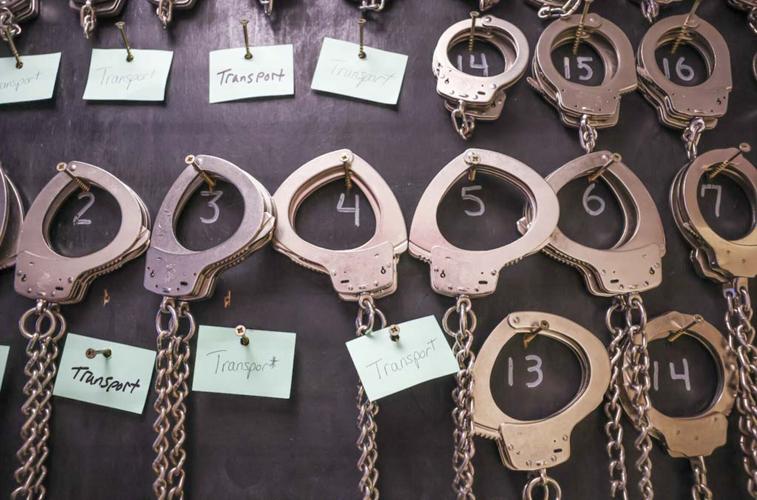
Several handcuffs hang on a wall for transport at the McLean County Jail.
Many jail officials interviewed in this series voiced no concerns implementing these new policies since they align closely with the jails’ existing policies.
“Most of the bill is feasible and things we already have in place from what I have read,” said McLean County Jail Superintendent Diane Hughes.
Every correctional officer employed at a facility where women are incarcerated must receive training related to medical and mental health care issues for pregnant persons. The training must also include information about the potential impact the use of restraints, invasive searches and placement into segregation would have on a pregnant person and their unborn child.
In 2021, Lesa Morrison's back began to ache. She was 36 weeks pregnant with her fourth child. She rushed to the local emergency department at St. Aloisius hospital in Harvey, North Dakota. The ER doctor said he was going to discharge Lesa from the ER and her husband would have to take her to another hospital 73 miles away.



