


Garden Sage - An American beautyberry; eliminating gnats; leaf-footed bug
- Updated
Answers to your gardening questions from an expert in Southern Arizona.
- By Peter L. Warren Special to the Arizona Daily Star
- Updated
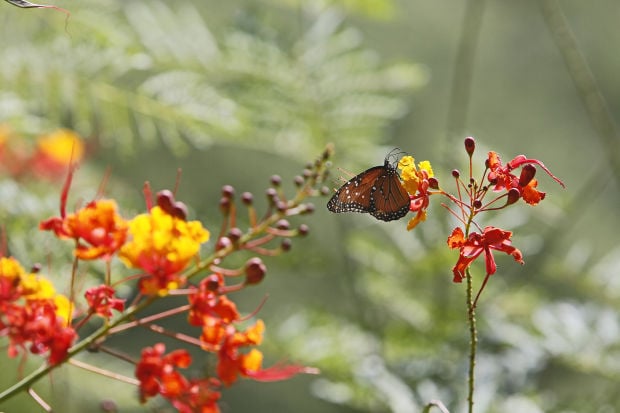
Q: Is it necessary to cut back our red bird-of-paradise bushes in the late winter (here in Sierra Vista)? Some folks in town don’t and their red birds seem to bloom OK. Is it also necessary to cut back (or really, cut down) our Tecoma stans-orange jubilee each winter?
A: There are three species of bird of paradise (Caesalpinia) grown in the Southwest, red (C. pulcherrima), yellow (C. gilliesii), and Mexican (C. mexicana). In general, the pruning of bird of paradise shrubberies is necessary only to remove frost-damaged limbs or to remove dead, crossing or damaged branches. More pruning will be needed if you are growing the Mexican bird of paradise and plan it to be developed and maintained as a small tree. Once blooming is finished, the flower stalks may be removed to prevent seedpods from forming and to reduce the likelihood of volunteer seedlings. If the pods are left on the plant to dry and split, the seeds can be thrown a surprising distance. The red bird of paradise dies back to the ground at temperatures below freezing. It generally regrows in spring from the ground and can be pruned to a few inches above the ground in late winter. Mulching the base of plants in colder areas may protect the crown until spring. For Tecoma stans, it is not necessary to cut way back or cut them down each winter. Generally, you should prune dead wood in early spring and otherwise just do light selective thinning as needed to maintain the size. Hard pruning Tecoma stans-orange jubilee back to 12-inch canes is sometimes done to reduce the size and to maintain its upright shape. Hard pruning is stressful for the plants so if you choose that method you might do it every third year.
Peter L. Warren is the urban horticulture agent for the Pima County Cooperative Extension and the University of Arizona. Questions and photos may be emailed to tucsongardensage@gmail.com
- By Peter L. Warren Special to the Arizona Daily Star
- Updated
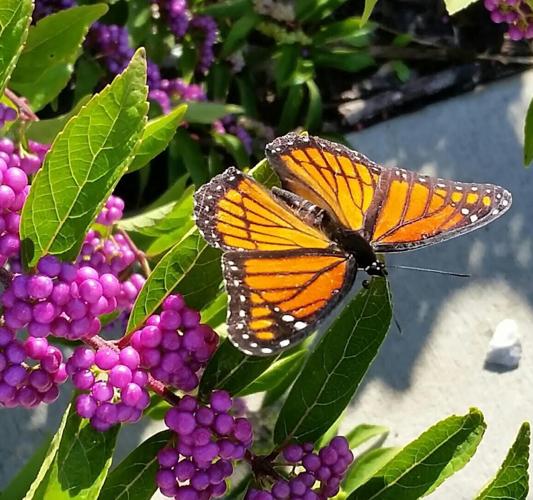
Q: This question is a shot in the dark concerning a bushy plant we saw in Alton, Illinois, this past September. The cluster berries are striking in their vibrant color. No one we spoke with including park personnel knew what the plant was called. It was in a landscaped area, and planted in a manner that would suggest a landscape architect was involved. Any guess?
A: The plant is American beautyberry (Callicarpa americana). It is native to the southeastern U.S. from Texas to Virginia and is easily grown in that area. I had it growing in my front yard in Virginia and it really tied the landscape together. It has also been found in the Caribbean and northern Mexico as it adapts to a wide range of soil pH. It is a striking plant and there is a variety called “lactea” with white berries that is sold by nurseries although it can’t compare to the purple in my opinion.
Peter L. Warren is the urban horticulture agent for the Pima County Cooperative Extension and the University of Arizona. Questions and photos may be emailed to tucsongardensage@gmail.com
- By Peter L. Warren Special to the Arizona Daily Star
- Updated
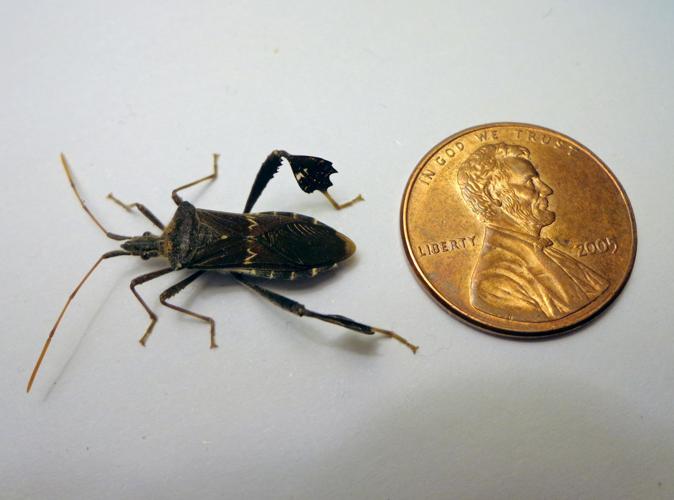
Q: The last couple of years, the fruit on my pom tree gets brown spots, and it is rotten inside. Any ideas?
A: Yes, it’s likely that insects are feeding on your pomegranate fruit and the feeding allows entry for a fungus that subsequently rots the fruit. The most likely suspect is the leaf-footed bug (Leptoglossus species). There are three species in the Southwest. These insects are common in our area and may be found feeding on a variety of plants including citrus, pecans and pomegranates. As adults, these insects are difficult to manage because they can fly, they can sense predators and they are quick to run around the other side of the plant or fly away. The best time to remove them is when they are in the egg stage, laid in a strand — end to end on the underside of leaves. There are insecticides available and effective against newly hatched nymphs. Either of these requires monitoring your pomegranate tree on at least a weekly basis with the goal of detecting them before they mature to the adult stage. If you only have one tree and you are looking closely for them anyway, you might be able to just remove them by hand or sweep them into a bucket of soapy water.
Peter L. Warren is the urban horticulture agent for the Pima County Cooperative Extension and the University of Arizona. Questions and photos may be emailed to tucsongardensage@gmail.com
- By Peter L. Warren Special to the Arizona Daily Star
- Updated
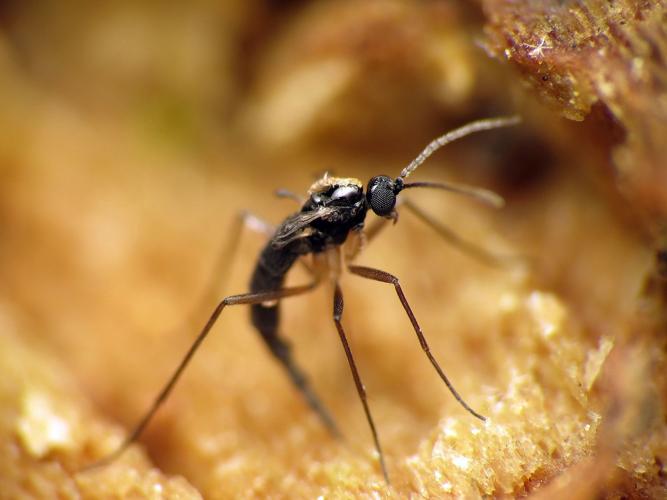
Q: We have tiny black gnat-like bugs flying around the house. They seem to live in the dirt of my plants and though they don’t bite, they annoy us endlessly. I put the plants outside to see if the change in temperature would encourage them to fly away but to no avail. They seem to end up even in rooms with no plants. We read somewhere to put dishes of soapy water out and we do catch a few this way, but I’d rather find a permanent way to rid myself of the annoying pests.
A: Your gnats are living on fungi in the soil of your plants. For this reason, we often call them fungus gnats. Unfortunately, the photo you sent wasn’t close enough to help identify which species. Fortunately, these are common insects in houseplants so we have a good understanding of their life cycle and some general methods for managing them. As you noticed, they don’t bite; in fact the adults don’t even feed. The adults are only alive for a week or so and their mission is to mate and lay eggs in the soil. They may fly to other rooms nearby seeking places to lay eggs. The larvae feed on decaying plant matter and fungi in the soil and complete their development in three to four weeks. The first step in managing them is to let the top 1 or 2 inches of soil dry out completely between watering. This step alone might be enough to solve your problem. If the population persists for a month after you change watering practices, you might need to use an insecticide. There are a few available including Bacillus thuringiensis israelensis (Bti), pyrethroid-based insecticides and parasitic nematodes. Some of these are not easy to find in stores so you might need to order them online.
Peter L. Warren is the urban horticulture agent for the Pima County Cooperative Extension and the University of Arizona. Questions and photos may be emailed to tucsongardensage@gmail.com
- By Peter L. Warren Special to the Arizona Daily Star
- Updated
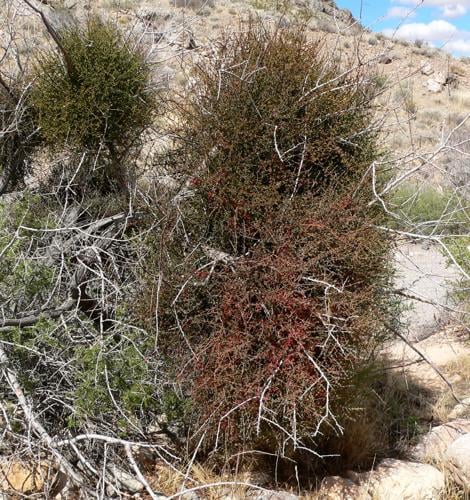
Q: I have heard from a number of people that mistletoe does not kill a tree. That might be true, but it weakens the tree so much that anything that comes along after the infestation of mistletoe will kill the tree—like our drought. I think people want to hear that it doesn’t kill the tree so they don’t have to act on ridding the tree of it. Or maybe people don’t care that much about their trees. Even the Rillito River Path trees have a lot of it in them, and the city pays to plant and water the trees.
A: There are many species of mistletoe and they are parasitic plants. In general, the species we are familiar with in the low elevations of the Sonoran Desert attach to their host plant to absorb water and nutrients. The healthier the host plant, the healthier the parasitic mistletoe that depends on it. If the host plant is suffering from other problems, such as drought, the mistletoe can take enough water and nutrients to weaken the host and that can lead to the death of the host. A common species in our area is called mesquite mistletoe (Phoradendron californicum). This is a native plant that has a place in our desert ecology in that it provides food and shelter for some animals. The birds that eat the seeds will spread mistletoe by pooping them out in other trees along with a dollop of their own brand of fertilizer. It would be impossible to eradicate mistletoe from our environment because it of the way it is spread by birds. It would also be hard to generalize about the relationship between people and mistletoe. I am fairly certain there are a few different reasons why mistletoe is allowed to thrive on landscape trees. Depending on the person, these may include the knowledge that it is food for birds, that it’s not always easy or affordable to cut it out of every tree, and that there is an endless supply of this plant in the open desert from which it can spread. I am familiar with the city’s lack of resources and I expect they are doing the best they can with limited staff and funds to manage trees and other plants on public property.
Peter L. Warren is the urban horticulture agent for the Pima County Cooperative Extension and the University of Arizona. Questions may be emailed to tucsongardensage@gmail.com

- By Peter L. Warren Special to the Arizona Daily Star
- Updated
Q: How can I get rid of the squirrels that are destroying my backyard? They have three huge (apparently connecting) holes around the large palo verde tree. They keep the gravel all messed up with their digging. Of course, my cat (who is an indoor cat) loves watching them from the door. The chipmunks have many holes around a large cholla on the bank outside the front wall, so I assume that is where they are coming from.
A: Round-tailed ground squirrels are not likely something you can eradicate. As you noticed, they can migrate from outside a wall by digging or climbing if it’s not made of slippery material. The best strategy is an integrated approach that includes systematic destruction of their habitat, trapping to reduce the population, and protecting the plants you like best with some sort of fencing. Since they are fairly small, using hardware cloth with smaller holes that can be buried a few inches into the soil may help. Since they climb, this means you also have to protect from that likelihood with either a cover or lining your barrier with flashing or some other material on which they cannot get traction. You can contain them but you can’t stop them.
Peter L. Warren is the urban horticulture agent for the Pima County Cooperative Extension and the University of Arizona. Questions may be emailed to tucsongardensage@gmail.com

- By Peter L. Warren Special to the Arizona Daily Star
- Updated
Q: My father has a tangelo tree that will sometimes have a second bloom in the summer. This year on one of the branches there are two grapefruit! Usually I would think if there is another fruit it would come from a branch that sprouted from below the graft but this did not. He picked and cut one open and the flesh was a very light orange and tasted like a bland tangelo.
A: The tangelo is a hybrid citrus created by crossing a tangerine with a pomelo or grapefruit. Occasionally hybrids or part of them revert back to one of the original parents by producing plant parts such as foliage, flowers, or fruit that more resemble the parent plants. These growths are sometimes referred to as a ‘sport.’ So the odd fruit is likely a sport but probably something other than a pure grapefruit. Hopefully, they taste good. If not, you can prune that branch out of the tree or just let it be.
Peter L. Warren is the urban horticulture agent for the Pima County Cooperative Extension and the University of Arizona. Questions may be emailed to tucsongardensage@gmail.com

- By Peter L. Warren Special to the Arizona Daily Star
- Updated
Q: I have a mature Valencia orange tree that has yellowing leaves and dead end tip branches. It also has some dried yellow fruit. The tree is watered three times a week for 45 minutes each time with three bubbler type irrigation system heads at the tree drip line. Any thoughts on what may be the problem?
A: Although yellowing leaves can also indicate a lack of nitrogen, the dead end branches and your current irrigation schedule tells me the tree needs more water. If you are fertilizing three times per year as recommended in late winter, spring, and fall, the other important input is water. While your placement of bubblers is appropriate, the scheduled watering is not ideal. Citrus trees do best with deeper watering on a less frequent basis. During the summer, every 7 to 10 days to a depth of 36 inches is recommended. In the spring and fall you can back that off to every 10 to 14 days and in the winter to every 14 to 21 days.
Peter L. Warren is the urban horticulture agent for the Pima County Cooperative Extension and the University of Arizona. Questions and photos may be emailed to tucsongardensage@gmail.com.
- By Peter L. Warren Special to the Arizona Daily Star
- Updated
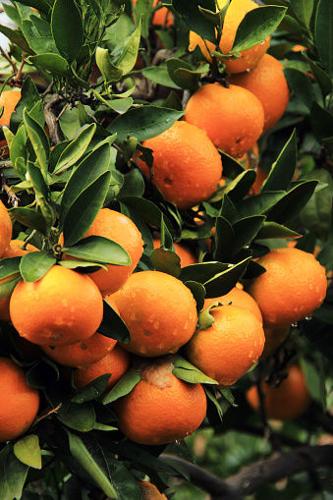
Q: We planted this Satsuma Mandarin Orange two years ago, and last spring it had good foliage and produced two or three small fruit. But now, it appears to lose leaves on lower branches, put out new leaves on upper branches, but has not gained any new branches or height. It is on a drip system. I don’t see evidence of anything chewing on it. Any suggestions on how to help out thrive?
A: This is typical for newly planted trees. The stress of transplanting sometimes causes some leaf drop and/or fruit and flower drop. Assuming you are watering and fertilizing properly, I expect you will see new growth in the coming year. Trees typically take between two and three years to get established in their new surroundings before they show a lot of growth. This is mainly due to the large amount of root damage they incur during transplanting.
Peter L. Warren is the urban horticulture agent for the Pima County Cooperative Extension and the University of Arizona. Questions and photos may be emailed to tucsongardensage@gmail.com.
- By Peter L. Warren Special to the Arizona Daily Star
- Updated
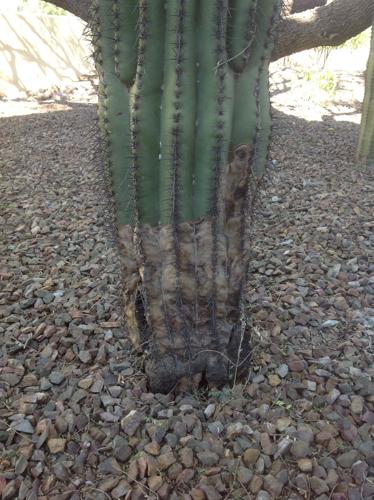
Q: What is wrong with this saguaro cactus?
A: The brown and black areas show signs of bacterial necrosis. This is a common affliction of cacti in the desert and unfortunately once it gets into the main stem and spreads that wide there is nothing you can do to fix the problem. Eventually the cactus will succumb and fall over. It would be wise to plan for that eventuality and make sure there aren’t any potential hazards such as the chance people or property could be damaged if it fell unannounced. Contracting with an experienced landscaper or certified tree professional to take it down would be appropriate if any hazards are present.
Peter L. Warren is the urban horticulture agent for the Pima County Cooperative Extension and the University of Arizona. Questions and photos may be emailed to tucsongardensage@gmail.com.

- By Peter L. Warren Special to the Arizona Daily Star
- Updated
Q: Can you tell me what is going on with this sage bush? I took a sample to the nursery and was told it is new growth. The bush has been this way for a couple of years and stays on the same side of the bush. Is this a problem or just new growth?
A: New growth is correct in so far as it’s newer than the shrub you planted. Unlike normal new growth, it won’t take on the appearance of old growth after a period of time. It appears that your Texas ranger has reverted back to it’s original form, at least in part.
Many of the interesting cultivars we see in landscapes originate from some mutation with desirable characteristics from the original parent plant. These interesting mutations can be propagated into new cultivars and then introduced into the horticulture trade. Unfortunately, not all of these cultivars are stable and they sometimes revert back to the original plant. The original is likely more vigorous than the designer cultivar and could take over the space by outgrowing the shrub you planted. So if you like the one you planted more than the new original version, you can prune out the offending parts. As long as we’re discussing them, these plants are commonly called sages but are actually not related to the true sages in the Salvia genus. Rather they are in the figwort family, Scrophulariaceae.
Peter L. Warren is the urban horticulture agent for the Pima County Cooperative Extension and the University of Arizona. Questions and photos may be emailed to tucsongardensage@gmail.com.
- By Peter L. Warren Special to the Arizona Daily Star
- Updated
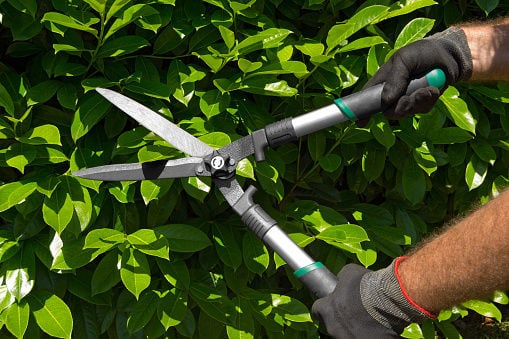
Q: I seem to recall that you have recently given advise on how to trim bushes to keep them looking full instead of like “horses tails”. If I’m mistaken about the article, I would appreciate any advise you have regarding the trimming.
A: There are a couple ways to trim bushes. Partly this depends on the function of the plant. Some shrubs are pruned to hedge shapes and others are designed to stand alone or in groups. The healthiest method for pruning is called selective pruning. This method involves selecting branches to prune that thin out the plant to allow for air, water, and sunlight to reach the inner parts while still maintaining the size of the plant. We typically want to remove any dead, damaged, and crossing branches to keep the plant in good health and good appearance. Good pruning cuts are also important to the health of the plant. This means using a sharp tool and cutting close to connecting branches. There is a publication that explains this in greater detail. Google AZ1499-2016.pdf to find this publication on the Internet.
Peter L. Warren is the urban horticulture agent for the Pima County Cooperative Extension and the University of Arizona. Email questions and photos to tucsongardensage@gmail.com

- By Peter L. Warren Special to the Arizona Daily Star
- Updated
Q: A barrel cactus turned brown and imploded. The center caved in and became an orange slime. I found these white larvae inside about an inch in length. What can I do to prevent this from happening to my other barrel cacti?
A: The larvae are maggots, aka fly larvae. These insects are decomposers and attracted to the rotting plant rather than being the cause of the problem. The rot may have been caused by a wound that allowed a bacteria or fungi to invade. Overwatering is another potential cause. If you can describe your watering schedule, we might be able to rule that in or out. Typically, cacti should receive water every 10 to 14 days to a depth of 12 to 18 inches during the summer, every 21 to 28 days during the spring and fall, and none during the winter. Preventing this damage from happening to your other plants is not always possible because other animals may damage your cacti. What you can do is to care for them properly, which you may already be doing, and hope for the best.
Peter L. Warren is the urban horticulture agent for the Pima County Cooperative Extension and the University of Arizona. Questions and photos may be emailed to tucsongardensage@gmail.com
- By Peter L. Warren Special to the Arizona Daily Star
- Updated
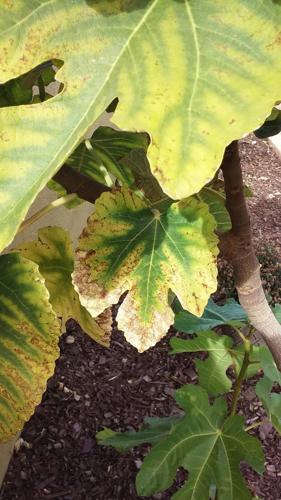
Q: Some of the leaves on my fig tree are turning yellow and rusty looking. Overall, the tree looks healthy and is producing fruit. I don’t see any bugs or caterpillars on the tree but I’m concerned that it might have problems. Is this normal or should I be treating the tree with something?
A: Your fig is showing signs of nutrient deficiency and drought stress. Application of a nitrogen fertilizer along with some irrigation should fix this problem. For an average tree, about a half pound of nitrogen is appropriate. This can be split in three applications over the year, spring, summer, and fall. Make sure you water after applying so the fertilizer reaches the absorbing roots.
Peter L. Warren is the urban horticulture agent for the Pima County Cooperative Extension and the University of Arizona. Questions and photos may be emailed to tucsongardensage@gmail.com

- By Peter L. Warren Special to the Arizona Daily Star
- Updated
Q: I’ve attached a photo (above) of one of several insect mud homes that are in my hot water heater closet (external door is to outdoors). Is it mud dauber? Any reason to be alarmed?
A: Yes, this is a home for mud dauber wasps, aka mud dobber, dirt dauber, dirt digger, etc. No reason to be alarmed unless you spend a lot of time going in that closet. They are relatively docile insects and would only be hazardous if they felt their home was threatened. Some people regard them as beneficial insects in that they are predators of spiders.
Peter L. Warren is the urban horticulture agent for the Pima County Cooperative Extension and the University of Arizona. Questions and photos may be emailed to tucsongardensage@gmail.com
- By Peter L. Warren Special to the Arizona Daily Star
- Updated
Q: I am desperately hoping you can help me. A mother moth laid eggs on my window screen in early November. As of today, surprise, some of them hatched. Tonight is supposed to be freezing and I did not feel comfortable leaving the poor hatchlings on the window screen. Well, now I have these creatures I barely know anything about. I don’t know what to feed them because I did not find them on a plant. What do I feed them? Are they better off on their own? I have them in a small Pyrex container with a stocking stretched over as the lid. I did thinly slice a lantana leaf and put it in there with them, but they are so new I am afraid that they can’t eat the leaf.
A: If you can send a photo of the caterpillars, I will see if I recognize them. Since insects have specific diets, it is important to identify them if you want to feed them. If you have any plants nearby, that might help us narrow down which moth laid the eggs. Some insects overwinter in the egg stage but if they hatched in this weather that is a horse of a different color. This generation might have been destined to freeze to death. It’s very possible that these moths had one or more generations in 2016 and this one just had bad timing.
Peter L. Warren is the urban horticulture agent for the Pima County Cooperative Extension and the University of Arizona. Questions and photos may be emailed to tucsongardensage@gmail.com
- By Peter L. Warren Arizona Daily Star
- Updated
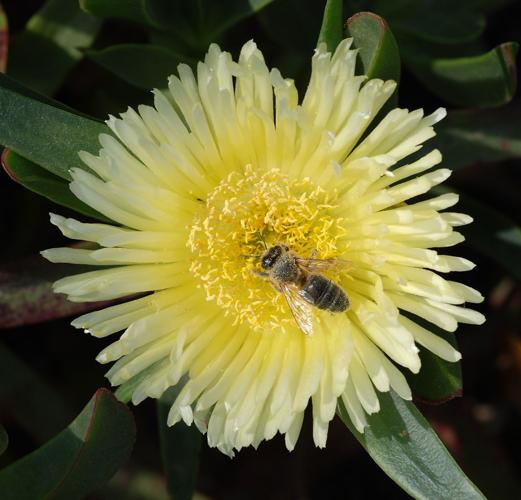
Q: How do you keep bees out of the hummingbird feeders effectively enough that the little hummers have a chance to feed? Despite their aggressive nature, it seems that our hummers don’t want to challenge the bees. What to do?
A: Bees are seeking nectar and water for the same reasons as the hummingbirds and they both prefer actual plant nectar to sugar water if they can get it. I recommend providing a variety of flowering plants for the bees to distract them from your feeders. Hummingbirds prefer flowers that are tubular in shape but bees can’t access the nectar in these because they lack the long tongues of hummingbirds. Bees would more likely be found on plants that have a wide-open bloom with a place for them to land and access the nectar and pollen up close. Sunflowers are an example of the shape they prefer.
Peter L. Warren is the urban horticulture agent for the Pima County Cooperative Extension and the University of Arizona. Questions and photos may be emailed to tucsongardensage@gmail.com.

- By Peter L. Warren Arizona Daily Star
- Updated
Q: I have two well-established lilac bushes that always did well with minimal care until about two years ago. I used to water them for 2 to 3 minutes every day, but stopped doing that at one point. When I realized that they were getting stressed I started watering them again — once a week for 20 to 30 minutes. That was a year ago. But they haven’t recovered. They’ve had mildew on the leaves for the last year or more. They grow well, but most of the leaves get mildew and wither up. Now I’m watering them every day for 2 to 3 minutes again. Am I overwatering now that it’s November? What can I do to help them recover at this point? The house is about 50 years old, we’ve been here 14 years, and so the lilacs could be quite old.
A: Non-native shrubs such as lilacs do best when watered infrequently and deeply. The recommended schedule is once every seven to 14 days in the summer to a depth of 24 to 36 inches. In the spring and fall you can reduce this to once every 10 to 21 days and in the winter every 14 to 21 days. Powdery mildew can be a problem in certain situations when the climate is suitable. Like any successful disease story, you need a susceptible host, the presence of the disease pathogen, and a suitable environment. If you were planting a new lilac I would encourage you to select a mildew resistant variety. To prevent an infestation, the first thing to do is remove any diseased leaves from the ground or on the plant. This will prevent the disease from overwintering nearby and spreading to new growth. Second, you can selectively prune your lilacs to provide space between the branches for air circulation and sunlight penetration. Dense areas will favor the infection. There are also fungicides you can use to spray the mildewed leaves. Choose a fungicide specifically labeled for mildew and spray according to instructions. Typically, they recommend beginning to spray when new leaves are emerging.
Peter L. Warren is the urban horticulture agent for the Pima County Cooperative Extension and the University of Arizona. Questions and photos may be emailed to tucsongardensage@gmail.com.
- By Peter L. Warren Arizona Daily Star
- Updated
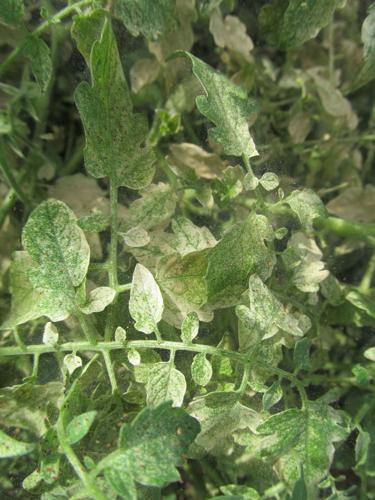
Q: My tomatoes show an unknown leaf disease that has slowly spread over 35 percent of all tomato plants. Based on my observations, it started approximately four weeks ago within the center of one plant and has slowly advanced. Also, there is a very fine spider like web covering some of the browned leaf areas. I am familiar with “leaf curl” problems, but this is a new one for me.
A: From the photos and your description, I suspect spider mites. The symptom that is most noticeable is the color change on the leaves as a result of their feeding. Their tiny mouthparts pierce the leaves and remove sap. Just one mite feeding wouldn’t be noticeable but after weeks of feeding by a number of them, the change in leaf color becomes more noticeable. The fine spider-like webbing is a sign as well. Spider mites, just like many of their spider relatives, produce webbing where they live. This is also something that may go unnoticed with a small number of mites but becomes apparent with a significant population. Identifying mites often requires a 10X magnifier and it’s good to make sure you have live ones before spending time and money treating for them. Sometimes we only see the damage after they moved on. Spider mites thrive in our arid climate and can be a problem on a variety of plants. They aren’t all bad though, since some mites are predatory and feed on the pest mites. When they become a problem there are a few tactics you can use to manage them. Sprays of water, horticultural oil, or insecticidal soap are usually effective in reducing their numbers. Mites often hang out on the underside of leaves so sprays should be directed to contact them there. Make sure your plants are properly irrigated because stressed-out plants are less tolerant of their feeding damage. Spider mites sometimes become a problem after spraying insecticides. The reason is that their natural predators are often victims of insecticides and the mites are less susceptible. That is why less toxic chemicals, such as oils and soaps, are recommended over stronger products to spare the predators.
Peter L. Warren is the urban horticulture agent for the Pima County Cooperative Extension and the University of Arizona. Questions and photos may be emailed to tucsongardensage@gmail.com.

- By Peter L. Warren Special to the Arizona Daily Star
- Updated
Q: We have several acacia trees that are about 12 years old. Our landscaper had described them as sweetgum acacia, but I am not sure if that is really what we have. They have grown up from an initial height of 5 feet to 15, but they are not looking healthy. Especially over the last five years, the leaves have gotten very sparse and they are often covered with small, white insects. Some of the branches have died and have no leaves at all. Our landscaper has repeatedly sprayed them with pesticide, but the white insects always return. These trees are irrigated with a drip system. Other neighbors all across Oro Valley seem to have the same problem . Also on our property we have other native acacias, which we did not plant and they are doing fine. They have the small orange-yellow colored balls and they have never been sprayed and they are not even irrigated. Should I just give up on these trees and replace them with mesquites, which seem to do fine here, or do you have other solutions for us?
A: It would be helpful to see the insects up close to be sure of the problem. Please let me know if you can bring a sample of infested leaves to my office or if I may stop by your trees and see them in person.
One likely possibility is that sweet acacias (Vachellia farnesiana) are occasionally infested with insects called whiteflies. They are very small white insects in their adult form. As immature insects they are wingless, darker in color and suck sap from the leaves, sometimes causing the tree to drop leaves prematurely. Repeated infestations can be hard on the tree, but in many cases the infestation is not severe and natural enemies reduce the population to tolerable levels. In recent years these whiteflies seem to be more common in the Tucson area, probably due to warmer weather.
Whiteflies in general have been a sporadic problem at our elevation, whereas in lower and warmer areas such as Pinal and Maricopa counties, they are a regular occurrence. I would be interested to know which insecticide your landscaper is using. There might be other options for pest management. I wouldn’t recommend giving up on your trees yet.
Peter L. Warren is the urban horticulture agent for the Pima County Cooperative Extension and the University of Arizona. Email questions and photos to tucsongardensage@gmail.com

- By Peter L. Warren Special to the Arizona Daily Star
- Updated
Q: Please tell me when I can transplant two small agaves that I raised from the little ones off a large plant. I was thinking of doing it now that it has cooled off, but I thought it would be better to get your advice.
A: Agaves are easily propagated from the offsets, aka pups, or little ones as you called them. Now is a fine time to plant them. If you removed them from the parent plant by cutting the stolons (the underground branches by which they are attached), it’s a good idea to let them dry for a few days to form a callus on the cut end. Agaves do best in well-drained soil such as a mix sold for cacti and succulents. You can simply push them into the soil, although they might get a better start if you put them in a container in a shady area until they establish roots.
The root establishment can take up to four weeks. Once rooted, they will start growing and then you can apply a soluble fertilizer, but only once or twice per year. Watering should be done as often as the container dries out. It’s not great for them to stay wet all the time, so allow the soil to dry between watering. If you eventually transplant them into the ground, watering should be done less frequently. In the summer, water every 10 to 14 days unless there was rain. In the spring and fall, every three to four weeks and none in the winter.
Peter L. Warren is the urban horticulture agent for the Pima County Cooperative Extension and the University of Arizona. Email questions and photos to tucsongardensage@gmail.com
- By Peter L. Warren Special to the Arizona Daily Star
- Updated
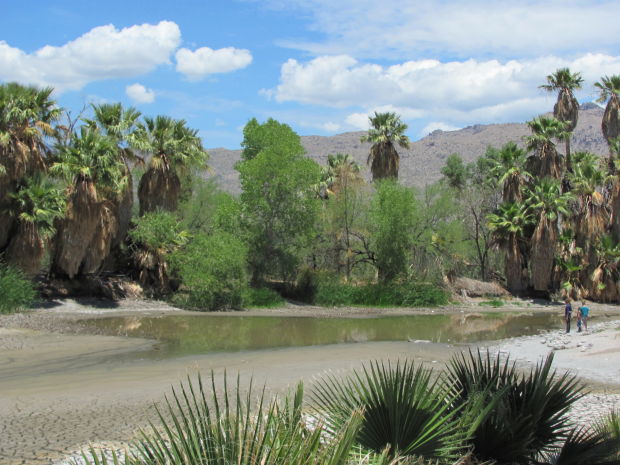
Q: I just moved to Arizona from Wisconsin. Is there any indication when the drought might end or is this long-term condition due to climate change? And if it doesn’t improve, what will be the impact for places like Tucson?
A: The drought we are experiencing has reportedly been going on for more than 20 years with no end in sight. Climate scientists predict it will likely get worse. The big challenge in the Southwest has always been a shortage of water. Even the earliest explorers thought the region was not a great place to build towns and cities, but we humans are sometimes determined to find a way. There are many articles and books on this subject, so there is no shortage of information if you’re interested in learning more.
“Cadillac Desert” by Marc Reisner is one of the classic books on this topic. Something more current would be the CLIMAS website at the University of Arizona, climas.arizona.edu, that assesses climate in the Southwest and includes research findings, blogs, and podcasts on many aspects of climate.
Peter L. Warren is the urban horticulture agent for the Pima County Cooperative Extension and the University of Arizona. Email questions to tucsongardensage@gmail.com
- By Peter L. Warren Special to the Arizona Daily Star
- Updated
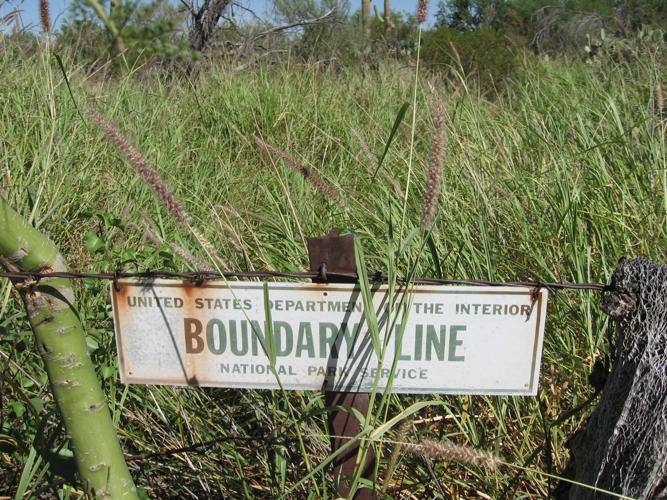
Q: Grasses? They are awful. What’s wrong with these landscape architects and their lack of concern for the desert and their poor plant material choices and layouts?
A: There are some native grasses that are fine for the desert and our landscapes. Extensive research has been and continues to be done to determine the best plants for our region. We even have a research operation in Tucson. It is called the United States Department of Agriculture Natural Resources Conservation Service Tucson Plant Materials Center.
You can schedule a tour if you are interested to learn more about grasses that are appropriate for our region. Google AZPMC if you want to learn more .
There are, however, other species that are invasive and should not be planted here. In some cases, these problems are self-inflicted because humans failed to see the downside to species that were once thought to be a great solution to erosion or nutrition for livestock . I like to think that nowadays we are much more careful about planting grasses that can reseed and become invasive.
Unfortunately, this only works if we are aware of the potential problems. Some grass species that are marketed as sterile are not 100 percent so and unfortunately they are popular landscape plants. I wouldn’t blame the landscape architects for all these troubles. Many of them are schooled in proper plant selection through their degrees and their experience. Part of the blame can be spread to consumers who buy the plants and nurseries that sell them.
In the end, it is something we all need to educate ourselves about when considering which plants to use no matter where we live.
Peter L. Warren is the urban horticulture agent for the Pima County Cooperative Extension and the University of Arizona. Questions and photos may be emailed to tucsongardensage@gmail.com.
- By Peter L. Warren Special to the Arizona Daily Star
Q: Is it necessary to cut back our red bird-of-paradise bushes in the late winter (here in Sierra Vista)? Some folks in town don’t and their red birds seem to bloom OK. Is it also necessary to cut back (or really, cut down) our Tecoma stans-orange jubilee each winter?
A: There are three species of bird of paradise (Caesalpinia) grown in the Southwest, red (C. pulcherrima), yellow (C. gilliesii), and Mexican (C. mexicana). In general, the pruning of bird of paradise shrubberies is necessary only to remove frost-damaged limbs or to remove dead, crossing or damaged branches. More pruning will be needed if you are growing the Mexican bird of paradise and plan it to be developed and maintained as a small tree. Once blooming is finished, the flower stalks may be removed to prevent seedpods from forming and to reduce the likelihood of volunteer seedlings. If the pods are left on the plant to dry and split, the seeds can be thrown a surprising distance. The red bird of paradise dies back to the ground at temperatures below freezing. It generally regrows in spring from the ground and can be pruned to a few inches above the ground in late winter. Mulching the base of plants in colder areas may protect the crown until spring. For Tecoma stans, it is not necessary to cut way back or cut them down each winter. Generally, you should prune dead wood in early spring and otherwise just do light selective thinning as needed to maintain the size. Hard pruning Tecoma stans-orange jubilee back to 12-inch canes is sometimes done to reduce the size and to maintain its upright shape. Hard pruning is stressful for the plants so if you choose that method you might do it every third year.
Peter L. Warren is the urban horticulture agent for the Pima County Cooperative Extension and the University of Arizona. Questions and photos may be emailed to tucsongardensage@gmail.com
- By Peter L. Warren Special to the Arizona Daily Star
Q: This question is a shot in the dark concerning a bushy plant we saw in Alton, Illinois, this past September. The cluster berries are striking in their vibrant color. No one we spoke with including park personnel knew what the plant was called. It was in a landscaped area, and planted in a manner that would suggest a landscape architect was involved. Any guess?
A: The plant is American beautyberry (Callicarpa americana). It is native to the southeastern U.S. from Texas to Virginia and is easily grown in that area. I had it growing in my front yard in Virginia and it really tied the landscape together. It has also been found in the Caribbean and northern Mexico as it adapts to a wide range of soil pH. It is a striking plant and there is a variety called “lactea” with white berries that is sold by nurseries although it can’t compare to the purple in my opinion.
Peter L. Warren is the urban horticulture agent for the Pima County Cooperative Extension and the University of Arizona. Questions and photos may be emailed to tucsongardensage@gmail.com
- By Peter L. Warren Special to the Arizona Daily Star
Q: The last couple of years, the fruit on my pom tree gets brown spots, and it is rotten inside. Any ideas?
A: Yes, it’s likely that insects are feeding on your pomegranate fruit and the feeding allows entry for a fungus that subsequently rots the fruit. The most likely suspect is the leaf-footed bug (Leptoglossus species). There are three species in the Southwest. These insects are common in our area and may be found feeding on a variety of plants including citrus, pecans and pomegranates. As adults, these insects are difficult to manage because they can fly, they can sense predators and they are quick to run around the other side of the plant or fly away. The best time to remove them is when they are in the egg stage, laid in a strand — end to end on the underside of leaves. There are insecticides available and effective against newly hatched nymphs. Either of these requires monitoring your pomegranate tree on at least a weekly basis with the goal of detecting them before they mature to the adult stage. If you only have one tree and you are looking closely for them anyway, you might be able to just remove them by hand or sweep them into a bucket of soapy water.
Peter L. Warren is the urban horticulture agent for the Pima County Cooperative Extension and the University of Arizona. Questions and photos may be emailed to tucsongardensage@gmail.com
- By Peter L. Warren Special to the Arizona Daily Star
Q: We have tiny black gnat-like bugs flying around the house. They seem to live in the dirt of my plants and though they don’t bite, they annoy us endlessly. I put the plants outside to see if the change in temperature would encourage them to fly away but to no avail. They seem to end up even in rooms with no plants. We read somewhere to put dishes of soapy water out and we do catch a few this way, but I’d rather find a permanent way to rid myself of the annoying pests.
A: Your gnats are living on fungi in the soil of your plants. For this reason, we often call them fungus gnats. Unfortunately, the photo you sent wasn’t close enough to help identify which species. Fortunately, these are common insects in houseplants so we have a good understanding of their life cycle and some general methods for managing them. As you noticed, they don’t bite; in fact the adults don’t even feed. The adults are only alive for a week or so and their mission is to mate and lay eggs in the soil. They may fly to other rooms nearby seeking places to lay eggs. The larvae feed on decaying plant matter and fungi in the soil and complete their development in three to four weeks. The first step in managing them is to let the top 1 or 2 inches of soil dry out completely between watering. This step alone might be enough to solve your problem. If the population persists for a month after you change watering practices, you might need to use an insecticide. There are a few available including Bacillus thuringiensis israelensis (Bti), pyrethroid-based insecticides and parasitic nematodes. Some of these are not easy to find in stores so you might need to order them online.
Peter L. Warren is the urban horticulture agent for the Pima County Cooperative Extension and the University of Arizona. Questions and photos may be emailed to tucsongardensage@gmail.com
- By Peter L. Warren Special to the Arizona Daily Star
Q: I have heard from a number of people that mistletoe does not kill a tree. That might be true, but it weakens the tree so much that anything that comes along after the infestation of mistletoe will kill the tree—like our drought. I think people want to hear that it doesn’t kill the tree so they don’t have to act on ridding the tree of it. Or maybe people don’t care that much about their trees. Even the Rillito River Path trees have a lot of it in them, and the city pays to plant and water the trees.
A: There are many species of mistletoe and they are parasitic plants. In general, the species we are familiar with in the low elevations of the Sonoran Desert attach to their host plant to absorb water and nutrients. The healthier the host plant, the healthier the parasitic mistletoe that depends on it. If the host plant is suffering from other problems, such as drought, the mistletoe can take enough water and nutrients to weaken the host and that can lead to the death of the host. A common species in our area is called mesquite mistletoe (Phoradendron californicum). This is a native plant that has a place in our desert ecology in that it provides food and shelter for some animals. The birds that eat the seeds will spread mistletoe by pooping them out in other trees along with a dollop of their own brand of fertilizer. It would be impossible to eradicate mistletoe from our environment because it of the way it is spread by birds. It would also be hard to generalize about the relationship between people and mistletoe. I am fairly certain there are a few different reasons why mistletoe is allowed to thrive on landscape trees. Depending on the person, these may include the knowledge that it is food for birds, that it’s not always easy or affordable to cut it out of every tree, and that there is an endless supply of this plant in the open desert from which it can spread. I am familiar with the city’s lack of resources and I expect they are doing the best they can with limited staff and funds to manage trees and other plants on public property.
Peter L. Warren is the urban horticulture agent for the Pima County Cooperative Extension and the University of Arizona. Questions may be emailed to tucsongardensage@gmail.com
- By Peter L. Warren Special to the Arizona Daily Star
Q: How can I get rid of the squirrels that are destroying my backyard? They have three huge (apparently connecting) holes around the large palo verde tree. They keep the gravel all messed up with their digging. Of course, my cat (who is an indoor cat) loves watching them from the door. The chipmunks have many holes around a large cholla on the bank outside the front wall, so I assume that is where they are coming from.
A: Round-tailed ground squirrels are not likely something you can eradicate. As you noticed, they can migrate from outside a wall by digging or climbing if it’s not made of slippery material. The best strategy is an integrated approach that includes systematic destruction of their habitat, trapping to reduce the population, and protecting the plants you like best with some sort of fencing. Since they are fairly small, using hardware cloth with smaller holes that can be buried a few inches into the soil may help. Since they climb, this means you also have to protect from that likelihood with either a cover or lining your barrier with flashing or some other material on which they cannot get traction. You can contain them but you can’t stop them.
Peter L. Warren is the urban horticulture agent for the Pima County Cooperative Extension and the University of Arizona. Questions may be emailed to tucsongardensage@gmail.com
- By Peter L. Warren Special to the Arizona Daily Star
Q: My father has a tangelo tree that will sometimes have a second bloom in the summer. This year on one of the branches there are two grapefruit! Usually I would think if there is another fruit it would come from a branch that sprouted from below the graft but this did not. He picked and cut one open and the flesh was a very light orange and tasted like a bland tangelo.
A: The tangelo is a hybrid citrus created by crossing a tangerine with a pomelo or grapefruit. Occasionally hybrids or part of them revert back to one of the original parents by producing plant parts such as foliage, flowers, or fruit that more resemble the parent plants. These growths are sometimes referred to as a ‘sport.’ So the odd fruit is likely a sport but probably something other than a pure grapefruit. Hopefully, they taste good. If not, you can prune that branch out of the tree or just let it be.
Peter L. Warren is the urban horticulture agent for the Pima County Cooperative Extension and the University of Arizona. Questions may be emailed to tucsongardensage@gmail.com
- By Peter L. Warren Special to the Arizona Daily Star
Q: I have a mature Valencia orange tree that has yellowing leaves and dead end tip branches. It also has some dried yellow fruit. The tree is watered three times a week for 45 minutes each time with three bubbler type irrigation system heads at the tree drip line. Any thoughts on what may be the problem?
A: Although yellowing leaves can also indicate a lack of nitrogen, the dead end branches and your current irrigation schedule tells me the tree needs more water. If you are fertilizing three times per year as recommended in late winter, spring, and fall, the other important input is water. While your placement of bubblers is appropriate, the scheduled watering is not ideal. Citrus trees do best with deeper watering on a less frequent basis. During the summer, every 7 to 10 days to a depth of 36 inches is recommended. In the spring and fall you can back that off to every 10 to 14 days and in the winter to every 14 to 21 days.
Peter L. Warren is the urban horticulture agent for the Pima County Cooperative Extension and the University of Arizona. Questions and photos may be emailed to tucsongardensage@gmail.com.
- By Peter L. Warren Special to the Arizona Daily Star
Q: We planted this Satsuma Mandarin Orange two years ago, and last spring it had good foliage and produced two or three small fruit. But now, it appears to lose leaves on lower branches, put out new leaves on upper branches, but has not gained any new branches or height. It is on a drip system. I don’t see evidence of anything chewing on it. Any suggestions on how to help out thrive?
A: This is typical for newly planted trees. The stress of transplanting sometimes causes some leaf drop and/or fruit and flower drop. Assuming you are watering and fertilizing properly, I expect you will see new growth in the coming year. Trees typically take between two and three years to get established in their new surroundings before they show a lot of growth. This is mainly due to the large amount of root damage they incur during transplanting.
Peter L. Warren is the urban horticulture agent for the Pima County Cooperative Extension and the University of Arizona. Questions and photos may be emailed to tucsongardensage@gmail.com.
- By Peter L. Warren Special to the Arizona Daily Star
Q: What is wrong with this saguaro cactus?
A: The brown and black areas show signs of bacterial necrosis. This is a common affliction of cacti in the desert and unfortunately once it gets into the main stem and spreads that wide there is nothing you can do to fix the problem. Eventually the cactus will succumb and fall over. It would be wise to plan for that eventuality and make sure there aren’t any potential hazards such as the chance people or property could be damaged if it fell unannounced. Contracting with an experienced landscaper or certified tree professional to take it down would be appropriate if any hazards are present.
Peter L. Warren is the urban horticulture agent for the Pima County Cooperative Extension and the University of Arizona. Questions and photos may be emailed to tucsongardensage@gmail.com.
- By Peter L. Warren Special to the Arizona Daily Star
Q: Can you tell me what is going on with this sage bush? I took a sample to the nursery and was told it is new growth. The bush has been this way for a couple of years and stays on the same side of the bush. Is this a problem or just new growth?
A: New growth is correct in so far as it’s newer than the shrub you planted. Unlike normal new growth, it won’t take on the appearance of old growth after a period of time. It appears that your Texas ranger has reverted back to it’s original form, at least in part.
Many of the interesting cultivars we see in landscapes originate from some mutation with desirable characteristics from the original parent plant. These interesting mutations can be propagated into new cultivars and then introduced into the horticulture trade. Unfortunately, not all of these cultivars are stable and they sometimes revert back to the original plant. The original is likely more vigorous than the designer cultivar and could take over the space by outgrowing the shrub you planted. So if you like the one you planted more than the new original version, you can prune out the offending parts. As long as we’re discussing them, these plants are commonly called sages but are actually not related to the true sages in the Salvia genus. Rather they are in the figwort family, Scrophulariaceae.
Peter L. Warren is the urban horticulture agent for the Pima County Cooperative Extension and the University of Arizona. Questions and photos may be emailed to tucsongardensage@gmail.com.
- By Peter L. Warren Special to the Arizona Daily Star
Q: I seem to recall that you have recently given advise on how to trim bushes to keep them looking full instead of like “horses tails”. If I’m mistaken about the article, I would appreciate any advise you have regarding the trimming.
A: There are a couple ways to trim bushes. Partly this depends on the function of the plant. Some shrubs are pruned to hedge shapes and others are designed to stand alone or in groups. The healthiest method for pruning is called selective pruning. This method involves selecting branches to prune that thin out the plant to allow for air, water, and sunlight to reach the inner parts while still maintaining the size of the plant. We typically want to remove any dead, damaged, and crossing branches to keep the plant in good health and good appearance. Good pruning cuts are also important to the health of the plant. This means using a sharp tool and cutting close to connecting branches. There is a publication that explains this in greater detail. Google AZ1499-2016.pdf to find this publication on the Internet.
Peter L. Warren is the urban horticulture agent for the Pima County Cooperative Extension and the University of Arizona. Email questions and photos to tucsongardensage@gmail.com
- By Peter L. Warren Special to the Arizona Daily Star
Q: A barrel cactus turned brown and imploded. The center caved in and became an orange slime. I found these white larvae inside about an inch in length. What can I do to prevent this from happening to my other barrel cacti?
A: The larvae are maggots, aka fly larvae. These insects are decomposers and attracted to the rotting plant rather than being the cause of the problem. The rot may have been caused by a wound that allowed a bacteria or fungi to invade. Overwatering is another potential cause. If you can describe your watering schedule, we might be able to rule that in or out. Typically, cacti should receive water every 10 to 14 days to a depth of 12 to 18 inches during the summer, every 21 to 28 days during the spring and fall, and none during the winter. Preventing this damage from happening to your other plants is not always possible because other animals may damage your cacti. What you can do is to care for them properly, which you may already be doing, and hope for the best.
Peter L. Warren is the urban horticulture agent for the Pima County Cooperative Extension and the University of Arizona. Questions and photos may be emailed to tucsongardensage@gmail.com
- By Peter L. Warren Special to the Arizona Daily Star
Q: Some of the leaves on my fig tree are turning yellow and rusty looking. Overall, the tree looks healthy and is producing fruit. I don’t see any bugs or caterpillars on the tree but I’m concerned that it might have problems. Is this normal or should I be treating the tree with something?
A: Your fig is showing signs of nutrient deficiency and drought stress. Application of a nitrogen fertilizer along with some irrigation should fix this problem. For an average tree, about a half pound of nitrogen is appropriate. This can be split in three applications over the year, spring, summer, and fall. Make sure you water after applying so the fertilizer reaches the absorbing roots.
Peter L. Warren is the urban horticulture agent for the Pima County Cooperative Extension and the University of Arizona. Questions and photos may be emailed to tucsongardensage@gmail.com
- By Peter L. Warren Special to the Arizona Daily Star
Q: I’ve attached a photo (above) of one of several insect mud homes that are in my hot water heater closet (external door is to outdoors). Is it mud dauber? Any reason to be alarmed?
A: Yes, this is a home for mud dauber wasps, aka mud dobber, dirt dauber, dirt digger, etc. No reason to be alarmed unless you spend a lot of time going in that closet. They are relatively docile insects and would only be hazardous if they felt their home was threatened. Some people regard them as beneficial insects in that they are predators of spiders.
Peter L. Warren is the urban horticulture agent for the Pima County Cooperative Extension and the University of Arizona. Questions and photos may be emailed to tucsongardensage@gmail.com
- By Peter L. Warren Special to the Arizona Daily Star
Q: I am desperately hoping you can help me. A mother moth laid eggs on my window screen in early November. As of today, surprise, some of them hatched. Tonight is supposed to be freezing and I did not feel comfortable leaving the poor hatchlings on the window screen. Well, now I have these creatures I barely know anything about. I don’t know what to feed them because I did not find them on a plant. What do I feed them? Are they better off on their own? I have them in a small Pyrex container with a stocking stretched over as the lid. I did thinly slice a lantana leaf and put it in there with them, but they are so new I am afraid that they can’t eat the leaf.
A: If you can send a photo of the caterpillars, I will see if I recognize them. Since insects have specific diets, it is important to identify them if you want to feed them. If you have any plants nearby, that might help us narrow down which moth laid the eggs. Some insects overwinter in the egg stage but if they hatched in this weather that is a horse of a different color. This generation might have been destined to freeze to death. It’s very possible that these moths had one or more generations in 2016 and this one just had bad timing.
Peter L. Warren is the urban horticulture agent for the Pima County Cooperative Extension and the University of Arizona. Questions and photos may be emailed to tucsongardensage@gmail.com
- By Peter L. Warren Arizona Daily Star
Q: How do you keep bees out of the hummingbird feeders effectively enough that the little hummers have a chance to feed? Despite their aggressive nature, it seems that our hummers don’t want to challenge the bees. What to do?
A: Bees are seeking nectar and water for the same reasons as the hummingbirds and they both prefer actual plant nectar to sugar water if they can get it. I recommend providing a variety of flowering plants for the bees to distract them from your feeders. Hummingbirds prefer flowers that are tubular in shape but bees can’t access the nectar in these because they lack the long tongues of hummingbirds. Bees would more likely be found on plants that have a wide-open bloom with a place for them to land and access the nectar and pollen up close. Sunflowers are an example of the shape they prefer.
Peter L. Warren is the urban horticulture agent for the Pima County Cooperative Extension and the University of Arizona. Questions and photos may be emailed to tucsongardensage@gmail.com.
- By Peter L. Warren Arizona Daily Star
Q: I have two well-established lilac bushes that always did well with minimal care until about two years ago. I used to water them for 2 to 3 minutes every day, but stopped doing that at one point. When I realized that they were getting stressed I started watering them again — once a week for 20 to 30 minutes. That was a year ago. But they haven’t recovered. They’ve had mildew on the leaves for the last year or more. They grow well, but most of the leaves get mildew and wither up. Now I’m watering them every day for 2 to 3 minutes again. Am I overwatering now that it’s November? What can I do to help them recover at this point? The house is about 50 years old, we’ve been here 14 years, and so the lilacs could be quite old.
A: Non-native shrubs such as lilacs do best when watered infrequently and deeply. The recommended schedule is once every seven to 14 days in the summer to a depth of 24 to 36 inches. In the spring and fall you can reduce this to once every 10 to 21 days and in the winter every 14 to 21 days. Powdery mildew can be a problem in certain situations when the climate is suitable. Like any successful disease story, you need a susceptible host, the presence of the disease pathogen, and a suitable environment. If you were planting a new lilac I would encourage you to select a mildew resistant variety. To prevent an infestation, the first thing to do is remove any diseased leaves from the ground or on the plant. This will prevent the disease from overwintering nearby and spreading to new growth. Second, you can selectively prune your lilacs to provide space between the branches for air circulation and sunlight penetration. Dense areas will favor the infection. There are also fungicides you can use to spray the mildewed leaves. Choose a fungicide specifically labeled for mildew and spray according to instructions. Typically, they recommend beginning to spray when new leaves are emerging.
Peter L. Warren is the urban horticulture agent for the Pima County Cooperative Extension and the University of Arizona. Questions and photos may be emailed to tucsongardensage@gmail.com.
- By Peter L. Warren Arizona Daily Star
Q: My tomatoes show an unknown leaf disease that has slowly spread over 35 percent of all tomato plants. Based on my observations, it started approximately four weeks ago within the center of one plant and has slowly advanced. Also, there is a very fine spider like web covering some of the browned leaf areas. I am familiar with “leaf curl” problems, but this is a new one for me.
A: From the photos and your description, I suspect spider mites. The symptom that is most noticeable is the color change on the leaves as a result of their feeding. Their tiny mouthparts pierce the leaves and remove sap. Just one mite feeding wouldn’t be noticeable but after weeks of feeding by a number of them, the change in leaf color becomes more noticeable. The fine spider-like webbing is a sign as well. Spider mites, just like many of their spider relatives, produce webbing where they live. This is also something that may go unnoticed with a small number of mites but becomes apparent with a significant population. Identifying mites often requires a 10X magnifier and it’s good to make sure you have live ones before spending time and money treating for them. Sometimes we only see the damage after they moved on. Spider mites thrive in our arid climate and can be a problem on a variety of plants. They aren’t all bad though, since some mites are predatory and feed on the pest mites. When they become a problem there are a few tactics you can use to manage them. Sprays of water, horticultural oil, or insecticidal soap are usually effective in reducing their numbers. Mites often hang out on the underside of leaves so sprays should be directed to contact them there. Make sure your plants are properly irrigated because stressed-out plants are less tolerant of their feeding damage. Spider mites sometimes become a problem after spraying insecticides. The reason is that their natural predators are often victims of insecticides and the mites are less susceptible. That is why less toxic chemicals, such as oils and soaps, are recommended over stronger products to spare the predators.
Peter L. Warren is the urban horticulture agent for the Pima County Cooperative Extension and the University of Arizona. Questions and photos may be emailed to tucsongardensage@gmail.com.
- By Peter L. Warren Special to the Arizona Daily Star
Q: We have several acacia trees that are about 12 years old. Our landscaper had described them as sweetgum acacia, but I am not sure if that is really what we have. They have grown up from an initial height of 5 feet to 15, but they are not looking healthy. Especially over the last five years, the leaves have gotten very sparse and they are often covered with small, white insects. Some of the branches have died and have no leaves at all. Our landscaper has repeatedly sprayed them with pesticide, but the white insects always return. These trees are irrigated with a drip system. Other neighbors all across Oro Valley seem to have the same problem . Also on our property we have other native acacias, which we did not plant and they are doing fine. They have the small orange-yellow colored balls and they have never been sprayed and they are not even irrigated. Should I just give up on these trees and replace them with mesquites, which seem to do fine here, or do you have other solutions for us?
A: It would be helpful to see the insects up close to be sure of the problem. Please let me know if you can bring a sample of infested leaves to my office or if I may stop by your trees and see them in person.
One likely possibility is that sweet acacias (Vachellia farnesiana) are occasionally infested with insects called whiteflies. They are very small white insects in their adult form. As immature insects they are wingless, darker in color and suck sap from the leaves, sometimes causing the tree to drop leaves prematurely. Repeated infestations can be hard on the tree, but in many cases the infestation is not severe and natural enemies reduce the population to tolerable levels. In recent years these whiteflies seem to be more common in the Tucson area, probably due to warmer weather.
Whiteflies in general have been a sporadic problem at our elevation, whereas in lower and warmer areas such as Pinal and Maricopa counties, they are a regular occurrence. I would be interested to know which insecticide your landscaper is using. There might be other options for pest management. I wouldn’t recommend giving up on your trees yet.
Peter L. Warren is the urban horticulture agent for the Pima County Cooperative Extension and the University of Arizona. Email questions and photos to tucsongardensage@gmail.com
- By Peter L. Warren Special to the Arizona Daily Star
Q: Please tell me when I can transplant two small agaves that I raised from the little ones off a large plant. I was thinking of doing it now that it has cooled off, but I thought it would be better to get your advice.
A: Agaves are easily propagated from the offsets, aka pups, or little ones as you called them. Now is a fine time to plant them. If you removed them from the parent plant by cutting the stolons (the underground branches by which they are attached), it’s a good idea to let them dry for a few days to form a callus on the cut end. Agaves do best in well-drained soil such as a mix sold for cacti and succulents. You can simply push them into the soil, although they might get a better start if you put them in a container in a shady area until they establish roots.
The root establishment can take up to four weeks. Once rooted, they will start growing and then you can apply a soluble fertilizer, but only once or twice per year. Watering should be done as often as the container dries out. It’s not great for them to stay wet all the time, so allow the soil to dry between watering. If you eventually transplant them into the ground, watering should be done less frequently. In the summer, water every 10 to 14 days unless there was rain. In the spring and fall, every three to four weeks and none in the winter.
Peter L. Warren is the urban horticulture agent for the Pima County Cooperative Extension and the University of Arizona. Email questions and photos to tucsongardensage@gmail.com
- By Peter L. Warren Special to the Arizona Daily Star
Q: I just moved to Arizona from Wisconsin. Is there any indication when the drought might end or is this long-term condition due to climate change? And if it doesn’t improve, what will be the impact for places like Tucson?
A: The drought we are experiencing has reportedly been going on for more than 20 years with no end in sight. Climate scientists predict it will likely get worse. The big challenge in the Southwest has always been a shortage of water. Even the earliest explorers thought the region was not a great place to build towns and cities, but we humans are sometimes determined to find a way. There are many articles and books on this subject, so there is no shortage of information if you’re interested in learning more.
“Cadillac Desert” by Marc Reisner is one of the classic books on this topic. Something more current would be the CLIMAS website at the University of Arizona, climas.arizona.edu, that assesses climate in the Southwest and includes research findings, blogs, and podcasts on many aspects of climate.
Peter L. Warren is the urban horticulture agent for the Pima County Cooperative Extension and the University of Arizona. Email questions to tucsongardensage@gmail.com
- By Peter L. Warren Special to the Arizona Daily Star
Q: Grasses? They are awful. What’s wrong with these landscape architects and their lack of concern for the desert and their poor plant material choices and layouts?
A: There are some native grasses that are fine for the desert and our landscapes. Extensive research has been and continues to be done to determine the best plants for our region. We even have a research operation in Tucson. It is called the United States Department of Agriculture Natural Resources Conservation Service Tucson Plant Materials Center.
You can schedule a tour if you are interested to learn more about grasses that are appropriate for our region. Google AZPMC if you want to learn more .
There are, however, other species that are invasive and should not be planted here. In some cases, these problems are self-inflicted because humans failed to see the downside to species that were once thought to be a great solution to erosion or nutrition for livestock . I like to think that nowadays we are much more careful about planting grasses that can reseed and become invasive.
Unfortunately, this only works if we are aware of the potential problems. Some grass species that are marketed as sterile are not 100 percent so and unfortunately they are popular landscape plants. I wouldn’t blame the landscape architects for all these troubles. Many of them are schooled in proper plant selection through their degrees and their experience. Part of the blame can be spread to consumers who buy the plants and nurseries that sell them.
In the end, it is something we all need to educate ourselves about when considering which plants to use no matter where we live.
Peter L. Warren is the urban horticulture agent for the Pima County Cooperative Extension and the University of Arizona. Questions and photos may be emailed to tucsongardensage@gmail.com.
Tags


View this profile on Instagram#ThisIsTucson 🌵 (@this_is_tucson) • Instagram photos and videos
Most viewed stories
-
Over 40 exciting events to check out this weekend! 🌱
-
New Eats! 20 new restaurants that opened up in Tucson this winter 🍽️
-
OaxaRico opened their first brick-and-mortar, serving up delicious mole and gorditas
-
A Jets fan and a Bills fan walk into a bar: My tasty journey at Anchor Bar
-
The #ThisIsTucson Snail Mail Club is here! Here's how you can get a little piece of Tucson in your mailbox 💗
-
$25 challenge kicks off at Tucson’s Pop Cycle
-
Nearly 90 fun events happening in March! 🌺