




“Deadly Peril” By Bonnie Edwards. Deadly Press. $12.95. Kindle $2.99
Life is rarely dull for Tucson Police Department Det. Tec Hoffman and his law enforcement team — there are more than enough miscreants in the Old Pueblo to keep them on the go. This newest title in author Bonnie Edwards’ “Peril” series opens with a puzzling homicide near the University of Arizona that has left the heir of a pecan plantation dead. But before Tec can really wrap his arms around the case, he’s distracted by upheaval in his own life, in the form of a bitter ex-girlfriend with revenge on her mind, a hypodermic in her hand, and evil designs on Tec’s fiancée and his 10-year-old son. That adds up to two distinct plots, and Tec is the through line, so perhaps you can forgive him for not putting two and two together about his crazy ex-girlfriend a little more quickly than he does, despite what appears to be some compelling history between them. No matter. His hands are full after all, and she is entertainingly malevolent. Edwards, who makes her home in Tucson, embraces the Arizona setting and spices up the narrative with plenty of local landmarks. This is the sixth title in her “Peril” thriller series.
– Helene Woodhams

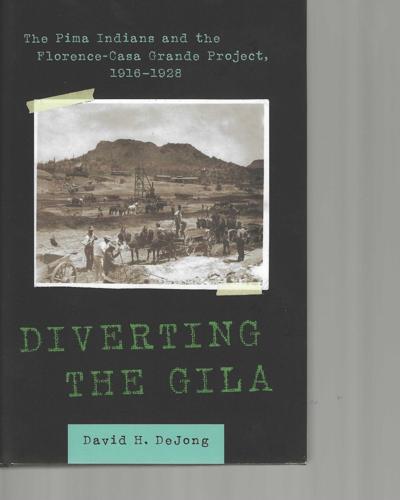
Diverting the Gila
“Diverting the Gila: The Pima Indians and the Florence-Casa Grande Project, 1916-1928” By David H. DeJong. University of Arizona Press. $50
“The wealth of the west was its water,” says author David DeJong, and the struggle for that wealth in Central Arizona is the subject of “Diverting the Gila.” DeJong, director of the Pima-Maricopa Irrigation Project, is an authority on federal Indian policy and regional water issues, and has written extensively about the Gila River. This volume is the sequel to “Stealing the Gila” (2009), his in-depth study on how, in the mid-19th century, the diversion of precious water by immigrant settlements upstream from Pima Indian tribal lands decimated the thriving, agriculturally-based economy of the Pima, reducing them to near starvation.
With “Diverting the Gila” DeJong returns to the struggle for critical water rights with a deeply researched and well-documented history of the Florence-Casa Grande Project (FCGP). The FCGP was originally presented as a means of benefitting the water-starved Pima by harnessing the floodwaters of the Gila and making them available to tribal farmers. Good intent, however, is rarely a match for big business and powerful self-interest, as DeJong ably demonstrates. Congressman Carl Hayden, who applied his political skill to the passage of the FCGP bill, had his eyes on a bigger prize than native water rights. Recognizing that his political fortunes rested not so much on the claims of indigenous farmers as they did on developing Arizona’s water resources and supporting the interests of non-native growers, he brokered a negotiation that left the Indians high and dry — literally — and with no say in the process. As enacted, the FCGP circumvented the intent of Congress to protect Pima water rights, benefitting instead non-native farmers in Pinal County.
With precise language, and copious references, DeJong describes how the shifting political and cultural climate impacted the government’s attitude toward native populations, and shows how racism functioned as a rationale for manipulating the legal process.
— Helene Woodhams

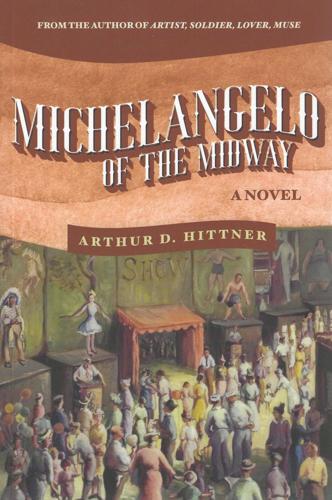
Michelangelo
of the Midway
“Michelangelo of the Midway” By Arthur D. Hittner. Apple Ridge Press. $14.95; $5.99 Kindle
It isn’t the smell of the greasepaint that attracts artist Burt Mason to the circus. With his promising career as a painter derailed by the Great Depression, Burt pragmatically opts to stave off starvation by becoming a manual laborer at the Swayze Family Circus in this historical novel of forgiveness, redemption, and love lost and found. It isn’t a bad move — he finds romance with an attractive equestrian and a niche drawing portraits on the midway. But he runs afoul of ne’er-do-well roustabout Wade Bennett, prompting the bullying drunk to revenge himself on the circus in general and on Burt in particular. Following the circus from town to town, Wade and his accomplice girlfriend pull off capers reminiscent of Bonnie and Clyde, and the result is a three-ring spectacle of mischief and mayhem. A retired attorney, Arthur Hittner is an aficionado of baseball and fine art, passions that are both evident in this novel. He is the author of five previous books and divides his time between Oro Valley and Natick, Massachusetts.
— Helene Woodhams

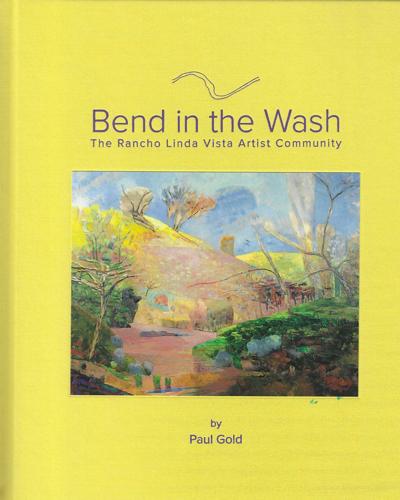
Bend in the Wash: The Rancho Linda Vista Artist Community
“Bend in the Wash: The Rancho Linda Vista Artist Community” By Paul Gold. Tubecat LLC. $95.
“The Visionary. The Historian. The Barn Master. Earth Mother”: Paul Gold frames this story of Oracle’s Rancho Linda Vista artist’s colony by featuring roles of a handful of its significant residents.
In 1968, inspired by the dream of University of Arizona art professor Charles Littler (“The Visionary”) to live in a community dedicated to creating art, a group of 10 families each pitched in $1,000, and bought former guest ranch Rancho Linda Vista. RLV continues as a viable artist’s community to this day.
The product of 15 years of research and interviews, “Bend in the Wash” is an in-depth, intimate portrait of the community. Gold gives historic and artistic overviews, but presents RLV through the intertwined work and lives of six participants: abstract painter and educator Littler; architectural designer Chuck Sternberg (“The Historian”); landscape watercolorist and lithographer Bruce McGrew; widely-exhibited painter and art professor James Davis; painter and print-artist (plus co-founder of Tucson’s The Drawing Studio) Andrew Rush; and sculptor and clay-artist Joy Fox McGrew.
Rich with voices and personal reminiscences, “Bend in the Wash” paints a picture of an often-messy, but ultimately successful experiment in artistic community: no property was owned individually — participants purchased shares in the ranch, and occupied the various buildings; all decisions were made by consensus. There was plenty of sex, drugs, and booze; marriages fell apart; the kids had free rein to raise themselves. And art was created.
Gold has packed the work with illustrations — period portraits and stunning photographs of artists’ work. “Bend in the Wash” is beautiful — art in its own right.
— Christine Wald-Hopkins

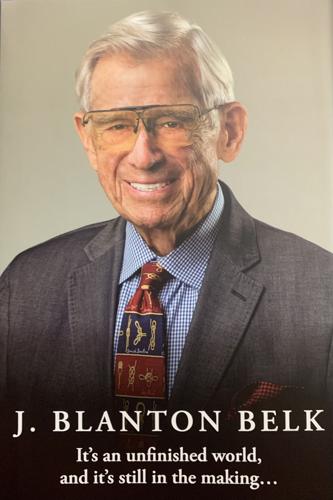
“J. Blanton Belk: It’s an unfinished world, and it’s still in the making…” By J. Blanton Belk. Pediment Publishing. $36 hardcover.
Well, it’s true; you can’t always tell a book by its cover. If you didn’t recognize his name (this reader did not), you could imagine the grinning, CEO-looking guy pictured on the dust jacket of this book would be just another business type. … Not the man with the vision that sending hundreds of smiling, dancing, singing young people out into the world might bring about international peace and unity. This memoir by Tucson nonagenarian J. Blanton Belk chronicles his life and career as CEO of Up With People.
A Southerner, the son of a Presbyterian minister and grandson of a plantation owner, Belk writes that he had an epiphany about his role in the segregated South in 1944, when he got leave from the Navy to attend his grandfather’s funeral. His grandfather had been an influential figure in his South Carolina county, and many folks turned out to honor him. They included 40 or 50 African-Americans. But “they could not come into the cemetery,” he realized, with a shock. That experience inspired Belk to become involved in the civil rights movement, the international Moral Re-Armament movement, and eventually to help found Up With People, designed as an alternative to 1960’s youthful angry voices and destructive behavior.
With African-American buddy Charles Howard, Belk would meet Martin Luther King and Jesse Owens. Later, as Up With People grew, Belk met U.S. presidents, two popes, an astronaut, European monarchs and heads of state, and scores of titans of industry. His memoir provides an interesting account of Up With People, its Tucson roots, and of his life.
— Christine Wald-Hopkins

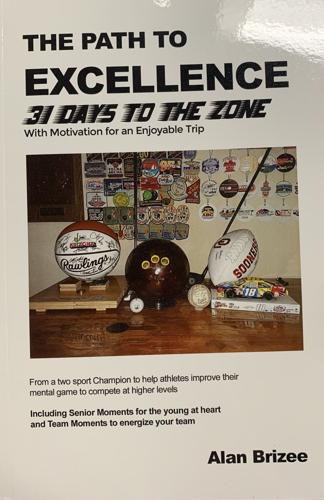
The Path to Excellence: 31 Days to the Zone
“The Path to Excellence: 31 Days to the Zone” By Alan Brizee. Dorrance Publishing Company. $14 paperback; $9 e-book.
Tucsonan Alan Brizee drew on decades of bowling and golf competition to write this workbook on improving athletes’ mental acuity — thus improving their competitive acuity — in a sequential, month-long regimen. Central to the book is the theory that excellence in competition depends on mental discipline. That discipline can be attained by proper preparation, the ability to adjust, practiced concentration, pre- and post-”shot” routines, and pre-match and post-match analyses. Brizee lays out each day with a concept, real-life experiences to support that concept, reader’s response to it, and plenty of motivational enthusiasm. His objective is to help reader-athletes learn to get into the “zone” and achieve excellence in whatever their sport.
— Christine Wald-Hopkins

