


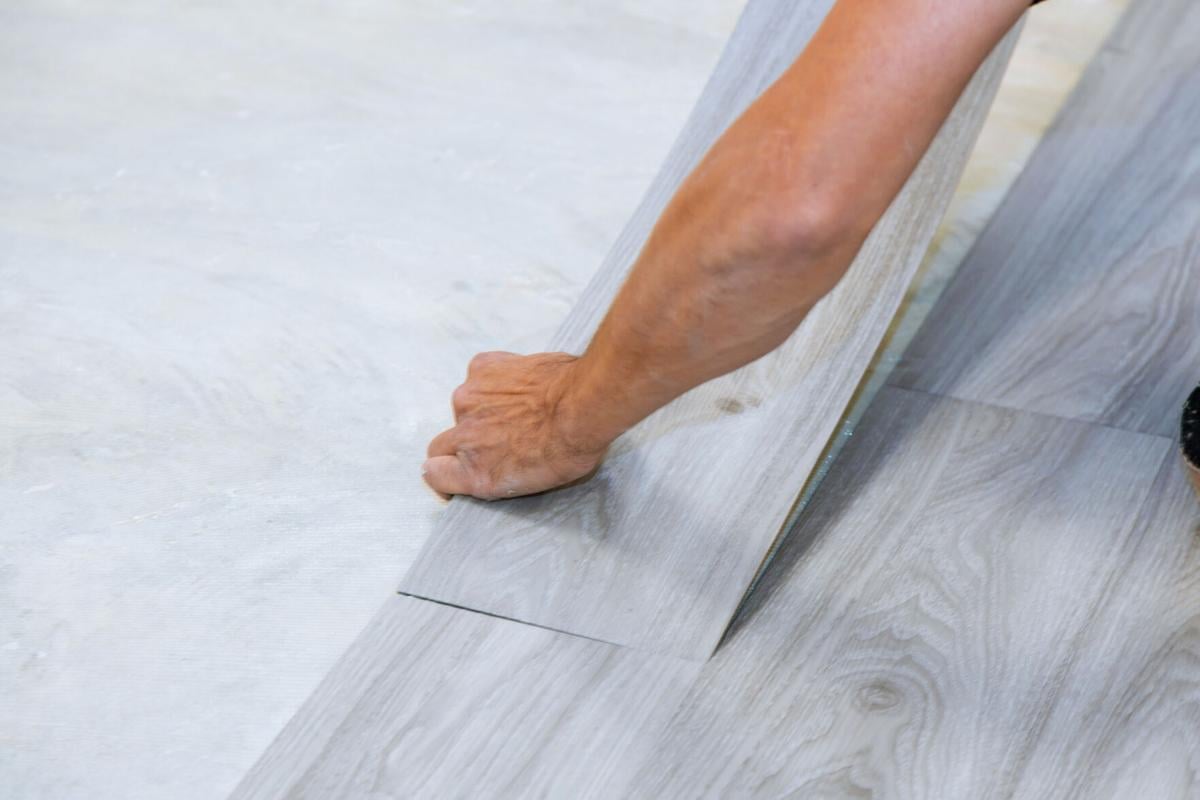
Question: Is vinyl plank flooring still popular?
Answer: According to our Rosie Certified partners, vinyl flooring is what homeowners want and that has been the case for the past 8 years. This type of flooring “floats” over the subfloor and underlayment.
Q: I heard that the vinyl flooring needs a moisture barrier. What is that and why do I need it?
A: Moisture barrier, also known as a floor vapor barrier, is typically a sheet of plastic that slows moisture from moving through a wall or subfloor. It is placed beneath the floor’s underlayment, especially in areas that are prone to moisture such as the bathroom and kitchen. When moisture penetrates flooring, it can cause mold, mildew, and the potential for water damage. The moisture barrier helps control the water vapor’s movement and protects the floor.
It is important to note that the moisture issues are not necessarily topical. It has to do with the minerals and moisture that penetrate up through the concrete slab. That is why the flooring needs to be placed on top of the barrier.
In addition, the manufacturers no longer allow caulking around the toilet or the baseboards. It can be pin nailed and a gap left, so it does not touch the floor. Toilets are fastened with bolts and the caulking is more of a finish look and really does not affect performance, so it is not an issue.
Some manufacturers, including Shaw Industries, do not warranty nor are responsible for damage to floor covering due to moisture-related issues.
Q: Do you have a recommendation for vinyl plank flooring?
A: The industry is evolving and there are many new and promising flooring products on the market.
At Rosie Right Remodeling they are installing a solid vinyl product by Shaw called COREtec. It is solid vinyl with as much as a 12 or 20 mil thickness wear surface. However, it is almost as expensive as wood flooring. Still, it is proving to be a very durable product.
Our Certified Partners also like RevWood, which is made by Mohawk. Mohawk has been making floors for more than 100 hundred years and this product is 100% made in the USA.
RevWood has a pressed core made of High-Density Fiberboard (HDF), a real wood core (made of fast-growing southern pine). Like laminate, it features a high-quality image layer (which makes it look like wood) and an extremely durable wear layer.
Its image layer is not just a high-resolution image—it’s embossed. It looks and feels like real wood and has the durability of laminate. It is extremely scratch-resistant and almost impossible to dent. Some versions even have a waterproof topcoat. They are also made in the USA and available in three versions.
RevWood is water-resistant, but not waterproof. Spills need to be wiped up as soon as possible. Because it’s not waterproof, it’s best to avoid installing it in a kitchen or bathroom.
RevWood Select is fade-resistant, scratch-resistant, and more water-resistant than RevWood. It comes with a 10-year warranty for the waterproof topcoat. The laminate layer uses the Mohawk Hydroseal technology to keep water out. It also uses a UniClic, a glue-free locking system that keeps water from seeping between the planks. The Select planks trap liquids on the surface, giving you time to catch spills.
RevWood Plus is fade-resistant, scratch-resistant, and ultra-waterproof. It’s safe to wet mop. It combines the Hydroseal layer and UniClic technology of the Select line with a unique beveled edge. Do not let any moisture get under the flooring so as not to void Mohawk’s waterproof warranty. This edging makes the flooring look like real hardwood and offers even more moisture protection.
If you install RevWood yourself, it is important to follow the manufacturer’s instructions to a T. Proper installation is paramount to getting the most out of its benefits and staying within the warranty.
Each of the RevWood systems has a different warranty. If you have pets, consider the RevWood Plus flooring.

