


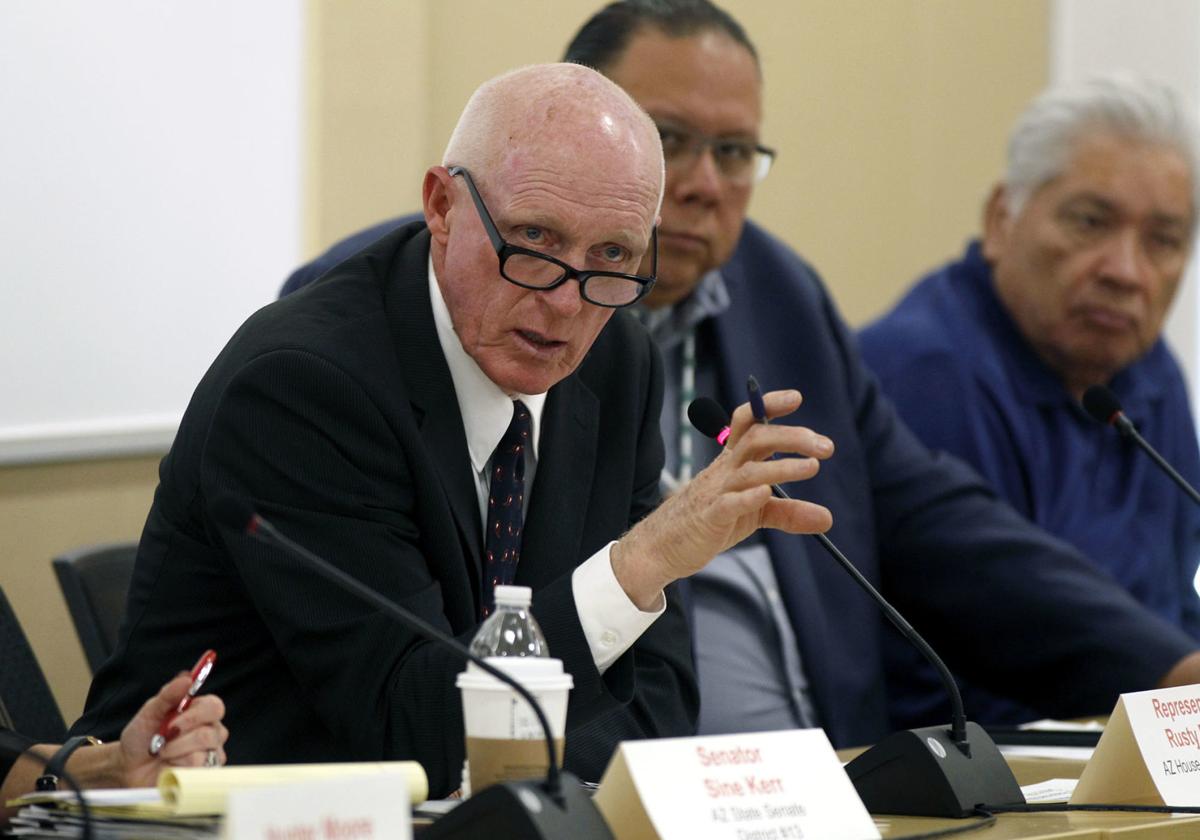
PHOENIX — House Speaker Rusty Bowers warned Tuesday he won’t be pressured by Gov. Doug Ducey into approving a drought contingency plan, which lawmakers have yet to see, by a Jan. 31 deadline.
Bowers told Capitol Media Services that the governor made a big show of announcing on Monday and again Tuesday the number of days that remain ahead of the deadline set by Brenda Burman, Reclamation Bureau commissioner, for Arizona to adopt its plan for dealing with the shortage of Lake Mead water.
But he said Ducey’s message isn’t directed to the public.
“It’s for me,” Bowers said. “But I don’t have what I need to give to my people.”
Bottom line, Bowers said, is if he does not get actual language of the agreement by Wednesday, “I’m adding a day.” And if there’s no language on Thursday, add another day to that. And so on, he said.
“I have an obligation, as the speaker of the House, to my membership and to our constituents,” the Mesa Republican said. “We are not going to act without knowing what we do.”
He said Ducey is “going along … with the demand for a showdown” with the feds.
It’s not just Bowers who is balking. Senate Minority Leader David Bradley, a Tucson Democrat, made it clear lawmakers won’t be stampeded into adopting something just to meet the Jan. 31 deadline.
“While the DCP (drought contingency plan) steering committee has spent months in delicate negotiations, the legislative language needs to be before our members and the stakeholders we represent as soon as possible to allow time for evaluation,” Bradley said.
“The Jan. 31st deadline is crystal clear,” he said. “But it should be equally clear that approval from the Legislature is not to be taken for granted.”
The warnings come as Pinal County farmers are demanding specific written assurances in any final plan that they will get the water they’re being promised. They also want money to drill new wells to make up for some of what they will lose in Colorado River water.
Rep. David Cook, R-Globe, said the Pinal County farmers he represents have no problem with reaching a deal, even with a sharp cut in Colorado River water deliveries and being forced to let 30 percent to 40 percent of their land go fallow.
“We need the assurances of the agricultural community that we’re just not entering into an agreement that can be changed or altered later on and the water not delivered,” he said Tuesday.
Less clear is how much power the farmers have to get what they want.
In a 2004 deal, which also settled Indian water rights, the farmers agreed to give up their claim to Colorado River water by 2030. That, however, was before projections that Lake Mead will reach critical levels next year, forcing cutbacks.
Complicating matters is Arizona’s own limited bargaining power. Other multi-state agreements make Arizona a junior partner in dividing up the water, part of the deal state officials cut to get federal dollars for the Central Arizona Project.
Former Gov. Bruce Babbitt sought to bring that point home at a news conference called Tuesday by Ducey to try to show bipartisan support for the plan.
“There are eight other parties, looking at this resource, ready to go to war and to fight it out over their respective shares,” Babbitt said. The whole purpose of the drought contingency plan, which has been approved in other states, is there would be agreement on “who gets what from Lake Mead.”
Also clear, Ducey acknowledged, is that adopting this plan to deal with the imminent shortage of Colorado River water does little, if anything, to address whether Arizona will have sufficient water in 2050, when another 3 million residents are anticipated to live here.
“There are other technologies and innovations that we can bring to solve our water issue,” Ducey said, though he provided no specifics.
The plan doesn’t include any requirement for individual Arizonans to conserve water. Ducey said there will be separate discussions about “a culture of conservation” to educate Arizonans.

