




‘Don’t be celebrating just yet, homes,” the voice barked through my telephone receiver.
I knew he’d call. I have a sixth sense about when I.K. Bruto, my longtime imaginary friend, will call to talk about changing Tucson.
“You know why I’m calling,” he almost snickered.
I did but I didn’t want to play along. “Wanna talk about Trump?” I asked. He didn’t respond. “How about gun control?” Still silence. “Ok, let’s talk about Rio Nuevo,” I said, feeling as if Bruto had disappeared and I was talking to no one.
“Now we’re talking,” he growled.
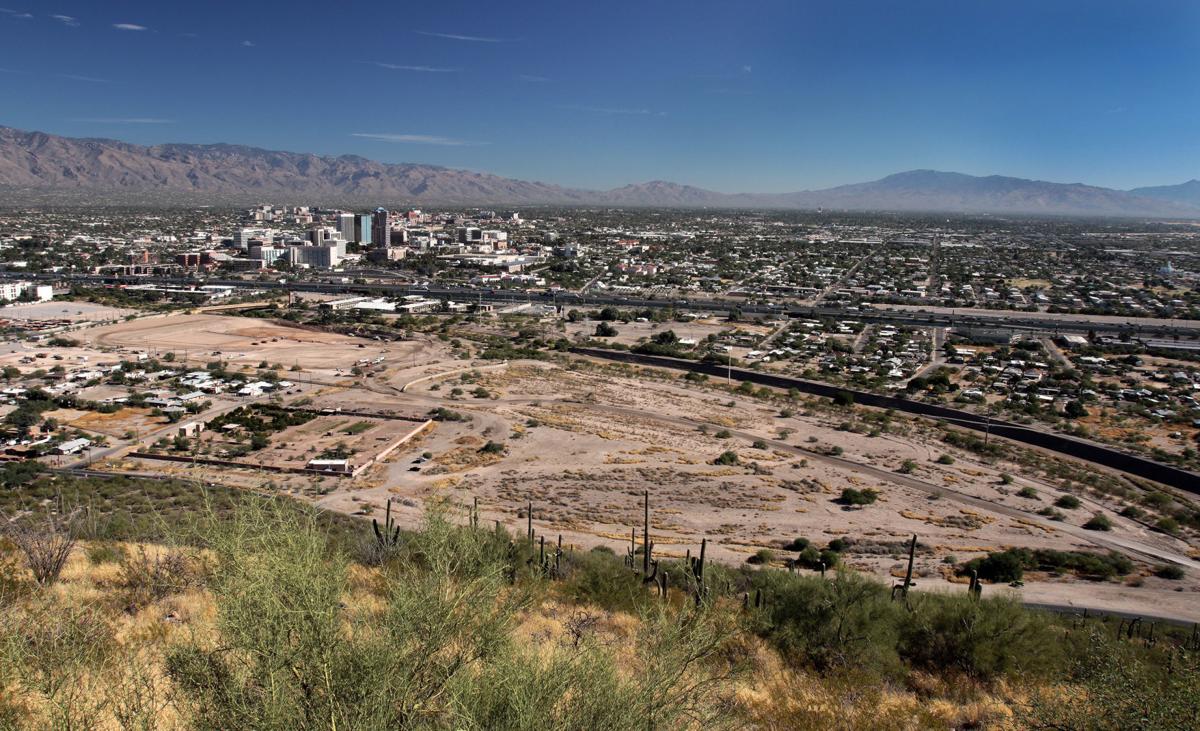
Tuesday, the Rio Nuevo board of directors voted to allow its chairman, Fletcher McCusker, to discuss with the Tohono O’odham Nation the future of the old city landfill at the eastern base of Sentinel Peak, the site of Tucson’s birthplace. The land is the ancient home of indigenous peoples who occupied the banks of the Santa Cruz River and is the site of the Spanish colonization beginning in the late 1600s.
“It’s an important conversation,” McCusker said at the board meeting, adding, however, “Can’t say where this will go.”
The landfill, which the city of Tucson operated in the 1950s through the ’60s, left the land with daunting development challenges. Still it is valuable property as commercial and residential development fills Tucson’s urban core and spills out into the gentrifying downtown-area barrios.
Last year a local cycling enthusiast and real estate agent proposed to Rio Nuevo that the landfill be converted into a bicycle-pedestrian park, which would include a velodrome, a venue where cyclists could train for competitive races or enjoy for leisure. That idea prompted an outcry of opposition from west-side residents, historical advocates and others, including Ward 1 City Councilwoman Regina Romero, who wrote in her February newsletter that “a Velodrome belongs elsewhere, not on Tucson’s birthplace.”
“People are finally coming around to oppose the bike thing,” Bruto said. “But if the Nation and Rio Nuevo could agree on a deal, it should be plastered all over your newspaper.”
Bruto, whose crescendoing voice began to sound like a south-side preacher, hit his stride.
“If the Tohono O’odham people were to take possession of the land, that would be hugely symbolic. How often, if ever, have the original inhabitants of S-cuk Son been able to retake their stolen lands?” he said, using the indigenous name of the Tohono O’odham village that existed at the foot of “A” Mountain and from which Tucson derives its name.
Yes, it would be. As Josefina Cardenas, a resident of nearby Barrio Kroger Lane told the board, “Rio Nuevo has the opportunity to deliver the land to its respectful place.”
There have been informal talks about a land deal, but we’re a long way from anything resembling a plan between the two entities for the 22 acres bounded by Mission Lane, South Grande Avenue, the Santa Cruz River and West 22nd Street. A representative from the Tohono O’odham Nation could not be reached for comment, but McCusker briefly said at the board meeting that Rio Nuevo understands that the land was home to people stretching back to pre-Hohokam, indigenous people who predated the Tohono O’odham and later a colonial site.
But the same challenges that Rio Nuevo faces in remediating the landfill would still be present for the Tohono O’odham, McCusker wrote me in an email Friday.
“Nothing is likely to happen elsewhere without some resources, partnerships,” he wrote.
After the city closed the dump, it left “a 45-foot deep hole and 50 acres of methane-producing landfill. The cost of that remediation has been the biggest barrier for our version of Rio Nuevo, about $1 million an acre.”
But if the Tohono O’odham and Rio Nuevo were to reach an agreement, there are options for the land that do not include building structures, like a velodrome or an office building such as the Caterpillar regional corporate office that is going up adjacent to the vacant land.
The idea of a Sonoran Desert park remains viable and appropriate, Diana Hadley told the board. Hadley, who lives across the street from the landfill and is active in neighborhood, historical and ecological initiatives, said remediation costs for a public park could be significantly less than the figure quoted by Rio Nuevo.
“But I’m not ready to celebrate just yet,” Bruto said.
I figured as much. Bruto is often skeptical, jaded about promises made and promises not kept for Tucson’s barrios. He can recite a litany of broken promises and desecration of history.
“Yeah, I’ll give Rio Nuevo some props for saying it’s willing to talk,” Bruto said, as his voice began to trail off. “But you know what they say about all talk and no action.”
I understand, I said to no one. Bruto had hung up.
But he’ll call again. I’m sure of it.

