


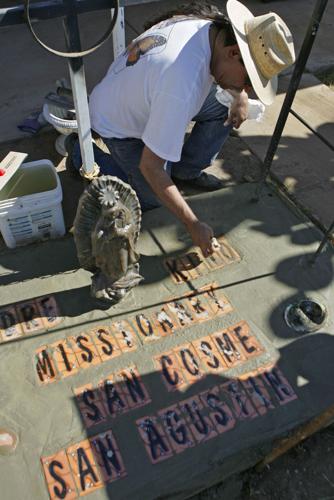
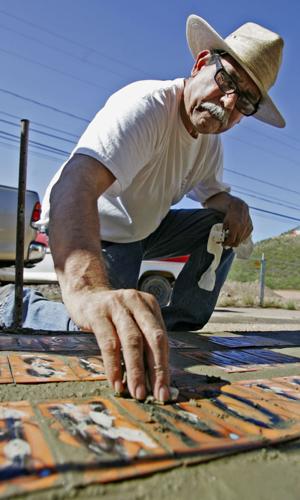

For most of Raul Ramirez’s adult years, he worked in social services, for La Frontera Arizona, a mental health and substance abuse services provider, and Pima County Juvenile Court Center.
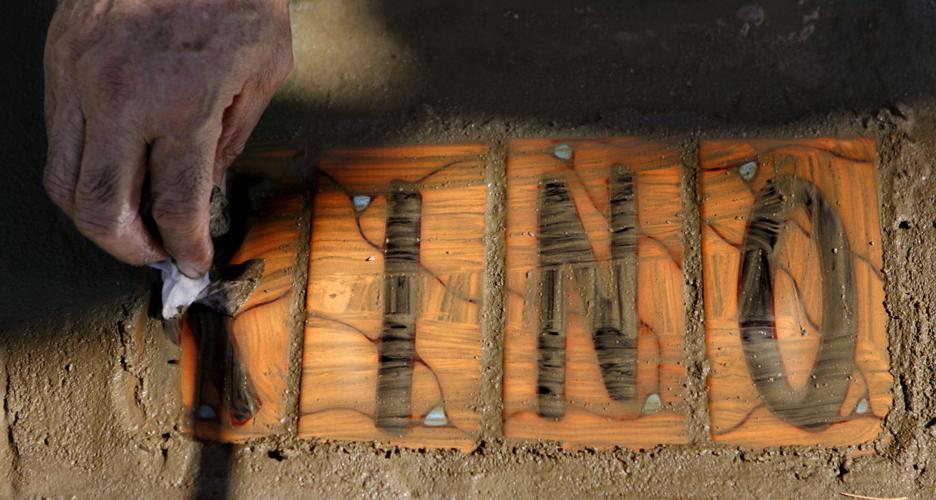
But inside this native Tucsonan beats the heart of a historian, a preservationist, a social service worker of a different kind. Nestled in his core was the desire to recognize indigenous and Mexican-American historical contributions to our region, and to honor the role of Eusebio Francisco Kino, the Jesuit European explorer of the Pimería Alta.
For the last seven years, since the 72-year-old retired, Ramirez has devoted much of his time to several community groups dedicated to keeping some slivers of our rich history alive.
“The payoff is the introduction to the community to a part of Tucson’s history we don’t know about,” Ramirez said.
We met at San Agustín Mission Garden, at the foot of “A” Mountain on South Grande Avenue on the edge of Barrio San Agustín, which for longtime residents was called Barrio Sin Nombre. The 4-acre garden, enclosed by an adobe wall, a re-creation of Spanish colonial days, is the fruit of the Friends of Tucson’s Birthplace, which he helped found, a group that recognized the agricultural past of Tucson.
Other groups that Ramirez has been involved with or continues to be part of are the Patronato de Kino de Tucson and the Kino Heritage Society, and Los Descendientes del Presidio de Tucsón, a nonprofit cultural and educational organization that supports local historic preservation efforts.
With the Descendientes, Spanish for descendents, one of the projects was the commission and placement of the statue called La Primera Vista, made by Tucsonan Luis Mena. The statue shows indigenous man, woman and child witnessing the arrival of Kino in the late 17th century. The statue, just south of Mission Garden, pays homage to the original inhabitants in the Pima village of Chuk Son.
With the Kino Heritage Society, Ramirez helped organize the restoration of an 1807 Spanish colonial bronze bell that once hung outside the small, adobe chapel of the Presidio Real de San Agustín del Tucsón. The bell, dedicated to the Virgin of Guadalupe, was returned to St. Augustine Cathedral last August as part of Tucson’s 241st birthday celebration.
But probably the biggest project is the Mission Garden, which is situated on the site of Mission San Cosme y Damián de Tucsón, established by Kino in 1692, the same year he founded the first mission at San Xavier, south of Tucson. San Cosme did not survive but subsequently a two-story convento building and garden was built on the site, though years later covered by a landfill.
At the present-day garden, supporters have planted various plants and trees to reflect the timeline of agriculture along the Santa Cruz River. They envision a comprehensive garden devoted to Tucson’s multi-ethnic food growers.
Ramirez’s missionary zeal reflects his days working in social services where he helped resolve issues, bring people together and find answers. His passion also comes from his life’s experiences, beginning with his travels to Mexico as a boy and in later years, and the community activism of his late mother, Velia Jiménez Villegas. And his connections to indigenous people were made through a mentor, the late Tito Carrillo, who for more than three decades helped connect indigenous communities in Sonora and Chihuahua, Mexico, with Tucson. Ramirez also worked in the Pascua Yaqui community while at La Frontera.
All these experiences, he said, forged his interest and involvement in promoting Tucson’s indigenous and Mexican-American histories, which are too often neglected and forgotten.
Case in point: The site of Mission Garden was supposed to have been a key component of the Rio Nuevo project approved by Tucson voters in 1999. The then-Rio Nuevo project envisioned an educational and interpretative campus focused on Tucson’s indigenous, colonial and territorial past. Also in the mix was a science center.
That’s history now. In their place will be the new regional headquarters for Caterpillar Inc. The Rio Nuevo taxing district contributed $52 million to the project.
Ramirez and the small band of the Mission Garden’s supporters will continue to grow the garden and expand its programs to attract more visitors. At the same time, they hope the seeds they plant will also expand the public’s interest in preserving and expounding on Tucson’s history.
“That’s the challenge,” Ramirez said. “Getting people involved, piece by piece.”

