



If Tucson had a voice, it might sound something like Ernesto Portillo Sr.
During his 50 years in radio, Portillo filled the local airwaves with music, information and inspiration, all while expanding the reach of Spanish-language programming and the Mexican-American community as a whole.
His shows and the stations he helped launch provided a vital platform for those working for change in Tucson and beyond.
The broadcaster, businessman and community booster died on Nov. 2, Día de los Muertos, while surrounded by family at his Armory Park home. He was 92.
“He always understood the power of media,” said long-time local activist and broadcaster Raúl Aguirre, president and CEO of REA Media Group. “Professionally and personally, he was one of my heroes.”
Portillo was born on Oct. 21, 1933, in the southern Chihuahuan mining town of San Francisco del Oro and grew up in Ciudad Juárez, just across the border from El Paso.

Ernesto V. Portillo arrived in the Old Pueblo on a Greyhound bus for a 9 a.m. appointment that day to audition at the KEVT studio near St. Mary’s Hospital. By 9:30 he was on the air.
He recalled his childhood in Northern Mexico during a 2017 interview with Aengus Anderson from Archive Tucson, an oral history project by University of Arizona Libraries and Special Collections.
Portillo said he rode his bicycle back and forth across the international border every day to attend school and learn English in El Paso. “I was getting acquainted with a new big world: the U.S.A.,” he said. “Very interesting.”
It was his brother-in-law in Juárez who helped him land his first job as a part-time, fill-in DJ — or a “radio announcer, if you please; that’s the way we would introduce ourselves,” Portillo said.
Before he was allowed to go on the air, though, the then-17-year-old had to study up on all the broadcasting rules and decency laws, then take a long bus trip to Mexico City so he could pass the government licensing exam.
He spent the next few years spinning records — mostly Mexican romantic ballads and the big band music that was popular at the time — at different stations in Juárez, before being lured to Arizona in March of 1954 by a job opening at Tucson’s brand-new, first-ever, Spanish-language radio station.
On the air
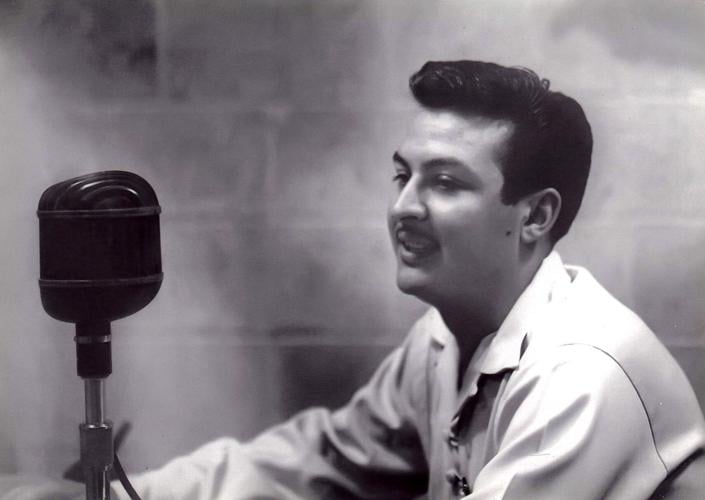
Portillo made that first trip to the Old Pueblo on a Greyhound bus, arriving hours before dawn to the smell of fresh rain. He had a 9 a.m. appointment at the KEVT studio near St. Mary’s Hospital, and by 9:30, he was on the air.
He knew almost immediately that he never wanted to leave.
“I fell in love with the desert,” he said in his oral history recording, “but also the people in Tucson, the families. It was a beautiful home life that I saw right away.”

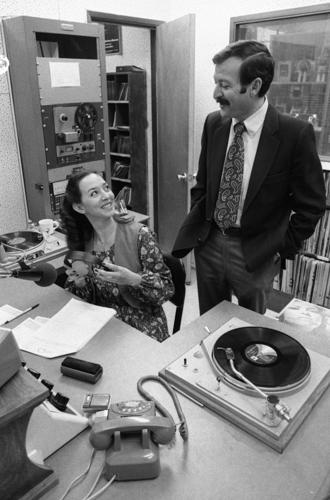
Ernesto Portillo talks to Margarita Robles in the KXEW radio studios in Tucson in 1980.
By the following year, he had married Julieta Bustamante Portillo, a Tucson girl and the love of his life. They would raise four children and stay together until the end, side-by-side for 70 years.
Portillo became an American citizen on Aug. 25, 1958, a point of pride that even late in life he still included near the top of his professional résumé.
But he was also deeply proud of his Mexican heritage, Aguirre said. “He died on Día de los Muertos. How much more Mexican can you get?” Aguirre said with a laugh. “He understood the power of identity.”
Portillo’s radio work in the 1950s made him a local Latino celebrity of sorts. During the six years he worked as a DJ and a sales rep for KEVT, he was a fixture at celebrations and events in the Spanish-speaking community.
He briefly left the business to sell life insurance, but he returned to radio in 1963, this time at KXEW-AM, better known as Radio Fiesta, a new station that quickly made him its general manager.
He later helped launch an FM version of KXEW, then joined with a group of investors to buy the station in 1969. KXEW-FM was eventually bought out by a company that turned it into Tucson Top 40 station KRQ in the late 1970s.

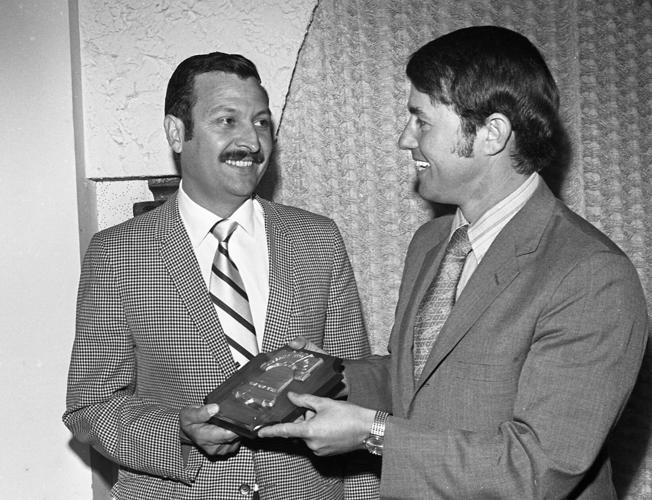
Ernesto V. Portillo receives the Liberty Bell award from Gordon T. Alley at the Pioneer Hotel in Tucson in 1971.
After Portillo and his partners sold the AM station in 1981, he helped build and launch bilingual KQTL Radio in Sahuarita, where he worked as a manager until his retirement from the business in 2001.
Portillo also spent 20 years as a newspaper columnist, writing opinion pieces in Spanish and English for the Tucson Citizen from 1981 until 1997 and occasionally for the Arizona Daily Star after that.
Through it all, he did what he could to give back to the community.
Portillo joined the Arizona Army National Guard in 1955 and served for seven years, earning the rank of sergeant.
Later, he was active in a number of service organizations and served on the board of directors of La Frontera Mental Health Center, the Tucson International Airport Authority and the YMCA.
He also played a key role in the creation of the annual Tucson International Mariachi Conference and the Southwestern Mission Research Center’s tours of Kino-era churches in Mexico and the U.S.
His professional career and his service to the community landed him in the Arizona Broadcasters Hall of Fame in 2019 and the Tucson International Mariachi Conference Hall of Fame earlier this year, among numerous other awards.
As Portillo told the Star in 2015, “My biggest satisfaction was in serving my community — Tucson and Southern Arizona.”
A powerful voice
“Sonorous” is the best word to describe Portillo’s famous radio voice, according to Aguirre. He said his friend and mentor spoke in a way that made people shut up and listen, with unique vocabulary, precise diction and a knack for being eloquent and succinct at the same time.
Aguirre grew up with the sound of that voice. “My parents listened to his program. Everybody listened to his program,” he said. “He had a power, and he was a powerbroker in our community.”
Thanks to Portillo and his stations, Spanish-speaking Tucsonans got to hear directly from politicians, service organizations, teachers, students, mental health professionals and labor leaders, Cesar Chavez and Dolores Huerta among them.
Needless to say, it was a big deal when Aguirre was invited onto Portillo’s Saturday program as a Pueblo High School student to talk about posting one of the highest scores in the nation on a Spanish-language test.
It was a much bigger deal a few years later, when Aguirre and a few of his fellow young activists at the U of A sold Portillo on the idea of a bilingual FM station devoted to politics, community service and an eclectic mix of music with a message.

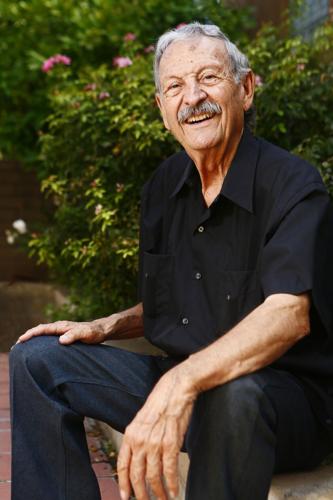
Ernesto V. Portillo poses for a portrait in the backyard of his home in Tucson, 2015. Portillo, a retired journalist and former radio station owner in Tucson, was being honored that year at a gala celebration by Los Descendientes del Presidio de Tucson.
“He opened the door for us,” Aguirre said. “He saw our vision.”
Aguirre would go on to launch a prosperous, multicultural marketing and public relations firm of his own and establish himself as a leader in the Latino community, mentoring others the way Portillo mentored him.
“That opening he gave us gave us permission to be very successful,” he said.
Portillo’s son, Ernesto Portillo Jr., also made something of a name for himself — “Neto” to be exact — as a long-time columnist for the Star and as editor of the Spanish-language newspaper La Estrella de Tucsón. But to this day, Portillo Jr. said, he regularly gets asked if he’s related to the famous radioman whenever people hear his name.
“He meant a lot to the community. He meant a lot to the families in the barrios,” he said of his father.
Portillo is survived by his wife, Julieta; daughter, Carmen Portillo; sons, Mario, Carlos and Ernesto Jr.; grandchildren Alita, Nina, Mario, Maya, Laurissa and Carlo; and two great-grandchildren.
Services for Portillo will be held on Nov. 15, with a 9:30 a.m. rosary and 10 a.m. Mass at St. Augustine Cathedral, 192 S. Stone Ave. A private burial will follow in Patagonia.
In lieu of flowers, the Portillo family requests donations be made in the name of Ernesto V. Portillo to Casa Maria Soup Kitchen, 352 E. 25th St., Tucson, AZ 85713 or the East Santa Cruz Community Food Bank, P.O. Box 1147, Patagonia, AZ, 85624.

