


Arizona could get more than $70 million annually for five years to clean up PFAS-tainted groundwater if a new infrastructure bill that just passed the U.S. Senate becomes law, says U.S. Sen. Mark Kelly’s office.
About $72 million a year would flow into the state under the bill, which could be used to remove PFAS contamination from groundwater supplies in the Tucson and Phoenix areas, said Jacob Peters, Kelly’s communications director.
But Tucson likely wouldn’t be the first place to get cleanup money, if a statement Wednesday from Arizona’s top environmental official becomes a formal policy. That’s because people here aren’t drinking PFAS-tainted water today.
The $72 million a year would represent a major step toward getting cleanups on track in the state’s two big urban areas.
Nathaniel Sigal, a policy advisor for Tucson Mayor Regina Romero, said he’s heard projections that a comprehensive PFAS groundwater cleanup in Tucson could cost $110 million to $140 million. The federal money in the pending infrastructure bill “would be a great start,’ Sigal said.
PFAS is an abbreviation for a group of commonly used, human-made chemicals known as perfluorinated and polyfluorinated alkyl substances that are very persistent in the environment and the human body, meaning they don’t break down easily.
Arizona Department of Environmental Quality Director Misael Cabrera called Kelly’s announcement “really good news.”
But when asked which areas of the state would most likely be the first to get any of this cleanup money, he said the first priority would be to spend the money in places with ongoing human health risks, “in places where people are currently drinking the water.”
That wouldn’t include Tucson because all the wells in the city and surrounding areas with excessive PFAS levels have been shut down, or their water is already being cleaned up.
The area around Luke Air Force Base in Glendale also might not be at the top of the priority list for PFAS cleanup money even though as recently as February 2021, base officials announced that studies had showed high levels of contaminants had affected drinking water for about 6,000 people in roughly 1,600 homes as well as a few neighboring businesses, Fox 10 News in Phoenix reported.
Later that month, the Air Force was distributing bottled water to those customers as a substitute for their tap water. But just this week, base officials announced that recent test results show a filtration system is clearing the area's drinking water of PFAS compounds, The Arizona Republic reported.
"At Luke Air Force Base, many of the water treatment plants are equipped or being equipped with PFAS treatment" equipment, Cabrera said Thursday.
The second priority would be places where there is a risk that people could be drinking the water, he said.
Tucson theoretically could fall within that category because the PFAS-contaminated water here may need to be used for drinking in the future if Central Arizona Project water supplies now serving most of Tucson are ever cut back due to climate change and drought.
Cabrera said the department has no firm position yet on which areas would first get cleanup funds. He said he’s not aware of any places where Arizonans are currently drinking PFAS-tainted water but there are likely areas where it’s happening but aren’t yet discovered.
“We are still assessing the problem statewide. Our water quality team is still doing a risk-based monitoring project based on an EPA grant throughout the state, trying to determine if there are problems,” Cabrera said.
Speaking of Tucson, Cabrera said the ADEQ and the state in general have dedicated more than $5 million to treat PFAS here, "in areas with very limited resources."
That includes $3.3 million that ADEQ plans to spend on building a pilot PFAS treatment plant near Davis Monthan, The state also has agreed to give Tucson Water another $2 million for construction of a pipeline to take treated water with PFAS from a south side water treatment plant to the Santa Cruz River.
"And we have not dedicated those kind of resources in the Phoenix area because others are taking leadership of the problem," he said. "We have deployed resources where there is a gap and people have not addressed the problem.
"In Phoenix, the Air Force has stepped up and water companies have stepped up" to help families drinking PFAS-tainted water, he said.
The federal money spent due to the infrastructure bill would go directly to ADEQ and not to individual cities, but “we have a strong partnership with ADEQ to bring a large chunk to Tucson to address our needs,” Sigal said.
“We have had no promises but we remain in close contact with ADEQ,” he said
Besides Luke, the Phoenix area also has suffered PFAS contamination in residential areas near the former Williams Air Force Base in Mesa.
In Tucson, PFAS has contaminated groundwater on the south side north of Morris Air National Guard Base near Tucson International Airport, and in the midtown area north of Davis-Monthan Air Force Base.
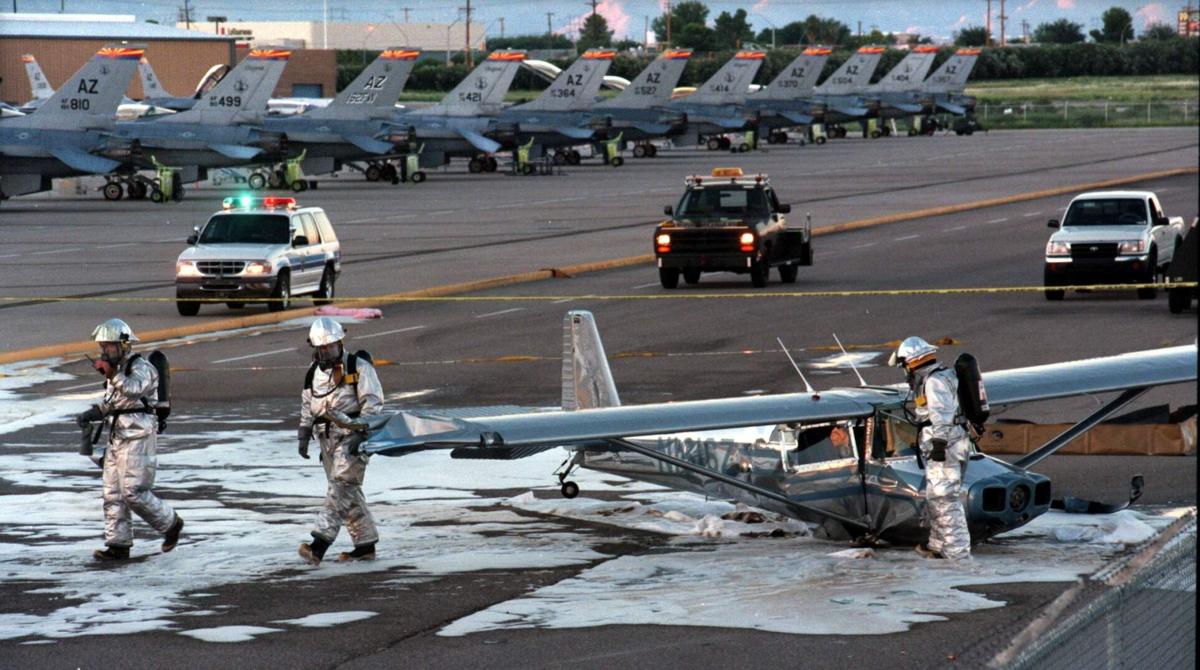
Military bases used firefighting foam containing PFAS in the past. The Air National Guard base in Tucson stopped all use of PFAS in firefighting foam in 2018.
The chemicals have also contaminated groundwater in areas of Continental Ranch in Marana that are served by Tucson Water.
In addition, PFAS has contaminated an area near Sweetwater Road and Interstate 10 where Tucson Water has for 40 years stored treated effluent in the ground and recovered it as reclaimed water to send to parks, golf courses, schools and other turf areas, Tucson Water Director John Kmiec told the City Council on Wednesday.
PFAS also has contaminated drinking water in parts of Marana served by that town’s water utility. But the town government has installed treatment plants to clean it up at its expense, in hopes of getting reimbursed later..
The $1.2 trillion infrastructure package, co-negotiated by Arizona Democratic Sen. Kyrsten Sinema, could give state agencies across the country $10 billion in grants to mitigate contamination and filter PFOS and PFOA — two specific varieties of PFAS compounds — from drinking water, The Arizona Republic reported. Kelly, also a Democrat who voted for the bill, was part of a bipartisan working group of 22 senators focused on water systems.
Romero thanked Kelly and Sinema for their work on the infrastructure bill. But “we are still at a standstill,” since the U.S. House isn’t scheduled to vote on the infrastructure bill until September, Romero said at Wednesday’s council meeting.
“The way I see it is the Department of Defense is responsible for this contamination of groundwater. Our residents and customers should not be left holding the bag. We will continue to add pressure to the DOD to insure the city is in line for additional funds for remediation of PFAS,” Romero said.
Heavy rainfall in Tucson on Tuesday morning caused flooding in Sabino Canyon, leading to temporary closures in the area.
North Upper Sabino Road is closed at Bridge 1 and Bear Canyon Trail is closed at Sabino Creek, according to the Forest Service at Coronado National Forest. Video courtesy USDA Forest Service at Coronado National Forest.

