

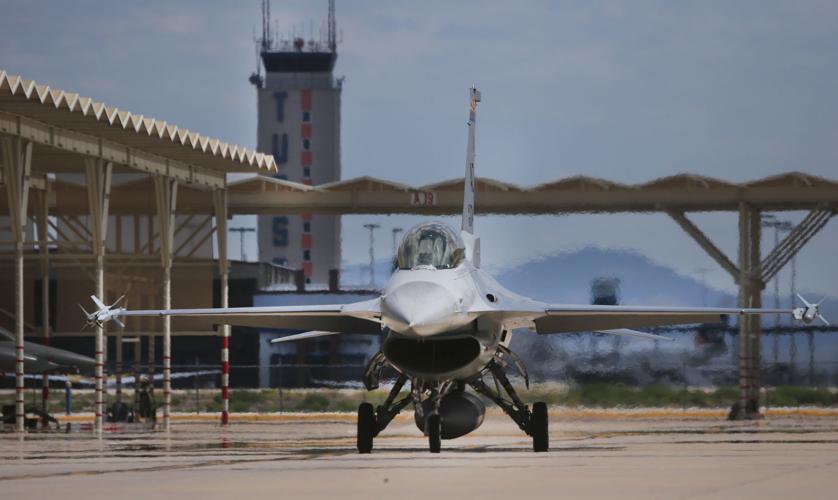

The Air National Guard will begin a full-scale investigation this fall of groundwater contamination by toxic PFAS compounds near its Morris Air National Guard Base on Tucson’s south side.
The probe, formally called a remedial investigation, is considered a key step toward launching a cleanup of contaminated groundwater under the federal Superfund toxic waste law. The Guard will award a contract for the investigation by Sept. 30.
It expects to complete a report on the investigation by the end of 2024, said Mark Kinkade, an Air Force spokesman, in an email Wednesday to the Star.
But because federally funded groundwater cleanups often if not generally don’t begin until such investigations are finished, the 2024 completion date could mean no cleanup will start until after that.
Such a timetable drew criticism from Tucson City Councilman Steve Kozachik, who accused the Air National Guard of “slow-walking” cleanup efforts. He noted that high concentrations of PFAS compounds in groundwater there have been known to exist on the south side since 2019.
But Kinkade held out the possibility of conducting a cleanup sooner if the investigation determines an imminent risk to human health exists.
The Air National Guard’s next step is “to determine the nature and extent of PFOS/PFOA in the environment,” Kinkade told the Star, referring to the two most commonly detected PFAS compounds. “The (investigation) will help us assess risk to human health and identify possible strategies to address that risk. (It) will also help us determine sources of PFOS/ PFOA.
“We are working closely with local regulators through all phases of the PFAS response, and are following the federal CERCLA process,” said Kinkade, referring to the Comprehensive Environmental Response, Compensation, and Liability Act, commonly known as the Superfund law.
Kinkade’s comments are the Air National Guard’s first detailed statements on PFAS contamination at and near its base in two years.
Concerns mount
While water untreated for PFAS isn’t used by the city for drinking, it’s considered a backup supply in case of future cutbacks of Central Arizona Project water deliveries from the imperiled Colorado River.
The Guard’s announcement of the investigation comes as local concerns mount over PFAS contamination northwest of the Guard base that is about to force a shutdown of Tucson Water’s south-side water treatment plant.
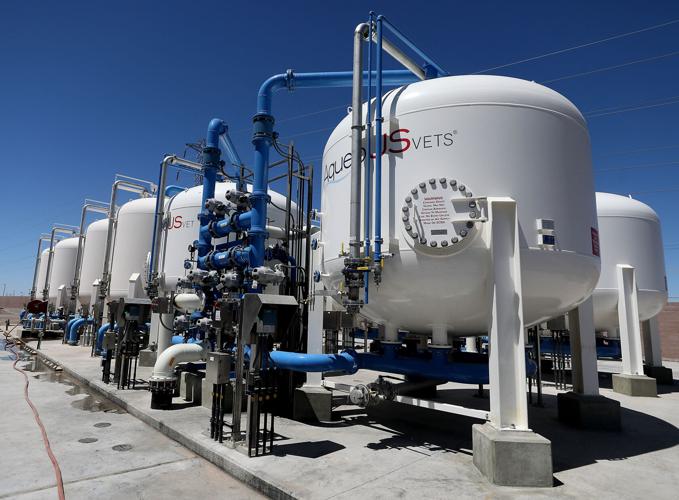
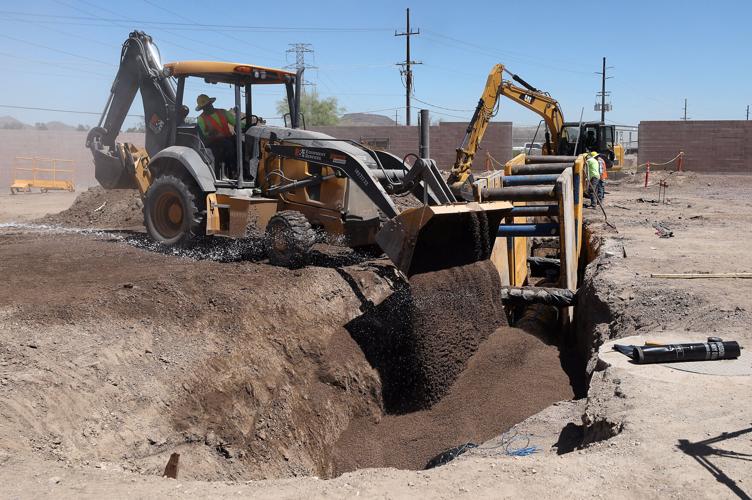
The utility say it intends to shutter the Tucson Airport Remediation Project plant, also called TARP, on Monday. That’s out of concern that rising PFAS levels in south-side wells could overwhelm the treatment plant that’s been cleaning it so far.
Tucson Water also seeks approval from the Environmental Protection Agency to be released from its commitment in a 1991 consent decree to serve the treated water from the plant to people’s homes. The decree lays out the ground rules for cleanup of another contaminant, trichloroethylene or TCE, on the south side by the city, the Air Force, the Tucson Airport Authority and other parties.
The EPA declined to say if it will permit Tucson Water to shut the treatment plant down.
“EPA is currently meeting with responsible parties, which includes the City of Tucson, U.S. Air Force, and the Airport Authority, to determine the best course and timing of action regarding the proposed shutdown of TARP. As a matter of policy, EPA does not comment on matters within its enforcement discretion,” the agency said in a June 11 email.
The decree doesn’t allow the city to unilaterally curtail plant operations unless treated water exceeds federal or state drinking water standards, which it doesn’t now. However, temporary shutdowns are allowed for “maintenance and treatment issues” if EPA approves, the agency said, declining to elaborate.
Tucson Water, in a statement relayed by spokesman James MacAdam, said only that “it’s actively engaged in discussions with EPA to resume operation of the remedy once an alternate end use is permitted and constructed,” and declined to discuss legal issues.
The city utility has said that until PFAS is cleaned up from the south-side groundwater, it wants to discharge treated TARP water into its reclaimed water system and the Santa Cruz River.
It wants to never serve treated water to customers again, saying something could go wrong with the treatment that would allow unsafe levels of contaminants to be served.
Republican Gov. Doug Ducey and five Democratic senators and congress members from Arizona wrote separate letters over the past two months to U.S. Defense Secretary LLoyd Austin, seeking a commitment to expedite cleanups of the groundwater under and near the Air Guard base and three other Arizona military bases, including Davis-Monthan Air Force Base in Tucson.
A spokesman for Austin told the Star June 10: “The department has received both letters and will respond accordingly.”
Treat now, get repaid later?
PFAS is an abbreviation for a group of commonly used, human-made chemicals known as perfluorinated and polyfluorinated alkyl substances that are very persistent in the environment and the human body, meaning they don’t break down easily.
Potential health effects for people exposed to PFAS chemicals at high enough levels over a lifetime include liver and kidney cancer, immune system damage, increased cholesterol blood levels, small decreases in infant birth weights, developmental delays in fetuses and children, decreased fertility and increased asthma risks, say the EPA and the federal Agency for Toxic Substances and Disease Registry.
The Air National Guard has acknowledged that it, like many other military departments around the U.S., used PFAS compounds regularly in firefighting foam nationally starting in 1970.
In 2019, an Air National Guard spokesman told the Star the base had gradually stopped using firefighting foam containing PFAS over the previous 2½ years.
Last week, Kozachik suggested the city first build its own treatment plant and extract the plant’s construction cost from the Air Force afterward. The Arizona Air National Guard is part of the Air Force and has state and federal missions.
The city decided to do something similar back in 2011, to remove an industrial solvent known as 1,4-dioxane from south-side groundwater that was contaminated by Air Force contractors’ use of it and TCE.
The $20 million dioxane treatment plant at the TARP site was built in 2013. The Air Force agreed in 2016 to reimburse the city for $17 million.
Timetable called unacceptable
Said Kozachik of the Guard’s response last week: “They are so slow-walking this thing. We have levels of 13,000 (PFAS) parts per trillion out there. We are shutting down our TARP facility, and they’re suggesting taking another three years to study it is an appropriate response.
“That’s insanity. That’s unacceptable. That’s not partnering,” Kozachik said.
Tucson Water said, “Time is obviously of the essence. Ultimately, the acceptability of the ANG’s (Air National Guard’s) plan, what recourse we have, and the feasibility of any alternatives is something we determine in consultation with the City Manager and the Mayor and Council.”
The utility doesn’t have a position “at this time” on Kozachik’s suggestion to build a PFAS treatment plant and seek Air Force reimbursement later, it said.
“We are evaluating the risks, costs, benefits, of various alternatives as we work to bring the responsible parties to the table,” Tucson Water said.
Mayor Regina Romero said in a prepared statement that a three-year wait for a cleanup is unacceptable. The federal government needs to take expeditious cleanup action or provide concrete assurances the city will be reimbursed for city-funded cleanup efforts, she said.
“Tucson Water ratepayers are not responsible for PFAS contamination and should not be left with the tab,” Romero said.
In a follow-up email to the Star on Thursday, Air Force spokesman Kinkade said the Air National Guard can take an “interim action” to clean up contamination “if we find there is an imminent risk to human health.”
The Guard can’t speculate on what circumstances may or may not be present as a possible imminent risk as the investigation gets started, and the Superfund law doesn’t define imminent risk, he said.
But, “EPA guidance says agencies should rely on scientific evidence and documentation in order to demonstrate the existence of conditions that may present an imminent and substantial endangerment ... and should carefully tailor the relief requested to address,” he said.
“The agency has great latitude” to determine when there may be such endangerment, said Kinkade. “Generally, the agency will rely on scientific evidence and documentation in order to demonstrate the existence of conditions that may present an imminent and substantial endangerment.”
Guard’s priority
So far, the Guard’s first priority has been to identify potential PFOS and PFOA impacts to drinking water and to respond when PFOS and PFOA concentrations in drinking water exceed the EPA’s health advisory of 70 parts per trillion for lifetime exposure, Kinkade said.
Its top priorities also have included changing formulations of firefighting foam used on base to eliminate use of PFAS compounds and changing training and emergency response procedures. It’s been retrofitting emergency vehicles to prevent inadvertent PFAS releases, he said.
“As members of the community, we recognize the importance of water to the Tucson community, and we are taking aggressive action and working closely with regulators to address risk to drinking water sources. The first thing we can and have done is protect drinking water because it is the most immediate pathway for human exposure to PFOS/PFOA, and the EPA has established a health advisory for PFOS/PFOA in drinking water.”
Under the federal Superfund law, the Guard must address immediate risk, and will continue to use a risk-based approach as it conducts the remedial investigation, he said. The investigation is “critical to determining what actions we should take, and best approaches to protecting human health,” he said.
The Guard’s announcement of an upcoming investigation comes two years after a March 2019 report by a Guard consultant concluded high concentrations of PFAS had contaminated much of the groundwater directly underneath the Guard’s base on Tucson International Airport property.
That fall, Tucson Water and Arizona Department of Environmental Quality officials said PFAS concentrations of up to 13,850 parts per trillion had been found in monitoring wells northwest of the Guard base.
This year, Tucson Water said several “production wells” that pump south-side groundwater to TARP for treatment have shown rapidly rising PFAS concentrations — up to 700% since 2017 and 2018.
The Air National Guard investigates, in general, to determine if the use of PFOS and PFOA, associated with activities on the base, causes drinking water sources to register concentrations above 70 parts per trillion, Kinkade said.
In the Tucson area, the Guard has provided bottled water to private well owners whose wells’ PFAS concentrations exceeded 70 parts per trillion and helped “coordinate” their efforts to get city water supplies from Tucson Water, he said.
“Our first priority is addressing these impacts,” Kinkade said.
Asked by the Star if the Air National Guard accepts responsibility for the PFAS contamination on the south side, Kinkade didn’t directly respond.
But, he said, “The Arizona Air National Guard 162nd Wing is a proud member of the Tucson community. As Guardsmen, our military members and their families have deep roots in the community and we share their concerns about this issue.”

