



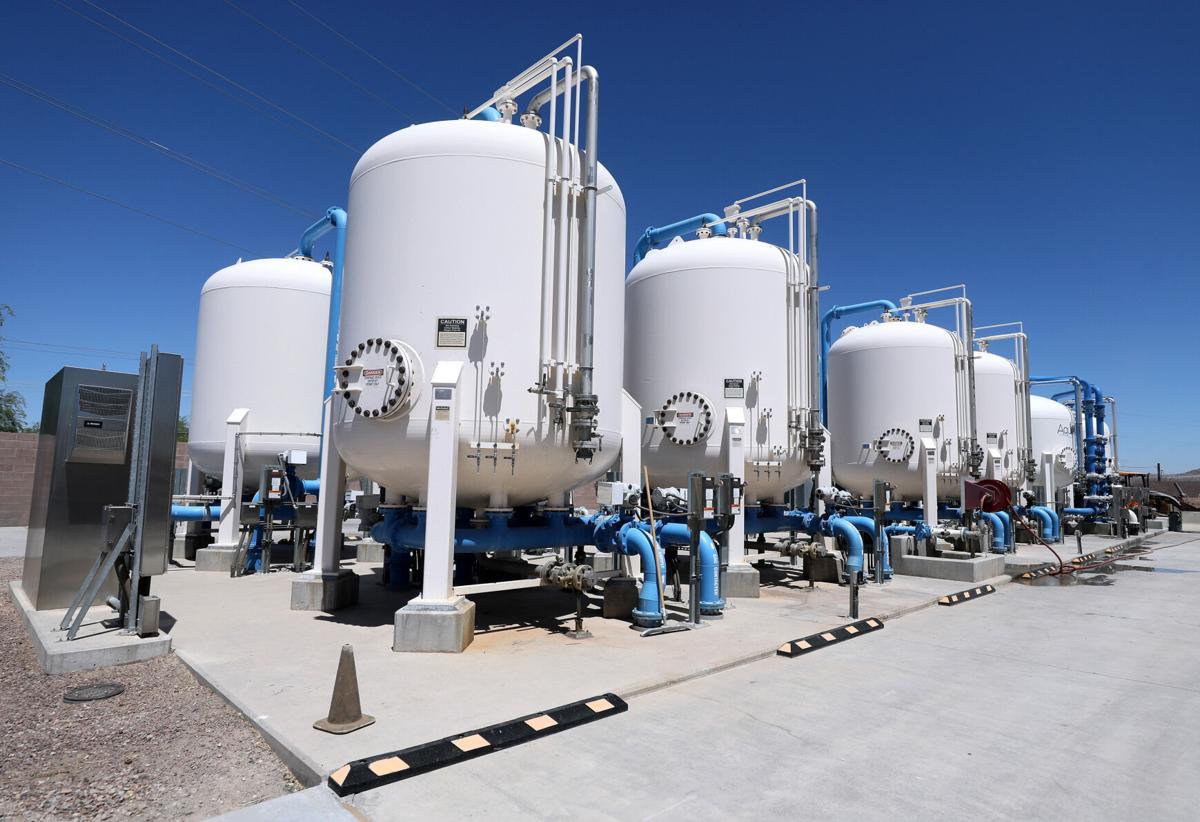
Tucson officials hope newly announced federal health guidelines for levels of PFAS contamination in drinking water will speed the flow of federal money to this area for what they say is a massive groundwater cleanup job that will cost well into the hundreds of millions of dollars.
City officials were already planning to apply for federal money for some cleanup of PFAS-tainted wells on the northwest side and in the city’s reclaimed water system.
Local officials also say they hope the tighter EPA standards will free up federal money from the Air Force and the Air National Guard to clean up longstanding pollution of groundwater in midtown, north of Davis-Monthan Air Force Base, and an Air National Guard base adjoining Tucson International Airport on the south side.
“Today’s announcement really underscores the urgency and need for responsible parties here in Tucson, the manufacturers of PFAS and the Department of Defense, to step up and help us remediate PFAS contamination that they contributed to water sources in Tucson,” Tucson Mayor Regina Romero said Wednesday.
“I’m glad the city of Tucson and Tucson Water for years now have led the nation in having the most stringent operational targets (for PFAS levels in drinking water),” Romero said, adding, “I would say we have one of the most stringent operational targets of any water utility in the nation.”
EPA tightens health guidelines
The Environmental Protection Agency announced Wednesday it is drastically tightening up health advisory guidelines for lifetime exposure to two PFAS compounds that have increasingly turned up in drinking water supplies in Tucson and nationally.
Since 2016, EPA has recommended that people be exposed over their lifetimes to no higher levels of the compounds known as PFOA and PFOS than 70 parts per trillion in drinking water. On Wednesday, EPA slashed recommended maximum levels to .004 parts per trillion for PFOA and .02 parts per trillion for PFOS.
Equipment owned by Tucson Water and many utilities and state and federal agencies around the country isn’t capable of detecting concentrations that low in drinking water, local and national officials say. That means EPA’s new guidelines really mean that no measurable levels of these compounds are acceptable in drinking water.
Tucson Water had already set its own, much lower health advisory level of 18 parts per trillion for both PFAS compounds. But in reality, it was shutting off all city wells found with any PFAS contamination, utility officials have said.
To find PFAS compounds in drinking water, Tucson Water uses EPA laboratory methods that can detect nothing lower than 2 parts per trillion PFAS concentrations, the utility said in a statement Wednesday.
The city has closed 25 PFAS-tainted wells north of Davis-Monthan Air Force Base, north of the Air National Guard base and on the far northwest side in the Marana area.
“However, we continuously sample across our system and we will review our past data to ensure any active wells that may have detectible levels of PFOA and PFOS are removed from active service,” Tucson Water said.
PFAS is an abbreviation for a group of commonly used, human-made chemicals known as perfluorinated and polyfluorinated alkyl substances that are very persistent in the environment and the human body, meaning they don’t break down easily and are known as “forever chemicals.”
Federal grants sought
The Air National Guard has acknowledged that it, like many other military departments around the U.S., used PFAS compounds regularly in firefighting foam nationally starting in 1970. In 2019, an Air National Guard spokesman told the Star the base had gradually stopped using firefighting foam containing PFAS over the previous 2½ years.
Tucson already plans to seek $133 million in federal grants to design treatment systems for PFAS contamination of wells on the northwest side and in its reclaimed water system. But the total cost of an entire PFAS cleanup from the city’s well system will run well into the hundreds of millions of dollars, said Romero and Tucson Water Director John Kmiec.
Due to last year’s congressional approval of a $1 trillion infrastructure bill, the federal government is already sending money for PFAS cleanup in the state, Romero said. The city is preparing proposals for grants of $61 million and $72 million, respectively, to design treatment systems for the northwest side and some of the city’s reclaimed water.
Those applications are targeted at the state’s Water Infrastructure Financing Authority, and “we’ve been working with them for months to make sure we have good applications,” Kmiec said Wednesday.
Romero said the federal Defense Department budget now contains money for environmental cleanup and that city officials will keep lobbying Arizona’s congressional delegation to pressure the department to come up with cleanup funds for the Tucson area as soon as possible.
“I’ve been saying since we first started discussing this that Tucsonans should not be left holding the bag” for cleanup costs, the mayor said.
The Defense Department has used the 70 part per trillion advisory level as a threshold for starting cleanup action of PFAS-tainted wells, said Tucson Water and Councilman Steve Kozachik, the most outspoken council member on the PFAS issue. Now, with the stricter health advisory, the department should change its scope for a Tucson cleanup, the utility and Kozachik said Wednesday.
“D-M is hiding behind the 70 part per trillion advisory level. They can’t do that anymore,” Kozachik said.
Contractors for the Air Force Civil Engineer Center started work last fall on investigations of the contamination near Davis-Monthan that was to be finished in 2024. But city officials have said they won’t accept waiting that long for cleanups to start.
To date, 30 surface and 15 subsurface soil sampling locations and seven monitoring wells near the base's northern boundary have been established, Capt. Elias Small, a base spokesman, said Thursday morning. A second phase of the investigation, on which work started in April, will include installation of eight additional monitoring wells and measuring devices, and additional soil sampling, Small said.
Thursday morning, Air National Guard spokesman Mark Kinkade offered a somewhat delayed timetable for its investigation of PFAS contamination. A contract to conduct a remedial investigation at the Tucson Air Guard base was awarded in September 2021, and the final report on the investigation should be completed by September 2025, Kinkade said.
As global temperatures rise, those that love to fish could have their hobby greatly impacted by climate change. Scientists are now discovering that groundwater is more influenced by climate variability the shallower it is. Source by: Stringr

