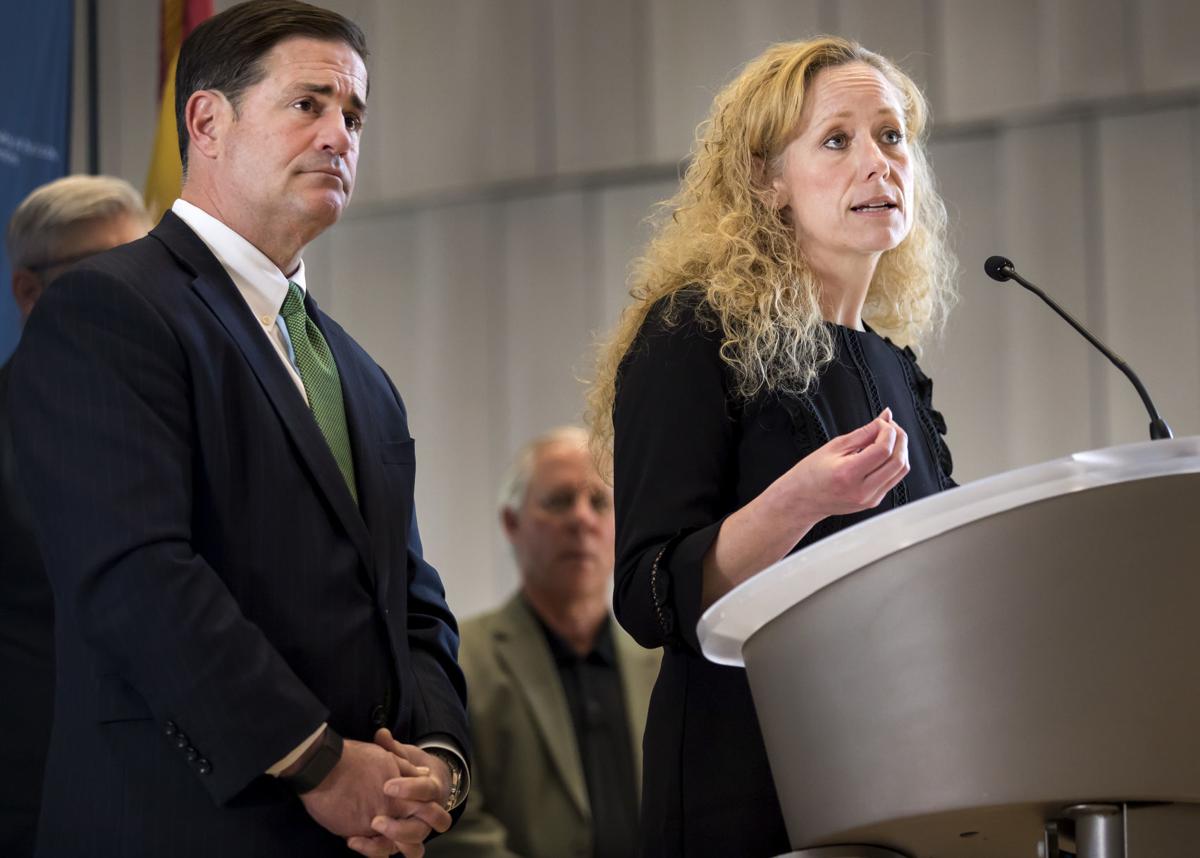
In response to growing criticism over a decision to pause the work of an Arizona team modeling the spread of the coronavirus, the state Department of Health Services announced Thursday that it has established “an ongoing partnership” with those university experts to continue providing their predictions.
“I’m pretty excited,” said Dr. Joe Gerald, who is a member of the modeling team and an associate professor with the UA’s Zuckerman College of Public Health.
The state’s reversal will allow Gerald and his colleagues to provide state leaders with useful and actionable information during the pandemic, he said. It’s the type of information that can help leaders decide when and how to reopen the state.
The health department said it communicated with members of the modeling team Thursday, telling them “we were very pleased with the model they provided” that was delivered April 20.
“Understanding the demands on their time, we let them know that we were putting the modeling project on pause until we could bring them back to assist with modeling COVID-19 resource requirements during the influenza season,” the statement said. “Since then, the universities and team members have expressed a willingness to continue doing this work. We are grateful for their dedication and we look forward to an ongoing partnership.”
The decision to pause the group’s work came as Gov. Doug Ducey had moved to ease social distancing restrictions across the state despite the professors’ model that showed reopening at the end of May was the only scenario that wouldn’t dramatically increase COVID-19 cases.
The department had told the group of university experts, which included at least four members from the University of Arizona, that it was pausing its work in an email on Monday, a move that took Gerald by surprise.
“I felt like our group was doing some good work, that we were beginning to make progress on each of the pieces of the puzzle,” Gerald said in a interview on Wednesday. “I felt like we were providing actionable counseling and evidence.”
The Arizona Department of Health Services had made a lot of progress toward doing the team’s work in house, but Gerald said he felt that university researchers, like himself, were still contributing in an important way.
While Gerald said he was disappointed the state had told the modeling team to stop working, he still has a good working relationship with the Arizona department, adding that he stood ready to “start up again tomorrow or continue helping them in other ways.” The initial decision led to an outpouring of criticism from a number of elected officials — including Sen. Kyrsten Sinema, U.S. Rep. Ann Kirkpatrick of Tucson and Tucson Mayor Regina Romero, all Democrats — while also garnering national newspaper and television headlines.
“Gov. Ducey should not be making decisions based on his political agenda of reopening,” Romero said during a segment on ABC News on Thursday.
“There will be more suffering and lives lost in Arizona if we do not operate on a science-based strategy. The governor’s rush to reopen the state puts more lives at risk, it’s not the time to halt research and data modeling from our university health experts who are working to better understand COVID-19 in Arizona. We can’t just remove scientific data and bury facts when it contradicts an agenda or narrative; this will extend and worsen an already detrimental crisis,” Kirkpatrick said on Twitter.
An Arizona State University spokesman had also said in a statement Wednesday that the professors “will continue to perform its COVID-19 research, and will make these updates publicly available during the ongoing COVID-19 pandemic.”
Gerald had also planned on continuing his research while the modeling team’s work was paused, but he’d probably only be able to do 80% of it, he said.
Many national models are limited to using county or metropolitan data to analyze the pandemic in Arizona, Gerald said. But he and his colleagues were working on drilling down into smaller geographic areas when the state paused their work. They were hoping to identify “outbreak hot spots,” he said. And they wanted to build an algorithm “to more efficiently target our public health response.”
It will be relatively easy to get back to work, Gerald said.
“Maybe it’s not quite as easy as flipping a switch and turning it back on. The pause was short enough that we should be back up and running very quickly.”
The move to reboot the team’s work was championed by local experts.
“It’s really great to hear that the modeling efforts are back on track,” said Michael Worobey, an infectious disease expert who heads the UA Department of Ecology and Evolutionary Biology.
Despite talk of reaching a peak in cases, the new coronavirus is not going away anytime soon, he said. “We’re still in the early days of this pandemic and we have a long way to go before enough people have been infected that the pandemic will trail off.”
“Modeling … is still a really crucial part of the fight against this pathogen,” he said.
Photos for April 23: Tucson gets by during Coronavirus Pandemic
Tucson, coronavirus
Updated
Erika Munoz, owner of Seis Kitchen, hands over a bag of meals to Michael Gallagher Carondelet, a registered nurse at St. Joseph's Hospital, to distribute to other nurses and hospital workers, on April 23, 2020. The donation was made in conjunction with A+C (Athletes/Artists+Causes) Foundation's “Project Frontline.” In two deliveries, 400 meals (200 poc chuck chicken and 200 puerco verde burritos) will be given to medical personnel at Carondelet St. Joseph’s Hospital. The particular donation was made possible by the Houston Astros' Pitching Coach Brent Strom, who lives in Tucson.
Tucson, coronavirus
Updated
Hospital workers wheel in carts full of catered meals donated by Seis Kitchen to Carondelet St. Joseph's Hospital, on April 23, 2020. The donation was made in conjunction with A+C (Athletes/Artists+Causes) Foundation's “Project Frontline.” In two deliveries, 400 meals (200 poc chuck chicken and 200 puerco verde burritos) will be given to medical personnel at Carondelet St. Joseph’s Hospital. The particular donation was made possible by the Houston Astros' Pitching Coach Brent Strom, who lives in Tucson.
Tucson, coronavirus
Updated
Kristi Hall, a sixth grade teacher at Desert Sky Middle School, participates in planning a lesson with a fellow teacher on Zoom, at her home on April 17, 2020. Schools in the Vail School District are supposed to open in July due to their year-round school calendar. Plans are being made for the possibility of students returning to the physical classroom.
Tucson, coronavirus
Updated
Bry Kelley, a warehouse assistant, places a pallet filled with food down next to other items donated to the Community Food Bank of Southern Arizona on on April 21, 2020. Forty-one thousand pounds of flour, pasta and canned goods were donated by The Church of Jesus Christ of Latter-day Saints. The donation is part of an ongoing global effort by the church to address immediate needs of people and orgainzations due to the coronavirus disease (COVID-19) pandemic.
Tucson, coronavirus
Updated
A pallet of food is placed down next to other items donated to the Community Food Bank of Southern Arizona on on April 21, 2020. Forty-one thousand pounds of flour, pasta and canned goods were donated by The Church of Jesus Christ of Latter-day Saints. The donation is part of an ongoing global effort by the church to address immediate needs of people and orgainzations due to the coronavirus disease (COVID-19) pandemic.
Tucson, coronavirus
Updated
Christian Bergman, 4th year University of Arizona medical student, takes the temperature of a patient outside the Z Mansion, 288 N. Church Ave., in Tucson, Ariz., on April 19, 2020. Medical students from the University of Arizona and other universities volunteer to help the homeless population with the growing concerns of Coronavirus Disease (COVID-19) within the homeless population. “This is a vulnerable population in our community; they can’t defend themselves in a society already running short on supplies and resources,” said Bergman. Medical students and medical personal help by giving out food, drinks with electrolytes and masks to the homeless. Those who are sick, medically impaired or have been exposed to those with COVID-19 are isolated outdoors in tents on the property. As of Sunday April 19, there were 13 individuals whom are isolated in tents.
Tucson, coronavirus
Updated
Lekha Chesnick, 1st year medical student at Burrell College of Osteopathic Medicine, talks with a homeless man (whom choose to not give his name) outside of the Z Mansion, 288 N. Church Ave., in Tucson, Ariz., on April 19, 2020. Medical students from the University of Arizona and other universities volunteer to help the homeless population with the growing concerns of Coronavirus Disease (COVID-19) within the homeless population. Medical students and medical personal help by giving out food, drinks with electrolytes and masks to the homeless. Those who are sick, medically impaired or have been exposed to those with COVID-19 are isolated outdoors in tents on the property. As of Sunday April 19, there were 13 individuals whom are isolated in tents.
Tucson, coronavirus
Updated
Christian Bergman, 4th year University of Arizona medical student, checks on a patient outside the Z Mansion, 288 N. Church Ave., in Tucson, Ariz., on April 19, 2020. Medical students from the University of Arizona and other universities volunteer to help the homeless population with the growing concerns of Coronavirus Disease (COVID-19) within the homeless population. “This is a vulnerable population in our community; they can’t defend themselves in a society already running short on supplies and resources,” said Bergman. Medical students and medical personal help by giving out food, drinks with electrolytes and masks to the homeless. Those who are sick, medically impaired or have been exposed to those with COVID-19 are isolated outdoors in tents on the property. As of Sunday April 19, there were 13 individuals whom are isolated in tents.
Tucson, coronavirus
Updated
Elliott Dumont, owner of Roadrunner Bicycles, 6177 E. Broadway Blvd., works on a customer's bike on April 22, 2020. The coronavirus disease (COVID-19) has not slowed down bike shops. With many people at home, they are bringing bicycles for repairs and buying new ones for exercise. Dumont says he's booked out till the first week of May for tuneups on bikes.
Tucson, coronavirus
Updated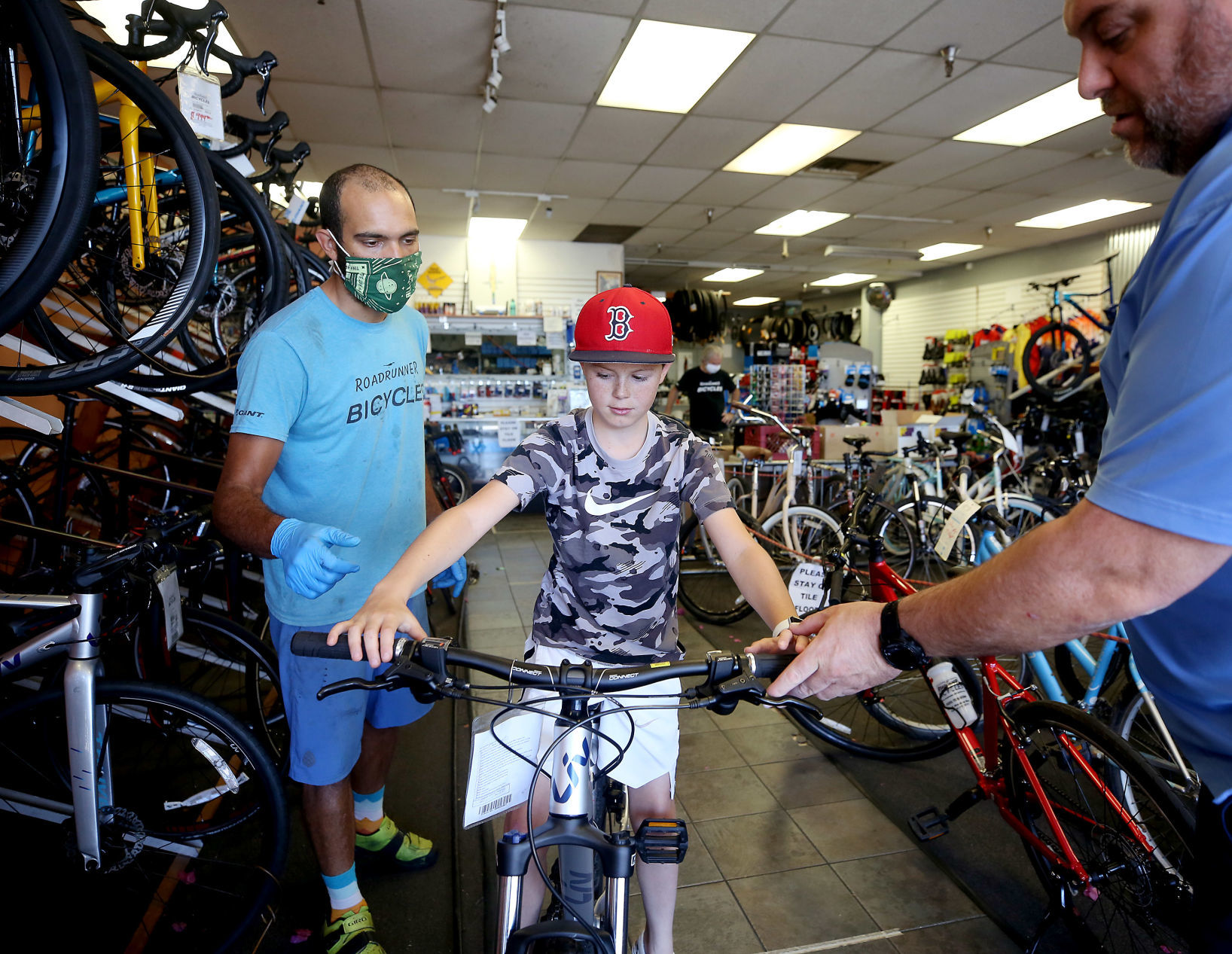
Elliot DuMont, owner of Roadrunner Bicycles, 6177 E. Broadway Blvd., far left, helps Ethan Sasz, far right, and his son, Evan, 10, with a mountain bike purchase on April 22, 2020. The coronavirus disease (COVID-19) has not slowed down bike shops. With many people at home, they are bringing bicycles for repairs and buying new ones for exercise. Dumont says he's booked out till the first week of May for tuneups on bikes.
Tucson, coronavirus
Updated
Marcella Montoya waits in her vehicle as general manger David Kessler brings out her order, as Bear Canyon Pizza serving their customers despite COVID-19 restrictions, April 22, 2020, Tucson, Ariz.
Tucson, coronavirus
Updated
Kitchen manger Koa Hoffmann tosses dough while working up a crust for a call-in order as he and few others keep cooking at Bear Canyon Pizza despite COVID-19 restrictions, April 22, 2020, Tucson, Ariz.
Tucson, coronavirus
Updated
Alvaro Enciso, a local artist, works in one of his studios at his home on April 9, 2020. Every Tuesday Enciso travels into the Sonoran desert to post crosses where migrants have died after crossing illegally over the U.S./Mexico border as part of a project he's titled Donde Mueren Los Suenos / Where Dreams Die. With the outbreak of the coronavirus disease his six year project is on hold and instead he works on other artwork at home.
Tucson, coronavirus
Updated
Dolly Spalding works on a pen and ink drawing in her apartment at the Redondo Tower Apartments on April 7, 2020. During her quarantine, Spalding has been creating drawings of all the Greek goddesses. She is collaborating with Emlyn Boyle, an artist from Ireland, and plans to publish a book with Boyle's writings.