



When it comes to asteroid samples, you can never have too much of a good thing.
On Wednesday, jubilant NASA officials offered the first glimpse of their surprising haul from the University of Arizona-led OSIRIS-REx space mission to the asteroid Bennu: an estimated 250 grams of rocks and dust dating back to the formation of the solar system.
That’s about four times more than the mission’s original objective.
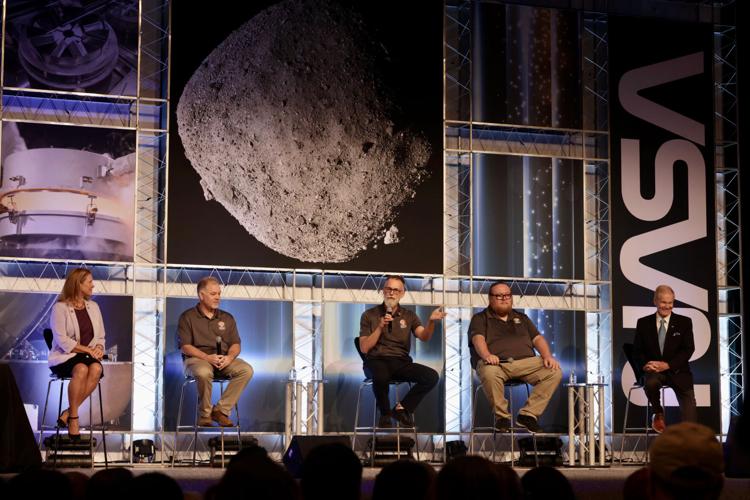
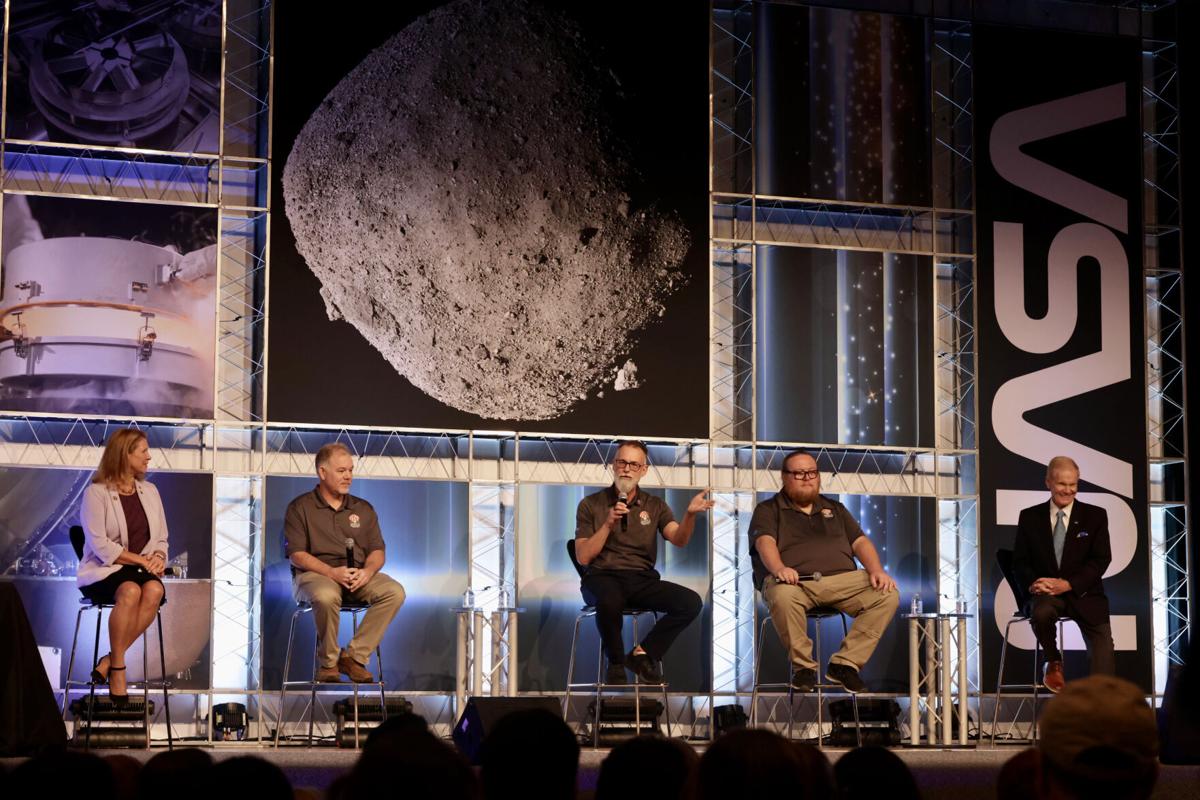
The first bits of the material were unveiled during a news conference at Johnson Space Center in Houston. The images show rough, rocky debris the color of coal that scientists said is filled with carbon and other building blocks of life. It also contains tantalizing evidence of water, including clay fibers.
“Already this is scientific treasure,” said OSIRIS-REx principal investigator and UA Regents’ Professor Dante Lauretta.

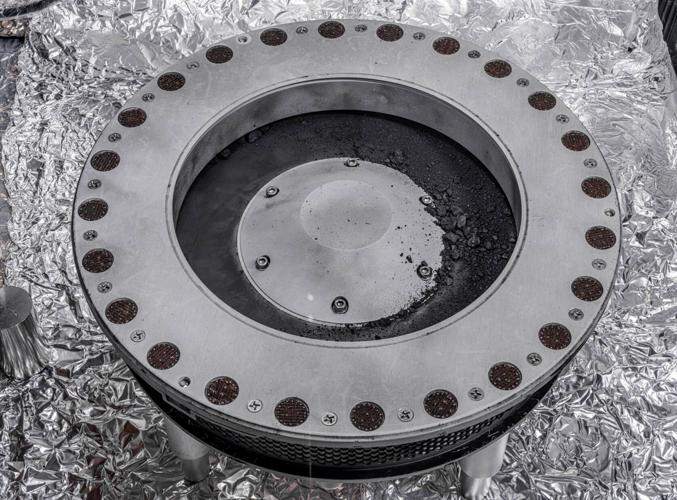
This photo provided by NASA on Wednesday shows the outside of the OSIRIS-REx sample collector with material from asteroid Bennu at middle right. Scientists have found evidence of both carbon and water in initial analysis of this material. The bulk of the sample is located inside.
And that’s just the stuff that was stuck to the outside of the spacecraft’s sampling arm. The mission team still hasn’t cracked open the OSIRIS-REx science canister containing the bulk of what was brought back from Bennu.
So much material was collected that it ended up spilling out of the sampling head and coating the avionics deck of its sealed return capsule, which safely landed back on Earth late last month.
Nicole Lunning, NASA’s curation lead for the mission, called it the “extra, bonus sample” — mostly dust and tiny stones no bigger than “the short width of a grain of rice.”
Specialists at the new OSIRIS-REx Sample Curation Laboratory that NASA built at Johnson Space Center have spent the past three weeks painstakingly collecting every grain from the inside of the capsule and the outside of the sampling head. More than a gram of tiny rocks and asteroid dust have been swept up so far.
The science canister, known as TAGSAM, won’t be opened until that work is done, though initial analyses suggest there is a great deal of quality in all that quantity.
“This stuff is an astrobiologist’s dream,” said Daniel Glavin, OSIRIS-REx sample analysis lead from NASA’s Goddard Space Flight Center in Maryland. “We picked the right asteroid, and, not only that, we brought back the right sample.”
Special delivery
Scientists hope their overflowing cupful of roughly 4.5 billion-year-old dirt will unlock clues about the origins of the solar system, the Earth and life itself.
Lauretta said the largest rock analyzed so far is about 2 millimeters across, roughly the thickness of a nickel.
The black powdery material contains almost 5% carbon by weight, a concentration that wowed even the scientists who did the initial testing. “And when a scientist says, ‘Wow,’ that’s a big deal,” Glavin said.
During Wednesday’s news conference, he showed off an electron microscope image of a dust grain speckled with bits of organic material that glowed like stars under ultraviolet light.
“This thing is loaded with organics,” he explained.
Glavin said he is eager to get some samples back to Goddard so he can make what he called “Bennu tea” and look for amino acids, peptides and other building blocks of life using instruments and techniques that didn’t exist yet when the OSIRIS-REx mission was first proposed almost 20 years ago.
A few tiny bits of Bennu are already being fussed over at the U of A’s Kuiper Space Sciences Building, where a world-class suite of labs has been assembled in the basement to probe the asteroid grains down to the atomic level.
The first samples were hand-delivered to the university from Houston late last week by U of A professor Thomas Zega and assistant professor Pierre Haenecour, both of whom served on the NASA “quick-look team” that performed the initial characterization of the asteroid material.
“It was kind of weird to walk through the airport and know that we had that really invaluable material in our carry-ons,” Haenecour said.
They brought back one vial and about a half-dozen glass slides containing a few milligrams of asteroid particles. Haenecour said one of his students was already looking at the stuff through an electron microscope on Wednesday.
“Everybody is very excited and very eager to get to work on it,” he said.
This has already been an unforgettable experience for Haenecour. His role on the quick-look team was to gather the first optical images of the sample, so he was among the first to look at it under magnification and take its picture.
“As someone who grew up loving rocks, I would never have imagined I would be looking at asteroid samples one day,” he said.
From a scientific perspective, the material is considered priceless. But if you had to assign a value to it, this cupful of rocks and dust is worth roughly 71,000 times its weight in gold. (If you’d like to double-check that math, gold is currently selling for approximately $1,848 an ounce, while NASA spent $1.16 billion — or almost $132 million an ounce — to bring back 8.8 ounces of debris from Bennu.)
In the coming months, about 25% of the sample will be turned over to the U of A-led science team for two years of detailed analysis at labs in Tucson and around the world.
Over 200 scientists at more than 35 research institutions are already lined up to conduct that work.
“The science team can’t wait to get their hands on it,” Lauretta said.

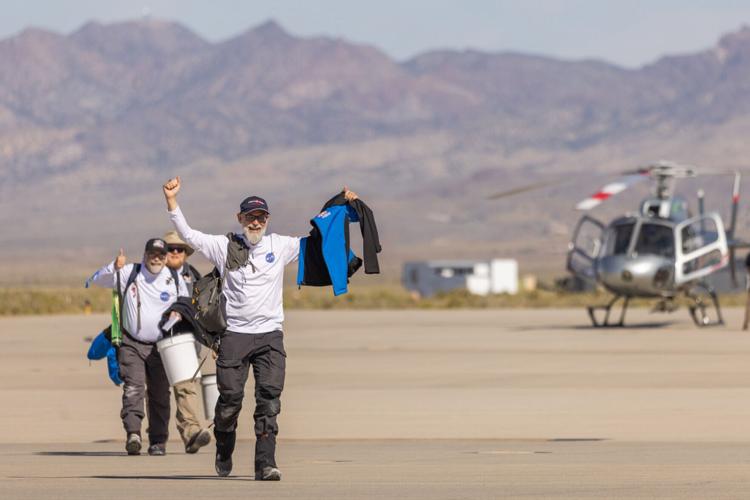
The University of Arizona’s Dante Lauretta, lead scientist for NASA’s OSIRIS-REx mission, signals the success and celebrates the triumph after a capsule containing materials from the asteroid Bennu landed last month on a Utah military range, capping a space mission conceived in Tucson and led by the UA.
Most of the Bennu bonanza will be carefully stored at Johnson Space Center for future research, joining the world’s largest collection of extraterrestrial materials from other asteroids, comets, Mars, the moon, the sun and dust from distant stars.
“Picture-perfect”
Tucson is one of just three places nationwide where samples from Bennu will be displayed publicly for the first time later this year.
The U of A’s Alfie Norville Gem & Mineral Museum downtown is slated to receive a tiny piece of the asteroid, as will the Smithsonian Institution in Washington, D.C., and Space Center Houston, the science museum at Johnson.
When NASA approved the U of A’s proposed mission in 2011, its stated goal was to bring back at least 60 grams of pristine asteroid regolith.
OSIRIS-REx was launched from Cape Canaveral, Florida, in September 2016.
The robotic spacecraft the size of a passenger van arrived at Bennu in December 2018, and briefly touched down on the asteroid on Oct. 20, 2020, to collect its sample.
After a journey of almost 4 billion miles, the seven-year mission came to a dramatic conclusion on Sept. 24, when the spacecraft’s sample-return capsule streaked through the atmosphere and landed safely at the Utah Test and Training Range west of Salt Lake City.
The capsule was flown to Houston the following day and delivered intact to the curation facility at Johnson.

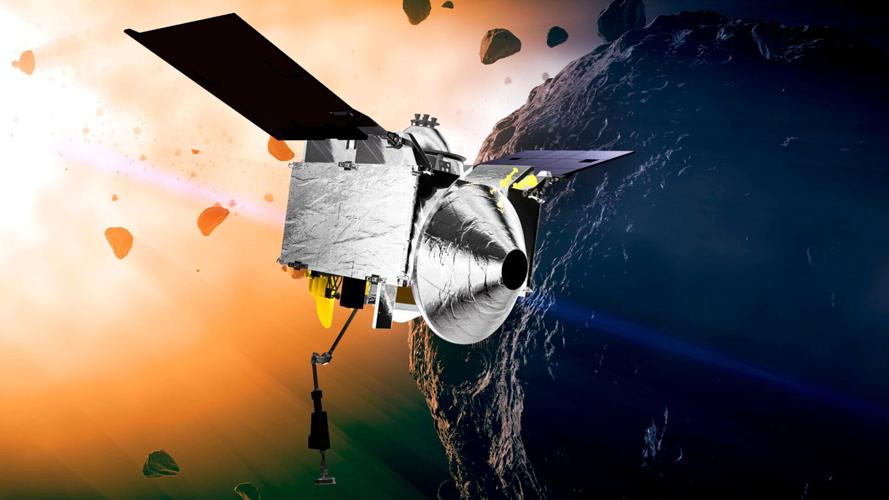
This illustration depicts the OSIRIS-REx spacecraft at the asteroid Bennu.
All the work in the curation lab is being done in a sterile cleanroom using glove boxes to keep the material as pristine as when it landed, said Francis McCubbin, NASA’s OSIRIS-REx deputy curation lead at the space center.
That’s the multigenerational gift of a sample-return mission, McCubbin said. “Scientists that haven’t been born yet will be able to use these samples to answer questions about our universe using instruments that haven’t even been invented yet.”
Wednesday’s news conference doubled as celebration of OSIRIS-REx and its mission team, which includes the U of A’s Lunar and Planetary Laboratory, Goddard Space Flight Center and Colorado-based Lockheed Martin Space.
The slickly produced sample-reveal event was held in a theater filled with people, including students from Houston-area schools, and broadcast live on NASA TV.
NASA Administrator Bill Nelson led the praise for OSIRIS-REx. “It was a picture-perfect mission,” he said.
After the news conference, Nelson and other NASA officials headed to Florida for the launch of the agency’s next big asteroid endeavor.
At 7:19 a.m. Tucson time on Friday, Oct. 13, a SpaceX Falcon Heavy rocket is scheduled to blast off from Kennedy Space Center carrying a robotic spacecraft on a journey to the metal-rich asteroid Psyche in orbit between Mars and Jupiter. That mission is being led by Arizona State University.

