


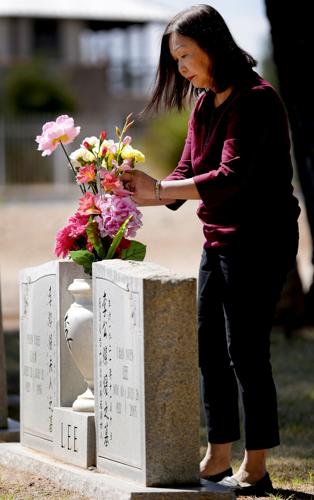

For the first time in about 30 years, Tina Liao is going home for Ching Ming, a Chinese festival honoring family ancestors.
That means she had to miss the festivities at Evergreen Mortuary and Cemetery Saturday — only the second time the cemetery has partnered with the Tucson Chinese Cultural Center to recognize the holiday.
Liao, a member of the center’s executive board, worked with others to make the day happen as part of an ongoing effort to teach younger generations about traditions held dear by parents and grandparents.
Ching Ming, like the Chinese New Year, is a significant holiday in Chinese culture, though the Communist Party repressed it for years before it was reinstated as a public holiday in 2008.
The actual holiday this year is Wednesday, April 5, Liao said.
“These holidays are imperative to our culture, and we have noticed that the younger generation has no clue what they are,” said Susan Chan, the executive director of the Tucson Chinese Cultural Center. “Our board of directors has a vision to educate and cultivate little kids. Even people under 60 don’t know what Ching Ming is. The first generation of parents are slowly dying, and their kids, 60-year-olds even, don’t know.”
The Saturday event was about educating and honoring, with a presentation on the festival at Evergreen in the morning and a second event in the evening. Throughout the day, families could stop by the cemetery to pay respects to loved ones now gone.
Peter Callaghan, the general manager of Evergreen, is the one who approached the cultural center about creating a partnership for Ching Ming after learning about the celebrations held in cemeteries in San Francisco.
“We have been taking care of the Chinese community for a lot of years here at Evergreen, and before last year, I didn’t know what Ching Ming was,” Callaghan said. “We wanted to support the Chinese community as they have been using Evergreen for many years.”
Chan has found that some families prefer not to talk about their practices for this day of “tomb sweeping,” and while everyone honors their ancestors in personal ways, the traditional staples of Ching Ming include cleaning the area around the tomb, burning incense and faux money and paper cutouts of other material goods, bringing food and drinks to set and pour on the grave, bowing multiple times and asking the ancestor for future blessings.
This is what Liao, 54, is doing with her family in China as she did so many years ago.
It’s a process of communicating to ancestors “I hope you will be OK on the other side. We sent you more money and clothes, and please bless my children with a good life,” Liao said. “It’s not just to show respect for them, but to ask them to bless my generation or the next generation.”
Liao will travel to the river in China where her parents’ ashes were scattered. All of these years in Tucson, she did a makeshift ceremony by facing photographs of her parents east and presenting the offerings and incense to the pictures. Then, she and her sister and their children would ask for blessing and bow.
“It means a lot,” she said of returning for Ching Ming with her husband and 30-year-old daughter. “You can stand in front of your ancestors to show respect. It’s different from what we do here.”
In 1988, Liao followed her husband to Tucson, where he was getting his master’s degree at the University of Arizona. They stayed but remained connected to China.
But that connection can fade over generations.
Patsy Lee is the 65-year-old senior program director for the Tucson Chinese Cultural Center. Her grandfather moved to San Francisco, bringing Lee’s father and his brother when they were young boys.
Lee grew up with a mother who wrangled the family to adhere to the traditions of Ching Ming, but since her passing Lee’s own observance of the festival has dwindled to stopping by the cemetery with flowers. Her three siblings do the same when they have a moment on the day.
It’s not the family affair it once was.
“I have a feeling if we didn’t go my mom would turn in her grave and spank us even at our age,” said Lee, who was raised the U.S.
But even her knowledge of the holiday is unique as it fades from memory in the minds of many.
That has to do with a variety of factors including Americanization, the repression of the festival in China and Chinese Christian communities that tend not to observe the holiday, Lee and Liao said.
“Here in America, a lot of Asians are Christian and we honor our parents but don’t worship them like ancestry worship,” said Allen Lew, president of the center’s board. He was born in the U.S., to parents who made the move to Tucson in the 1930s.
Those that didn’t grow up observing Ching Ming likely don’t know much about it, Lee said. And even if families choose not to observe the festival, the center wants to at least keep the memory of the traditions alive.
“It was something we kind of grew up with,” Lee said. “I know (the cultural center) wants to make it a bigger thing because my generation that was born and raised in Tucson, we have lost that.
“... The cultural center is trying to bring it back and teach the younger generation that this is what our parents did, that you honor your ancestors because people need to remember that you wouldn’t be here or have what you do if they didn’t provide for you.”

