




Boudinot Bakewell Atterbury — whose family name would later be given to a wash in Tucson — was born in 1892 in Beijing, China, where his parents were missionaries.
His parents were Dr. Boudinot C. and Mary (Lowrie) Atterbury.
Around 1897, Atterbury went chasing after his father and ended up getting the front of his foot run over and mangled by a trolley. His father had to amputate the front of his own son’s foot since there was no one else to help. The front part of his foot was replaced with wood and the heel remained his natural foot.
By 1900, the family, including two younger sisters Marguerite and Olive, had taken up residence in San Rafael, California, and within five years more relocated to Pasadena, as the father worked as secretary and physician of the Los Angeles City Mission Society.
While residing in the Los Angeles area, the younger Boudinot Atterbury grew to enjoy fishing, becoming the youngest member of the Light Tackle Club, a group that fished using regulation light-tackle gear. He even made the Los Angeles Times, in 1909, with a photo of himself and a huge fish he had caught near Santa Catalina Island.
According to his grandson, Boud T. Atterbury, “He was on the boat all by himself when he caught this massive fish. Neither his father nor anyone else was there to help in the fight to reel this big bass into the boat.”
In 1910, his mother died after being in poor health. He attended Lawrenceville School in New Jersey, graduating around 1912. He went on to Princeton University, receiving a bachelor’s degree in literature in 1916.
While at Princeton, Atterbury began dating Ruth Rand, who at the time was attending Wellesley College in Massachusetts. It’s likely he took the train to go see her. She later attended Cornell and Columbia universities.
By 1917, when the U.S. declared war on Germany, Atterbury was residing in Baltimore, Maryland. Even though he had lost his right foot, he refused to accept an exemption from military duty and demanded to be accepted into the military. He believed he could perform some service and wanted to, and was recommended for service in the quartermasters department although he wasn’t accepted.
In 1918, his uncle, Rev. Anson P. Atterbury, held a ceremony to marry his nephew to Rand at her parents’ house in Brooklyn, N.Y., with the couple planning to reside at Gramercy Park, Manhattan, a well-to-do neighborhood. However, by 1926, they were living on Long Island, N.Y., in a home they named Ramshambles, because they had a pet ram and it left their house in disarray. They had children June, Joan and Boudinot Phelps Atterbury.
From 1917 to 1929, Atterbury worked at the Guaranty Trust Co. of New York, first as manager of the securities department, then as company vice president. He was resident vice president of the New York offices of the Foreman-State Corp., a national investment company, from 1929 to 1931, before becoming assistant vice president of National City Bank of New York from 1932 to 1937.
Then, for a couple of years, Atterbury served as president of Consolidated Coppermines Corp., which operated a large mine at Kimberly, Nevada, but he seems to have left the company after an internal power struggle.
In the early 1940s, he began acquiring land in the San Marcos, California, area, north of San Diego. After 1943 it’s likely he made permanent residency in California.

Joan Atterbury with one of her horses in Tucson.
In 1947, Atterbury and his wife made their first-known of several land purchases of the old Kinnison Lake property, on the east side of Tucson along the Pantano River.
Their daughter Joan, who had by this point graduated from the Orme Ranch School near Mayer, Arizona, Brownmoor School in Santa Fe, New Mexico, and Wellesley College, had spent some time back at the Orme Ranch School as a teacher. In 1948, Joan applied for and received a fellowship from the University of Arizona to be a teacher’s assistant in bacteriology.
By 1949, she is believed to have moved out to the old Kinnison Lake property, and also received an assistantship to research animal pathology, working on a research project called “Range livestock losses from poisonous plants.”
By 1952, Joan’s parents were spending part of their time in San Marcos and part in Tucson.
In 1957, Atterbury and his wife sold their property in San Marcos and are believed to have moved to Tucson, residing with their daughter for a year or two. By this point it’s believed that their daughter was raising race horses at the Kinnison Lake property. But in time, with urban sprawl beginning to encroach on their peaceful land, they wanted out.
In 1959, Atterbury offered the Kinnison Lake property, which included a two-bedroom home, outbuildings, a tack room and corral, to Pima County as a future park for $85,000, a very generous price according to Gilbert Ray, (namesake of Gilbert Ray Campground in Tucson Mountain Park), county recreation director at the time.
In a meeting with the Pima County Parks and Recreation Committee on Jan. 21, 1959, Atterbury said, “We are very much interested in the county getting it. We’ve enjoyed living out there ourselves. Now we’d like to look forward to sitting on a park bench and enjoying it in later years.”
He continued, “Although the lake basin is 20 acres, the size of the lake itself varies.” He said there was usually some water in it and if it were sealed, the lake could be kept at a high level all the time.
The offer to Pima County to purchase the property apparently fell through and the Atterburys moved to New Mexico, buying the Palovista Ranch, near La Madera. Soon after, in 1960, they sold the Tucson property to the Arizona Land Title & Trust Co., which conveyed it to the Lusk Corp.
In turn, Lusk built the Lakeside subdivisions, giving their homes water-themed names like The Laguna, The Malibu and The Tahoe, as well as the streets names like (Lake) Champlain Avenue, (Lake) Victoria Drive and (Lake) Mead Avenue.
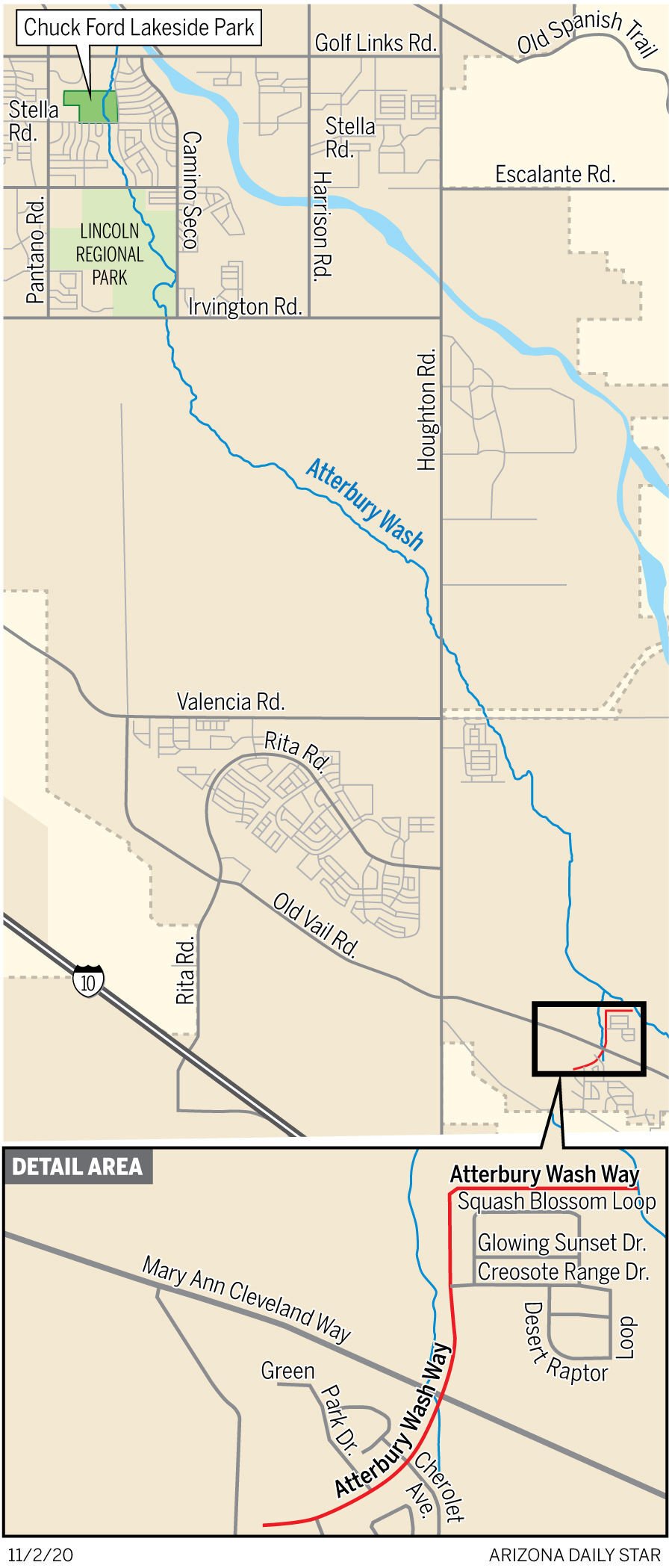
The company originally planned on calling Kinnison Lake “Lake Tucson” but ended up calling it Lakeside Lake. It is located at Chuck Ford Lakeside Park on Stella Road.
Boudinot B. and Ruth Atterbury would spend the rest of their lives in New Mexico. Ruth died in a car accident in 1973 and Boudinot died in 1976. Joan Atterbury married a cowboy named Claude Lowery and they ran the Palovista Ranch together for awhile. She died in 2000.
The Atterbury family name lives on in Tucson in the Atterbury Wash on the east side, right next to Lakeside Lake; and further south in the street Atterbury Wash Way in the Vail area and the Atterbury Trails Planned Community Development near Irvington Road and Houghton Road.

