


Negotiators in the Colorado River Basin weren't able to reach a seven-state agreement to cut water use by Saturday's federally imposed deadline.
A series of announcements saying so came out Friday from various states, just as the U.S. government released one of its bleakest forecasts ever for how low Lake Powell will go.
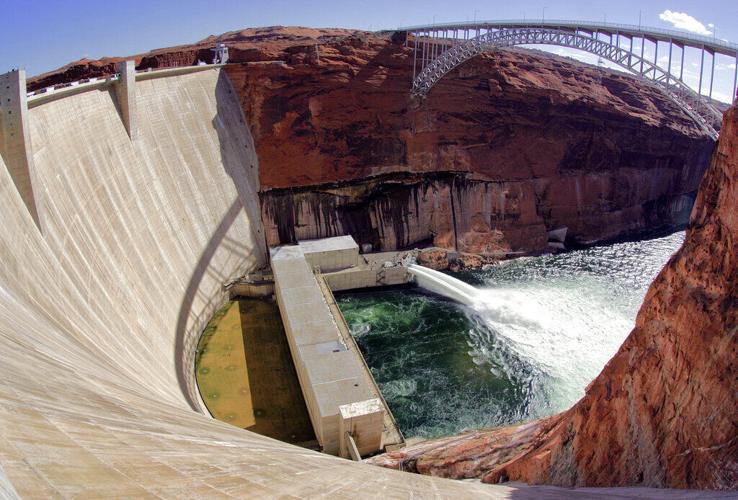
That forecast showed the most likely outcome is that Lake Powell will fall below 3,490 feet — the lowest level at which Glen Canyon Dam can generate electricity — by December 2026. In that "most probable" forecast, the lake is expected to fall below 3,500 feet — the lowest level that the U.S. Bureau of Reclamation wants it to fall — as early as September 2026.
The forecast also has Powell falling to 3,476 feet — its lowest level since Glen Canyon Dam's construction created the lake in the 1960s — by March 2027.
A more pessimistic forecast, which is often more accurate than the "most probable" forecast, projects the lake will fall below 3,490 feet as soon as August 2026.
Those alarming forecasts will increase pressure on the basin states and the federal government to come up with some way to reduce water use to prevent the lake from falling that low. The officials have all expressed hope of reaching agreement on new operating guidelines for the river and its reservoirs to take effect in 2027, after the current guidelines expire later this year.
But the lack of agreement between the Colorado River's Upper and Lower basins clearly increases the risks of litigation, something state officials have said they've very much wanted to avoid, said Sarah Porter, a top Arizona State University water researcher.

The federal government's latest forecast shows the most likely outcome is Lake Powell will fall by this December to the lowest level at which Glen Canyon Dam, shown here, can generate electricity. This comes as the seven states that depend on Colorado River water failed again to reach agreement on how to cut water use as the river declines.
On Friday morning, the governors of Lower Basin states Arizona, California and Nevada released a statement saying, "The federal deadline for a consensus agreement on managing the Colorado River after 2026 is passing for a second time without resolution."
Mid-afternoon Friday, the Upper Basin states — Colorado, New Mexico, Utah and Wyoming — released a similar statement.
In an interview Friday afternoon with the Star, Arizona Department of Water Resources Director Tom Buschatzke said the states' failure to reach agreement came despite seven "face to face" meetings of their representatives, held virtually, just in the past two weeks.
Most recently, "we had a meeting today," he said.
He and other officials of both basins said they would keep trying to reach an agreement through negotiations. Their window of time is narrowing greatly, however, before federal officials might impose a top-down solution.
That's because the Bureau of Reclamation wants to finish work on its environmental impact statement on the river and make a decision on future management of it by late summer or early fall.
"The stakes couldn’t be higher for our Lower Basin states of Arizona, California, and Nevada. Approximately 75% of the population, employment, and agricultural crop sales of the Colorado River Basin are in our states. This also includes 25 of the 30 sovereign Tribal Nations that live within the basin," the Lower Basin states said in their statement.
In theirs, the Upper Basin states said, "The Upper Division States have negotiated in good faith to reach a durable, long-term, basin-wide agreement on post-2026 Colorado River operations.
"We have consistently offered compromises to develop a supply-driven operational framework as a practical and realistic path forward. In addition, we appreciate Reclamation providing concepts rooted in compromise that are largely aligned with many of our core concepts."
ADWR's Buschatzke, however, said in a statement, "Throughout the negotiations of the post-2026 operating guidelines for the Colorado River, Arizona and its Lower Basin partners have offered numerous, good-faith compromises to the representatives of the Upper Basin states. In that time, virtually all of them have been rejected."
Still deadlocked on key points
These announcements follow three months of fruitless negotiations after the seven states failed to reach an agreement by an earlier federally set deadline of Nov. 11 last year. This time, Reclamation set a Feb. 14 deadline for the states to reach consensus.
"I don’t want to say there's been no progress but not enough progress that a seven-state deal would be imminent," Buechatzke said Friday.
For one of the first times during the private and often secretive negotiations, Buschatzke went point by point over the various disagreements between the two basins in his interview.
The Star reached out to three Upper Basin state officials, including Becky Mitchell of Colorado, the Upper Basin's most vocal advocate, to share their views on the negotiations. None responded in any detail.
Michael Sakas, a spokeswoman for Mitchell, who is Colorado's Colorado River commissioner, responded by sending the Star the Upper Basin's statement that already had been released.

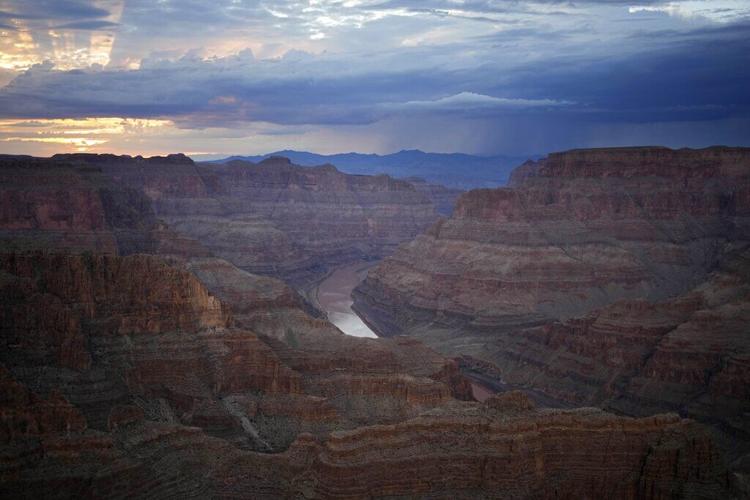
The imperiled Colorado River flows through the Grand Canyon in northwestern Arizona. Negotiators in the Colorado River Basin weren't able to reach a seven-state agreement to cut water use by Saturday's federally imposed deadline.
The seven states have been gridlocked over several key issues. Most prominent is that the Upper Basin states, which use far less water than the Lower Basin states, have refused to commit in writing to making any cuts in water use. They've said declining river flows have already triggered major shortages for many farmers in their basin who rely on river water.
The Lower Basin states, which have far more people than the Upper Basin states, have refused to accept Upper Basin requests and demands that they take all the cuts needed to bring human demands on the river in line with its declining supply.
While the Upper Basin states have shown some willingness to conserve water, they won't contribute any conservation until the Lower Basin states have already cut their use by 2.1 million acre-feet, Buschatzke said. One million acre-feet is equivalent to 10 years of Tucson Water's use.
The Lower Basin states have offered to reduce their use by 1.5 million acre-feet at first, but then want the two basins to split any water use cuts that would be needed after that.
Second, the Upper Basin states want their conservation contribution to be one unit of water for every two taken by the Lower Basin, he said. The Lower Basin states have demanded that the cuts be split 50-50 after those three states take the 1.5 million acre-feet in cuts.
Finally, the Upper Basin states, when they talk about conservation, "it's not the level of certainty we're looking for," Buschatzke said. "It would be voluntary, temporary and compensated."
The Lower Basin states have said they would be willing to guarantee their conservation measures be mandatory and permanent, and would not expect compensation.
'All must share in the responsibility'
The two basins have also argued over how much water should be released from Lake Powell to Lake Mead on a regular, annual basis, and how the releases could comport with requirements in the 1922 Colorado River Compact.
While Lower Basin states say the compact requires Upper Basin states to release 82.5 million acre-feet from Powell over a decade, they said they'd be willing to live with a slightly lower "release curve" if necessary.
Asked about the Upper Basin's position on that, Buschatzke said, "I will just generally say there may be some in the Upper Basin who may think the release curve is too wet, has too much water."
If the two basins could ever agree on water use cuts and on how much water should be released into Powell from upstream reservoirs, "that could be the basis for a deal with that type of a release (schedule) that the Lower Basin finds acceptable," he said.
The Lower Basin governors said in their statement, “Our future management of the Colorado River must be built on a foundation of shared contribution and innovation, with all Colorado River water users stretching to conserve water. Our commitment to a collaborative outcome is unwavering, and we will continue to pursue a negotiated resolution while protecting our water users."
Buschatzke said in a statement, "Arizona remains committed to compromise and accommodation. The negotiations may be at an unfortunate stalemate, but they are not at an end — not, at least, if our river partners in the Upper Basin accept the reality that Arizona cannot be asked to sacrifice its water security while receiving virtually nothing in return."
"Through it all, these difficult negotiations still reduce to a simple truth: All of those who benefit from the Colorado River’s bounty must share in the responsibility to preserve the river’s health," he wrote.
The Upper Basin statement said, "While a seven-state consensus has not yet been achieved, the Upper Division continues to work with the Bureau of Reclamation and Lower Basin partners. We are prepared to set aside long-standing legal arguments to reach a workable agreement that stabilizes the system for the 40 million people in the United States and Mexico who depend on the Colorado River."
Colorado's Mitchell, who also chairs the Upper Colorado River Commission, said in a statement sent by the Upper Basin states, “We’re being asked to solve a problem we didn’t create with water we don’t have. The Upper Division’s approach is aligned with hydrologic reality and we’re ready to move forward.”
In another statement, Utah Colorado River Commissioner Gene Shawcroft said, “The Upper Division is unified, and we continue to seek a path forward. What we need now is for everyone in the basin to be willing to live within the means of the river.”
But John Entsminger, the Southern Nevada Water Authority's general manager, said in his own statement, "As I talk with people throughout Southern Nevada, I hear their frustration that years of negotiations have yielded almost no headway in finding a path through these turbulent waters. As someone who has spent countless nights and weekends away from my family trying to craft a reasonable, mutually acceptable solution only to be confronted by the same tired rhetoric and entrenched positions, I share that frustration."
While he will continue to work with his Colorado River counterparts in hopes of finding a workable solution to this crisis, "we must also prepare to fight for our water supply if it comes to that," Entsminger said.
Noting Southern Nevada residents and agencies have made major efforts to conserve water, including investments, "We have the high ground," he said. "While I hope it doesn’t come to a fight, we are prepared to go the distance to protect the community you call home."
Warm weather, low snowpack
In its monthly forecast, the bureau, for the first time ever, projected that the "most probable" conditions will put Lake Powell below 3,490 feet.
The latest bleak forecast is based on the last few months of continued, unusually warm weather, poor snowpack in the Upper Basin and the likelihood of very low spring-summer runoff into Lake Powell.
It means the bureau will have to either cut releases of water from Lake Powell to Lake Mead to levels lower than previously planned, or release more water than planned from reservoirs upstream of Powell, or both, many outside experts have said.
Until now, the bureau has planned to release 7.48 million acre-feet of water from Powell to Lake Mead this year. But Buschatzke said it's now likely the release will fall below that, though he couldn't say how much below.
He said he also expects the bureau to release more water than normal into Powell from other, upstream reservoirs such as Flaming Gorge at the Utah-Wyoming border. But exactly how much is likely to be a continued bone of contention among the two basins and the bureau.
In 2022, when runoff conditions were forecast to be bad but not as bad as this year's, the bureau cut Powell's release to 7 million acre-feet and released extensive amounts of water from Flaming Gorge and other reservoirs into Powell.
This year, a lack of precipitation over the past month pushed the "most probable" forecast for total flows into Powell down dramatically for what experts call the "water year," running from October 2025 through September 2026, the bureau said.
The current forecast for "water year" 2025-26 flows into Lake Powell is down 1.5 million acre-feet just since January and 3 million acre-feet since November, the bureau said.
The 3 million acre-foot loss in forecasted flows is equivalent to approximately 50 feet in elevation in Lake Powell, the bureau said.
The Upper Basin states seized on the new, poor river/reservoir forecast to underscore their views about why they can't commit to mandatory water use cuts.
"This year is a stark reminder of why all in the Colorado River Basin must learn to live within the available supply, as water users across the Upper Basin are preparing for deep cuts to their water supplies," their statement Friday said.
"These cuts are mandatory, uncompensated and painful. Upper Basin water users are preparing for reductions of more than 2.0 million acre-feet this year. Across the entire Upper Basin, this will amount to reductions greater than 40% of the proven water rights.
"Meanwhile, our downstream neighbors are seeking to secure water from the Upper Division states that simply does not exist."
To help boost Lake Powell’s elevation, Reclamation began lowering monthly releases on Dec. 1, 2025, to temporarily retain more water in the reservoir. Additional operational tools will likely be needed if hydrologic conditions remain as projected or deteriorate further, the bureau said.
Protecting reservoir elevations in 2026 is important to ensure the dams can continue reliable delivery of water and generation of power, the bureau said.
"The basin's poor hydrologic outlook highlights the necessity for collaboration as the Basin states, in collaboration with Reclamation, work on developing the next set of operating guidelines for the Colorado River system," said Acting Reclamation Commissioner Scott Cameron in a news release. “Available tools will be utilized and coordination with partners will be essential this year to manage the reservoirs and protect infrastructure.”

