


With no seven-state agreement for the Colorado River in sight, the U.S. Bureau of Reclamation is likely to focus on a plan that would cut river water deliveries to the Central Arizona Project by more than three-fourths, two outside experts said.
That plan is one of five alternatives the bureau is reviewing under its draft environmental impact statement for the river. It's the alternative the bureau designed specifically for use in the event the seven river basin states can't agree on a solution for the depleted river's chronic deficit between water use and supply, said the draft, released in mid-January.
But while this plan would cut CAP supplies by 77%, the outside experts — retired bureau official David Wegner and longtime Colorado River researcher Eric Kuhn — said it could very well be changed, based on what kind of public comments the bureau gets. The public comment period on the draft environmental impact statement ends on March 2.
The CAP canal system delivers Colorado River water to cities and towns in the Tucson and Phoenix areas, as well as to farmers.

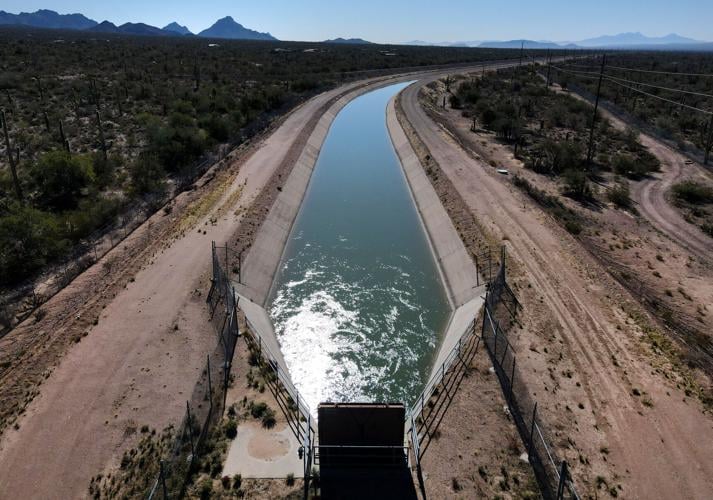
The Central Arizona Project canal, shown near Sandario Road and Mile Wide Road northwest of Tucson, brings Colorado River water to Tucson for its drinking supply.
Losing 77% of CAP water would deliver a major blow to arid Arizona's drinking supplies, since the river now provides about 36% of all the water the state uses. The impacts wouldn't be immediate in many cases, because Tucson and several other cities, along with the state-run Arizona Water Bank, have recharged millions of acre-feet of river water into the ground to be pumped out if needed in emergencies like that.
But a cut of that scale would over time, force more and more users to rely on natural, ancient and non-renewable groundwater supplies — a practice CAP was built to put a halt to.
Beyond that, if the Lower Basin states of Arizona, California and Nevada continue to agree on their own current blueprint to split water-use cuts much more evenly than the 77% for Arizona, "I can't imagine" the U.S. Interior secretary would turn them down, said Kuhn. The Interior Department oversees the Bureau of Reclamation, which manages river operations.
As of now, in a plan the three Lower Basin states have proposed to the feds, Arizona has agreed to take annual cuts of about 760,000 acre-feet of water, while California has agreed to cut about 440,000 acre-feet. Nevada and Mexico would take much smaller cuts.
CAP ranks very low in priority for the water
The reality of no seven-state agreement is facing the federal agencies now that the states missed the Feb. 14 deadline the bureau set for them to reach consensus on a plan to scale back their water use.
The plan in the bureau's environmental report that the outside experts consider a likely alternative, known as the Basic Coordination Alternative, would reduce total river water use by 1.148 million acre-feet at most, a lesser amount than some other alternatives under consideration.
By contrast, two other alternatives would cut river water use by up to 3 million and 4 million acre-feet, respectively. A million acre-feet would be enough to serve Tucson Water customers for close to a decade.
But the Basic Coordination Alternative would cut CAP's — and Arizona's — total water use by 77% because it bases the reductions on the priority that individual states and water users have under the law for getting Colorado River water.

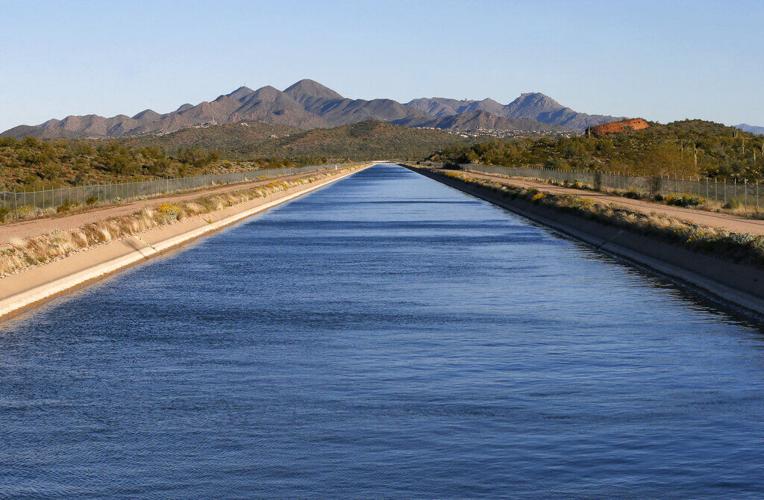
The Central Arizona Project canal cuts through the desert near Fountain Hills, Arizona. The 336-mile long system of aqueducts, tunnels, pumping plants and pipelines is the largest single resource of renewable water supplies in Arizona.
CAP, which would swallow all of Arizona's cuts under this plan, ranks very low in priority during river water shortages because of an agreement Arizona made in 1968 as part of the federal law that year authorizing CAP's construction. Arizona officials agreed to that low priority because it was the only way it could get support for CAP's approval from more politically powerful California officials.
The Basic Coordination Alternative, as it now stands, wouldn't cut California's share of river water at all. That matches the 1968 act's provision saying California wouldn't have to give up any of its Colorado River water until Arizona gave up all of its CAP supply.
Feds will move forward as states deadlock
Bureau officials have made it clear since at least December that if the states couldn't reach an agreement reasonably soon, the U.S. government would move ahead and devise its own plan.
On Saturday, the day of the deadline, the bureau made it official that its parent agency, the Interior Department, will now move forward with finalizing new operating guidelines for the river's reservoirs by Oct. 1, the day after the current guidelines expire.
"While the seven basin states have not reached full consensus on an operating framework, the department cannot delay action. Meeting this deadline is essential to ensure certainty and stability for the Colorado River system beyond 2026," the bureau said.
At the same time, the bureau's news release made it clear the agency would be open to considering another plan if the seven basin states ever reach an agreement.
“Negotiation efforts have been productive. We have listened to every state’s perspective and have narrowed the discussion by identifying key elements and issues necessary for an agreement. We believe that a fair compromise with shared responsibility remains within reach,” said Interior Secretary Doug Burgum in the news release.
“I want to thank the governors of the seven basin states for their constructive engagement and commitment to collaboration. We remain dedicated to working with them and their representatives to identify shared solutions and reduce litigation risk.
"Additionally, we will continue consultations with tribal nations and coordinate with Mexico to ensure we are prepared for water year 2027," said Burgum. He was referring to the period between Oct. 1 of this year and Sept. 30 next year that water officials typically refer to as a water year.
Least risky option politically
In its draft environmental report, the bureau said the Basic Coordination Alternative is designed to be carried out, if necessary, "without agreements among basin water users regarding distributions of lower Colorado River mainstream shortages, storage and delivery of conserved water from system reservoirs, or other voluntary agreements."
Politically, this option is the least risky for the bureau because it literally meets requirements of the Law of the River, said Wegner, a former bureau engineer and environmental planner who now sits on a National Academy of Sciences panel on water issues. The Law of the River is a collection of federal laws, regulations and court precedents governing how the government should manage the Colorado River.
"They could pick any of the five alternatives," Wegner added. "This one has all the elements they need to do to stay legal. That’s the way the laws are written, as of today."
Arizona officials have made it clear, however, that they oppose all five river management plans the bureau is reviewing, including one calling for no action. Arizona's officials say all the alternatives fail to adequately describe the social and economic impacts of the cuts being proposed on affected states and communities.
They also say the statement fails to deal with issues involving the 1922 compact, which requires the four Upper Basin states to deliver a minimum amount of river water every decade to the Lower Basin. They're also unhappy that the alternatives don't require any cuts from the Upper Basin states, which are Colorado, New Mexico, Utah and Wyoming.
The Basic Coordination Alternative is one of three under review that would subject the CAP to huge cuts, project officials said recently. The other two would slash CAP deliveries by 98% and 82% respectively, while two others would cut CAP supplies by 33% and 32% respectively.
"Absolutely," the bureau could change its mind depending on what sorts of public comments it gets, Wegner said.
"The beauty of NEPA (the National Environmental Policy Act, which requires reviews of major federal actions) is that in theory, if you get some good feedback from the public or whoever, you can integrate that into the final Record of Decision," Wegner said. "You are not bound by the alternatives you lay out if you get more information."
While the Basic Coordination Alternative "is not necessarily cast in stone, if the (Interior) secretary wants to cast it in stone, he could," said Kuhn, retired general manager of the Colorado River District, which serves northwest Colorado. "Normally, in an EIS, the secretary evaluates comments he gets on the draft to make a decision."
While it's very early to speculate on how Interior and the bureau might ultimately resolve this matter, "at the same time, I can't imagine if the three Lower (Basin) continue their current plan for sharing of shortages, that the secretary would deny that," Kuhn said.
Tony Davis graduated from Northwestern University and started at the Arizona Daily Star in 1997. He has mostly covered environmental stories since 2005, focusing on water supplies, climate change, the Rosemont Mine and the endangered jaguar. Tony and David talk about the award winning journalism Tony has worked on, his journey into journalism, Arizona environmental issues and how covering the beat comes with both rewards and struggles. Video by Pascal Albright/Arizona Daily Star
Tony Davis graduated from Northwestern University and started at the Arizona Daily Star in 1997. He has mostly covered environmental stories since 2005, focusing on water supplies, climate change, the Rosemont Mine and the endangered jaguar. Tony and David talk about the award winning journalism Tony has worked on, his journey into journalism, Arizona environmental issues and how covering the beat comes with both rewards and struggles. Video by Pascal Albright/Arizona Daily Star
Tony Davis graduated from Northwestern University and started at the Arizona Daily Star in 1997. He has mostly covered environmental stories since 2005, focusing on water supplies, climate change, the Rosemont Mine and the endangered jaguar. Tony and David talk about the award winning journalism Tony has worked on, his journey into journalism, Arizona environmental issues and how covering the beat comes with both rewards and struggles. Video by Pascal Albright/Arizona Daily Star

