



ARIVACA —
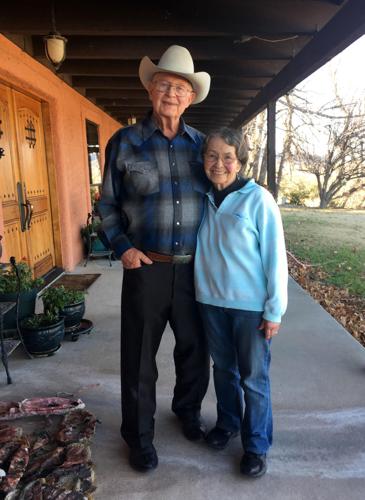
Jim and Sue Chilton keep scrapbooks containing the business cards and contact information of all the journalists who visit them.
They’ve filled two of the handmade books already, thanks to a parade of photographers and reporters, producers and videographers, from across North America, Europe and even East Asia. On Thursday, they added my card to a third scrapbook, which they started recently as a new wave of reporters tramped south past Arivaca to their ranch house to capture their views.
The Chiltons, as much as anybody in Southern Arizona, have come to represent borderland residents in news coverage of security issues along the U.S.-Mexico line. Jim Chilton even met with President Trump Jan. 14 and was invited on stage, in front of 7,000 people, where he delivered a strong endorsement of Trump’s border-wall proposal.
“Mr. President, we need a wall,” Chilton said, drawing an ovation from the crowd at the Farm Bureau Federation convention in New Orleans. “I would say we need a wall all the length of the border.”
But while the Chiltons’ embrace of the wall-first approach to border security is undoubtedly sincere, the couple is also not representative of border-region residents, for sure, and not necessarily even of border ranchers in the specifics of their views.
Still, journalists and politicians find again and again that the allure of the rock-ribbed border rancher is impossible to resist, and so they make the Chiltons or one of the other standby ranchers a part of every tour and fact-finding mission.
It grows tiresome to people in Arivaca and some other border towns, where some residents feel they’re being misrepresented.
“I value their opinion,” Nogales, Arizona community organizer and Democratic activist Mary Darling said, speaking of border ranchers in general. “Many of them have been (multi) generational ranchers, and I understand that. It feels as though we have their opinion to excess. Whatever else happens, and whoever else experiences the border, doesn’t count as much.”
I’ve noticed this over 22 years of covering border issues. Politicians and reporters, when they want to consult with border residents, never miss ranchers, even though they are a small, unrepresentative segment of the borderland’s population — wealthier, whiter and older — compared to the townspeople in places like Nogales, Douglas and Bisbee.
To an extent, the attention is justified. The Chiltons are among a handful of neighbors who have grazing leases that front on a 25-mile, wild stretch of the border between the Nogales fence and the Sasabe fence with no barriers.
The Chiltons are not among the multi-generational ranchers in the area — they’ve owned their place for three decades, but they’ve been here long enough to see the wave of Mexican migrants wash ashore in the early-mid 2000s, then disappear as drug backpackers took over the routes across their lease.
Jim and Sue Chilton are also political veterans. Jim was a staff member for Sen. Carl Hayden early in Chilton’s career; Sue has been active on the Arizona Game and Fish Commission.
For years, they’ve been speaking out on the outrageous situation they say they find themselves in. Their point of view has found renewed prominence during the recent shutdown. On Saturday, Jim Chilton was featured on a new video put out by the White House.
“I’m outraged that the border isn’t secure,” Jim Chilton told me Thursday. “I’m outraged that now most of the traffic appears to be drug packers coming through. And I’m outraged that there are cartel scouts on our mountains, and the Sinaloa Cartel has control of our ranch.”
I asked what he meant by “control.” He said they use mountaintop spotters and satellite phones to avoid detection by American authorities. The idea that this means the cartels “control” the area has become a common argument over the years, but I don’t see it that way. Even if they can move their loads, no one controls the area. And that’s the real problem, in my view.
But it isn’t a problem that a wall could solve, at least not a wall or fence alone. Even the Chiltons recognize that. They and other ranchers are exasperated with the fact that agents drive 90 minutes to two hours, or even more, to get to where their ranch and neighboring leases touch the border. It is astonishing to think that agents drive from the station on Golf Links Road in midtown Tucson well past Arivaca just to get near the line.
In fact, more than the wall, the likely point of greatest agreement among ranchers and other rural residents is that they want agents to patrol closer to the line.
“What most of the ranchers want, and we especially want, is a road on the border, so the Border Patrol stays on there,” Dena Kay told me.
She and her husband, Tom, own the Las Jarillas Ranch, further south of Arivaca. Like the Chiltons and other neighboring ranchers, they own relatively small properties outright, but they have grazing leases on tens of thousands of acres that stretch across the oak- and mesquite-marked hills to the border. The ranch to the south, the Robinson family’s Tres Bellotas Ranch, has the property closest to the international line.
Dena Kay said they all value their independence but also help each other out as needed. The Chiltons handed me a resolution that five ranching families in the area signed last year, including Dena Kay’s husband Tom. It asks for a border fence, improved roads to and along the border, flood gates at water crossings on the border, surveillance technology and other improvements. Still, there is divergence in their views.
“If you take the Chiltons, you take me, and you take the Robinsons, we have three entirely different perspectives,” said Dena Kay, a retired therapist, noting their different backgrounds.
One of the key issues has been militias — groups of people (almost all have been men) who patrol the border on their own and, at least theoretically, report illegal crossers and smugglers to the authorities.
Tim Foley’s Arizona Border Recon group has operated in the Sasabe and Arivaca area for years. The Chiltons welcome Foley and his fellows to operate on the land the Chiltons lease as long as they obey the law.
“The huge bulk of them are basic American middle (class) folks who range from former military to mostly electronics guys,” Sue Chilton said. “These people don’t shoot anybody, they don’t arrest anybody, they don’t accost anybody. They are scrupulously following the law.”
Much of Arivaca disagrees with the Chiltons’ appreciation of militias. That’s because, in 2009, a Washington woman leading her own self-styled border militia, along with another Washington man she had allied with and a local Arivaca man, conducted a home invasion in which they killed Raul Junior Flores and his 9-year-old daughter Brisenia. Since then, people wanting to patrol the border on their own have been met with reactions ranging from skepticism to open hostility in Arivaca, an issue that burst into the open last year when three different groups arrived.
In a September interview with a group called the Utah Gun Exchange, which brought a gun-mounted armored vehicle to Arivaca last year, and in my interview with the Chiltons Thursday, Sue Chilton said she did not view the 2009 murders as a militia attack, but as an effort to take over northbound drug-trafficking distribution routes.
This is not what prosecutor Rick Unklesbay presented in his cases against convicted killers Shawna Forde, Jason Bush and Albert Gaxiola. His cases centered on evidence that Forde wanted to rob Flores in order to fund her border militia effort.
So Sue Chilton’s comments don’t sit well with the many people in Arivaca who want self-styled border patrollers to go away.
I don’t have a gate and signs for the border traffickers or the migrants,” said Mary Kasulaitis, a member of the Noon ranching family and retired librarian in town. “I have it because of the militia people — they’re scary and could be scary.”
Kasulaitis opposes the border wall idea for environmental reasons. It’s not as uncommon a position as you’d think — especially for ranchers in areas where traffic has diminished already thanks to border security efforts.
A new wall would do nothing to reduce the amount of drugs coming into the country,” said Tony Sedgwick, who runs ranches east and north of Nogales. “As we’ve militarized the border, the heroin epidemic has increased. If you try something and it doesn’t work, you might want to try something different.”
A lifelong Republican until recent years, when he converted to independent, Sedgwick told me, “Most ranchers would disagree with my views. My view would be that most ranchers don’t read the newspapers, don’t look at the facts, and base their points of view on what they hear on Fox News, which is of dubious validity.”
This may sound like sacrilege coming from a rancher, but that could be because only certain rural borderland voices have been heard by visiting politicians and journalists, who go seeking an archetype wearing a cowboy hat and bearing anger about the border.
The Chiltons have been willing and eager to tell their story and have done so effectively, even if it offends some Arivaca townspeople. The scrapbooks show that, as does the presidential recognition.
But there’s a whole variety of positions beyond them, across the borderland, that also deserve attention.

