

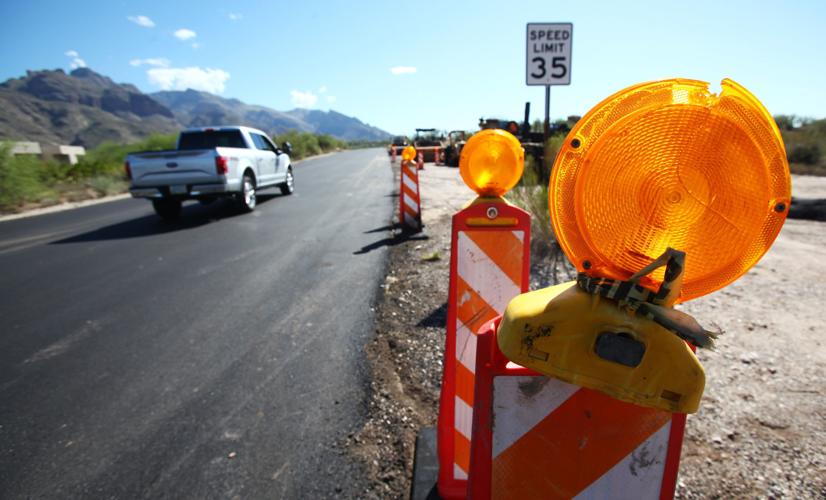

There’s a defect at the heart of the new Pima County road-repair plan that probably dooms it.
And, sadly, while a long-term solution looms attractively at the state Capitol, it’s probably doomed, too.
Pima County Administrator Chuck Huckelberry knows the worst road-repair problem is in unincorporated Pima County. But he also knows that traditionally, county supervisors want any road-repair money spread evenly among the various districts, including roads within incorporated Tucson, Marana and other municipalities.
Since he can’t find enough money in the general fund to do significant repairs throughout the county, he found a way to justify spending general-fund money just in the unincorporated county. It’s an understandable goal, but there’s just no fair way to do it.
Here’s how Huckelberry explained his plan: If an arterial or collector road in the unincorporated county receives at least 40 percent of its traffic from drivers from incorporated areas, that road will be eligible for road repair money from the general fund. No specific amount of money has been proposed, by the way.
The idea sounds defensible, but the methodology is not ironclad. Ana Olivares, the transportation director, explained it to me this way: County staff overlaid traffic volumes and municipal boundaries in the county’s geographical information system. Where they saw a spike of 40 percent or more going into or out of the incorporated areas during daily traffic peaks, they labeled that as an eligible roadway.
“That was the best estimate short of tracking everybody or doing a survey,” Olivares said.
So, for example, South Country Club Road in the county island on Tucson’s south side is eligible. So is East River Road and West Ina Road. Presumably, 40-percent plus of traffic on those stretches comes from Marana, Oro Valley or Tucson.
You can see the logic, and Supervisor Steve Christy said he likes the concept because there is an existing revenue stream, the property tax, not a proposed new tax.
But of course the plan ignores the obvious flip-side phenomenon: The many roads in incorporated Tucson and other municipalities that Pima County residents use.
“It is intuitive that county residents are driving into the city more than city residents are driving into the county,” said Tucson City Council member Steve Kozachik. “It’s a silly way for him to try to find a way to fix the roads at the city’s expense.”
The detractors aren’t just in the cities, either. Rural Pima County outside the immediate Tucson metro area doesn’t see any benefit from the plan, and Supervisor Sharon Bronson has been hearing complaints about that.
”We need a regional plan paid for at a regional level,” Bronson said. “At the state level it’s the same thing.”
Of course, Pima County voters soundly rejected a proposal to bond for road repairs at the ballot box in November. This, it seems, is what’s left in the county’s control right now.
At the state level, Rep. Noel Campbell, a Republican from Prescott, has proposed an increased gas-tax and vehicle-fee plan that would pay for transportation infrastructure. The gas tax would go up from the current 18 cents per gallon to 43 cents per gallon in 2021.
New annual fees on electric and hybrid vehicles would ensure that those drivers, too, pay for the roads they use. The new fee for electrical vehicles, for example, would start at $130 per year in 2019 and rise to $198 by 2021. Both the gas tax and the new vehicle fees would then adjust with inflation.
The plan passed unanimously out of the House Transportation Committee on Wednesday, but it still has to pass through the House Ways and Means committee and pass the whole House and Senate with at least 75 percent of the vote to become law.
Like the passage of Huckelberry’s road plan, that’s unlikely.
Border buyer beware
As my colleague Joe Ferguson reported, a group of high-profile conservative activists is hosting a forum in Green Valley Friday evening to discuss a plan to privately fund a border wall.
This new effort is an outgrowth of a previous GoFundMe fundraiser by Brian Kolfage, a University of Arizona graduate and a triple amputee wounded in the Iraq war in 2004.
While this event is not a fundraiser, it is part of a broader new effort to raise money for a border wall, apparently to be built on private land near the international line — somewhere that federal permission is not needed.
Kolfage’s original GoFundMe campaign caught fire and raised $20 million in commitments before GoFundMe pulled the plug because of concerns about how the money could be used. Now Kolfage has created a new organization to handle the effort, We Build the Wall Inc., and those who donated to the GoFundMe campaign before Jan. 11 can simply have their money shifted to that new effort.
You are, of course, free to donate to the cause if you’re so inclined. But I will be interested to hear what sort of assurances the group gives about how the money is to be spent.
Kolfage previously ran websites called FreedomDaily and Right Wing News that trafficked in false and divisive reports intended in part to collect email addresses for marketing campaigns, NBC News reported. If We Build the Wall does not fulfill its promised use of funds, it would not be the first organization to profit from enthusiastic but gullible political activists.
So, buyer beware.
Dems meet GOP sheriff
Pima County Sheriff Mark Napier has been making appearances on news outlets from New York to Europe in recent weeks, thanks to the controversy over the U.S.-Mexico border. A public appearance in Tucson, though, may have been his most controversial.
Napier, a Republican, asked the Pima County Democratic Party’s executive committee if he could speak to them. They said yes, but gave him just 10 minutes. It happened at Monday’s meeting.
“For a Republican sheriff to be in front of this group is awkward. That’s a fact,” Napier said. “But we have to get out in more awkward environments. If you’re always preaching to the choir, you’re not doing any good.”
The audience and executive committee peppered Napier with hard questions, especially about whether he’s using his newfound prominence adequately. As he has in other recent appearances, he struck a balance between humanitarianism and public-safety concerns.
New party chair Alison Jones said opinion is split on whether the appearance before the executive committee was a good idea, considering that it is not generally a forum of that sort.
New executive director
Also at that Monday meeting, Jones picked and the Democratic Party officers confirmed Cat Ripley as the party’s new executive director.
Ripley ran for the Democratic nomination for state House in Legislative District 10 last year but finished fourth in a four-person race with around 19.6 percent of the vote.
The executive committee confirmed Jones’ selection of Ripley by a 4-2 vote.

