


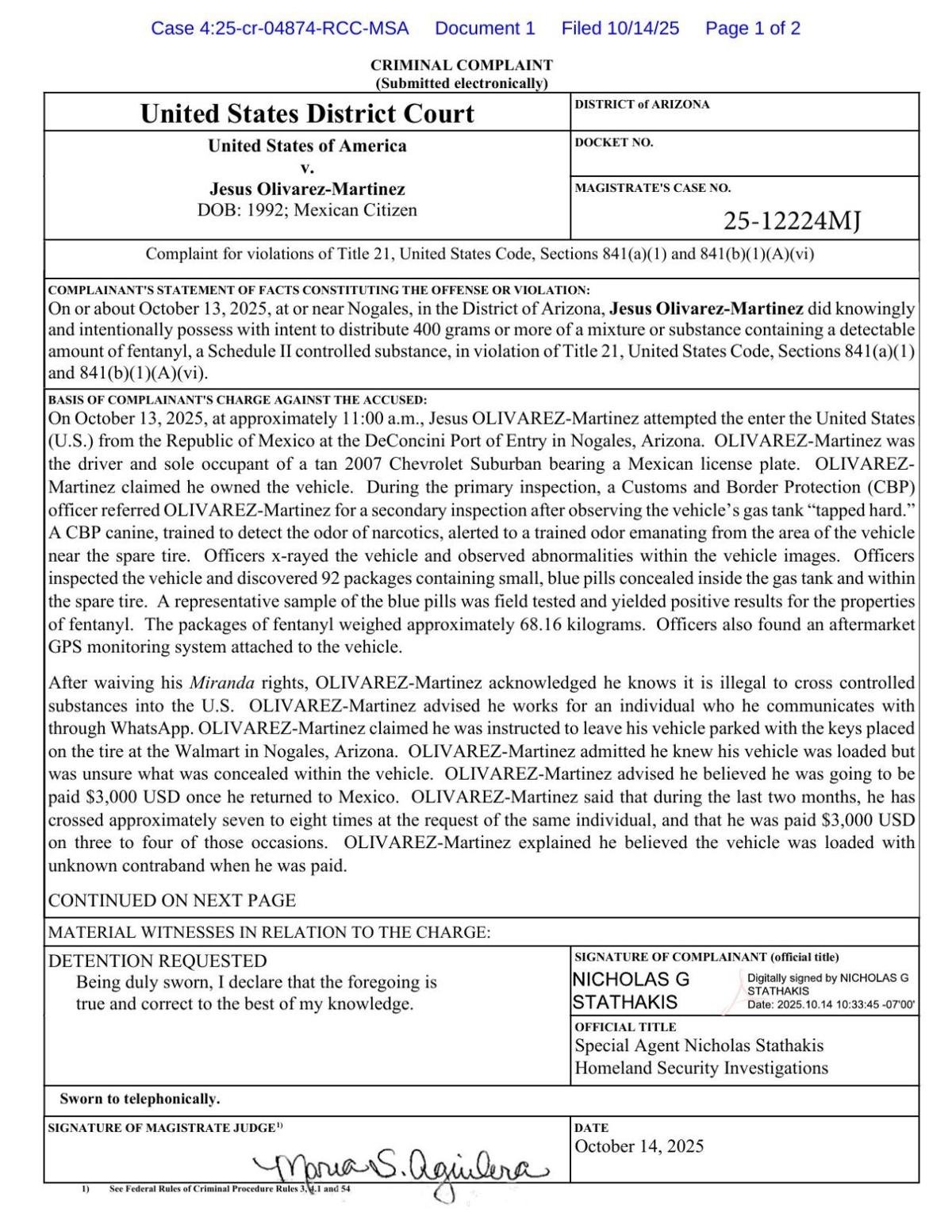
When a port inspector tapped the gas tank of a Chevy Suburban heading into Arizona in downtown Nogales, the tank felt hard, not hollow.
It was about 11 a.m. on Oct. 13, and the inspector sent the driver for a deeper look in the secondary bay, a federal criminal complaint says. There, a drug-sniffing dog alerted to the spare-tire area, and an X-ray revealed abnormalities.
Officers dug into the vehicle and found 92 packages of fentanyl pills in the gas tank and spare tire, weighing about 150 pounds, the complaint says. They arrested the driver, 33-year-old Mexican citizen Jesus Olivarez-Martinez, and took him to a federal lock-up.
A Nov. 12 indictment charges Olivarez-Martinez with conspiracy to distribute fentanyl, possession with intent to distribute fentanyl, conspiracy to import fentanyl and importation of fentanyl.
They're big felony charges that could land Olivarez-Martinez more than 10 years in prison.
Still, he should count himself lucky. If he were Venezuelan, or Colombian, or Ecuadorian, he might be dead.

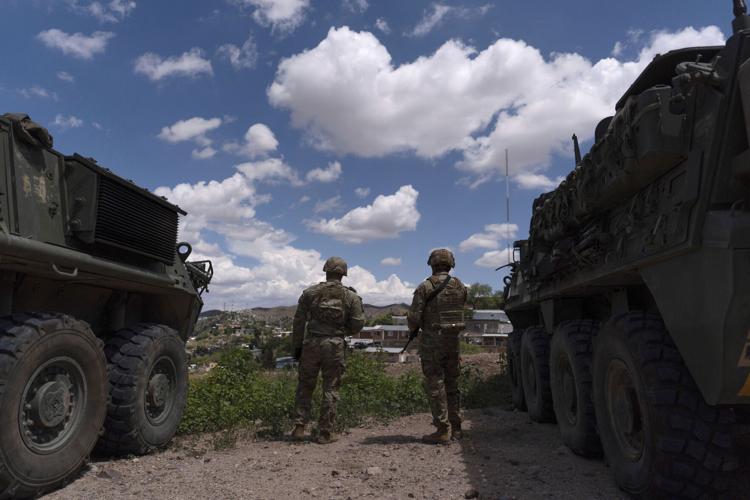
Two U.S. Army soldiers stand between Stryker combat vehicles in July as they watch over the U.S.-Mexico border fence from a hilltop in Nogales, Arizona.
U.S. forces have killed 83 people in 21 military strikes on boats in the Caribbean Sea or the eastern Pacific Ocean, all on the justification that those on board were "narco-terrorists" carrying drugs to the United States. The strikes were based on intelligence that has not been shared with the public, so it is unverified that they were actually carrying drugs and also unclear where the cargo was headed.
In the case of drug boats leaving Venezuela, almost all of them carry cocaine, not the opiates that have addicted so much of the American public, and so many in Tucson. And much of that cocaine is headed to Europe, not to the United States, experts say.
If we really think these drug transporters are terrorists deserving of instant death, why aren't our military forces targeting people like Olivarez-Martinez?
Alternatively, we have a missile factory and military bases in Southern Arizona. Why aren't we shooting Raytheon missiles from Davis-Monthan Air Force Base or Fort Huachuca at vehicles with drug loads in Sonora as they head toward the Arizona border?
I'm not advocating this, but it would be consistent with our maritime policy. Instead of awaiting a criminal trial in a federal prison, Olivarez-Martinez's family would have buried him by now, a luxury not afforded the families of those killed on the ocean.
Targeting is political
The explanation isn't found in the relative importance of the different countries as sources of the drugs that are killing Americans regularly. Of the 21 strikes, 18 of them took place off the cocaine-exporting countries of Venezuela and Colombia. Only three took place off Mexico, our primary source of fentanyl and methamphetamine.
The distinctions in how we're treating the countries aren't based on who poses the biggest drug threat. They're logistical and political.
So far, according to the Trump administration's reports, all the attacks have occurred in international waters. That isolates the potential legal ramifications as well as the lethal ones.
But why Venezuela? It's a pariah state, where sham elections took place last year, a place where Secretary of State Marco Rubio is itching to overthrow the dictator Nicolas Maduro.
I asked a few experts their thoughts on the disparate treatment of the different countries, and former Mexican ambassador Enrique Berruga Filloy put it most pithily when he quoted George Orwell's Animal Farm: "All animals are equal, but some animals are more equal than others."
Michael Burgoyne, a retired U.S. Army colonel who served as U.S. Army attache in Mexico City and Defense Department attache in Guatemala, said it's unclear to him "if the administration knows" why it's attacking the Venezuelan boats.
"It feels like to me that there’s a group that wants to go after Maduro and figure out regime change, and there’s a group that’s counter-drug," said Burgoyne, an assistant professor of practice in the U of A's School of Government and Public Policy. "It could just be for a domestic audience — blowing up drug boats."
Adam Isacson, director for defense oversight at the Washington Office on Latin America, noted that the United States' interests in Venezuela are limited, compared to the Mexico relationship.
With Venezuela, "The relationships are bad, and the relationship is not multifaceted," Isacson said. "The only thing they (the Trump administration) want out of Venezuela is oil and for them to take migrants back."
The Trump administration has designated the "Cartel de los Soles," allegedly based in Venezuela, as a foreign terrorist organization. But many experts, including Isacson, say that the cartel is a U.S. invention, just a name applied to a network of relationships.
The Cartel de los Soles "doesn’t really exist," said Isacson, who has carried out research throughout the region for decades. "There’s no such thing."
Mexico relations multifaceted
The Mexico drug cartels, in comparison, are quite real, but are a limited part of an intricate, multifaceted relationship with the United States.
"With Mexico, you’ve got migration, you’ve got energy, you’ve got your biggest trading partner, you've got cooperation on stopping fentanyl," Isacson said. "You’ve got a lot of things you don’t want to fall apart."
Despite all that, there are some in the administration who have been advocating for U.S. military strikes on drug-trafficking targets inside Mexico. In fact, Vice President J.D. Vance called for that in Tucson when he was here campaigning in October 2024.
This month, Rubio said the U.S. would not strike targets in Mexico without that country's permission, but Trump equivocated on that pledge when asked if he'd strike drug targets unilaterally.

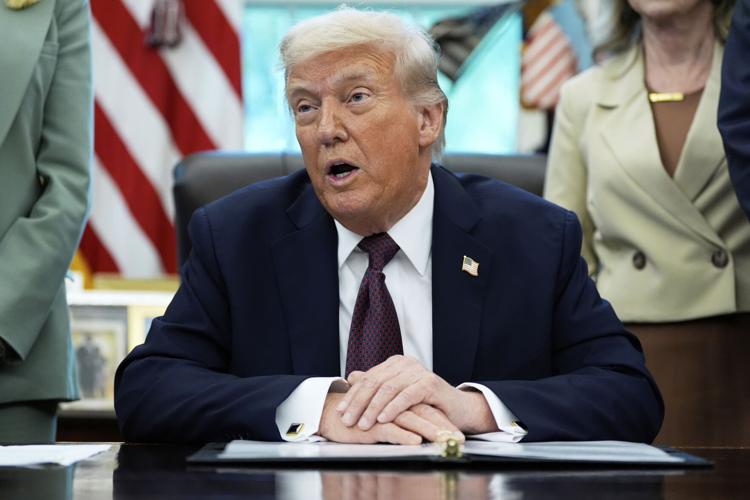
In this September 15 file photo, President Donald Trump announced that the U.S. military again targeted a boat allegedly carrying drugs from Venezuela, killing three aboard the vessel.
"Would I do it? I’d be proud to," he said, noting the United States knows the addresses and locations of Mexico's big drug traffickers.
But doing anything unilaterally in Mexico would likely upend a relatively cooperative relationship between Trump and Mexico's President Claudia Sheinbaum.
"If you hit some targets in Sinaloa and kill civilians, I don’t think the INM (Mexico's immigration agency) is going to be very energetic about stopping migrants anymore," Isacson said.
Unjustified killings?
Nobody's actually talking about the United States targeting drug smugglers at or near the border, the way we are on the high seas, or the way we could target leading traffickers in Mexico's interior. Thinking about it is just my way of trying to apply the same logic to the real source of the deadliest drugs that we're applying to Venezuela.
Burgoyne played along with me.
"If you’ve got intelligence that a van or truck is coming through Nogales carrying drugs, then, you could do a drone strike," he said. "You’ve got a lot more potential for collateral damage."
"You’re also making a strike inside a sovereign country," he added. "You risk blowing up this powder keg of Mexican nationalism."
So, for now, American officials are only targeting suspected smugglers like Olivarez-Martinez with arrest and charges, not missiles.
That's a good thing. It also, I think, shows that killing people on the high seas is unjustified when arrest is possible. That's especially true when we're not targeting the specific drugs, like fentanyl, that are killing Americans.
Even then, the long-term solution to our addiction problem lies with us and our demand, not the many people out there around the hemisphere feeding it.

