


It’s one thing to sell the name of Arizona Stadium.
Yes, to many people around Tucson, that’s a sacrilege. But having seen the financial condition of the University of Arizona and its athletics operation over the last few years, I can understand the need for a neat $3 million per year over the next 20 years.
It’s another thing, though, to sell those naming rights to a gambling business, Casino Del Sol. Yes, it’s a local firm run by a local tribe — those are good things.
But naming the stadium after a casino just reinforces tendencies in society that appear to be growing especially bad among students on the U of A campus.
At the UA, probably well over 50 percent of the male population engages in sports betting. As I spoke with more than a dozen male students on campus Monday, they gave me rough estimates that often ranged higher, especially in certain subcultures, like the fraternities.
Among those gambling students, there are some who get in deep. One student I spoke with on frat row Monday told me he is $10,000 in the hole.
This is, of course, just a reflection of society as a whole since the Supreme Court ruled in 2018 that states could legalize sports betting. Arizona legalized it in 2021 and capped its tax rate on the profits in 2022.
In the first month of legalized sports betting, September 2021, Arizona gamblers placed $291 million in bets. Four years later, in September 2025, the total of known sports bets in Arizona was $851 million.

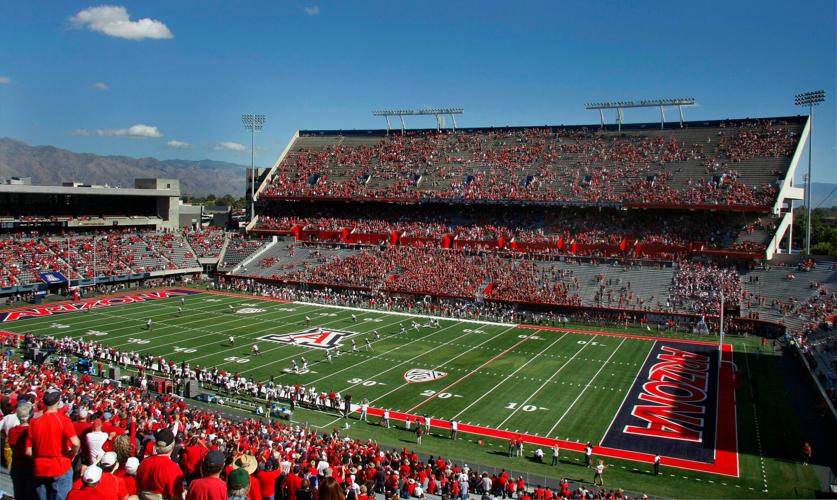
Arizona kicks off to Washington State to start a Nov. 16, 2013, college football game in Tucson.
Subtract the $794 million in payouts this September, and you get a net of about $55 million. After that, you subtract $35 million in free bets or promotional credits for a profit of $19.6 million. On that, Arizona took in “privilege fees” of $1.9 million, a pretty paltry sum on total bets approaching $1 billion, in my view.
Of course, those figures represent just what’s known and conducted through the 14 sports books registered with the state. Those big online betting sites like FanDuel and DraftKings require proof that users are actually 21 years old.
On campus, everyone knows the other sites, the ones that anyone can play, or ways to use the big apps despite being underage.
“With the big time apps, you have to be 21 to do those, but there are so many other ways around it, so many loopholes,” said senior Ryan Lisa, the son of my long-ago Flagstaff roommate.
Sitting outside the student union, freshman Tanner Gunn told me he and two of his friends there “used to do it, but we quit.”
Why? The obvious reasons: “I lost my money. I’m a broke college student.”
Sophomore Grey Sia told me he uses an account of a friend who is over 21, but he stays in control.
“I wouldn’t say it goes more than like $20. I like to keep it safe,” he told me.
But not everybody can do so. Among the dozen or so students I talked to, the word “degenerate” to describe friends with bad gambling habits came up more than once.
“There’s definitely a lot of sports betting going on. I’m included in that, but my friends take it to another level,” Lisa said.

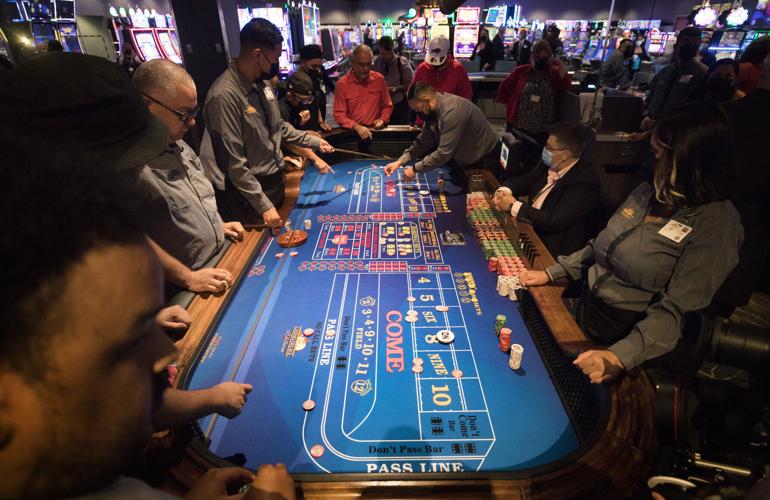
Players shoot craps at Casino Del Sol, which just made $60 million naming-rights deal for Arizona Stadium. With online sports betting so pervasive on the University of Arizona campus, the decision to sell football stadium naming rights to a casino is dubious.
He explained that on a day with a lot of good games, he’ll bet small amounts on games and parlays.
“For me, it’s more of that lower range,” he said. “I’ve got people I know who bet $1,000, $1,500.”
Gambling addictions have, of course, surged with the spread of sports betting. And the brains of the young, still developing till around age 25, are especially susceptible.
This is a nationwide issue, of course. In 2023, the NCAA had a survey done of 18- to 22-year-olds and found that 67% of those living on a college campus were bettors.
“The likelihood of engaging in betting activities, the amount wagered, and the amount lost increases as educational attainment level increases, although this could be attributable to other factors such as an increase in age,” the report found.
Now, Casino Del Sol is not a big sports betting venue like the online apps are. They have SolSports, a site at the casino where you can go to bet on sports, but they don’t have online betting, which is how almost everyone gambles on sports these days.
Still, I was surprised that when I asked students about the newly named stadium Monday, two of the bettors mentioned having gone to Casino del Sol to gamble.
In other words, there is not a solid divide between the app-based sports-betting that entices most young bettors and the trips to the casino that, to me, seem more old-fashioned and typical of an older cohort.
The sale of Arizona Stadium’s naming rights to Casino Del Sol reinforces that connection, between the pervasive youthful betting on apps and trips to the casino that can become a lifelong hobby, or habit.

