


If only the deaths of three U of A students in a crosswalk were an isolated incident.
If it were isolated, in time or in space, then speeding up the installation of new pedestrian crossings on North Euclid Avenue would be the sort of solution we need.
But of course, the killings of UA students Josiah Santos, Sophia Troetel, and Katya Castillo-Mendoza weren't isolated. Deaths, injuries and collisions have happened in that area many times before. And they happen across Tucson in increasingly alarming numbers.
Between Oct. 23 and Nov. 3, seven pedestrians were killed in five different traffic incidents around Tucson.
It's not just a pedestrian problem, either. So far this year, 79 people have died in motor vehicle collisions in the city of Tucson. Of that total, 27 were pedestrians, two were bicyclists, 22 were motorcyclists and 28 were in vehicles.
The Pima County Sheriff's Department has recorded 20 additional deaths in traffic collisions in its jurisdiction this year — a significant reduction from last year.

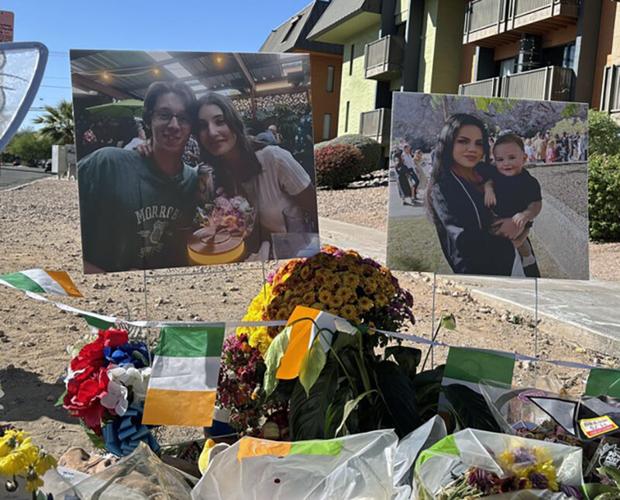
A memorial at the corner near a crosswalk where three University of Arizona students were struck and killed includes photos, flowers and hand-written messages.
Still, these numbers should shock us all — around 100 traffic deaths have happened just in the Tucson area already this year. But traffic deaths are something that we Americans, especially in car-oriented places like Tucson, seem to accept as a price of life.
I've been writing about traffic safety and deaths in some depth since October 2013, when 7-year-old Simon Foster was killed in a crosswalk at North Alvernon Way and East Speedway, walking home from McDonald's with his dad. At that time, the 14 pedestrian deaths in that year to date were a shocking total, up from just six the year before.
Now it is normalized to have dozens of pedestrians die here every year, not to mention many dozens more drivers and passengers of cars and motorcycles.
My hope is that the incoming Tucson City Council will be stronger than any before on this issue, despite inevitable pushback. Many Tucson drivers, I've found, are reflexively defensive when this issue arises and quick to blame others — pedestrians, motorcyclists, bicyclists, other drivers.
But the fact is, our traffic safety is badly broken in Tucson and needs more drastic action to fix it.
The city's efforts
It's not that Tucson has done nothing.
We adopted a "Complete Streets" policy in 2019 and a design guide to accompany it in 2021.
The policy commands the city to create an "interconnected transportation network that safely accommodates all anticipated users and transportation modes."
"Specific attention shall be given to the safety and comfort needs of the most vulnerable individuals on our streets — people walking, biking, taking transit, and using wheelchairs or other mobility devices —while still balancing the needs of those driving private, commercial, freight, and emergency vehicles," it says.

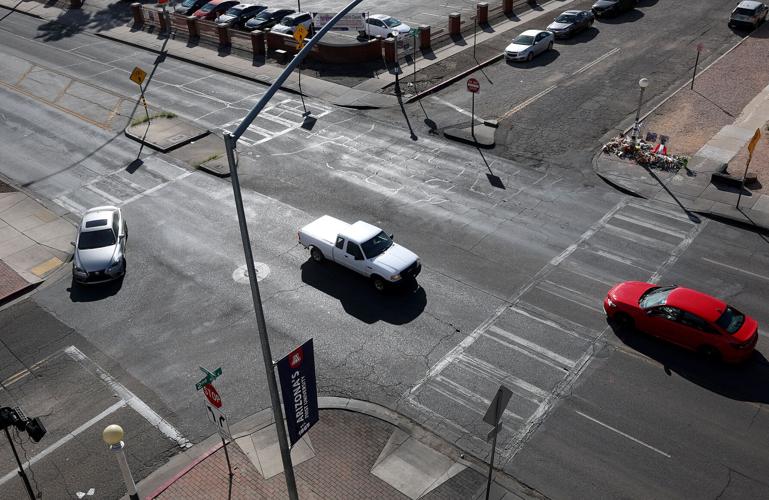
An overview of the intersection on North Euclid Avenue at East Second Street, near East University Boulevard. City officials said Monday that short- and long-term safety upgrades are planned there.
New road projects tend to have a healthy helping of sidewalks, pedestrian crossings and bike infrastructure.
Tucson Police Chief Chad Kasmar also announced a renewed focus on traffic enforcement when he took office in late 2021. Anyone who's driven on Tucson's streets can tell you that hasn't gone far enough. Speeding is the norm and red-light running is routine.
So, they're aware, and have tried. It just hasn't had the key tangible effect of reducing deaths.
Many injured in collisions
It's important to remember, though, that it's not just about deaths.
As students criticized the Tucson City Council at Tuesday's meeting over the tardiness of their action on North Euclid, they were talking to at least two members with recent experiences of pedestrian collisions.
Vice Mayor Lane Santa Cruz, who was presiding while Mayor Regina Romero was out of town, was struck by a car in 2023 and injured. The brother of Ward 5 council member Rocque Perez was struck by a car and severely injured in the last week, he said.

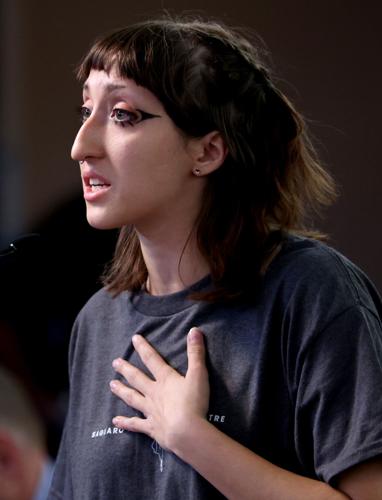
Justine Wilken tells the Tucson City Council, “You can ask anyone on campus, and they will tell you that crosswalk is terrifying. As a pedestrian, you have zero faith that you’re not going to be mowed down the second you step off the curb.”
Ten years before the Oct. 30 deadly collision on Euclid, Analekha Chesnick nearly suffered a similar fate. Chesnick, the daughter of former colleagues at the Star, was weeks into her freshman year at the University of Arizona when she went for an afternoon run, she recalled Friday. It was Sept. 23, 2015.
She and two other people started crossing at the crosswalk on Euclid Avenue at East First Street, she said, with Chesnick continuing her run. A driver slammed into her.
She doesn't remember any of this but knows from witness accounts that her body smashed the windshield of the car and landed 20 feet away. She broke several bones and suffered a concussion.
As luck would have it, she survived. But it left a variety of scars.
"I don’t have a sense of smell, from the concussion," said Chesnick, who has since become an osteopathic doctor. "It sheared off my olfactory nerves."
She also has a titanium rod in her leg, and realized later there were emotional effects to deal with.
"I was diagnosed with PTSD by my mental-health professional five years later," she said. "I don’t go for a run and panic in a crosswalk. It was more a sense that the rug could be pulled out from me at any time."
Hope for change
As things are, that's how everyone should feel using Tucson's streets.
But I have some hope for change. Last month, I worried in a pre-election column that a progressive majority of close allies to the mayor could become an ideologically homogeneous majority on the council.
Well, they won — but on this issue, I'm glad. Incoming Ward 6 Council Member Miranda Schubert, in particular, is an advocate for bicyclists, pedestrians and transit.
"This latest tragedy was preventable," she told me Friday. "That crosswalk has been a problem for a long time. There are other problem areas that have been known for a long time."

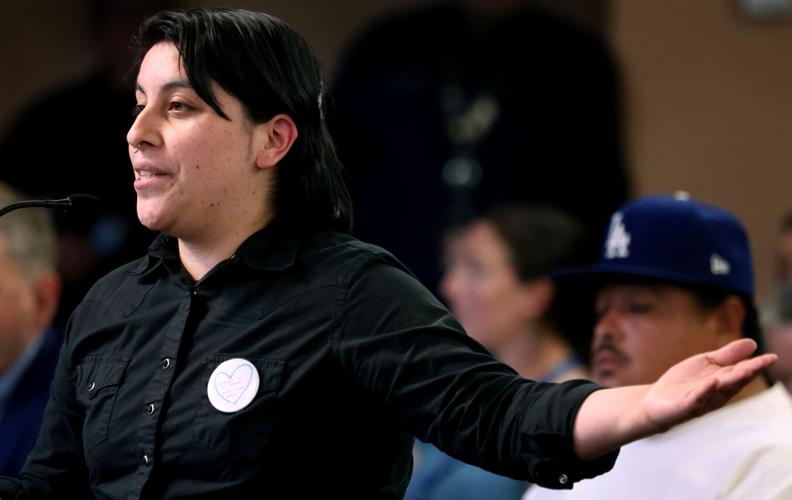
Topaz Servellon speaks about missing friends Sophia Troetel, Katya Castillo-Mendoza and Josiah Santos — and urges the city to improve traffic safety — at the Tucson City Council meeting Wednesday night.
"It’s incredibly important that we wean ourselves off car dependence," she added.
Her immediate prescription is to use road design, engineering and the promotion of alternative travel modes to slow traffic down and get people out of cars. You can expect to see more chicanes (curb curves that butt into the road), speed tables and humps, and other engineering tweaks to slow people down.
Santa Cruz, who has repeatedly referred to cars as "weapons" in public comments, said "We need to lower speed limits and retrofit our streets for bike and pedestrian safety, especialy in high-traffic areas. Safer crossings and protected bike lanes should be the standard, not the exception."
Incoming Ward 5 City Council member Selina Barajas spoke at the celebration of life for the victimized students Thursday. She said, "Pedestrian safety isn't only a matter of infrastructure — it's a matter of justice and compassion."
'Vision Zero'
While Tucson already has its "complete streets" policy, in May Romero brought up Vision Zero, another, potentially stricter program for reducing traffic deaths.
It's a set of policies Tucson's Living Streets Alliance has been advocating. It means deeper change in the way we design roads and intersections, which tend to be among the most dangerous spots for drivers and pedestrians, said Vanessa Cascio, the alliance's executive director. It's important, she noted, to account for the fact people will make mistakes and try to ensure they lead to fewer fatal crashes.
"If we continue to prioritize the efficiency and speed of car movement, we won’t get there," she said. "The faster cars are going, the more likely people will be killed in a collision."
What we need to do that drivers won't like is slow them down. Since 2022, I have advocated revisiting the ban on red-light and speeding cameras, which voters passed in 2015.
More of us, I'm sure, are fed up enough with traffic chaos and carnage to recognize that as a group, Tucsonans can't handle the free rein we've been given on our streets.

