



In the heart of Tucson, you can’t go far without seeing a mural by Joe Pagac.
That struck me Thursday, shortly after I interviewed the Tucson muralist, when I turned up North Fourth Avenue from downtown and was surprised to see a piece I hadn’t noticed before, on a first-floor wall of the new Ari on Fourth apartment tower.
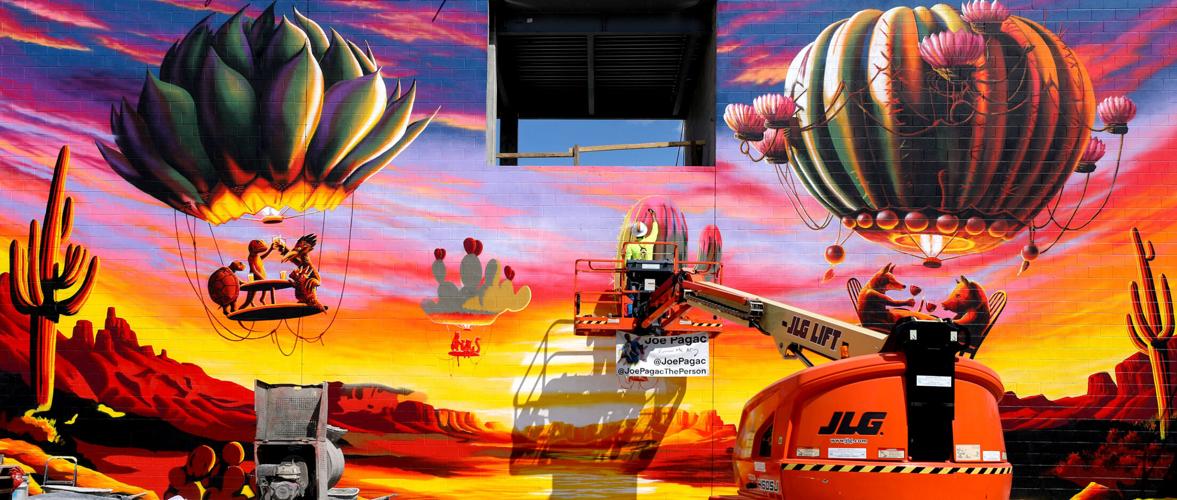
The mural, painted last year, features a desert setting of saturated sunset clouds, in which Sonoran Desert animals ride beneath hot-air balloons made of agave, saguaro and prickly pear plants.
Classic Pagac.
It’s a whimsical Sonoran Desert scene, pleasing to the eye, bringing a smile or chuckle and feeling familiar.

A Joe Pagac mural inspired by the Tucson desert lives on the side of the new Ari on Fourth Avenue apartments, 213 North Fourth Avenue. The desert-themed mural is three stories high and 80 feet wide.
That feeling of familiarity is in part because Pagac has been so visibly prolific around Tucson, especially lately. Beyond the massive saguaro on the Transamerica building, painted last year, he also is painting a mural on each of the new Desert Drifter coffee shops opening around town, starting with three of them, but probably expanding to more.
It’s impressive and overall a good thing, probably, but Pagac has detractors in the mural scene, who point out the pervasiveness of his style and subjects as a downside to his popularity.
Pagac, as his reputation has grown, has been able to do work around the country, from Washington, D.C. to Alaska. But could there be too much of his work in his hometown, Tucson?

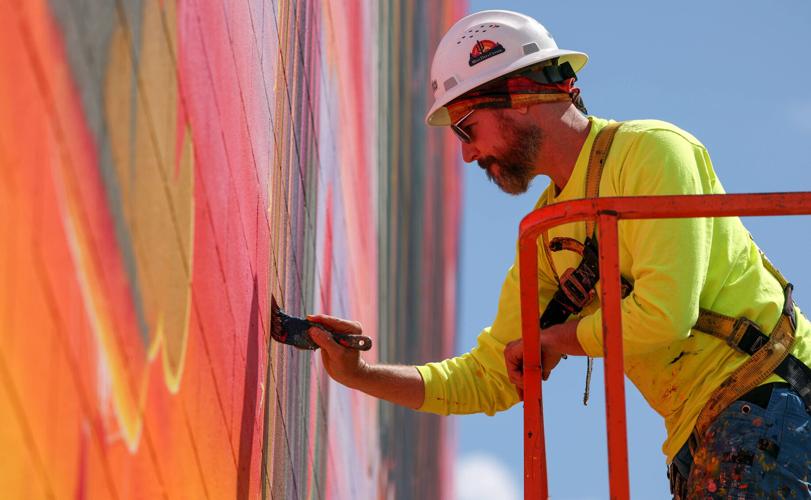
Joe Pagac, a local muralist, paints a Tucson-themed mural onto the side of the new Ari on Fourth Avenue apartments, 213 N. Fourth Avenue, in March 2024. The desert-themed mural is three stories high and 80 feet wide.
It’s a question I put to Pagac himself as he took a break from a new piece on a Desert Drifter shop under construction near East Broadway and Alvernon Road on Thursday. That mural features his familiar style, but it’s not at sunset, and the animals are dinosaurs while people ride a large hang-glider across a sky filled with plump clouds.
He took a bit of a pause before answering.
An explosion of murals
You have to understand the context of the question, in order to understand the pause. And understand the question isn’t just about Joe Pagac — it’s about the explosion of murals in Tucson over the last decade or so.
What’s the dominant style? Who gets the jobs? What are the paintings saying?
There’s a growing cadre of muralists in Tucson who are painting walls both around the traditional core of Tucson and out into further-flung reaches of the city.
Pagac is the best-known, but others, such as Jessica Gonzales and Ignacio Garcia, have established themselves and completed large, impressive murals.
Some Tucson muralists question the style that’s come to dominate Tucson’s mural scene. I attended a panel discussion at the UA Poetry Center on Oct. 25, and the four muralists there raised several critiques of the drift of Tucson murals:
— They have become too dominated by similar desert scenes and sunset colors
— People wanting to pay for murals go for the same look that they’re seeing around town, which multiplies the same style
— Expressions of the city of Tucson itself and its cultures are disfavored, compared to the desert wildlife and scenes
— Getting jobs from the city is too bureaucratic, while getting private walls usually means painting more of the same sort of scenes
“Unfortunately, in this city we’re starting to see a monopoly of style,” said Allison Miller, who has been doing murals around town for years and teaches high school art. “Right now our aesthetic is sunset-cactus murals.”
Fellow muralist Adelynn Olea said, “We feel we either have to conform to a certain aesthetic or dilute our own style. We shouldn’t have to be making ourselves smaller to appeal or get a wall.”
Added Jessie Rosas: “People have to modify their style to mimic the mainstream style. It’s a loop of diluting and conforming.”
“Who should decide the aesthetic of the city?” Rosas continued. “We did not all consent to live in this gallery.”
A stylistic sameness
Pagac, who graduated with a bachelor’s degree in fine arts from the University of Arizona, has been painting murals full-time for 20 years, he told me. It wasn’t always well paid nor offering opportunities to paint how he wanted.
“I worked 80 hours a week, and still work 80 hours a week, and wow, for the first 10 to 12 years, was making $12,000 a year. You know, I took every single job I could get. I was willing to paint what was in other people’s hearts, not mine,” he said.
Over time, he established himself and started to make a living wage. And he was able to paint more of what he wanted, favorite topics being the creatures and landscapes of the Sonoran Desert.
Now, he said, he’s able to be more choosy with jobs. He said he turns down three or four jobs per day.

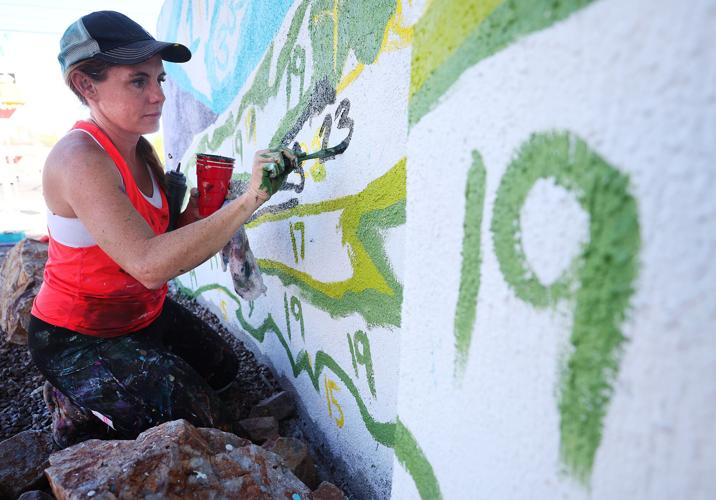
Tucson artist Pen Macias paints the number 23 onto a wall at Child and Family Resources, 2800 E. Broadway. Macias hosted a paint-by-numbers party in which people helped to finish the mural.
“I see that complaint all the time of like, ‘You’re taking all the work.’ I’m not. I’m currently booked out till 2027, so I have to turn down every single job that I get a call for. So there’s a ton of work.”
But he acknowledges the stylistic sameness that sometimes is self-reinforcing. Take the whales that he painted swimming through the sky at North Campbell Avenue and East Grant Road.
“It’s become everyone’s favorite, to the point where I’ve done whales so many times now,” he said. “I mean, they’re on Scented Leaf, they’re on Downtown Dispensary. They’re on the other Desert Drifter. This one was supposed to have whales. And last minute, they were like, ‘You know what? Too many whales — do dinosaurs?’ I was like, ‘Yes, thank you.’ “
But the old tastes tend to reinforce. Another mural Pagac was recently painting at North Alvernon Way and East Fifth Street originally did not have a sunset or desert animals, but those who contracted the work later asked for that, he said.
“It ends up getting pulled back into things you’ve already done,” he said. “And I think the second problem is new artists who are starting, they see that’s what’s around town, and so they emulate it, knowing that’s what’s selling.”
‘Meaningless stickers’
For Olea, the proliferation of similar desert scenes adds up to a sort of silencing of the city of Tucson and its people.
“They often don’t reflect the people, the history or the traditions of what this town is,” Olea said via text message. She likened it to “putting meaningless stickers all over town.”
She and the others would like greater chances to reflect what they see in Tucson. Muralist Maxie Adler, who also spoke at the Poetry Center event, put it this way: “The purpose of public art is to represent all of us. It should be our shared vision and shared understanding of what we are here in Tucson.”
The good news is, there is growing opportunity. Paid for largely by private parties, murals are popping up all over, and there are big block walls all over the city that could be painted.

Maxie Adler, a local muralist, speaks to the crowd during the unveiling at Mission Garden, 946 West Mission Lane, Tucson, Ariz., April 13, 2024.
Pen Macias, one of the half dozen or so muralists who do the work full time, gives credit to Pagac for building the market.
“We weren’t a nationally known hub for public art. He figured out how to do huge pieces of public art,” Macias said. “What’s he’s done gets work for all of us.”
That’s of course a good thing and eventually could lead to a greater diversity of subjects if those who contract them expand their vision a bit.
When I asked whether his hometown has too many Pagac murals, his answer was not “yes,” and not “no.” It was “maybe.”
“I would like to keep branching out on what I’m doing. Like this one, I feel really good about because I feel like it’s weird and different, and I would like to keep doing more of that.”
“I’ll get backlash, like, ‘Oh my God, if I have to see one more animal on a bike from you.’ And I’m like, ‘Man, it has been five years since I painted an animal on a bike.’”
It’s no wonder people have imitated Pagac’s winning style and that the public has encouraged more. It would be great if muralists, including Pagac himself, got more chances to do something different.

