



A proposed Pima County ordinance to limit heavy truck traffic on dirt roads is dead, although it may be revived in a revised form, county supervisors told the Star.
The comments from Board Chairman Rex Scott and Supervisors Matt Heinz and Steve Christy that the ordinance is dead came in the last week, after the board voted unanimously on Dec. 16 to remove the proposal from its agenda for that meeting. That vote was taken after no public discussion, following an executive session about the ordinance with attorneys from the County Attorney's Office.
"The motion was to pull the ordinance from the agenda and proceed as discussed in executive session," Scott said. "The board had staff in executive session, obviously including the county administrator. If any of the topics come back before the board, it will be in a completely different format."
The ordinance, as it was, is "absolutely not coming back," Scott said. "That's why we didn’t just table it, we removed it. That's essentially the same as killing it."

Rex Scott, chairman of the Pima County Board of Supervisors.
That vote came after a number of business groups wrote detailed letters to the county opposing the ordinance, with many arguing it would be an illegal exercise of the county's powers and a direct violation of state law. While none of the opponents' letters directly threatened to sue the county if the ordinance passed, letters from the Arizona Trucking Association and the Goldwater Institute, which advocates for limits on government, argued the ordinance, in the trucking group's words, "puts the county at financial risk" from legal issues.
It was the second time this month that the ordinance was discussed by county supervisors and staff behind closed doors. On Dec. 2, the supervisors delayed any action on the ordinance after discussing it in executive session, although they did take public testimony on it.
Numerous environmental groups and a number of individuals wrote letters supporting the ordinance as a boon to public health because dust pollution has been linked by scientists to a wide variety of ailments, including bronchitis, asthma, emphysema and valley fever.
The ordinance would have limited heavy truck traffic on dirt roads to 75 total daily trips and limited all truck traffic on dirt roads to 150 daily trips. It would also have set a 15 mph speed limit for heavy trucks on dirt roads. Companies that wished to run more trucks than allowed by the ordinance would have had to apply for a permit from the county and face a public hearing.
Supervisor Jennifer Allen said she didn't consider the ordinance effectively dead but is prepared to work on revisions. Christy said he would strenuously oppose future such regulations. The remaining supervisor, Andres Cano, couldn't be reached for comment.
"Pulling it is not a victory" for opponents, Allen said. "I believe we will be coming back with a stronger policy rooted in many air quality issues created by unpaved roads that are trampled by heavy industrial trucks."
The supervisors said they couldn't disclose what had prompted them to pull the ordinance because it took that action following discussion in an executive session. Legally, county supervisors aren't supposed to publicly discuss anything that's discussed in executive session, which can be held to discuss legal matters.
Deputy County Administrator Carmine DeBonis also declined to discuss reasons for pulling the ordinance, adding, "All I can say is that we will be considering how to proceed based on discussions in executive session."
While the ordinance would have restricted heavy truck traffic countywide, much of the discussion centered on a seven-mile dirt stretch of Santa Rita Road leading to Hudbay Minerals Inc.'s planned Copper World mine operation on the Santa Rita Mountains' west slope. In fact, county officials said they started work on the ordinance at the request of the mine opposition group Save the Scenic Santa Ritas.

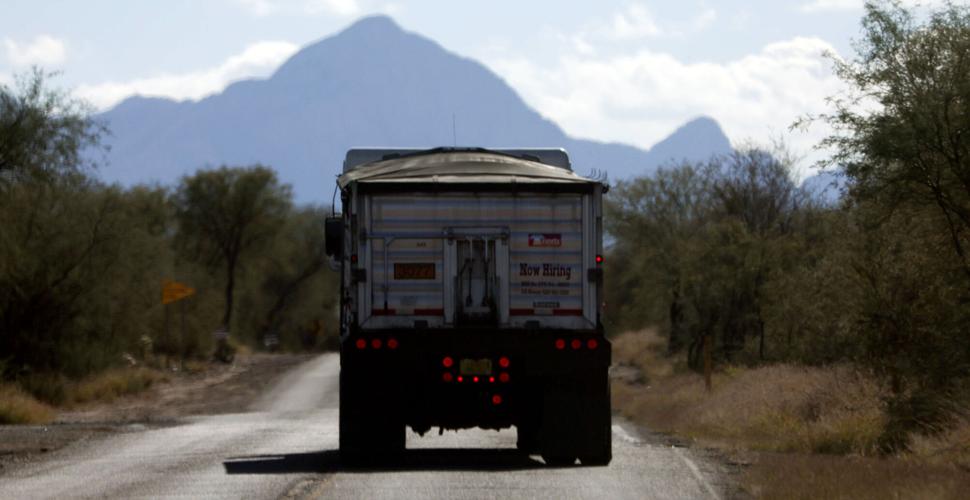
Santa Rita Road, shown here, has been identified as the most likely access route for heavy-duty truck traffic to and from the planned Copper World mine site, Pima County's administrator said in a memo.
"We are pleased by the Board’s decision to remove the proposed ordinance from the agenda. We are also thankful for our many supporters who attended the hearing to oppose the proposed ordinance," Hudbay said in a statement to the Star. "These voices that advocate for production of critical minerals necessary to Arizona and for high-paying, multigenerational local jobs must continue to be heard by the Pima County Supervisors.
"Our focus remains on being a responsible neighbor and working constructively with regional partners to move Copper World forward and bring its economic benefits to the region," the company said.
Hudbay added that while county supervisors provided no clear basis for their decision, "we do know the ordinance is illegal and if passed, will result in costly litigation from a challenge in court that the county will lose. The board also received robust opposition, not just from mining advocates, but from many other industry groups and organizations."
John Dougherty, Save the Scenic Santa Ritas' executive director, said he was "shocked" to see the board pull the ordinance without explanation.
"I have to assume it was legal (reasons)" that killed it, he said. "Attorneys were talking to them in executive session, and they came out and canned it. There must be some sort of legal issue.
"It’s unfortunate that we get this far, and we were able to have a hearing with it, and then the whole thing gets pulled," Dougherty said.
"I understand that there are executive sessions. I understand that issue. What I don’t understand is how we got pretty far down the road with this and suddenly it’s pulled, with no explanation."
Because that stretch of Santa Rita Road would draw significant truck traffic once the mine starts operations, supporters of the ordinance expressed concerns the resulting dust pollution could or would lead to that area of the county being formally classified by the Environmental Protection Agency as out of compliance with the federal Clean Air Act.
Opponents, however, said such "speculative" concerns about future air quality violations can't be used to legally justify the kind of truck restrictions the county had proposed. Hudbay didn't write a letter to the county opposing the ordinance, but told the Star in response to questions that it strongly opposed it and agreed with other opponents that it was illegal.
Heinz told the Star, "I think we don't know exactly" what a revised ordinance would look like, and said it may contain some components of the initial ordinance." But he wants "legal and staff advice" before proposing anything specific, he said.
"Doing this is in the best interest of county residents. It's incredibly important since we have an area of Pima County falling into non-attainment already," said Heinz, using the formal legal term for non-compliance with federal air quality standards. "Why let something go out of attainment, then try to claw our way and struggle our way back to attainment?"
He noted that the Rillito area in northwest Pima County has been declared out of compliance with the federal laws. County officials haven't yet received formal advice on how to get back into compliance from the Arizona Department of Environmental Quality, even though that area was found out of compliance back in 2021, he said.
Scott said if any issues addressed by the original ordinance come back to the board, "it will be in completely different form. What that form would be, I don’t know that any of us could say."
He also wants to know, separately from the issues of the mine and Santa Rita Road, "what is the policy basis for moving forward with an ordinance that would affect all the dirt roads in the county? I need to know more on a policy basis about that."
"I also need to know if any future ordinance came forward, what are its chances of being defended legally?" Scott said.
He added that he thinks board members put themselves in a very difficult position when County Administrator Jan Lesher wrote in a Nov. 12 memo that staffers had taken up this ordinance when encouraged to do so by Save the Scenic Santa Ritas.
"That poses a challenges not only in defending the ordinance. It also sets up a challenge to say to the public we did take this up because an anti-mining group asked us to do so," said Scott, who noted that he himself has voted in favor of three resolutions opposing the mine since taking office in January 2021.
He added, however, that he shares concerns about the possibility of the county going into non-compliance with the Clean Air Act due to dust pollution.
"Anybody who wants to know what that's like should look at Maricopa County," Scott said. "They've been dealing with non-attainment for several years. It's a burden on the public and private sector, and it's a public health concern. That’s why we need to hear more from staff about the policy basis for this ordinance."
Allen said, "We’ll see it again for sure. I'll be really emphasizing the impact of the trucks and the need for this policy, the impacts dirt roads have on public health as well as on the environment.
"We're going to be building a stronger case for it. It won't be the same exact ordinance, but at this point I can't tell you much more. We will have to roll up our sleeves," Allen said.
Christy, who unlike the rest of the board is a supporter of Copper World, said he would oppose placing any future restrictions on truck traffic on dirt roads. He noted that Hudbay has spent $1 million on applying a palliative substance on the road to hold down the dust. It has worked, although county officials have said they don't believe it will work under the much heavier truck traffic the mine's operation would bring.
"To slap an ordinance on what they're trying to do is kind of a slap in the face to Hudbay after their investment in this issue," said Christy, the lone Republican on a five-member board. "It leaves one to believe that maybe the health issue and the air pollution issue really isn’t what driving this. Maybe it's another way for Save the Scenic Santa Ritas with their county proxies to try to forestall or prevent Hudbay from operating. I think that’s the real driving force."
He noted that in Green Valley, which, like the Copper World site, lies in his district, a "vulnerable" elderly community is also subject to issues of living near a copper mine, in this case, the Sierrita mine owned by Freeport-McMoRan. But every time a dust issue has come up, "it's been handled and resolved to the full satisfaction of residents for decades," Christy said.
He said, however, that at the Dec. 16 board meeting, he had unsuccessfully moved to not discuss this ordinance in executive session.
"I think the public had a right to know. That issue should have been discussed publicly with public present," he said. "We spend far too much time in executive session on too many issues that should be discussed in public."

