

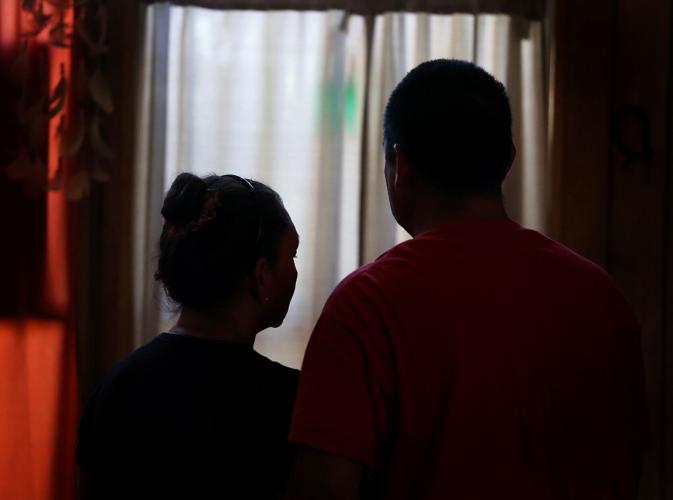





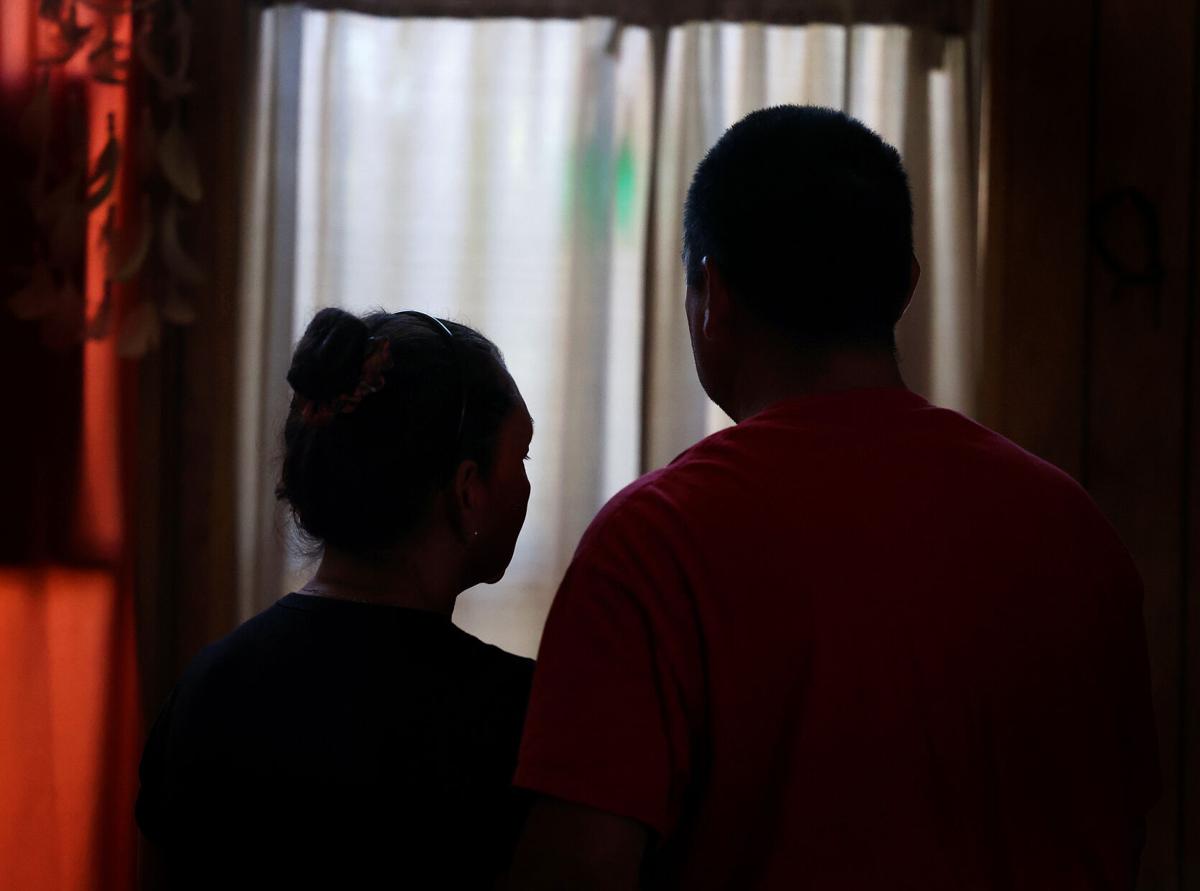
Throughout seven months locked in immigration detention, 47-year-old Cielo could only see his wife and son through a glass window that was like a barrier between the living and the dying.
"You can't do anything in there but die slowly," said Cielo, speaking in Spanish in his family's living room, just outside Tucson, five weeks after his release.
The no-contact visits at Florence Correctional Center often intensified the pain of separation, said the long-time landscaper, a native of Sinaloa, Mexico who's lived in Arizona for 30 years.
"You can't touch your wife, you can't touch your son," he said. "If they’re crying, you can’t give them a hug of comfort. It's sad, it's expensive, it's exhausting."
Although he's finally back home, as his family tries to recover financially and physically, Cielo says he isn't yet free.

Cielo holds his wife Mari's hand inside their Pima County home in September. Cielo, who has lived in Arizona for nearly 30 years, was released from immigration detention in late August, after seven months in Florence Correctional Center. He was arrested in front of his home in February by heavily armed agents, despite having work authorization, complying with ICE check-ins and having no criminal record.
Despite having no criminal record and a valid work permit, Cielo was arrested during a February immigration operation at his Pima County home, a terrifying experience from which his family says they're still reeling.
(Cielo asked the Arizona Daily Star to identify him and his wife Mari, a U.S. citizen, only by their nicknames, because he's afraid of risking his pending petition for asylum.)
While he was in detention, Cielo's work permit was canceled, his driver's license was rescinded and the family's previously stable finances have been upended, said Cielo, speaking at his home in early October.
Now unable to work, or afford basic necessities, "It's like you're a prisoner again. A prisoner at home, but still a prisoner," Cielo said.
Cielo is among the thousands of noncitizens without any criminal history who have been swept up in President Donald Trump's ever-widening detention net that's splintering families and communities across the U.S.
On that February morning, Cielo stepped onto his front porch to find eight armed agents in his front yard, their weapons already trained on him, he said.
As Cielo tried to pull his work permit from his wallet, an agent grabbed the wallet and threw it to the ground before putting him in handcuffs, Cielo said.
Because he is the primary breadwinner and caregiver for Mari and their son, who are both disabled, Cielo's absence was devastating. Mari couldn't run their busy landscaping business on her own, and her health declined without Cielo to help care for their adult son, who has developmental delays and seizures.

Mari shows her feeding tube port inside of her home in Pima County in October. Mari, a U.S. citizen, can no longer eat or drink by mouth, after previous surgical cancer treatments. She used to be able to feed herself intravenously, using a nutrition mix that came in large bags, she said. But after Cielo was detained, Mari became too weak to lift the food bags herself and was losing weight. In May, her doctor gave her a feeding tube instead, so she could feed herself without Cielo’s help, she said.
"Without him, we just went downhill," said Mari, who can't eat or drink by mouth due to earlier surgical cancer treatments. She now relies on a feeding tube. "My body got weaker and my health got worse because of all the stress."
Knowing everything Mari was going through on the outside was like torture, Cielo said.
"Knowing that she's sick and I can't be with her, I can't do a thing to help her ... It's hell on earth," he said. "It's like you're being stabbed inside. It kills you, little by little by little."
Mass-detention strategy
Advocates say Cielo's experience exemplifies the dramatic, and unwarranted, expansion of Trump's mass-detention net, now ensnaring long-time residents with deep community ties, as well as those with valid work permits or some form of protected status.
"They didn't have to detain him, but they chose to," said Tucson immigration attorney Siovhan Ayala, who is representing Cielo. "It's a complete change of course in terms of their discretion in detaining people."
ICE has reversed earlier guidance prioritizing arrests of violent offenders and is increasingly targeting non-criminal working people, advocates say, relying on racial profiling or ICE records of people already in the system, as well as arresting asylum seekers and noncitizens attending court hearings.
Even asylum seekers who entered the U.S. with permission, at official ports of entry using the now-canceled CBP One appointment-scheduling app, are being detained by Trump's DHS. Many waited nearly a year in Mexico for their appointment through the app, determined to do things "the right way," advocates say.
But once detained — a discretionary decision by DHS — they face mandatory detention under existing law, Ayala said.
"They followed the rules and entered lawfully, and then the government just switches its policies and is detaining and deporting them," she said. "It's very unjust."
Another escalation began in July, when the Department of Homeland Security issued a policy memo to ICE employees, requiring mandatory detention for anyone facing deportation who entered the U.S. "without inspection," even decades ago.
It's a dramatic departure from long-standing precedent, potentially subjecting millions to mandatory detention and blocking immigration judges from even considering alternatives, like release on bond with an ankle monitor and monthly ICE check-ins.
Advocates say the mass-detention strategy is not about public safety nor enforcing the law, but rather represents fuel for the lucrative immigration-detention system, which under the latest budget bill got an infusion of $45 billion over the next four years.
"I see this as part of a multi-pronged attack," said Tucson immigration attorney Luis Campos. "They go hand and hand: these new directives, with the construction of new detention facilities."
The strategy also aims to demoralize noncitizens with legitimate pathways to stay in the U.S., coercing them to leave voluntarily rather than face an extended detention while fighting their case, said Setareh Ghandehari, advocacy director at Detention Watch Network, which advocates for the end of immigration detention.
"It's very much being used as a way to convince people to self-deport," she said. "Make the (detention) conditions so awful that people give up and leave, even if there may be a path for them to stay."
Although Cielo previously took a voluntary departure in 2006, he returned to the U.S. that year after he was threatened by criminal groups in his home state of Sinaloa, Ayala said. He's now in the process of applying for asylum protection and has been complying with required check-ins with U.S. Immigration and Customs Enforcement, she said.
But that compliance meant ICE had his home address on record, and because he had a previous removal order, it was a matter of government discretion whether to detain him, Ayala said.
"It's just indicative of this current administration and the fact that humanitarian factors are not being considered," she said.
Communities "ruptured"
Historically, immigration detention wasn't big business in the U.S., with capacity for just 5,000 immigration-detention beds in the 1980s, according to Nancy Hiemstra and Deirdre Conlon, co-authors of "Immigration Detention Inc.: The Big Business of Locking Up Migrants," published in June.
Capacity has grown to 41,000 and with the recent infusion of federal funding, that figure is set to climb to 100,000 beds, Ghandehari said.
"When you think about what it would look like to detain all these people, we’re talking about rupturing family and community networks across the country," she said.
That expansion could soon involve Pima County: In May, the state of Arizona sold the former Arizona state prison in Marana to Management and Training Corp., for $15 million.
A few months ago MTC informed the Marana Town Council that "the facility may be used as an Immigration and Customs Enforcement detention center," but hasn't confirmed that officially, town spokesman Vic Hathaway said in an email.
"As a municipality, we have always been in favor of a facility use that would generate local employment and create opportunities for collaboration on essential public services, such as road and street cleaning that could be performed by inmates," he said. "Ultimately, any decisions regarding the future use and operation of the facility would fall under MTC."
An MTC spokeswoman said in an email that "no final decisions have been made."
Civil, not criminal, detention
Often lost in the public discourse on immigration detention is that it's civil in nature, and is not intended as punishment for any crime, attorneys say.
Criminal acts by noncitizens and citizens alike are handled by the criminal-justice system, while the immigration court system handles the administrative question of immigration status.
Yet for immigrants in detention, their experience is indistinguishable from criminal incarceration — without the protections built into the latter, like the right to legal counsel, Campos said.

Tucson immigration attorney Luis Campos, pictured talking to Homeland Security Investigations agents in February, said he hasn't been taking on bond cases lately because there's such a slim chance for success. After a DHS issued a policy memo in July that said anyone who crossed the border without inspection at any time is subject to mandatory detention, "I've told clients, don’t even bother spending your money to hire me" for a bond hearing, Campos said.
"It is tantamount, effectively, to being in jail," Campos said. "Yet immigration proceedings are not criminal; they're civil-administrative actions. This is the clear inconsistency in all this."
Prior to the 1990s, it wasn't widely assumed immigration detention was necessary, researchers say. The idea took hold through years of lobbying and campaigning by stakeholders, of all political stripes, driven by financial motives, said Hiemstra, co-author of Immigration Detention Inc.
"I think it's important to remember, the idea that detention is necessary and effective is invented," she said. "Through these narratives of criminalizing, and assumptions that people will abscond, it has become normalized and accepted that this works."
Non-detained immigrants have high rates of attendance at their court dates, research shows.
Overall, 83% of non-detained immigrants attended all of their court hearings, and those who missed court dates often hadn't received notice or experienced hardship preventing attendance, according to an analysis of 2.8 million removal proceedings by the American Immigration Council, a nonprofit research group that advocates for immigrant rights.
Of non-detained immigrants with legal representation, 96% attended all court hearings, the analysis found.
"They want to show up," Hiemstra said. "They want to be documented."
"All about money"
Researchers say mass immigration detention feeds a system that enriches private-prison operators and their investors, as well as the network of subcontractors that provide services like food service, on-site commissary stores, medical care and e-messaging.
But the diversion of billions in taxpayer funding to immigration detention comes at the expense of American communities, and priorities like health care and education, said Geoff Boyce, research affiliate at the University of Arizona's Binational Migration Institute.
Lengthy detentions extract wealth and assets from immigrant families, which often include U.S. citizens, Boyce said.
"I think it's really important for people to understand the collateral effects of this," he said. "It's going to be super beneficial for a handful of companies involved in these industries of detention. But our communities are poorer as a result."
If it weren't for personal loans and fundraising efforts by friends, Cielo and Mari said they would have faced foreclosure on their home, both due to Cielo's lost income and the thousands Mari had to spend to support her detained husband.
Mari estimates she spent more than $11,000 during Cielo's detention, not including attorney's fees, gas expenses for visits or the recent bond payment for Cielo's release.
Her estimate included $200 in weekly car rental fees to visit Cielo, the $50 weekly transfer into Cielo's e-messaging account, so they could communicate, and $100 weekly transfer for Cielo's use at the commissary, which multiple detainees told the Star is the only way to access decent food.
For the government, "what's happening right now is all about money," Mari said.
Boyce said Mari's calculations are in line with his 2020 research that found families of immigrants in detention longer than one month spent on average $1,800 monthly, including visitation costs and money transfers.
Democratic legislators point to financial conflicts of interest for Trump's "border czar" Tom Homan, a former consultant for private-prison company GEO Group.
"As Border Czar, you are uniquely positioned to help your former business client reap a huge windfall from the Trump Administration’s spending on immigration enforcement and ICE’s massive budget," according to an Aug. 25 letter to Homan from three Democratic House members.
Last year Homan was caught on video accepting $50,000 in cash from undercover FBI agents posing as business executives, after allegedly indicating he could help them get government contracts in Trump's second term, MSNBC reported.
ICE targeting non-criminals
ICE is now holding 59,762 people in detention, and 71.5% of them — nearly 43,000 people — have no criminal convictions, according to the agency's latest data. And of those with past convictions, many committed only minor offenses such as traffic or immigration violations.
The detained population far exceeds ICE's current capacity, causing overcrowded conditions and raising sanitation and safety concerns, advocates warn.
In Arizona, ICE arrest data — accessible thanks to a Freedom of Information Act request by the Deportation Data Project — shows more non-criminals targeted for arrest by ICE, which usually operates in the U.S. interior, rather than on the border like U.S. Customs and Border Protection, or CBP.
In the first seven months of 2025, the number of people without a criminal record arrested by ICE in Arizona rose by 290% to 1,048, compared with 270 non-criminals arrested during the same period in 2024, under former President Joe Biden, according to an analysis by the Lee Enterprises Public Service Journalism Team.
Of those arrested who did have a record, most had only convictions for non-violent crimes.
From January to July, the most serious criminal conviction for most people arrested by ICE in Arizona was an immigration violation, according to the Lee analysis. About 62% of the immigration-related convictions were for illegal entry, a misdemeanor, and 32% were for illegal re-entry after a previous deportation, a felony.
Nationally, ICE data shows a steep increase since Trump took office in the number of ICE arrestees who are currently detained and have no criminal convictions or pending charges.
In September an average of 35% of detainees arrested by ICE had no criminal history or charges, compared to 6% under Biden in December 2024.
ICE's public affairs team did not respond to the Star's query on how the detention of more noncriminals squares with its promise to target "the worst of the worst."
Mandatory detention
In July, DHS dramatically shifted its legal position on who is subject to mandatory detention, relying on a legal argument that attorneys and former immigration judges say is deeply flawed.
"What's crazy about it is, the law hasn’t changed," said Phoenix immigration attorney Ravi Arora. "They’ve literally just reinterpreted the same law we’ve been using since 1997. And since 1997, not once has DHS made this argument that all of these people were subject to mandatory detention. Now all the sudden, the law we’ve been using for almost 30 years means something completely different."
DHS attorneys began rolling out the new legal position in immigration court following a July 2025 ICE policy memo, an argument affirmed by a precedent-setting Sept. 5 decision from the Board of Immigration Appeals, part of the U.S. Department of Justice.
Immigration judges can typically consider a detained immigrant's release on bond, if they can show they've been here at least two years, based on whether they pose a risk to the public or are a flight risk. That's as long as they don't have a disqualifying criminal history that triggers mandatory detention.
DHS attorneys now argue that all immigrants who crossed the border without inspection at any time, even decades ago, are "applicants for admission," subject to a different section of the Immigration and Nationality Act — Sec. 235 — that requires mandatory detention.
For decades that section has been interpreted as applying to newly arrived immigrants arrested near the border.
Advocates say the indiscriminate expansion to include long-time residents — who often have homes, businesses and U.S.-born children — is inhumane, costly and defies logic.
"You can make the argument that someone who’s physically in the U.S. just past the border, maybe that person is an 'applicant for admission,'" said Eva Bitran, director of immigrants' rights and a senior staff attorney at the ACLU of Southern California. "But someone who has been in country for 35 years, living their life — it strains credulity."
Dozens of federal judges have rejected the argument in individual cases, and the ACLU hopes to block the DHS policy nationally through a pending legal challenge, due for a decision this month.
In an emailed statement, DHS Assistant Secretary Tricia McLaughlin said DHS expects the U.S. Supreme Court to overturn the district court rulings against its new policy.
"Politicians and activists can cry wolf all they want, but it won’t deter this administration from keeping these criminals and lawbreakers off American streets — and now thanks to the Big Beautiful Bill, we will have plenty of bed space to do so," McLaughlin said. "Judicial activists … have been repeatedly overruled by the Supreme Court on these questions. ICE has the law and the facts on its side, and it adheres to all court decisions until it ultimately gets them shot down by the highest court in the land."
The passage of the Laken Riley Act — supported by Democratic U.S. Sens. Mark Kelly and Ruben Gallego of Arizona — further expanded those subject to mandatory detention to include unauthorized immigrants accused, not necessarily convicted, of theft-related crimes, including shoplifting.
"It adds another arrow to the government's quiver," Campos said. "If we can’t get you through July directive, we’ll get you through Laken Riley Act, if you're arrested or charged for one of those qualifying crimes. ... It's just a massive expansion of the 'legal' tools used by the government to detain people and hold them."
In an email, Gallego's office said he supported the Laken Riley Act "to kick out criminals. Instead, Trump and Stephen Miller have decided it’s fair game to round up anyone who is undocumented. Sen. Gallego does not support this administration’s haphazard push to separate families and racially profile Latinos."

Long-time Arizona resident Cielo was released from ICE detention in late August, after seven months at Florence Correctional Center. He now must wear a GPS ankle monitor that’s causing blisters on his right ankle, he said. While detained, Cielo’s work permit was canceled, his driver’s license was rescinded and the family’s previously stable finances have been upended, he said. Now unable to work or afford necessities, “It’s like you’re a prisoner again. A prisoner at home, but still a prisoner,” Cielo said in Spanish.
Courtroom scenes
On a Thursday in mid-September, Immigration Judge Kathryn DeAngelis presided over Courtroom 3 in Tucson's Federal Building on Congress Street, which houses immigration court. The room was nearly empty, but for a translator and court reporter flanking the judge.
Detained noncitizens appeared remotely on a large screen from Eloy Detention Center.
In a series of bond hearings, the DHS attorney followed the same script, arguing the court didn't have the authority to consider bond.
"The court lacks jurisdiction," one DHS attorney recited in multiple bond hearings, "because, given the respondent's entry into the U.S. without inspection ... he is subject to mandatory detention."
By now familiar with the argument, most defense attorneys deferred to the court, and withdrew their bond request.
But one lawyer, Mayra Joli, spoke up against the court's refusal to consider bond for her client, a Miami business owner and mother of three, who had previously been charged with selling counterfeit sports equipment.
Appearing remotely from Miami, Joli argued her client's civil charge had "already been resolved" through pretrial diversion and that she had a strong case for cancellation of removal, a form of relief for long-time residents.
"We're going in a circle right now. Nobody is eligible for bond. ... The attorney for the government sits there and just recites that there's no jurisdiction," Joli said, her voice rising. "This is unworkable. The father is detained, the mother is detained, relatives are trying to juggle the children, and basically this is just a civil crime. There's no violence. ... She's been here over 10 years and she is not a danger to the community. Their whole life is in disarray, your honor."
"I do appreciate your argument, and I do understand your frustration," DeAngelis said. "Unfortunately, I'm not able to exercise jurisdiction."
Ultimately, Joli also withdrew the bond request, later telling the Star by phone, "Nobody is going to be released on bond. So why are we wasting everybody's time? Why does my client have to pay me to go through all these hoops, file all these documents, and they’re gonna say, 'My hands are tied?'"
Asylum seekers vulnerable
Asylum seekers with valid parole status are also facing mandatory detention, which advocates say is causing many to abandon their cases, rather than face months or years in detention.
Pursuing an asylum claim from within detention, even with an attorney, is extraordinarily difficult, advocates say.
On a late September morning, Yvrose Pierre, an asylum seeker from Haiti, sat in the courtroom at Eloy, in her remote appearance before Judge DeAngelis in Tucson. Pierre wore a green top and pants, indicating that ICE classified her as having "no threat level."
Pierre, 37, hadn't seen her 3-year-old daughter in nearly two months, since she and her long-time partner were detained after an August traffic stop.
Appearing remotely from San Diego, attorney Wismick Saint-Jean tried to make his case for Pierre's release on bond: With no criminal record in Haiti or the U.S., and a U.S.-born daughter to care for, Pierre wasn't a public safety threat or a flight risk, he said.
If allowed, he would have explained Pierre has a pending asylum case and a U.S. work permit valid for five years, he later told the Star.
In April 2022, Pierre and her long-time partner entered the U.S. near the El Paso port of entry and surrendered to border agents to request asylum. They were fleeing direct threats against their family, due to Pierre's brother's political position in Haiti's opposition party, according to her asylum petition, which the Star reviewed.
But the judge interjected, reminding Saint-Jean the hearing was only about the question of jurisdiction.
Pierre's head hung low as a translator, speaking in Haitian Creole, explained she could not be released on bond, as she's subject to mandatory detention. Pierre pleaded that her 3-year-old needs her, not understanding the merits of her case were irrelevant.
"I'm very sorry I'm not able to grant you a bond today," DeAngelis said. "Your attorney can explain to you the legal reasons why."
After the hearing, Saint-Jean told the Star immigration attorneys are despondent. Facts and individual circumstance don't seem to matter now, he said.
"None of this matters, because we’re not operating under the rule of law," he said, noting that under U.S. law, it's legal to request asylum once on U.S. soil, regardless of how one entered the country. "That's the law, whether they admit it or not."
The Trump administration has fired 139 immigration judges since February, which Saint-Jean said amounts to "intimidation tactics."
"A lot of judges know this is wrong," he said. "But once the administration fires two or three judges, the other judges just fall in."
ICE did not respond to questions about why Pierre and her partner were detained in August before the Star's deadline.
Pierre's 20-year-old daughter, whom the Star is identifying by the pseudonym "Zina," is now caring for her 3-year-old sister in Mesa, Ariz., where the siblings are staying with relatives. Zina said the toddler is "distressed" being away from her parents.
"She’s always been with them," Zina said, speaking to the Star by phone, with Saint-Jean as translator. "This is the very first time she hasn’t been with her mom and dad. She doesn’t understand what’s happening."
"Dismantling justice," former judge says
Immigration judges are DOJ employees, which advocates say represents an inherent conflict of interest. But historically, there's been a "firewall" between DOJ and DHS, to ensure judges maintain impartiality and insulate them from politics, said former Boston immigration judge George Pappas.
That firewall has crumbled, said Pappas, one of the 139 immigration judges fired this year, despite a 3.4 million-case backlog in immigration courts.
Pappas thinks he was fired in part due to his refusal to grant DHS lawyers' motions to dismiss cases, which would allow ICE agents to make quick courthouse arrests.
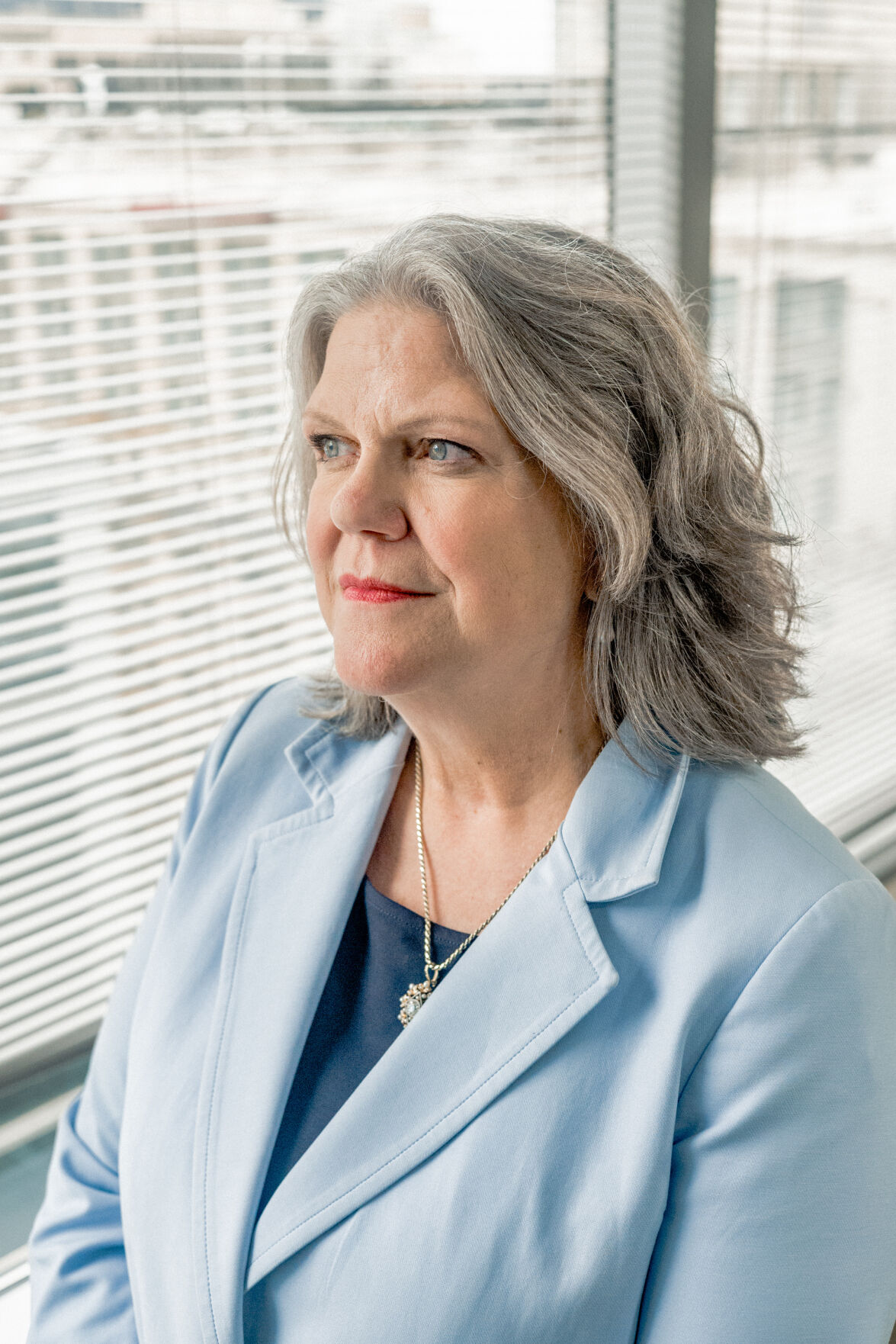
Former assistant chief immigration judge Jennifer Peyton, who oversaw Chicago’s immigration court for almost nine years, was one of dozens of immigration judges fired by the Department of Justice via email in July, without explanation.
Starting in May, "the DOJ was aligning their policy with DHS to make it easier to arrest and deport these people," he said. "I denied those motions. I'm Exhibit A for resisting that."
DHS's new policy on mandatory detention deprives noncitizens of due process and access to counsel, said former assistant chief immigration judge for Chicago, Jennifer Peyton, who was fired by email on July 3 without explanation, after nine years as a judge.
Before her termination, she saw asylum seekers with strong claims give up and ask for voluntary return, reflecting the harsh detention conditions, Peyton said.
"I know there are respondents with valid claims for relief, who suffered in their home country, but just did not want to be jailed anymore," she said. "This is not the country that I started working for. This is dismantling justice, not upholding it."
The $170 billion Congress approved for ICE in the last budget bill, combined with Trump's attacks on DOJ's independence, represent a threat to democracy, Pappas said.
"You finance enforcement, you undermine justice, what do you have? You have an authoritarian state," he said. "The infrastructure is being expanded, and those companies that own those detention centers stand to make billions with this authoritarian push."
The Executive Office for Immigration Review, the DOJ agency that runs the immigration courts, did not respond to the Star’s request for comment on the firing of judges and concerns about coordination between DOJ and DHS.
Detention expands, conditions worsen
Meanwhile, as the number of people in immigration detention rises, in-custody deaths are also up, and advocates fear already poor detention conditions will worsen.
Nationally, 16 immigrants have died in ICE custody since Jan. 23, according to ICE records. Ten of the deaths happened in the first six months of 2025 alone — "the highest number of deaths in the first six months of any year listed in ICE’s public records," said a Sept. 23 letter from concerned legislators to the heads of ICE and DHS.
Arizona's Eloy Detention Center is among the most notorious and, according to an October 2024 report from Detention Watch Network, the most deadly. At least 16 people have died there, including five suicides, the report said. ICE records show two more Eloy detainees have died since last year.
Attorneys with the Florence Immigrant and Refugee Rights Project, which provides pro-bono legal counsel to detained adults, say they're hearing more reports of suicidal ideation among detainees in recent months.
Detainees at Eloy and Florence — both owned by private operator CoreCivic — told the Star about poor detention conditions including inedible, rotten food; understaffing; overcrowded cells; and negligent medical care.
Cielo recalled one detainee he met at Florence whose face was so swollen from a tooth infection that one of his eyes barely opened. The detainee only got medical treatment after he dropped to the ground and held on to a guard's feet, begging for help, Cielo said, recounting what the man told him.
CoreCivic spokesman Brian Todd said in an email that Florence's clinic is staffed with "physicians, nurse practitioners, psychiatrists, psychologists, mental health counselors and dentists who contractually meet the highest standards of care. ... All individuals have daily access to sign up for dental care, health care, and mental health services."
Cielo also said he was unnecessarily given a course of tuberculosis treatment, despite never testing positive for TB. After four months, a doctor at Florence told him to stop taking the treatment — which can have serious side effects and which Cielo said made him ill — because he did not have the disease.
Todd said CoreCivic follows guidelines from the Centers for Disease Control for tuberculosis prevention and treatment, adding that detainees can refuse treatment.

Mari said both she and her son, who has developmental delays, struggled with their health after Cielo was arrested by immigration agents in February and sent to Florence Correctional Center for seven months. Cielo was not only the household's breadwinner, but also caregiver to Mari and her adult son, she said. As her health declined while Cielo was detained, Mari felt sure she wouldn’t see her husband again. "If my husband had lasted another month in that place, I would have died," she said through tears. "It was a nightmare, and I really thought I would not hold him in my arms again."
Mari said although Cielo prefers not to discuss it, she knows he's haunted by what he experienced at Florence.
"There were nights he called me crying, saying he didn't know what to do," she said. As her health declined while Cielo was detained, Mari felt sure she wouldn't see her husband again.
"If my husband had lasted another month in that place, I would have died," she said through tears. "It was a nightmare, and I really thought I would not hold him in my arms again."
Deficiencies by design, experts say
Experts on immigration detention say some deficiencies exist by design, with one goal in mind: increasing profits.
Companies that provide food services at immigration detention centers are selected based on cost above all other considerations, according to Immigration Detention Inc., by Hiemstra and Conlon. The co-authors spent 10 years tracking down public records and investigating six immigration detention centers to better understand who benefits from detention, and how profits are maximized.
Prices at immigration-detention center commissaries — the on-site store and vending machines where detainees can buy food, hygiene products and some clothing — are often six times what those items cost on the outside, Conlon said. Detainees are also charged fees on deposits family members make to their commissary accounts.
Subcontractors at detention centers, such as food service providers and commissary operators, are often owned by the same parent company, working together to maximize each other's profits, Hiemstra said.
That's the case at the Eloy and Florence detention centers in Arizona, where Trinity Services provides food services and Keefe Group runs the commissary, according to the facilities' recent ICE inspection reports. Both are owned by the same company, TKC Holdings, which did not respond to the Star's request for comment.
"They’re all kind of feeding off each other," Hiemstra said. "The food company makes money by not feeding them enough, so people are hungry and need to buy things in the commissary. ... When you start to look at a bigger level, you see that just treating people badly is part of this business model for how detention is so profitable."
CoreCivic's Todd said detainees get "three nutritious meals a day" and menus are approved "by a registered dietitian to ensure appropriate nutrition and food portions size. Many of our employees eat the same meals."
Commissary prices are "reasonable," set in collaboration with vendors and government partners, he said. "The commissary program is not a profit mechanism. Any proceeds from commissary sales are put into the facility's inmate/detainee welfare fund ... used periodically to purchase items that would be of benefit to the detainee population," like electronics or educational items.
Hiemstra said, in their research, they found no evidence of that and regardless, a facility's "welfare fund" doesn't put money back in detainees' accounts.
"Rather die" than stay detained
In the overwhelmed detention system, many noncitizens seeking refuge in the U.S. are experiencing lengthy detentions, advocates say.
Fleeing the Taliban in Afghanistan, 22-year-old Hijran Malik and his wife Lime, 19, say they escaped to Pakistan last year, where Lime remains with family. Malik continued to the U.S. to seek asylum protection, planning to have Lime join him once he could fund her travels.

Afghan couple Hijran Malik, 22, and his wife Lime, 19, are pictured here on their wedding day. The couple said they fled the Taliban in Afghanistan last year, reaching Pakistan together. Hijran continued to the U.S.-Mexico border, where in July 2024 he entered Arizona near Lukeville and surrendered to border agents to request asylum. He’s been detained at Eloy Detention Center for the 15 months since then, despite getting an order of removal in February. His asylum claim was denied due to lack of evidence, he said. Malik said doesn’t understand why he’s still detained and would rather risk his life in Afghanistan than stay at Eloy. "If I commit a crime in the U.S., okay, I deserve to be punished. But I'm fighting for a better life. I don’t deserve that," he told the Star on a video call from Eloy.
On July 9, 2024, Malik crossed the U.S.-Mexico border near Lukeville, Arizona, with about 30 others led by a Mexican human trafficker. Malik said he surrendered to U.S. Border Patrol agents and asked to request asylum.
After getting fingerprinted and processed near the border, Malik has been detained at Eloy ever since.
A judge has already denied his asylum request due to lack of evidence, which Malik said he couldn't bring from Afghanistan. Malik, who doesn't have a lawyer, received a final order of removal in February, eight months ago.
Malik said he's learned English during his 15 months in detention. He told the Star he's desperate to know why he's still at Eloy and that he'd rather risk his life in Afghanistan than continue being detained indefinitely.
"It's better that I die once, than be tortured here every day for no reason," said Malik in September, on a video call through a prison-messaging app.
In a Sept. 12 email, an ICE spokeswoman said Malik's continued detention is due to ICE "working to secure travel documents to remove Malik to his birth country of Afghanistan."
"We don’t hold people without cause," Yasmeen Pitts O'Keefe said. "Immigration detention isn’t punitive, it's administrative as you know."
Malik's wife Lime shared photos of herself and Malik on their wedding day, sent through WhatsApp. She asked the Star not to publish photos showing their faces because it could endanger them, if they must return to Afghanistan.
In one photo, Lime wears a white lace dress with sheer sleeves and no head covering, her black hair loose as she gives a grinning Malik a kiss on the cheek. Lime's family are Islamic fundamentalists of the ethnic group Pashtun, which has ties to the Taliban. That's part of the reason she and Malik — of the more "open-minded" Tajik ethnic group — weren't safe in Afghanistan, she said.
Malik said he's developed friendships in detention. A Guatemalan man, who has since won his case and been released, has been depositing money into Malik's accounts, so Malik can use the prison-messaging app and buy decent food at the commissary.
"He's a beautiful guy," Malik said. Another detainee recently helped Malik file a habeas corpus petition in Tucson's U.S. District Court, asking a judge to review the legality of his detention.
But Malik said he's losing faith in the U.S. legal system.
"They keep me here for no reason. Why? I’m not a dangerous person," he said on the video call. "If I commit a crime in the U.S., okay, I deserve to be punished. But I’m fighting for a better life. I don’t deserve that."
Last line of defense
Under the U.S. Constitution, the writ of habeas corpus ensures anyone imprisoned by the government can challenge their detention in a court of law, and more immigration attorneys are turning to habeas petitions.
"There’s no other way to get people released in these circumstances, when basically no one is eligible for bond," said Monica Cordero-Vazquez, adult legal program manager at the Florence Project.
The newly formed National Immigration Habeas Institute — a project of the National Immigration Litigation Alliance, or NILA, and Cardozo School of Law in New York — is offering immigration lawyers free trainings on filing habeas petitions, in exchange for the lawyers taking on pro-bono habeas referrals.
Habeas petitions must be filed in federal district court, where the law and procedures are vastly differently than in immigration court, said Trina Realmuto, NILA executive director.
Demand for the training quickly overwhelmed capacity, she said.
"We have been inundated with requests for habeas training from all over the country," she said. "The administration is weaponizing detention as a both deterrent and enforcement tool. ... With so many unlawful detentions, the need for (habeas) has skyrocketed."
That fundamental protection could be in the Trump administration's crosshairs, advocates say. In May, White House Deputy Chief of Staff Stephen Miller said, "The writ of habeas corpus can be suspended in a time of invasion, so that is an option we’re actively looking at."
Habeas corpus can only be suspended by Congress, legal experts say, but Miller's threats "should still be taken seriously — because the whole point of suspending habeas would be to take courts out of the equation," wrote Katherine Hawkins, senior legal analyst with the Project on Government Oversight.
The possibility is chilling, said Tucson attorney Campos, representing a threat to democracy and the rule of law in the U.S.
"Habeas is fundamental constitutional protection," he said. "When it disappears, it's game over."
"A weight we carry"
Back in their Pima County home, Cielo and Mari are still haunted by that day in February when immigration agents came onto their property and took Cielo. Even now, he's reluctant to go outside unless Mari goes first, she said.
Inside their home of 14 years, where they helped raise their grandchildren, the shades are drawn. The front gate and front door have new padlocks and "No Trespassing" signs, a futile effort to regain a sense of safety in their home, they say.
"They took me once. I already know they can take me," Cielo said. "It's a fear we have, a weight we carry," Mari added.
Nightmares have plagued Cielo's sleep since he got home, Mari said. He's started having stomach problems and headaches, and his right ankle is blistered from the GPS monitor he now wears.
"He’s home now, but the storm is still ongoing," she said, speaking in Spanish. "Every time I leave the house, I see the same thing that happened, as if my husband was taken away just yesterday."
Mari believes that in its pursuit of arrest quotas and funding for mass detention, DHS is doing harm that can never be undone.
"No one should have to go through this," she said. "They took seven months of our lives. Those are seven months that caused so much damage. No one is going to be able to replace those months we lost."

