



After three months in immigration detention at Eloy Detention Center, a longtime Tucson physical therapist has been deported to Laos, the country he fled with his family at age 6 in the 1970s.
Vone Phrommany, 53, said Wednesday he had arrived at a distant relative’s home, in Laos’ capital of Vientiane, following five days of exhausting international travel while shackled at the wrists and ankles, and about 10 days of processing at a Lao military camp.
Since arriving in Laos, Vone said almost all of his mental energy has been consumed by logistical issues, such as looking for a job; getting clothes, a Lao identification card and cell phone access; and figuring out how to access and manage his U.S. assets, including the home he owns in Marana.
Vone only had the clothes he was wearing when agents in plain clothes detained him as he was leaving a client’s home north of Tucson in July. But he was brought a change of clothes at the Lao military camp by two relatives he’d never met before: a half-niece and a cousin, who will be his sponsor in Laos.
He’s still processing the reality that he’s now thousands of miles from his loved ones, Vone said.

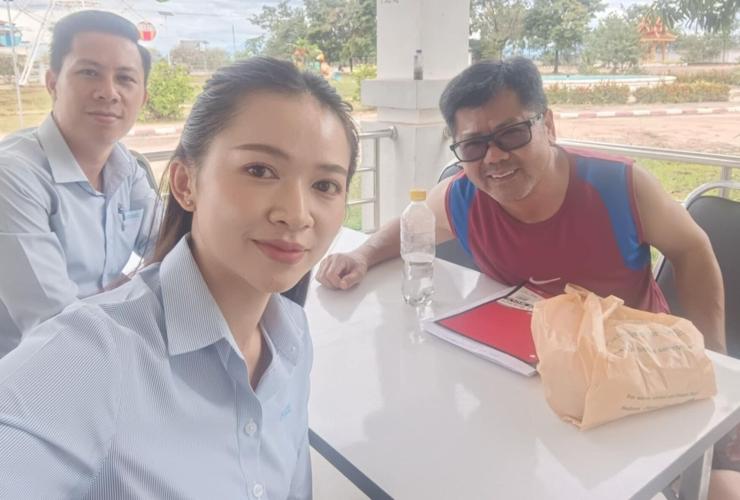
Vone Phrommany, pictured at right at a Lao military camp after his deportation from the U.S., said he arrived in Laos with only the clothes he was wearing when he was detained by immigration agents in July, and the detention attire he wore at Eloy. In Laos he's met distant relatives for the first time, including a cousin and half-niece who brought him a new set of clothes at the military camp. He was processed and released from the camp after about 10 days, he said.
“The emotion is overwhelming. I’m not quite myself yet,” said Vone, speaking to the Arizona Daily Star on a video call from the front porch of an uncle’s home. There, he said he’s been able to rest and eat traditional Lao foods, including pork and seafood.
“The food here is fantastic,” he said, adding he’s refreshing his memory on the Lao language. “Hopefully in a few months I can at least learn the streets, and the lingo.”
Anxiety and uncertainty are the main feelings he can put into words at the moment, he said.
Vone, who has a doctorate in physical therapy, has worked in the field for more than 20 years. He’s known by friends and clients as a devoted, talented caregiver who makes friends wherever he goes. That was even the case at Eloy, where he said he helped treat fellow detainees who were struggling with mobility.
A legal permanent resident, Vone was in compliance with routine check-ins with U.S. Immigration and Customs Enforcement at the time he was detained; his next check-in was scheduled for January.
But Vone was vulnerable to removal due to a non-violent crime he committed as a teenager, 35 years ago. At age 18, Vone was caught selling $140 worth of LSD and faced deportation for the crime, which is considered an aggravated felony since LSD is a controlled substance.
Vone said that “stupid, naive” mistake meant he couldn’t become a U.S. citizen like the rest of his family did after fleeing the communist regime in Laos. (The family first settled in South Dakota as refugees, sponsored by Lutheran Social Services, in 1980.)
In the decades since, Vone put himself through college, got a master’s degree and a doctorate in physical therapy. He maintained a clean record and work authorization, and complied with ICE’s requirement for routine check-ins. He’s worked as a physical therapist for 23 years, 18 of them in Tucson.
He’s passed numerous drug tests and background checks over the years, in order to be able to work as a home-health provider, his family said.
“I truly regret what I did when I was a kid. It changed my life, and that is not who I am,” Vone told the Star in an August phone call from Eloy. “I just want to get my life back and take care of my clients.”
‘Chaotic, disorganized’

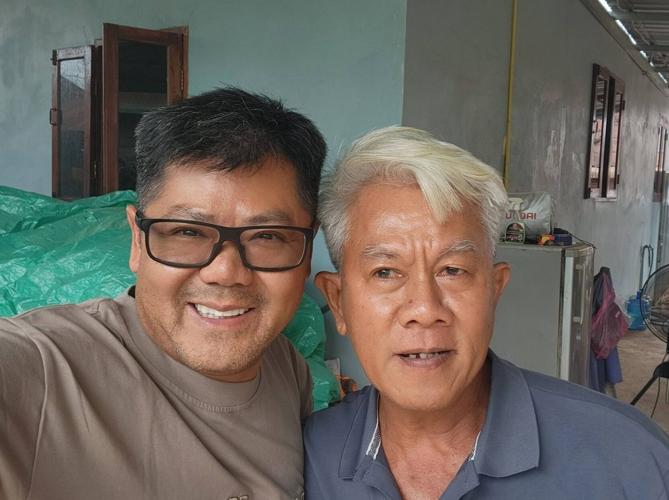
Tucson physical therapist Vone Phrommany said he's met distant relatives in Laos, after he was deported there in late October. His cousin, Thongphet Phrommany, pictured at right, is his sponsor in Laos.
Under previous presidential administrations, Vone wasn’t considered a priority for deportation, and since Laos wasn’t accepting deportations at the time, Vone was released after serving his criminal sentence.
That changed under President Donald Trump, who has called for mass deportations, regardless of individual circumstances, and has pressed immigration agents to meet aggressive arrest quotas.
Vone said he had no warning that his deportation date had been set, and his family was still hopeful he could avoid deportation.
But around midnight on the morning of Monday, Oct. 20, an Eloy officer came into Vone’s cell, waking him from a dead sleep, and told him he had five minutes to get ready, Vone recalled.
At first, Vone thought he was being released, even though he still had a few days before his 90-day custody review with ICE to evaluate if he could be released on bond. (Because of his prior offense, attorneys said that would not be possible.)
“I thought, ‘Maybe this is it.’ I was thinking positively,” he said.
That hope soon evaporated, he said, and the first leg of his journey after leaving Eloy was “chaotic.” Vone and the other deportees were in shackles the whole time, he said.
He and a handful of others were first flown to Washington state to pick up more deportees, then to El Paso, where Vone and dozens of others waited on a bus for six hours before more deportees arrived. They were then flown to Alexandria, Louisiana, where he and hundreds of others destined for Southeast Asia were processed. Fourteen hours later, they boarded a flight to Baltimore, where the plane would refuel.
The plane sat on the tarmac in Baltimore for five hours before the flight took off, Vone said. Hours later, when the flight landed, Vone said the passengers were shocked they were back in Louisiana.
One of the destination countries had not given clearance for the deportation flight, so the whole process had to begin again, he said.
“They should have had that all in place. They treated us like we were nothing. It was so disorganized,” he said. Finally, they made it back to the East Coast before setting off on the more than 24-hour, multi-stop flight to Southeast Asia.
Food was minimal and at times, inedible; at one point, Vone was given a bread and cheese sandwich, but the cheese had mold on it, he said.
There were about 400 deportees on the international flight, which made stops in India, Sri Lanka, Cambodia, Vietnam and Laos, he said.
Everyone was shackled the whole flight, he said. Some of his fellow passengers told him they had U.S. citizen spouses and children they’d been forced to leave behind.
“They’re ripping families apart,” Vone said.
Outpouring of support
Beloved by his in-home physical therapy clients, and his tight-knit family and work community, Vone said he’s received an outpouring of support since he was detained.
Nearly 4,000 people signed a petition on Change.org calling for Vone’s release. Vone’s family and friends wrote letters, made visits to Eloy and printed Superman-themed T-shirts that read “Super Vone” — one of his nicknames.
Vone’s Phoenix-based sister, Sace Phrommany Rydberg, has booked travel to Laos to help her brother get settled, and to bring him some clothes and personal items from his Marana home. She expects to arrive there this weekend, she told the Star by phone.
Vone’s family and friends are devastated by his removal, but focusing on the positive as much as possible, she said.

Vone Phrommany's Phoenix-based sister, Sace, at center, has booked travel to Laos to help her brother get settled, and to bring him clothes and personal items from his Marana home. His sister Steffinnie, at right, also plans to visit, Sace said. Vone's family and friends are devastated by his removal, but focusing on the positive as much as possible, she said. "Throughout this whole thing, there is light at the end of the tunnel, knowing that we actually do have relatives there" in Laos, she said.
“Throughout this whole thing, there is light at the end of the tunnel, knowing that we actually do have relatives there,” Sace said. “I have to look at it this way, like, oh my gosh, we didn’t realize we do have family there.”
Sace said Vone eventually hopes to move somewhere closer to family, such as Canada, but that’s likely years away: To get travel documents, he first has to establish Lao citizenship, which can take up to five years, he said.
Vone is also holding out hope that U.S. law might change, or a new presidential administration might re-evaluate his case.
“He’s going to continue to fight to come back to us,” Sace said. Messages of encouragement, and financial donations, from friends and strangers have helped make the past few months bearable, she said.
“Whether you reached out, donated or simply kept us in your prayers, please know that we appreciate you more than words can say,” she wrote in a text. “Because of (friends’) kindness and understanding, we never felt alone through it all.”
Vone said he misses his friends, family and his physical therapy clients.
“I wish I hadn’t been deported,” he said. “My lifestyle truly has changed. All the stuff I grew up accustomed to is totally different here.”

