



The Trump administration’s move to halt spending on “green” energy programs leaves a big question mark hanging over federally funded water conservation efforts from Tucson to Southern California’s Imperial Valley to the Colorado Rockies.
Numerous projects as disparate as a Tucson plant to purify wastewater for drinking, to water-saving sprinkler irrigation in Southern California, to a purchase of century-old water rights on Colorado’s Western Slope have all received financial commitments in the past six months from the U.S. Bureau of Reclamation.
The future of at least some of them is now uncertain because of a Jan. 20 White House order to “pause” spending under the law that appropriated those funds, the 2022 Inflation Reduction Act. Also frozen by that order was spending under the 2021 law that appropriated money to build roads, bridges, pipelines and other infrastructure projects.
The Inflation Reduction Act funds for water were appropriated under a provision that drew little national attention but has had a huge if temporary impact on water use in the Colorado River Basin. It has been paying cities, irrigation districts and other entities billions of dollars to use less water from the climate-stressed river.
It remains unclear whether the White House order affects money set aside for water conservation. But numerous Western water officials and experts say it would be a major detriment for the West if such projects would now be cancelled.
“If financing for the projects disappears so does the conservation associated with the projects,” said Bart Fisher, a longtime official and former president of the Palo Verde Irrigation District, based in Blythe, California.
“It’s really simple. They are asking farmers to forego planting crops and to do other things that conserve water at the expense of their revenue on the farm. Without that (federal) revenue, there’s certainly not going to be any farmer wanting to cooperate with conservation,” said Fisher, whose district gets about $45 million a year to fallow farmland to save river water.

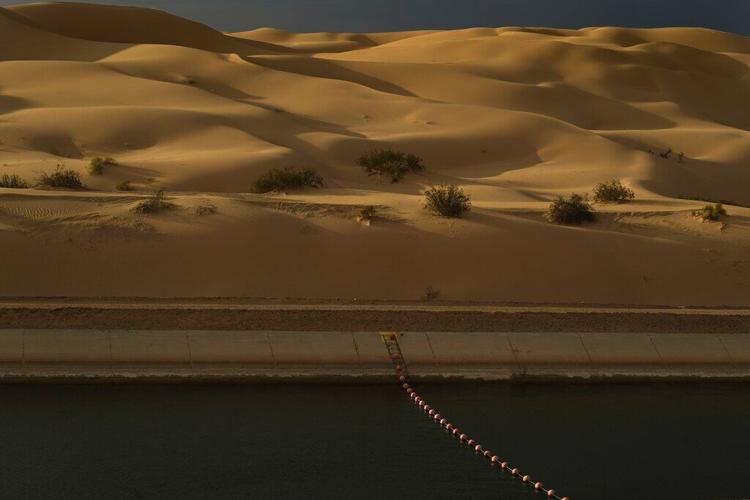
Water flows along the All-American Canal near Winterhaven, California. The canal conveys water from the Colorado River into the Imperial Valley of Southern California. A provision of the now “paused” Inflation Reduction Act spending has made a huge if temporary impact on water use in the Colorado River Basin by paying cities, irrigation districts and other entities billions of dollars to use less water from the climate-stressed river.
Water flows along the All-American Canal near Winterhaven, California. The canal conveys water from the Colorado River into the Imperial Valley of Southern California. A provision of the now “paused” Inflation Reduction Act spending has made a huge if temporary impact on water use in the Colorado River Basin by paying cities, irrigation districts and other entities billions of dollars to use less water from the climate-stressed river.
Beyond that, water saved through federal spending played a major role in propping up Lakes Mead and Powell in the past two years, along with an unusually high burst of rainfall and snowpack in 2023, he and other water officials and experts have said.
Two years ago, the reservoirs were low enough that a shutdown of power generation at Lake Powell in the very near future was a distinct possibility. The worst-case scenario of “dead pool,” in which the lakes would be too low to yield water, also seemed a real possibility within a few years.
“By saving this water we managed to prop up Lake Mead where dead pool isn’t even talked about much now,” Fisher said. “If we don’t continue to conserve water in the future, we could be very quickly looking once again at dead pool.”
For the river’s Upper Basin, the loss of funds targeted for water conservation and related projects would be “huge,” said Anne Castle, who just stepped down as a federal representative to the Upper Colorado River Commission.
“The projects that were allocated IRA money in the Upper Basin — they are projects that are designed to create resilience against drought and incentivize water conservation,” said Castle, who was assistant Interior secretary for water and science in the Obama administration. “So when we are talking about the Colorado River system where we’ve already got an imbalance between supply and demand, taking away these projects that would put us in a better position … would mean we are in a world of hurt.”
But Sarah Porter, who runs an Arizona State University water research center, noted that the cutoff of future funds for conservation programs won’t have as big of an impact today as it would have in 2022.
“We are not in that dire situation we were facing then,” said Porter, director of the Kyl Center for Water Policy. “What we thought we needed back in 2022 was emergency funding. This year, it so far hasn’t been a very good winter” for river replenishment. “But we are not in the same situation today as we were then.”
‘Drought relief’ part of law
The Inflation Reduction Act is best known, and most controversial, for having appropriated or allocated tax credits for at least $370 billion for clean energy programs and projects such as heat pumps, solar panels, electric vehicles and battery plants.
But added to that landmark piece of legislation, partly at the behest of both Arizona senators, was a $4 billion appropriation for “drought relief” for the Colorado River Basin.
That has resulted in Tucson, Phoenix, Scottsdale, the Metro Water district on Tucson’s northwest side and numerous other Lower Basin cities and irrigation districts being fed hundreds of millions of dollars in payouts since 2022 to compensate them for using less water.
Tucson just last month signed an agreement with the U.S. Bureau of Reclamation to receive $86.7 million for constructing a new “advanced water purification” system to make wastewater drinkable. It will serve residents of the northwest side whose wells have been shut down due to contamination from PFAS compounds known as “forever chemicals.”
Tucson was awarded another $20 million to leave more than one-third of its annual Central Arizona Project supply in Lake Mead in 2026.
But Trump’s Jan. 20 executive order told “all agencies” to immediately pause the spending of money appropriated to carry out the Inflation Reduction Act and the Bipartisan Infrastructure Law.
The next day, the Office of Management and Budget, which controls the federal spending spigot, issued a follow-up memo to the heads of “all departments and agencies” that sought to scale back the impact of the previous day’s memo.
It said spending would be frozen only on projects and programs covered by another section of the Jan. 20 order applying mainly to energy programs and in general, to those that discourage the use of fossil fuels.
That section of the Jan. 20 order stressed the need for the country to have an affordable and reliable energy supply, and took a blast at federal policies aimed at encouraging — it inaccurately said “mandating” — the use of electric vehicles. The order is titled “Unleashing American Energy,” and the section freezing spending on the federal programs is titled “Repealing the Green New Deal.”
The Bureau of Reclamation, which funnels water conservation grants from the 2022 act to cities and farms, didn’t respond to questions from the Arizona Daily Star about whether the new sending freeze will stop the flow of water-saving dollars to the West.
Tucson officials offered few comments on whether the White House order could affect the wastewater purification plant or other conservation funds.
City spokesman Andrew Squire said Wednesday, “It is my hope that this interpretation is correct,” a reference to the Jan. 21 memo from the Office of Management and Budget, but offered no further comment.
Previously, Squire had said, “At this point we are evaluating what the impacts from the very recently signed executive orders for IRA and the other federal programs might be. It is a quickly changing landscape and we are working to put together that information.”
In Phoenix, water officials are trying to negotiate a $300 million payment from the bureau to pay part of the cost of building their own advanced wastewater treatment plant, along with other conservation efforts. Michael Gertzman, a spokesman for the Phoenix Water Services Department, also declined comment on the recent White House memos.
“The city of Phoenix is actively assessing the implications of these developments, particularly concerning the city’s ongoing negotiations with the Bureau of Reclamation …,” Gertzman said. “As the City continues its assessment, it would be premature to provide further comment at this time.”
‘Creating more confusion’
Outside experts say the Trump administration memos created uncertainty about the direction of federal spending.
“They are creating more confusion that makes it hard to plan projects,” especially after another federal agency sent out a letter offering buyouts to all federal employees who leave voluntarily, said David Wegner, a retired Reclamation official and a member of a National Academy of Sciences advisory board.
He noted that Castle’s resignation letter from the Upper Colorado commission said the river basin is in a “very tenuous” spot right now politically due to the ongoing, but deadlocked negotiations over how to put together a new agreement by 2026 to replace existing rules for managing the river’s reservoirs.
“Disruptions like this will cause more uncertainty and less interest from states in committing one way or the other to projects, leading to more and more confusion,” he said. “There’s nobody in charge. They’re just throwing this stuff out there to find out where it lands.”
The Inflation Reduction Act spending memos indicate confusion in the administration itself about where spending should continue, and where it should stop, said Martin Lockman, a fellow at the Sabin Center for Climate Change Law at Columbia University Law School.
Although federal law forbids the White House from refusing to spend money Congress appropriates, Trump administration officials have made it clear they’re looking for ways to “impound” funds for projects they dislike.
“Frankly, we’re worried that the Trump administration has a lot of ability to stall spending, even if they can’t redirect it or cancel it entirely,” Lockman said in an interview last month with Colorado Public Radio.
Lockman told the Star Friday, “If the administration wants to make people fight for their rights in court, they have a lot of ability to slow the dispersal of funds, and make people fight for their rights in court.”
Conservation projects at stake
In all, cities and farms in the Lower Colorado River Basin won at least $1 billion in Inflation Reduction Act, water-conservation related grants in 2023. In the past six months, at least another $1 billion of conservation grants from the act was awarded to cities, irrigation districts and tribes in the Lower and Upper basins.
Some examples:
— The same time Tucson and the reclamation agency inked the $86 million deal for the wastewater-for-drinking plant, Reclamation awarded eight other Southern and Central Arizona users well over $100 million more for other water projects.
The biggest was $154 million for a major pipe and pump construction project to connect the Salt River Project canal system with the CAP canal near Phoenix. That will allow SRP, which serves many Phoenix-area cities, to put water it doesn’t need in years of heavy rainfall into the CAP canal. That will give CAP customers an extra source of water to replace supplies lost to delivery cutbacks from the Colorado River.
In another deal, the city of Gilbert agreed to take $13 million to upgrade a water distribution system inside its Riparian Preserve. That will allow it to recharge more locally produced wastewater for future use, and save 6,000 acre-feet of Colorado River water.
In the Tucson area, Metro Water agreed to take up to $2 million from the bureau in return for leaving up to 5,000 acre-feet a year in Lake Mead. That’s a similar arrangement to what the suburban water district made for 2023, 2024 and 2025.
The mining giant Asarco agreed to take up to $8.4 million to leave 21,000 acre-feet of CAP water its Mission Mine south of Tucson normally uses in Mead in 2026, on top of similar arrangements for the previous three years.
The cities of Scottsdale, Peoria and Glendale agreed to leave a total of about 18,000 acre-feet in Mead this year for more than $7 million.
— In December, the four Upper Colorado River Basin states were awarded $388 million for 42 water conservation and eco-restoration projects. The states are Colorado, Utah, New Mexico and Wyoming.
The large amount is no surprise because this is the first water conservation award of any consequence to the Upper Basin from the Inflation Reduction Act.
The biggest Upper Basin outlay will be $40 million to buy water rights from an aging, privately owned power plant that uses river water in northwest Colorado to generate electricity. This purchase, which will require additional money from other agencies and entities, is a way of ensuring the river flows in that area and that no other private party obtains the rights.
— In October, the feds announced a $107 million grant from the act to the Gila River Indian Community in Central Arizona for a series of conservation projects to save 73,000 acre-feet of water over a decade. They include upgrading the irrigation system for the community’s farms, lining earthen canals to reduce seepage and building a reservoir to capture water that now spills from a major canal during heavy rains.
— In September came the single biggest recent federal award for water. It pledged well over $500 million to the Colorado basin’s single biggest water rights holder: The Imperial Irrigation District in the Southern California desert near El Centro. It’s supposed to save 700,000 acre-feet total from 2024 through 2026.

A sprinkler system installed on a field in the Southern California desert is designed to improve the efficiency of its water use compared to the longstanding practice of flooding fields with water to grow crops. Growers in the Imperial Irrigation District, which controls the largest share of Colorado River water in the West, installed the sprinklers with money it got from the federal Inflation Reduction Act. That spending is now in question under a pause ordered by the Trump administration.
A sprinkler system installed on a field in the Southern California desert is designed to improve the efficiency of its water use compared to the longstanding practice of flooding fields with water to grow crops. The Imperial Irrigation District, which controls the largest share of Colorado River water in the West, installed the sprinklers with money it got from the federal Inflation Reduction Act. That spending is now in question under a pause ordered by the Trump administration.
The district will use the money to install water conservation systems such as drip and sprinkler irrigation in place of water-slurping flood irrigation, and to use lasers to level land to insure water is distributed evenly on a field, minimizing waterlogging and runoff.
Some of the money will also pay farmers not to grow high-water-using alfalfa and other grasses for 45 to 60 days during summers, when crops have lower yields and require more water.
Farming district, tribe not overly concerned
Officials of both Imperial and the Gila River tribe say they’re not overly concerned about the prospect of the Trump administration taking back any of the money the government already gave them or declining to pay funds for which grants have already been awarded.
“IID has a fully executed contract and anticipates Reclamation will honor that contract as the district fulfills its commitment” to save enough water to raise Lake Mead’s elevation by 11 to 14 feet, said Tina Shields, the district’s water manager.
“The district is not immune to the current uncertainty during this change in federal administration. However, transition processes are not unusual and IID looks forward to working with the new federal team to implement the last two years of this agreement,” Shields said.
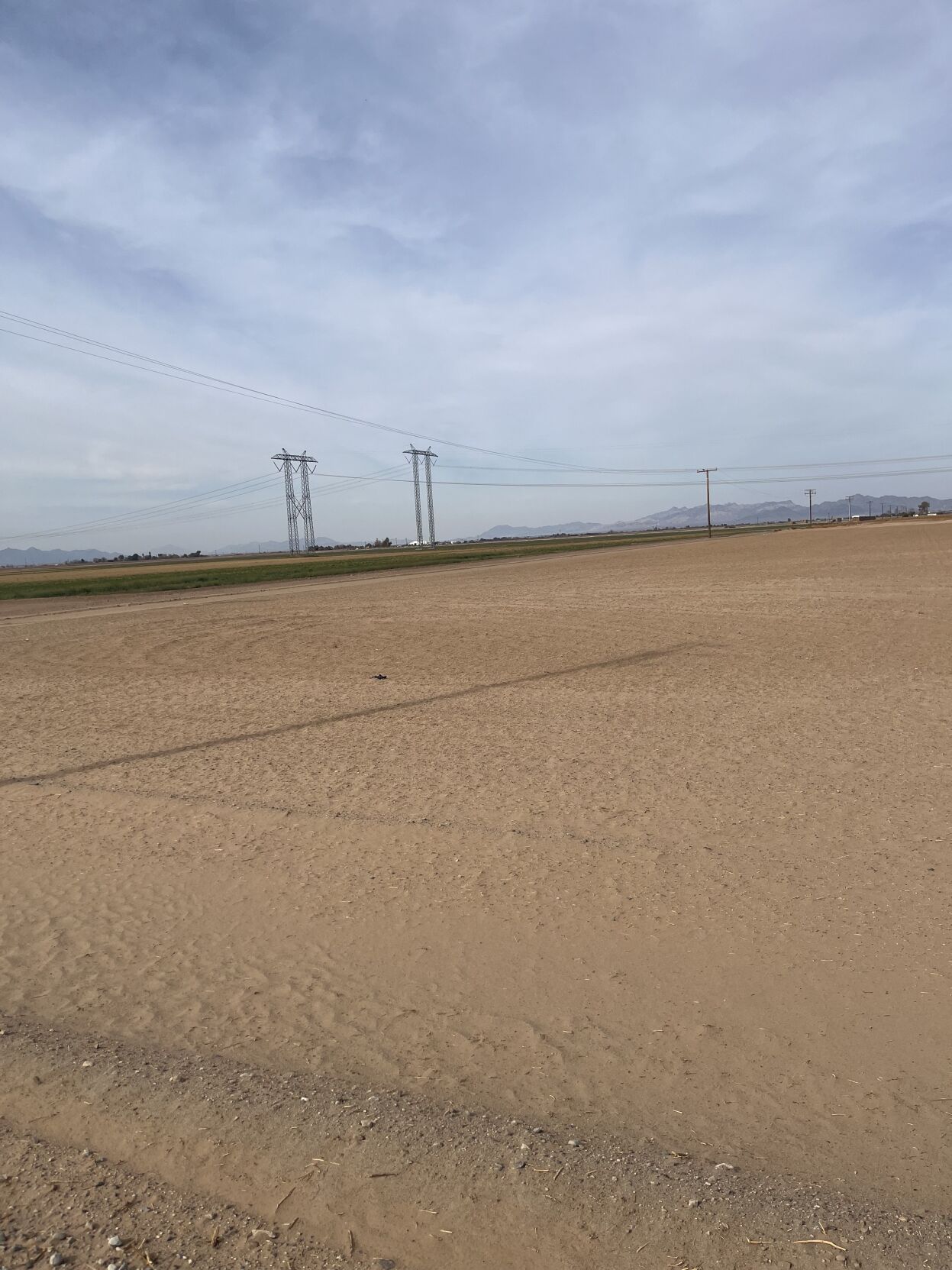
In the Palo Verde Irrigation District near Blythe, California, along the Colorado River’s west edge, many farmers have fallowed some of their fields for long periods to save water. In return, they got money from the federal Inflation Reduction Act. Spending under that law has been "paused" by the Trump administration.
Tribal attorney Jason Hauter said he’s heard no concern about water conservation funds being targeted by Trump and he think energy-related project funds are most likely at risk.
“Our stuff contracted out is already contracted out,” Hauter said of the federal money for which the tribe has signed contracts.
“I think the new administration has made it very clear it wants to be able to control the purse (strings), and not spend on things the administration disagrees with. (But) water conservation is not one of the things I’ve heard about,” he said.
But retired bureau official Wegner is less optimistic about the Trump administration’s intentions for the water conservation funds.
If grant recipients haven’t spent it, “he’ll try to take it back, but he will have a harder time doing that,” Wegner said.
In many cases, the feds haven’t sent all the money it awarded to grant recipients because they time the actual spending to when the cities and farms can document they’ve actually conserved water. In such cases, “There’s a high probability it won’t be allocated to the states for distribution,” he said.
“If Arizona has it in their bank account, it would be very difficult to claw it back,” he said of the federal money. “That’s not always the case.”
In theory, people are correct when they say it will be hard for Trump to hold back money when there are signed contracts, he said.
“Sadly, this president doesn’t seem to want to abide by things like treaties, agreements and contracts,” Wegner said.
A blanket of crops covers the ground of the Imperial Valley in southern California, a patchwork of vibrant greens given life by the Colorado River in a landscape bleached by the desert sun. But as a decades-long drought desiccates the U.S. West and the once-mighty river dwindles, questions are being asked about why a handful of farmers are allowed to take as much water as all of Nevada and Arizona combined.

