



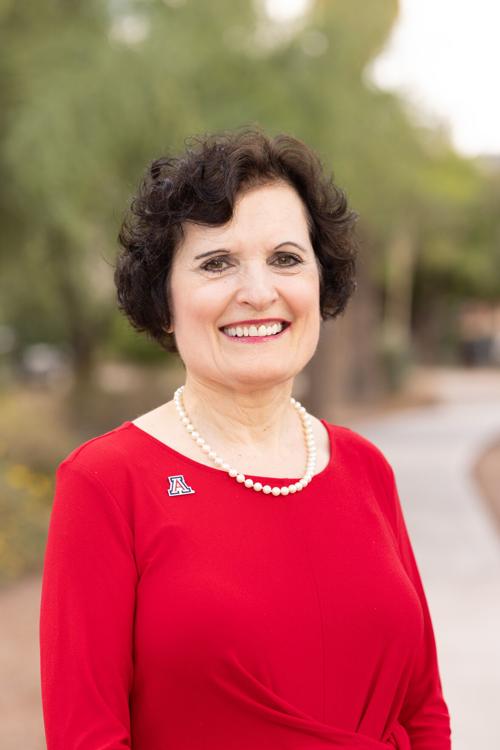
The University of Arizona will create a committee to look into its alcohol policy, education and prevention activities, its provost says, after the recent crash in which police allege a student struck and killed three other UA students while driving when impaired by alcohol and/or drugs.
“It’s not just about the policy, because we know alcohol is here and if you’re over 21, that is a choice people make. But what is really important is what are the education and prevention activities that we are engaged in,” Provost Patricia Prelock told the Arizona Daily Star in a wide-ranging interview Monday, adding that alcohol use can also lead to sexual assaults, accidents and other problems.
“So, we’ll be putting together a committee to do a serious look at — how are we educating our students? How are we educating our community? What are some prevention strategies that we have to support safety for students who choose to engage in drugs and alcohol?” Prelock said. “And really share with them statistics on the health and wellness of the brain and body, and also the challenges (they) have when engaged in substance use, where (students) may not be able to make the best decisions when driving or hanging out with their friends.”
On Oct. 20, UA students Sophia Troetel, Josiah Santos and Katya Castillo-Mendoza were fatally struck in a hit-and-run while walking at about 11 p.m. in a crosswalk on North Euclid Avenue at East Second Street near campus. A fourth UA student, 19-year-old Louis John Artal, was arrested and is charged with three counts of manslaughter and with leaving the scene of an accident.
Prelock said she has already met with UA’s Chief Financial Officer John Arnold, Chief Safety Officer Steve Patterson and undergraduate student body president Adriana Grijalva to start creating the committee. She said she’s “re-looking” at UA programs which address substance use among students, and working on developing a task force to look into aspects including UA’s policies, education, prevention and impact on safety.
“I was reading several articles on the use of certain drugs and alcohol, and students often (say) the reason they do it is, ‘it’s just a social thing,’ (and) for their anxiety and stress,” Prelock said. “The misnomer that students have is that alcohol and drugs will help decrease your anxiety. But, in fact, the research is really clear — if you already have an anxiety problem, alcohol and drugs are the worst things you can do, because it only exacerbates it, it doesn’t make it less. And I was like whoa, I don’t think a lot of kids know that.”
This was just one of the topics Prelock addressed in the Star interview, as she spoke about her goals as the university’s chief academic officer. Former interim president of the University of Vermont, she began her UA role in May this year, overseeing the faculty and the academic mission. Sitting in her office during the interview, she was surrounded by fresh flowers, which, she shared with a smile, her husband sends her every Monday.
She said her role is to carry forward UA President Suresh Garimella’s three strategic imperatives: success for every student, research that shapes the future, and community engagement. She talked about creating an ecosystem where students flourish academically as well as in extracurricular activities, and graduate in four years with either a career plan or a path to graduate school. “I want to make sure that students feel a sense of belonging and community, that they’re retained,” Prelock said.
Prelock also addressed the current political climate and the precarious position university administrators are in, with respect to standing up for their institutions’ values while also making sure to abide by changes in federal and state priorities under the Trump administration. “I’m in it for the long game,” she said.
“I’m trying to help our students and our faculty know that the decisions we make or don’t make now, we don’t want to destroy the potential for the future of the university,” Prelock said. “So we have to think — are there some adjustments we could make that don’t compromise our values, but allow us to live in this complex world where things change every time but we can still do what we need to do?”
The Trump administration, as well as Arizona’s Republican-controlled Legislature, have ordered universities to cease any diversity, equity and inclusion or DEI activities, which they said are discriminatory and unfair practices. These orders are directed at processes of admissions and hiring, as well as student support groups that cater to specific racial and gender communities on campus.
Prelock talked about a subsequent controversy, UA’s decision at the end of the spring semester this year to consolidate six Cultural and Resource Centers into one “Student Culture and Engagement Hub.” Some students, faculty and staff protested and signed petitions asking Garimella to retain the centers as they were.
The provost said the programming provided previously by the cultural centers is still occurring in the now-consolidated hub.
Physical spaces for individual cultural centers were retained even with the centralization, are “used a lot," and are appropriate "as long as they remain open to ‘all students’ and they can really support one another,” she said. She added that while “they were all doing individual programs, there’s a way that some of their programs would be beneficial for all the students, because there’s a lot of intersectionality between our students who have different identities.”
In terms of shared governance, Prelock said, “nothing gets accomplished if we don’t think about it together,” on the matter of administration, faculty, students and staff putting their heads together to make important university decisions. “I’m ultimately going to have to make decisions that my shared governance colleagues might not like, but at least they know that I’ve heard them. We are in this together. We’re giving them an opportunity for feedback.”
The UA announced plans in June to set up a first-year study-abroad option for students who don’t manage to get their U.S. visas in time. This came during a decline in international enrollment across the U.S. due to the Trump administration vetting and revoking international student visas.
“The plan is that we would have an organization that does that for students who might not be able to get their visas right on time, so they could study in London and then come and transfer here,” Prelock said.
“There was a challenge with the organization that we were going to work with, but we’re trying to do that for either spring or fall semester,” she said. “There will be more information coming from Kris Wong Davis, our VP for enrollment management, and hopefully things will be a little easier for students with their visas.”
In addition to having international students study abroad, Prelock said they are also looking into programs that would take more UA students to study, research, do internships and take part in exchange programs in other countries. She said study-abroad experiences for students are “transformational,” and she wants to triple the number of students who are able to do this with a recent $20 million gift commitment from the philanthropic Garcia Family Foundation and $1 million from former Wildcat basketball legend Steve Kerr to expand study-abroad access.
In addition to UA’s Global Center, where international students can go for information and resources, Prelock said the university is equipped to offer local community support, financial literacy classes and legal support, and is working to set up systems of basic needs and mental health support as well.
UA’s decline in international students “wasn’t as bad as some institutions where a significant percentage of their graduate students are international … but I think when you do good research in areas that other countries want to really capitalize on, whether it’s agriculture, health, biomedical sciences, etc., they will find people that they want to work with,” Prelock said about UA attracting international students.
“We have incredible experts in precision medicine, cancer, transplants, Alzheimer’s and Parkinson’s. Those are things that hit every particular cultural group,” she said. “So, for me, it’s how do we continue to raise up the things that we do really well, so that graduate students say, ‘Hey, I want to come to the University of Arizona, because I’m going to get a really powerful research and educational program.’”
Prelock said she also has a plan for overall enrollment, as universities across the U.S. deal with the “demographic cliff” — the projected significant drop in college enrollment starting around 2025-26 caused primarily by declining birth rates since the 2008 recession.
She said while UA’s strategy has many levels, the first is to “right-size” the number of students on campus so all have resources for support and success.
“Having giant-size classes just because we can say we have giant classes isn’t really a goal. I don’t want to take students just because I want money,” she said. “I want to take students who can graduate and be successful. Now, I have to balance that with being fiscally responsible. … Just because you take more students doesn’t mean your net tuition revenue is better. And in fact, last year, we took less students, but our net tuition revenue was about the same, and that’s important to understand.”
UA’s fall 2025 enrollment of first-year students dropped by 19%, mostly due to declines in out-of-state and international students. But the university’s net tuition revenue stayed the same, due to a reduced number of merit-based scholarships for out-of-state students.
Prelock also mentioned her initiative of working with community colleges to create easier and more accessible pathways for students to transfer to the UA. She said UA reorganized its Transfer Student Services office so that applicants will connect with an advisor rather than just a computer.
“It’s also our model in how we’re providing financial aid and support for students,” said Prelock. “It may be that we have a more needs-based approach and be very thoughtful about merit scholarships, so that we’re giving merit to students who we know are high-quality students but want to come here and be successful and we can provide the path for success.”

