


Mike Blommer doesn’t need some string of Roman numerals to remind him which Super Bowl this is.
The long-time Tucson resident and musician was on the field at Los Angeles Memorial Coliseum for the first true professional football championship game, 59 years ago last month.
“They called it the Super Bowl, but they didn’t use the 1” at the end of it, he said. “At the time, no one knew whether there was going to be a Super Bowl II.”
Blommer was one of about 200 members of the University of Arizona Symphonic Marching Band picked to provide the halftime entertainment for the big game that started it all: the Jan. 15, 1967, contest between the National Football League's Green Bay Packers and the American Football League's Kansas City Chiefs.
Eleven participants in that historic trip gathered at Arizona Stadium last month for a reunion of sorts that doubled as an informal oral history project. The former band members, most now in their late 70s, sat in the stands and watched as a grainy, low-resolution video of their performance played on the stadium’s scoreboard. Then they fielded questions from current U of A band director Chad Shoopman, with a university camera crew filming the conversation.

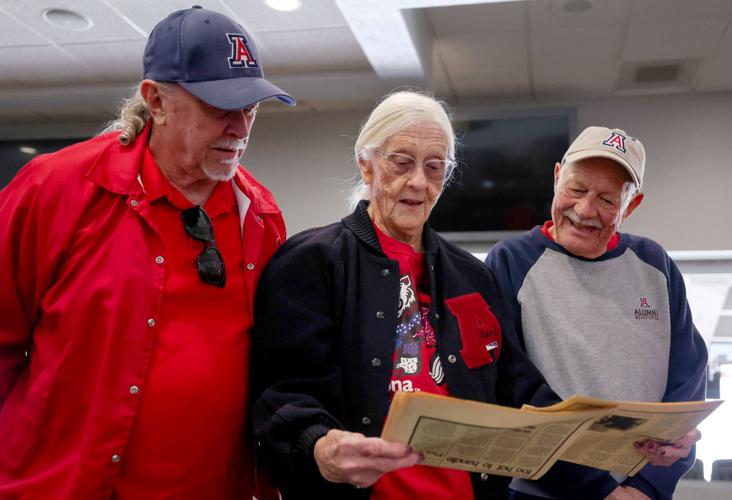
Former University of Arizona marching band members, from left, Nic Hiner, Elizabeth Miller and Robert Lochner, look through old newspaper articles about their 1967 Super Bowl performance during a reunion last month at Arizona Stadium. Hiner and Miller played clarinet and Lochner played trumpet in the band.
“The Super Bowl was one of the most fantastic memories of my career,” said 89-year-old Shirlee Bertolini, who came to the U of A in 1954 to be its first featured twirler and ended up coaching the twirling team for 60 years.
Former marching band member Mayann Nuckolls described that day in 1967 as one of the best experiences of her life. “It has provided me never-ending ice-breaker information before meetings: ‘I played in the first Super Bowl,’ and then everybody scratches their head,” she said.
Songs in smog
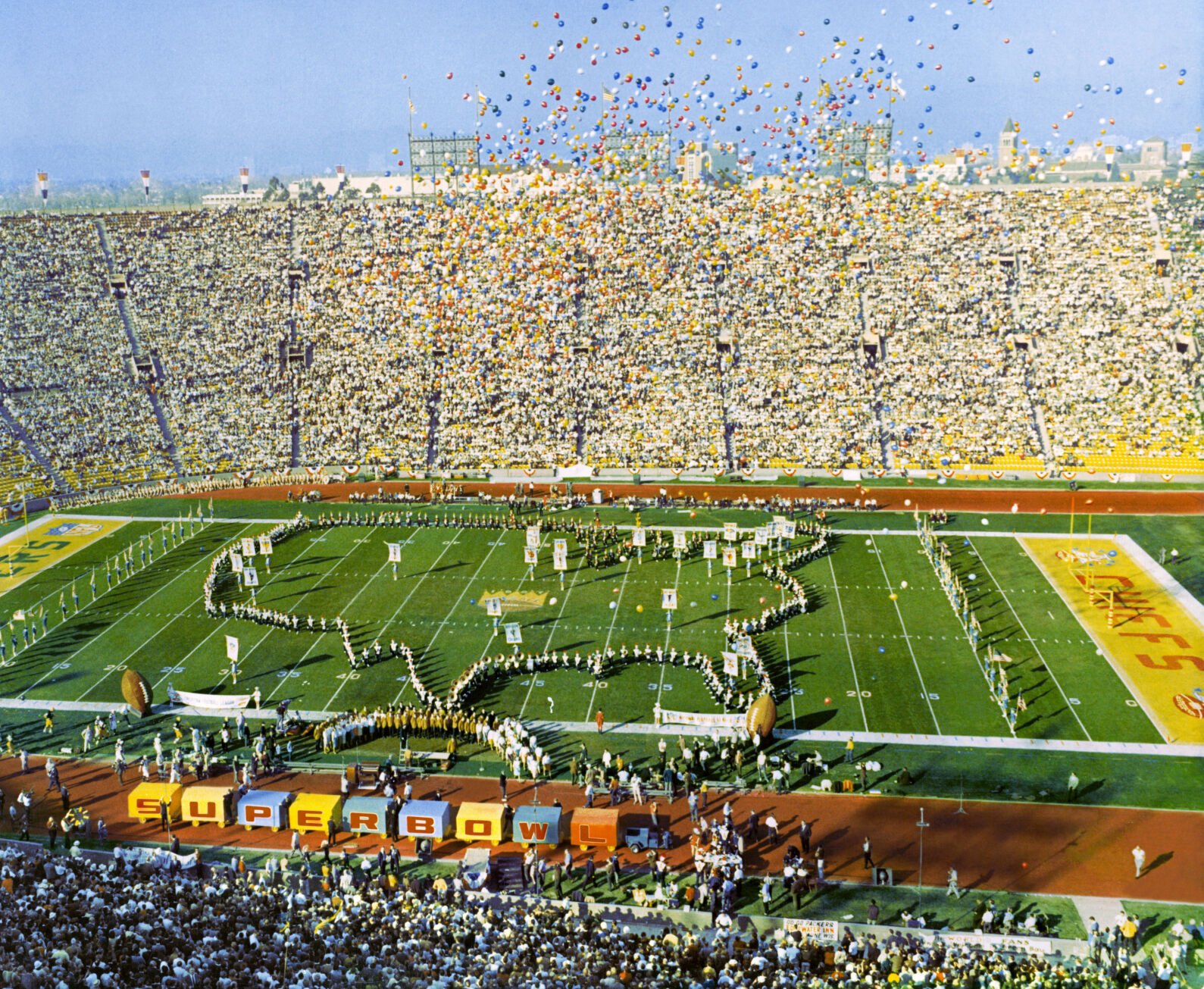
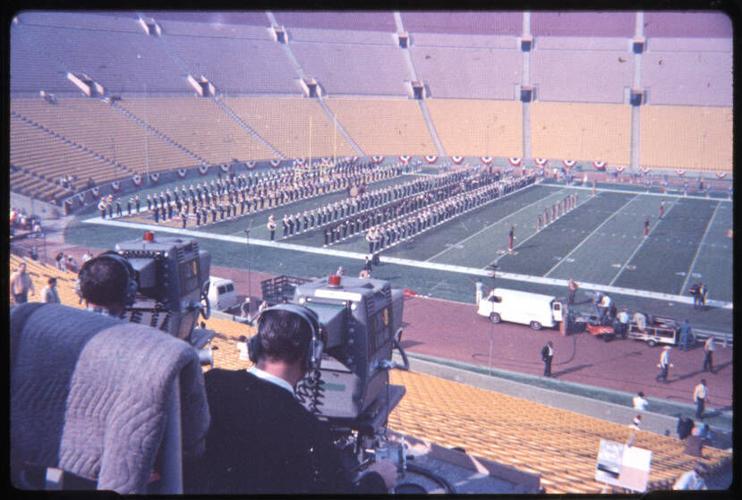
The U of A's self-annointed “Best Band in the West” played a medley of nine different songs, and finished the show by lining up to form a map of the U.S. that covered most of the field. Blommer and his trumpet ended up somewhere along the Florida Panhandle.
“I remember walking into the stadium and not believing how huge football players were,” said the retired Raytheon engineer, who never put down his horn and once toured the world as a part-time member of what he called “the best blues band in Arizona.”

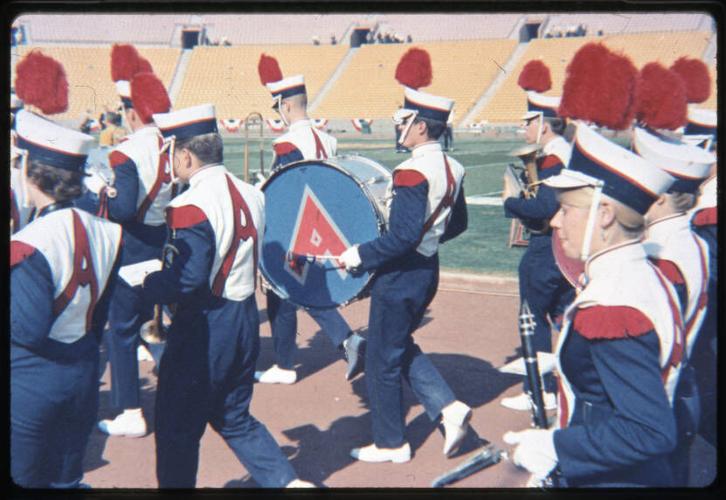
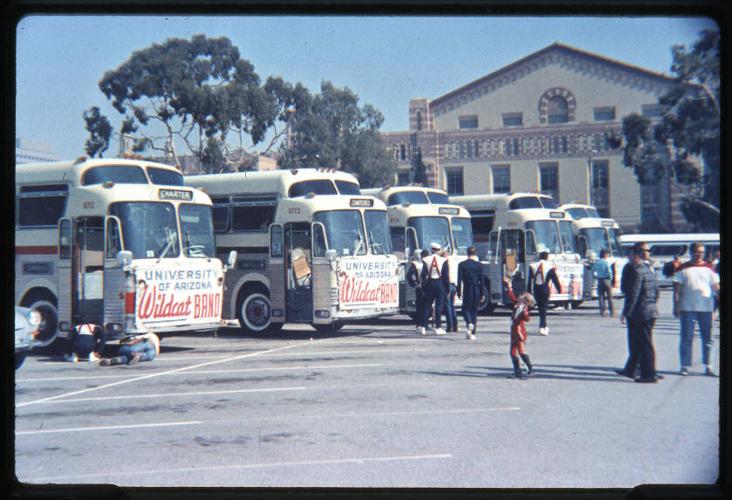
Members of the University of Arizona Symphonic Marching Band at Los Angeles Memorial Coliseum before performing at the first Super Bowl on Jan. 15, 1967.
The game drew a crowd of about 62,000 people, with millions more watching the live broadcast on both CBS and NBC, but piccolo player Ray Martinez said there wasn’t much time to get nervous or take in the scene. There was too much choreography to remember.
“It was just like a day game at home. When the show starts going, you’re focused,” he said.
Though they got to sit in the stands after their performance, clarinet player Nic Hiner doesn’t remember much about the football action. “Was there a game?” he said with a grin. “We were there for one reason.”

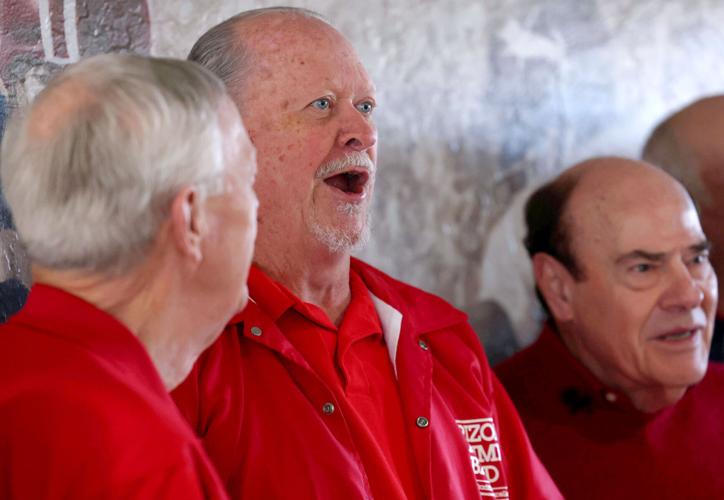
Nic Hiner belts out the University of Arizona fight song at Arizona Stadium during a reunion in January of Symphonic Marching Band members who performed at halftime of the first Super Bowl in 1967.
The two pro football leagues hired Disneyland’s original director of entertainment, Tommy Walker, to put on the halftime show for their first-ever championship. Walker called on Jack Lee, the legendary, long-time U of A director of bands and composer of the school fight song “Bear Down, Arizona.”
“There was never a discussion of money,” Lee would tell Arizona Daily Star sports columnist Greg Hansen decades later. “We all went over on a bus on the Wednesday before the game. We stayed in a hotel near the 405 Freeway and rehearsed at UCLA. Our expenses were paid. That’s it.”
The show “had Jack’s signature on it,” Blommer said, but they didn’t have a lot of time to rehearse. “It was a knuckle-down-and-do-it kind of a thing.”
The practice field was dusty and the sky was smudged with the sort of air pollution Los Angeles was notorious for at the time. “I can remember the next day my chest not feeling good because of the smog,” Martinez said.
On with the show
The almost-15-minute halftime show began with the band playing “The Sound of Music” as they marched onto the field and into intricate, crisscrossing formations.
Then they formed a giant riverboat with a paddle wheel that spun as world-famous trumpeter Al Hirt led them through “Way Down Yonder in New Orleans.”
The riverboat morphed into a trumpet with working valves for Hirt’s renditions of “When the Saints Go Marching In” and “Bugler’s Holiday,” during which a group of band members marched out of the trumpet’s bell in the shape of a musical note 30 yards tall.
Later, they formed a giant machine with moving sprockets and a Liberty Bell that rang and then cracked.
Even Lee’s 8-year-old son, John, got in on the act, standing at the 50-yard line in shiny red cowboy garb and twirling a baton in the air.

Eight-year-old John Lee, son of University of Arizona bandleader Jack Lee, practices his baton twirling in front of the band's charter buses before their performance at the first Super Bowl on Jan. 15, 1967, in Los Angeles.
The show also included some slapstick. During the reenactment of the gunfight at the OK Corral, a tuba player went down in the crossfire, prompting two other band members to rush over with a stretcher, load up his tuba and carry it away.
At the 11-minute mark, the band formed two enormous stick figures and walked them to midfield to shake hands, but not before they kicked a pair of oversized footballs, which sent two real stunt pilots in jetpacks rocketing above the stadium.
“They blew all our (sheet) music off the lyres,” said Fred Klein, who played clarinet in the band.
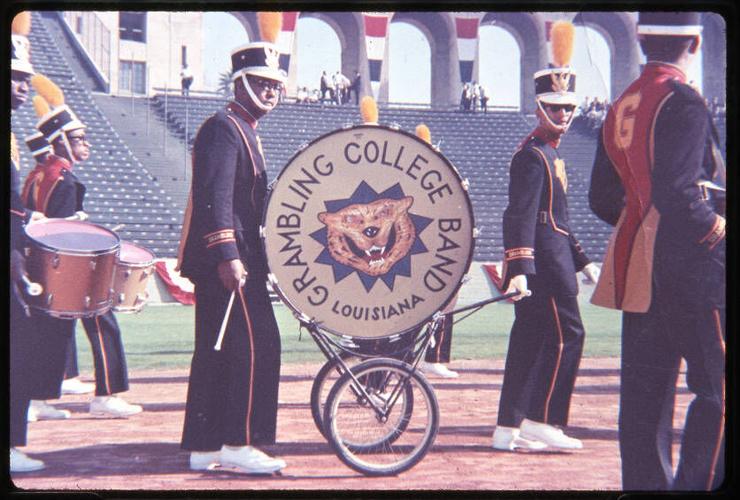
For the grand finale, the U of A ensemble was joined on the field by the marching band from all-Black Grambling College in Louisiana to form the giant U.S. map and play “This Is My Country,” as a multicolored cloud of balloons was released into the sky.
The musicians from Grambling left an impression on their collegiate counterparts from the U of A.

The U of A marching band was joined on the field for Super Bowl I by the band from Grambling College, now known as Grambling State University, in Louisiana.
“Those guys had discipline. When they got off the bus, they were marching,” Blommer said.
“They had rhythm,” Martinez added. “They were good.”
The renowned band from what is now Grambling State University would go on to perform at Super Bowl II in Miami and three more Super Bowls after that, most recently in 1998.
Forever the first
Over the decades, of course, the halftime show has grown into its own kind of global spectacle, sidelining traditional marching bands in favor of superstar performers such as Beyonce, Madonna, Michael Jackson, Prince, The Rolling Stones and this year’s Bad Bunny.
But as far as Shoopman is concerned, that 1967 performance was every bit as elaborate as the multimillion-dollar productions of today — and at a fraction of the cost.
“If you could put that halftime show on the field today, people would freak out over it,” said the former U of A trumpeter and drum major, who was hired to lead the award-winning Pride of Arizona in 2016. “The idea that it was a full production, something that everyone wanted to see, I thought that was pretty damned outstanding.”
Like any good band director, Shoopman said he would love the chance to recreate the Super Bowl I show in all its glory, maybe to mark next year’s 60th anniversary of the performance. He knows the perfect occasion for it, too: halftime of Super Bowl LXI in — where else? — Los Angeles.
“That’s my dream,” Shoopman said.
Until then, he and his fellow band alumni have some history to hang their shako hats on: Bad Bunnies may come and go, but Super Bowl I will forever belong to the Packers and the Chiefs and the University of Arizona marching band.
No one ever forgets their first.
See the A1 covers from the past for this day in history.

