



About 59% of all national forest lands in the U.S., including some in southern and central Arizona, would be open to logging under far fewer environmental restrictions than exist today, under a new directive from the Trump administration.
Agriculture Secretary Brooke Rollins released a memo April 3 calling for the new rules as a way to combat wildfire risk and disease. The memo designated an “emergency situation.”

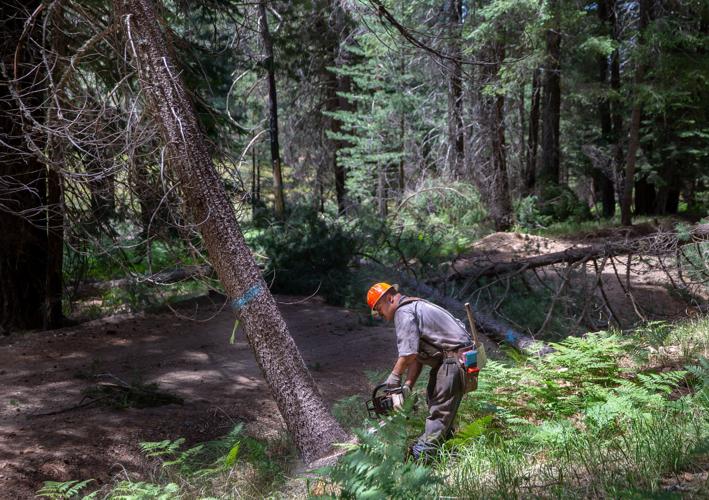
Logging on Mount Graham in southeastern Arizona. About 59% of all national forest lands in the U.S., including some in southern and central Arizona, would be open to logging under far fewer environmental restrictions than exist today, under a new directive from the Trump administration.
It said “National forests are in crisis due to uncharacteristically severe wildfires, insect and disease outbreaks, invasive species, and other stressors whose impacts have been compounded by too little active management.”
The same day, a letter from the U.S. Forest Service’s national office called for regional Forest Service offices to develop plans in about 90 days to increase timber production nationally by 25% over five years. The department is the Forest Service’s parent agency and the letter was written by Christopher French, the service’s acting associate chief.
A map issued by the Forest Service shows large chunks of the West, including parts of southern and central Arizona, that fall under the Agriculture Department’s emergency classification. There, logging of federal lands could at least theoretically be done with fewer environmental reviews under the new directives.
Environmentalists, however, are already strongly opposed to these measures. They'll lead to an environmental disaster by streamlining or outright bypassing environmental rules aimed at protecting endangered species, clean water and historic sites, among other things, they say.
Overall, Rollins’ new directive classifies 112,646,000 acres of forest lands as being in an “emergency situation” due to wildfire risk and insect or disease infestations.
The service won’t be specifying which lands it wishes to prioritize for timber-cutting until its new plans are done. But a number of small sections of Coronado National Forest, stretching as far south as the Nogales area, would be among the Arizona lands where the liberalized rules and guidelines would apply, the Forest Service map shows.
A much larger swath of central Arizona is also shown on that map as open to logging under the slimmed-down timber-cutting rules. Those lands include a large area in which a wide variety of interest groups have spent more than a decade preparing compromise plans under a program known as the Four Forest Restoration Initiative that are aimed at thinning of forests for wildfire prevention while trying to protect the most sensitive stands of trees that are havens for endangered species.
In his letter, French wrote, “Today, we enter a new era marked by pressing issues like a growing demand for domestic lumber and wildfire resilience.”
“To address these challenges, we need to increase our active forest management to improve both the prosperity of rural America and the health of our forests. Our efforts will lead to an increase in America’s wood independence, a thriving wood products economy, and the protection of our water supply.”
Southern Arizona forests ‘at risk’
Environmentalists in southern and central Arizona criticized the agencies’ new timber-cutting efforts, saying they could lead to major amounts of clear-cutting that could damage old-growth and other large trees.

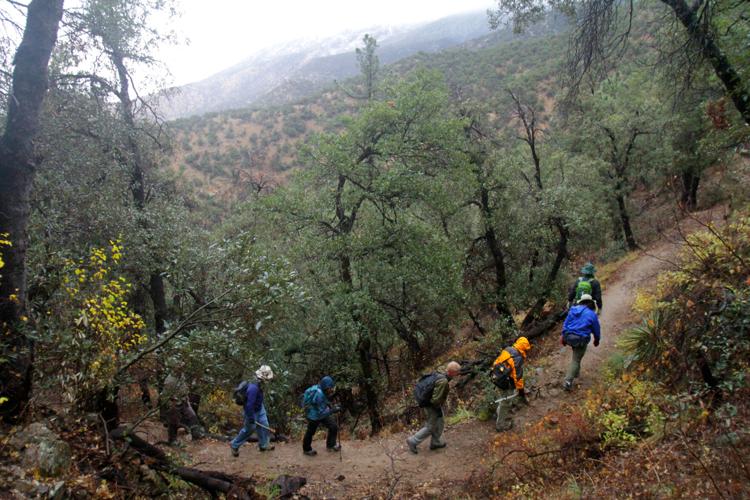
Coronado National Forest land in the Santa Rita Mountains.
Measures outlined in Rollins’ memo “point to a very clear direction to focus solely on the extraction of merchantable timber at the greatest possible scale,” said Brian Nowicki of the Center for Biological Diversity in Albuquerque. “This would be a disaster for our national forests and is entirely contradictory to the work that Arizona has been doing for two decades to reduce fire risk and reintroduce beneficial fire on the landscape.”
Southern Arizona forests “are absolutely at risk from the Trump administration,” said Nowicki, whose group is involved in the forest restoration initiative, also known as 4FRI. “Particularly, the Sky Island forests with some of the last remaining large trees in these areas, and where expanded timber extraction would be highly damaging to those isolated habitats.”
The Coronado forest has “very sensitive forest ecosystems that are suffering from climate change (increasing aridity) and an accelerating fire regime,” said Emily Burns of the Sky Island Alliance in Tucson. “Cutting wood commercially on the Coronado would be costly and impractical due to lack of infrastructure and would threaten the overall survival of the coniferous forests of southeastern Arizona.”
Most of the large trees and certainly all the old-growth forests left in Arizona are places where it’s impossible to take them out of the forest without harming wildlife, Nowicki added.
“As far as it becoming open season on large trees, there’s no way to do that in Arizona without seriously degrading our forests,” he said.
But Jay Smith, forest restoration director of the Coconino County Flood Control District, said, “I’m cautiously optimistic” that the new federal guidelines and directives won’t lead to clear-cutting in his area. Coconino is one of several counties involved in the 4FRI effort.
“The county, we’ve been involved in Forest Service restoration work on federal lands since 2018. We know and understand the need to increase the scale of restoration. More concern is, do we have enough industry to consume all these acres logged if they increase them quickly?” Smith said.
“We don’t have a concern the Forest Service is going to change the way they treat the forest. We don’t do clear cutting here. We remove small trees to restore forests to their natural state. We’re looking to reduce the wildfire threat, not to start cutting the forest to produce lumber.”
Lumber mills in that area are designed to deal with small diameter trees, and if they start cutting old-growth trees, “we would definitely have concerns about that,” Smith said. “There are too many ecological benefits with the old-growth trees to our area and our forests.”
Tabi Bolton of Campbell Global, a forest investment company involved in the 4FRI effort, declined to comment on the Forest Service and Agriculture secretary letter and memo. The company, based in Portland, Oregon, calls itself a leading global investment manager focused on forest land.
Steps to be taken
Specifically, Rollins’ memo and French’s letter outlined steps they want the service to take to expand timber-cutting:
— Exemptions, waivers, and expedited mechanisms for emergency programs on joint efforts with other Agriculture Department agencies and tribes;
— Emergency consulting with various agencies, that could presumably bypass normal timetables to complete these efforts, to comply with the federal Endangered Species Act, the National Historic Preservation Act and the Clean Water Act.
— Expedited permitting, certification, and qualification processes for timber-clearing, as defined in Forest Service directives or as directed by the Forest Service chief.
Take a trip up to the top of Mount Lemmon with drone footage showcasing breathtaking spots along the way.
Mount Lemmon, with a summit elevation of 9,159 feet, is the highest point in the Santa Catalina Mountains. It is located in the Coronado National Forest north of Tucson.
— “To the maximum extent practicable,” agencies should employ what’s known as categorical exclusions for timber stand improvement, salvage, and other site preparation activities for reforestation, consistent with applicable law. A categorical exclusion is a class of actions that a federal agency determines won’t have a significant environmental effect and therefore don’t require an environmental analysis, let alone a full-fledged environmental impact statement.
— French directed the service’s national deputy chief to release direction for using emergency provisions of various environmental laws “to streamline and simplify our permitting processes.”
— French also directed the National Forest system’s natural resources director “to streamline or reduce certification requirements and processes.” Similarly, Agriculture Secretary Rollins directed the Forest Service to “streamline, to the extent allowable by law, all processes related to timber production, including project planning, decision-making, implementation and required certifications.”
Speaking of the threats from wildfires and insect infestations, Rollins wrote, “These threats — combined with overgrown forests, a growing number of homes in the wildland-urban interface, and more than a century of rigorous fire suppression — have all contributed to what is now a full-blown wildfire and forest health crisis.
“Immediate action is needed to mitigate risk, protect public health and safety and critical infrastructure, support local and rural economies, and mitigate threats to natural resources on national forest lands. We can do more to contribute to American prosperity and protect our national and economic security,” Rollins wrote.
‘They clear a path to bulldoze’
Grand Canyon Trust Executive Director Ethan Aumack called Rollins’ orders misguided.
His group, like the Center for Biological Diversity and Coconino County, has been a key stakeholder in the Four Forest Restoration Initiative, a 2.4 million-acre forest restoration and wildfire risk reduction effort across four national forests in northern Arizona, in collaboration with industry, state and local representatives, other government agencies, and others.
“They clear a path to bulldoze our national forests, including old-growth trees that for centuries have filtered our drinking water and provided habitat for wildlife. Here in northern Arizona, we simply cannot afford to lose these forests to logging — it will make climate change and wildfires much worse,” Aumack said.
“The measure of success for forest management should not be board foot volume, it should be acres restored and an increase in resilience to mitigate wildfire risk.”

