



A new study gives Arizona and Nevada high marks for their reuse of treated sewage effluent as a way to reduce Colorado River use, but says the other five river basin states have a long way to go.
Nevada reuses up to 85% of its wastewater after it’s gone through sewage treatment plants and Arizona reuses 52%, the study says.
If all seven river basin states reused that much, it would leave enough river water behind in lakes Mead and Powell to wipe out more than one-third of the Colorado’s typical annual shortfall between water supply and demand, it finds. In recent years, the annual shortfall has ranged from 2 million to 3 million acre-feet per year, and estimates are it could someday reach 4 million if current trends toward heating and drying of the entire river basin continue.
But no other river basin state reuses more than 22% — California’s score — leading the researchers to conclude, “most basin states are falling well short of their potential to reuse wastewater.”
“Overall, the Colorado River Basin states are missing opportunities to ensure a safe, sustainable, climate-resilient supply of water in a hotter, drier future,” says the study, a joint effort from UCLA’s Institute of the Environment and Sustainability and the Natural Resources Defense Council.

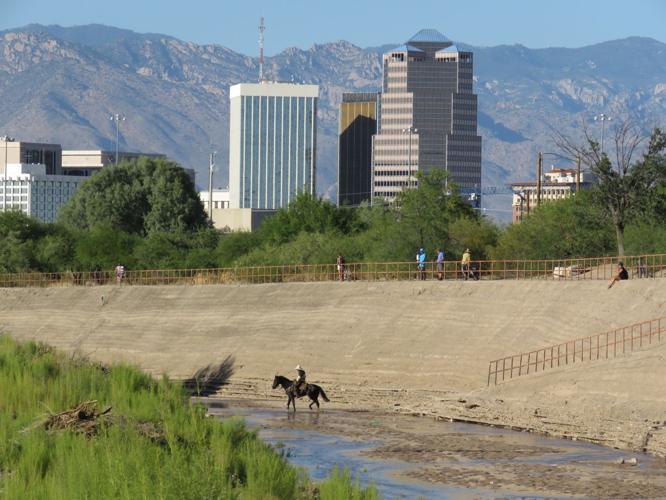
Treated effluent flowing in the Santa Cruz River west of downtown Tucson. A new study gives Arizona and Nevada high marks for their reuse of treated sewage effluent as a way to reduce Colorado River use, but says the other five river basin states have a long way to go.
UCLA water researcher Noah Garrison, the study’s lead author, said in an interview, however, that Arizona in general and Tucson and Phoenix in particular deserve “accolades” for their wastewater reuse efforts.
Today in Tucson, 70% of the wastewater coming from Pima County’s Agua Nueva Wastewater Treatment Plant near Sweetwater Road west of Interstate 10 is directly reused by Tucson Water’s reclaimed water system that serves parks, golf courses and schools.
While no wastewater from the county’s Tres Rios plant near Interstate 10 and Ina Road is now reused, Tucson Water is in the middle of awarding a construction contract to build facilities to transport 30% of that wastewater into its reclaimed system, says Pima County’s Regional Wastewater Reclamation Department.
In addition, Tucson Water will take another 8% of that plant’s wastewater for its new advanced water purification facility that will treat wastewater to drinking quality, the county agency said, bringing total use of the plant’s wastewater to 38%. The city was awarded an $86.6 million federal grant in January to build that plant.
Phoenix’s water utility plans to upgrade two existing wastewater plants — an active one on 91st Avenue along the Salt River, the other a now-shuttered plant on the city’s northwest side — so they can treat wastewater for drinking.
A major factor that already boosts the Phoenix area’s reuse of effluent is that 25% of the state’s total effluent is consumed and evaporated for cooling purposes at Palo Verde Nuclear Generating station, located near Buckeye, the new study says.
“Unquestionably,” Garrison said, Arizona and California’s percentage of wastewater reuse will grow significantly with the new and expanded plants in Phoenix and Tucson and when and if new plants now planned or under study in the San Diego and Los Angeles areas go online to treat wastewater for drinking.
But “we need more of them across the seven states, not just California and Arizona,” Garrison said.
Nourishing Lake Mead
Nevada’s 85% recycling rate is largely due to southern Nevada cities’ and water agencies’ longstanding practice of returning treated wastewater into tributaries to Lake Mead including the Las Vegas Wash.

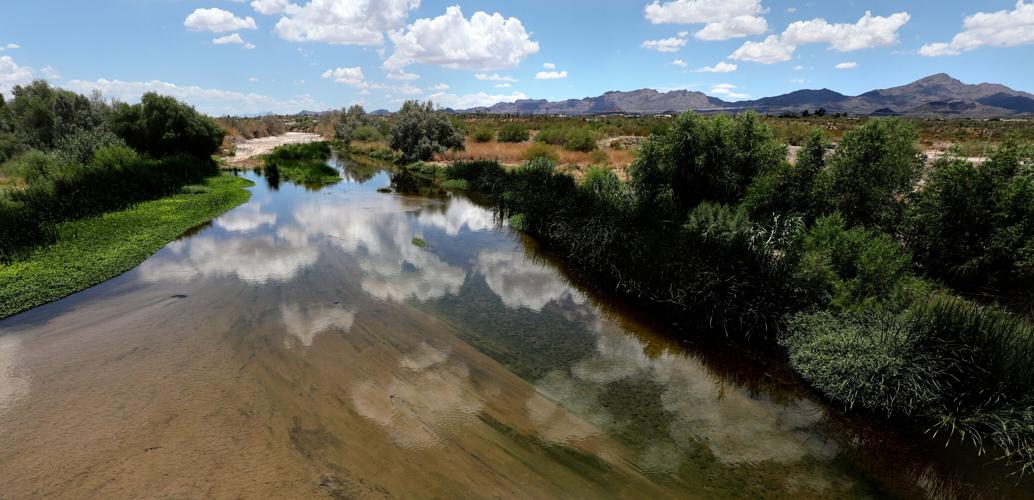
Clouds are reflected in the effluent discharge water from the Agua Nueva and Tres Rios wastewater treatment plants running in the Santa Cruz River at Ina Road in Marana. If all seven Colorado River basin states reused as much wastewater as Arizona and Nevada, that would leave enough river water in lakes Mead and Powell to help alleviate the annual shortfall between river water supply and demand, a new study says.
Because so much of that area’s wastewater is returned to Lake Mead — the Las Vegas area’s prime drinking water source — Nevada receives a one-gallon credit, adding to its authorized supplies, for every gallon of water that goes back to the lake.
Because of that, “the state is able to withdraw far more” from the lake than the 300,000 acre-feet it is legally entitled to take under the 1922 Colorado River Compact, the study says. In 2022, the Las Vegas area took about 465,000 acre-feet from the lake before the reuse was taken into account.
The Southern Nevada Water Authority, which manages the region’s water supplies, estimates that mostly because of the return flows to Lake Mead, that area recycles 99% of its wastewater.
In 2017, the authority adopted a policy giving a higher priority to returning treated wastewater to the lake than building more “direct use” wastewater treatment plants that would put the wastewater back into the area utilities’ supplies, the study says.
Should putting it downstream count?
At times, the study’s estimate of effluent reuse is lower than how state and local officials see it, because the study has a stricter definition of effluent reuse.
In Tucson, Pima County Wastewater Director Jackson Jenkins notes that a large portion of the two plants’ effluent that Tucson Water doesn’t take is recharged to the aquifer, particularly from the Tres Rios plant. The wastewater agency earns 95% credits for every gallon of effluent that is recharged into an underground storage area and is tracked by a state water bank, Jenkins said. The credits allow for the pumping of that much groundwater elsewhere.
“Recharge is a form of reuse,” he said.
In Colorado, officials also consider wastewater that’s dumped into rivers after treatment recycling because other parties downstream ultimately use that water for crops or for city purposes.
Colorado farmers are limited in how much water they can permanently consume from a river by century-old “prior appropriation” rules that require farms that divert river water to return it so it can be used again downstream.
“In other words, water used for irrigation on the West Slope (of Colorado) and across the state is used and re-used numerous times before it leaves the state. For its part, the municipal sector only consumes 10% of the amount of water it diverts, with the remainder returning to the stream,” says the Colorado Department of Natural Resources.
In Colorado’s South Platte River watershed, which serves a big metropolitan area and an area intensely used by farmers, “a given volume of water is likely to have been used 5-7 times before leaving the state,” said Jason Ullman, Colorado’s state engineer.
But the new study doesn’t count effluent that is dumped back into a river after treatment toward a state’s reuse total, UCLA’s Garrison said.
“The theory that if you put it downstream, somebody will make use of that water, it’s not intentional reuse,” he said.
Lack of reuse in Upper Basin
The Colorado’s four Upper Basin states do much more poorly than the three Lower Basin states at reusing wastewater, the study finds. While the Lower Basin states of Arizona, California and Nevada together recycle about 30% of their wastewater, the Upper Basin states of Colorado, New Mexico, Utah and Wyoming reuse only about 5%, it says.
The most populous Upper Basin states, Colorado and Utah, reused only 3.6% and 1% of their wastewater respectively, the study finds.
Utah’s ranking is low mainly because the state’s big urban areas around Salt Lake City are required by state law to discharge their effluent into rivers and streams feeding the Great Salt Lake, which many experts agree is in danger of drying up due to overuse by other sources and a severe drought and climate change.
A 2023 state law says state officials can’t approve a water reuse project if that water would otherwise have been discharged into the Great Salt Lake. That law “threatens to effectively prohibit future water reuse projects in the Great Salt Lake watershed ... stalling the state’s already meager progress,” the researchers wrote.
But “over 300,000 acre-feet (of wastewater) goes into the Great Salt Lake” every year, said Joel Ferry, Utah’s natural resources director. “If we pull that much out of the Great Salt Lake, it will dry up and we’ll have an environmental disaster of epic proportions.”
One big reason more wastewater isn’t reused in Colorado by water utilities that produce it is that downstream users have a legal claim on that water once it’s discharged into a river, Garrison said.
But Colorado officials also say the study’s definition of wastewater reuse doesn’t take into account a considerable amount of reuse that occurs in their state after one city or other entity runs its wastewater through a treatment plant and puts it back into a river. Then the water goes downstream and somebody else uses it, said Ullman, the state engineer.
“The report characterizes this practice as hampering reuse. But it protects other water uses in the system, and has allowed certainty and economic development in our state,” Ullman said.
Issues hindering progress
The study also takes all the river basin states except California to task for “the overall lack of data” on wastewater recycling, including volume, level of treatment, and end use of the recycled water, calling this problem “glaring.”
“While we were able to gather data directly from individual wastewater treatment facilities in other states, determining how much water is being recycled was a significant challenge, and determining how much recycled water is ultimately directed to municipal, agricultural, or industrial users was often limited to qualitative description, if information was available at all,” the study says.
In a statement to the Star, the Arizona Department of Water Resources and the Arizona Department of Environmental Quality acknowledged they don’t keep comprehensive data on wastewater reuse.
“That being said, information about the majority of water reuse in Arizona is not hard to obtain, since the majority of the wastewater generated in Arizona is in the Phoenix and Tucson metro areas. Additionally even smaller utilities are typically more than happy to discuss their water conservation and reuse programs,” the statement said.
The study also takes note of what it called “the absence of strong federal recycled water policy or any federal regulation. The lack of federal support for or consistency among state programs has hampered efforts and stands as a significant impediment to further growth,” it says.
In an interview, Garrison said, “We absolutely need more investment in wastewater recycling at the federal level. The amount of federal money made available for grants for wastewater recycling is a tiny faction of what’s needed. Some of these larger projects to serve major metro areas are costing billions.”

