



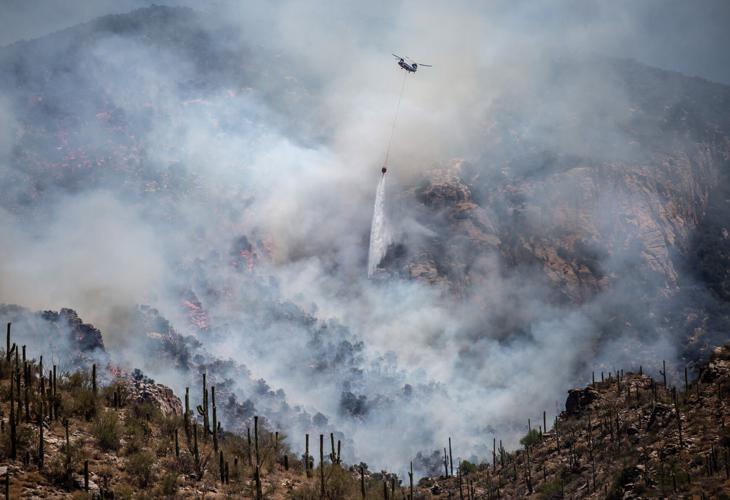

Tucson isn’t Los Angeles, and the patchy saguaro scrubland of the Sonoran Desert isn’t the combustible coastal chaparral of Southern California.
But the Old Pueblo does face a growing wildfire threat, and it isn’t just our beloved cactuses that are in danger.
Experts warn that a “paradigm change” is underway in parts of the Sonoran Desert, where a dramatic surge in major wildfires over the past 20 years has burned through landscapes that almost never saw such infernos before.
Increasingly, “we do live in a fire landscape, and the mechanism for that change is invasive species,” said Ben Wilder, a Tucson-based ecologist who served as lead author on a comprehensive report last year documenting the danger.

Crew members with the Smokey Bear Hotshots from Ruidoso, New Mexico, cut line near the mouth of Finger Rock Canyon as a precaution against the growing Bighorn Fire on June 10, 2020.
Historically, Wilder said, desert lowlands would experience occasional, localized fires, usually sparked by lightning in areas with high concentrations of native grasses and brush after a wet winter. “A hundred acres would be a really big one,” he said.
The risk of such fires tended to be greatest during what he called the “arid foresummer,” that typically dry period in May and June, just before the onset of the monsoon.
But much larger and more destructive fires are becoming an almost-year-round concern, as buffelgrass and other invasive weeds fill the gaps between slow-growing desert plants, carpeting the landscape with fuel.
Wilder and others fear this new fire cycle, spurred on by the worst impacts of climate change, will eventually turn the desert we know into a grassland of fire-adapted invaders that regrow and spread after every blaze.
People living near these emerging landscape transition zones have their own reason to worry. The same buffelgrass that can carry fire across the desert can also carry it into neighborhoods.
If you think Tucson is immune from a major human disaster like the one still unfolding in Southern California, consider what nearly happened here five years ago this June, when a lightning strike touched off the largest wildfire on record for the Santa Catalina Mountains or anywhere else in Pima County.
The weeks-long blaze eventually forced the evacuation of hundreds of homes and thousands of people from the Foothills to Oracle and from Catalina to Redington, as the flames shifted and spread across the range.
“The Bighorn Fire was a near miss, but it’s only a matter of time,” Wilder said. “I think the mitigation of risk starts with the acceptance of risk.”

Tucson ecologist Ben Wilder examines saguaros severely burned in the Bighorn Fire at Catalina State Park, during a visit to the site of a scientific study on desert fire recovery on July 21, 2021.
This is not just a problem for wealthy homeowners high in the Catalina Foothills, either. Wildfire poses a threat to any neighborhood built in or connected to the so-called wildland-urban interface, from the sprawling master-planned community of SaddleBrooke to the tight cluster of houses nestled between “A” Mountain and Tumamoc Hill along Sentinel Peak Road.
The way fire behaves in the desert is shifting so quickly, even the professionals are struggling to keep up.
“It’s kind of a new anomaly within the last 20 years, I would say: the fact that fire can spread across the surface in the Sonoran Desert,” said KP Maxwell, an engine captain and wildland coordinator for the Tucson Fire Department. “We haven’t adapted to the environment that has changed, because we just don’t have the experience with it.”
Going coastal
Maxwell has seen the difference between fires in Arizona and Southern California firsthand.
Before he joined TFD, he chased smoke through the coastal sage and chaparral as a firefighter with the U.S. Forest Service.
“It’s just a harsh environment to fight fire in,” he said, with steep terrain covered in a tangled mess of highly flammable brush and scoured periodically by the strong, dry Santa Ana wind from California’s interior.
“I don’t know if you’ve ever seen oleanders burn, but oleanders have chemicals in them that act almost like gasoline,” Maxwell said. “The brush in Southern California is very much the same. It has a lot of chemical content in it, which just allows it to burn more violently.”
And the risks to people and property are even greater there, thanks to a much higher population density overall and a much larger number of homes built on hillsides and deep inside once-wild areas.
But Tucson and L.A. do share some of the same basic hazards, Maxwell said.
“We have plenty of wind. We have plenty of dry humidity, which leads to dry fuels. And we have more than enough heat. That combination of things really allows fire to burn,” he said.
Starting in 2018, the Tucson Fire Department began gradually assembling its own small team of wildfire specialists by training a few firefighters at a time and sending them out of state to get valuable hands-on experience at major wildfires across the West.
“I would say the Bighorn Fire was the catalyst for change,” Maxwell said. “We started before the Bighorn Fire, but that was the realization that, hey, we actually do need this. We’ve been building our wildland program ever since.”
The department now has 17 trained wildland firefighters out of a total staff of more than 600 uniformed personnel, and there are plans to add 10 more within the next year or so, Maxwell said.
“We treat it as a specialty, kind of like hazmat or technical rescue. We’ve tried to keep our numbers small so we can get more reps and get better at it. In order to be better firefighters here, we have to be able to go somewhere else and fight fire.”
Since its inception, the budding program has sent crews-in-training — usually four people at a time in a single truck — to firelines as far away as Oregon and Montana. California is their most frequent destination.
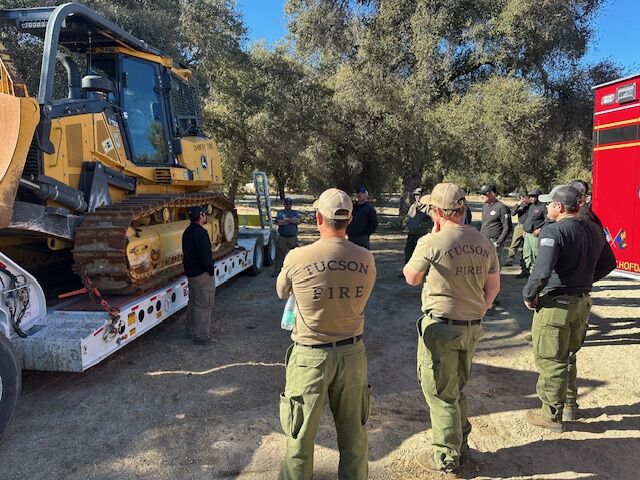
A wildland firefighting crew from the Tucson Fire Department takes part in a briefing during a 16-day deployment to Southern California in January.
Maxwell just returned from the Golden State on Jan. 24, after 16 days spent leading a four-man TFD crew as part of a multi-agency fire task force sent from Arizona.
When they drove their fire engine out of Tucson on Jan. 8, Maxwell and company figured they were headed to Pacific Palisades or Altadena to help with the devastating fires there. Instead, they were staged outside of Temecula, northeast of San Diego, to handle any fires that broke out in the Cleveland National Forest while local crews deployed to L.A.
“We call it pre-positioning,” Maxwell said.
It turned out to be a pretty quiet assignment. They were dispatched to four new fires and only made it to one of them in time to take part in the “initial attack” that put the blaze out before it could spread, Maxwell said.
“Firefighters are like moths to a flame. We all want to go wherever the excitement is,” he said. “But the reality is there was still high fire danger from L.A. all the way to San Diego. If another fire broke out down by Oceanside or Carlsbad or San Diego, they needed to have resources there to respond rapidly as well, so that’s what we were doing.”
Assessing risk
On average, Maxwell said, the city of Tucson sees between 800 and 1,100 brush fires a year. He said a fire in tall buffelgrass can spread at a rate as high as 10 mph.
Part of his job is risk assessment — namely identifying parts of the city where wildfires could pose a significant risk, based on the conditions on the ground and the department’s current level of training, experience and equipment.
“I would say generally anywhere that’s along a wash. I call them conduits for fire,” he said. “They concentrate water, so you’re more likely to have grass grow there, and that provides more fuel.”
Such secluded areas also tend to attract kids up to no good or homeless people looking for a shady place to camp, Maxwell said, which can mean ignition sources such as matches, fireworks, cook stoves and campfires.
“My concern is if we get enough fire established in a wash that has very limited access for our fire trucks, (burning) mesquite trees are going to cast embers into people’s yards and catch houses on fire,” he said.
Educating the public on the importance of fire safety and preparation can go a long way. Common sense preventative measures include clearing brush away from structures, removing leaves, pine needles and other flammable debris from roofs, stacking firewood someplace other than against a wall or on the porch and pruning low-hanging branches to help prevent a grass fire from climbing into the canopies of nearby trees.
“I would argue that any house can be safe in that environment with the right protective measures,” Maxwell said. “But you have to be diligent about it.”
The sad reality, though, is that not every fire can be contained before it takes a terrible toll. California is home to some of the most robust fire codes and experienced wildland firefighting operations in the country, and even they were quickly overwhelmed by the Palisades and Eaton fires.
“We like to think that we can stop or control wildfires, but that’s not really the case,” Maxwell said. “We can save structures, we can evacuate people, but the reality is you don’t get to start putting that fire out until the wind lets up and the conditions change. You usually need a little bit of a break in Mother Nature to give you the upper hand.”

People watch from Oracle Road, just north of the entrance to Catalina State Park, as Chinook helicopters drop water on the Bighorn Fire on June 12, 2020.
If there’s a silver lining to the devastation in California, he said, it may be found in the renewed focus the tragedy has placed on fire prevention, preparedness and response in Tucson and other communities.
In recent days, Maxwell said he has been called into meetings with local leaders and emergency management officials to review Tucson’s readiness.
“There are a lot of people who want answers. I think the discussions that are going to come from this will be a very positive thing for the city,” he said. “A lot of us are going to be learning lessons from California’s misfortune.”
Grassroots effort
Clare Aslan is director of the School of Earth and Sustainability and the co-director of the Center for Adaptable Western Landscapes at Northern Arizona University, where she has spent the past decade not just studying fire resilience but trying to quantify and even map it.
She also knows the Tucson area well. She earned her undergraduate degree in ecology from the University of Arizona in 2000 and worked for a time at the Arizona-Sonora Desert Museum.
Aslan said that while ecological conditions certainly play a role in how certain communities prepare for and emerge from wildfires, so do social and political factors.
“It’s not just what elevation you’re at or what plants are growing there. It’s what jurisdiction you are in,” she said.
Some communities are simply better equipped than others to take preventative measures before fires, fight them when they occur and restore areas after they burn.
For example, Aslan said, a fire official from a rural department in Pinal County once told her that they don’t have the manpower or the equipment they need to “get on (a wildfire) quickly and suppress it” before it can spread. Maybe a fire that starts in a place like that has a better chance of becoming a major disaster.
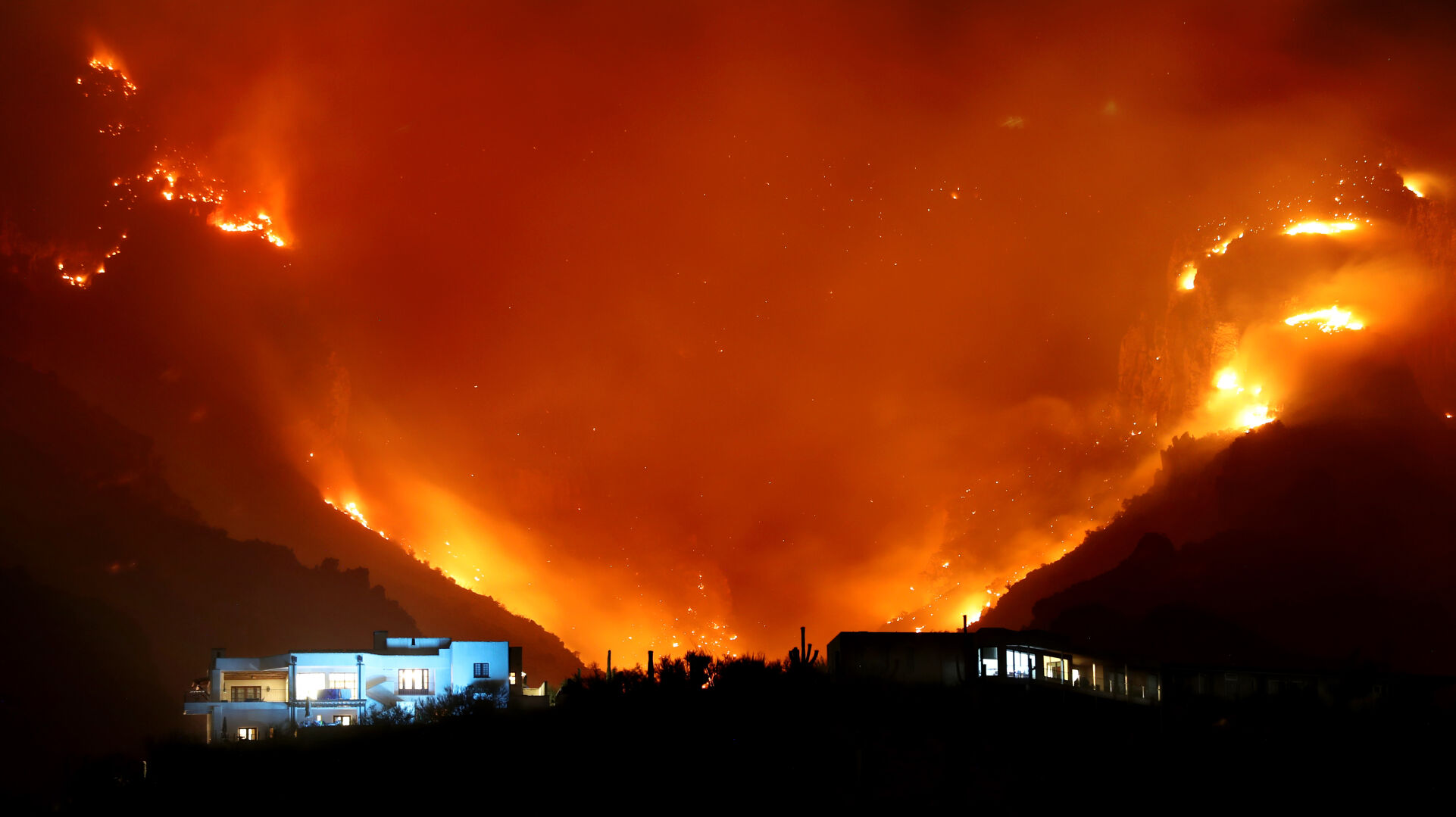
The Bighorn Fire breaks onto the southern slopes of the Santa Catalina Mountains and burns above a pair of homes in the Foothills just west of Finger Rock Trailhead on June 10, 2020.
Aslan has partnered with fire ecologist Andi Thode and social scientist Catrin Edgeley from the state-funded, NAU-based Arizona Wildfire Initiative to learn more about how major fires impact different landscapes and communities.
The team is holding a series of workshops with local officials, fire experts and residents to discuss post-fire recovery and assess the accuracy of forecasts for fire risk and resilience.
The first workshop took place in November in Payson, site of the 2021 Backbone Fire. The next community discussion will be held here later this month and focus on how the Bighorn Fire affected our area.

A Chinook helicopter drops a load of water on the Bighorn Fire as is moves into the top of Finger Rock Canyon and up Mount Kimball on June 10, 2020.
Additional workshops are planned in Globe for the 2021 Telegraph Fire, Sedona for the 2014 Slide Fire and two in New Mexico for fires there.
Aslan said their ultimate goal is “a predictive model that can be applied to future fire on the landscape” to help identify areas of vulnerability, direct preventative work and guide decisions about post-fire recovery.
“If we are going to use resources to restore areas, it would be good to target those areas that are not as likely to recover on their own,” she said. “If you don’t, you run the risk that the only thing that comes back is the nonnative grasses.”
The new desert fire regime could require novel and aggressive tactics to combat it, including things that would have been unheard of just a decade ago.
Already, officials in the Tonto National Forest outside of Phoenix have been experimenting with controlled burns around target shooting ranges and other wildfire flashpoints. Now forest managers are talking about expanding the use of prescribed fire into other desert areas to reduce invasive weeds and other fuels, Aslan said. “That’s totally new.”
Wilder said a problem as widespread as buffelgrass can only be solved through “active management,” and not just by land management and firefighting agencies. A literal grassroots effort is required, using every weapon at our disposal, including herbicides, controlled burns, targeted livestock grazing or just yanking the stuff out with our bare hands.
“We’re not facing a lot of great options here, but all options need to be on the table,” Wilder said. “The costs of action now are orders of magnitude less than the costs of doing nothing and then a fire hits.”
Researchers say alarming scenes like this are becoming more common in the Sonoran Desert.

