


The state agency looking to import new water supplies into Arizona may pay private companies seeking to build desalination plants and other projects as much as $50 million to $75 million in tax dollars for technical, economic and environmental reviews of the projects' feasibility.
The reviews — which the Water Infrastructure Finance Authority of Arizona considers one of its most important steps in deciding what projects to build — will examine seemingly every facet of the projects. The reviews will also cover the projects' cultural impacts and examine issues that will be involved for them to obtain government permits.
The authority's governing board voted unanimously Wednesday to authorize the reviews of three projects proposed by the private water company Epcor and four projects proposed by a partnership of two companies. The partnership includes Acciona, a Spanish company that builds renewable energy projects along with more conventional water projects. The other partner, Fengate Capital, a company acting as an equity investor, has offices in Houston, Miami and Toronto.
The seven proposed projects include three desalination plants that would be built in Mexico and California, costing billions of dollars to construct; a project to reduce farmland water losses; two plants for treating wastewater to drinking quality; and a project to store surplus water runoff underground for future use by people. All of the projects would be built in Mexico or in California, Colorado or Utah, states within the Colorado River Basin.

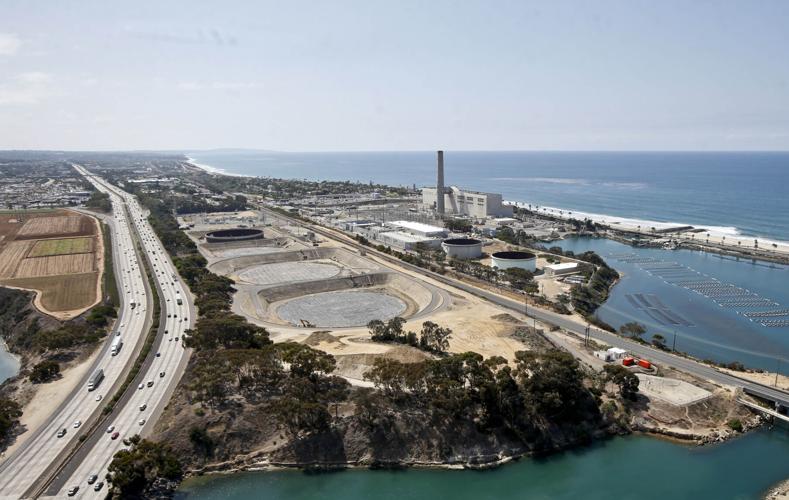
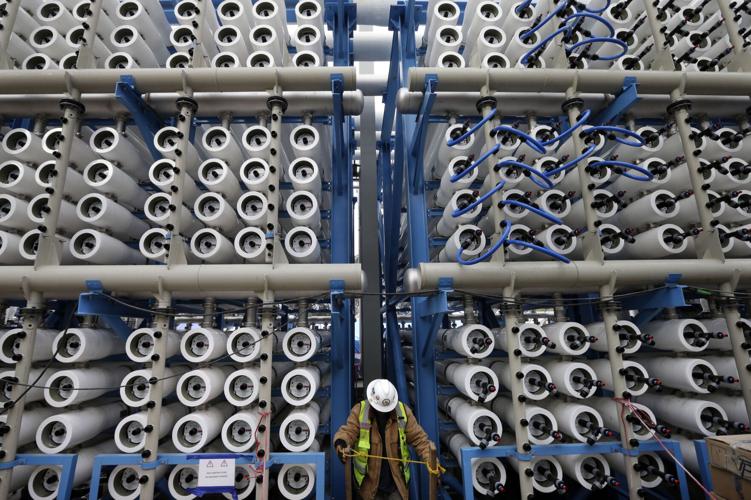
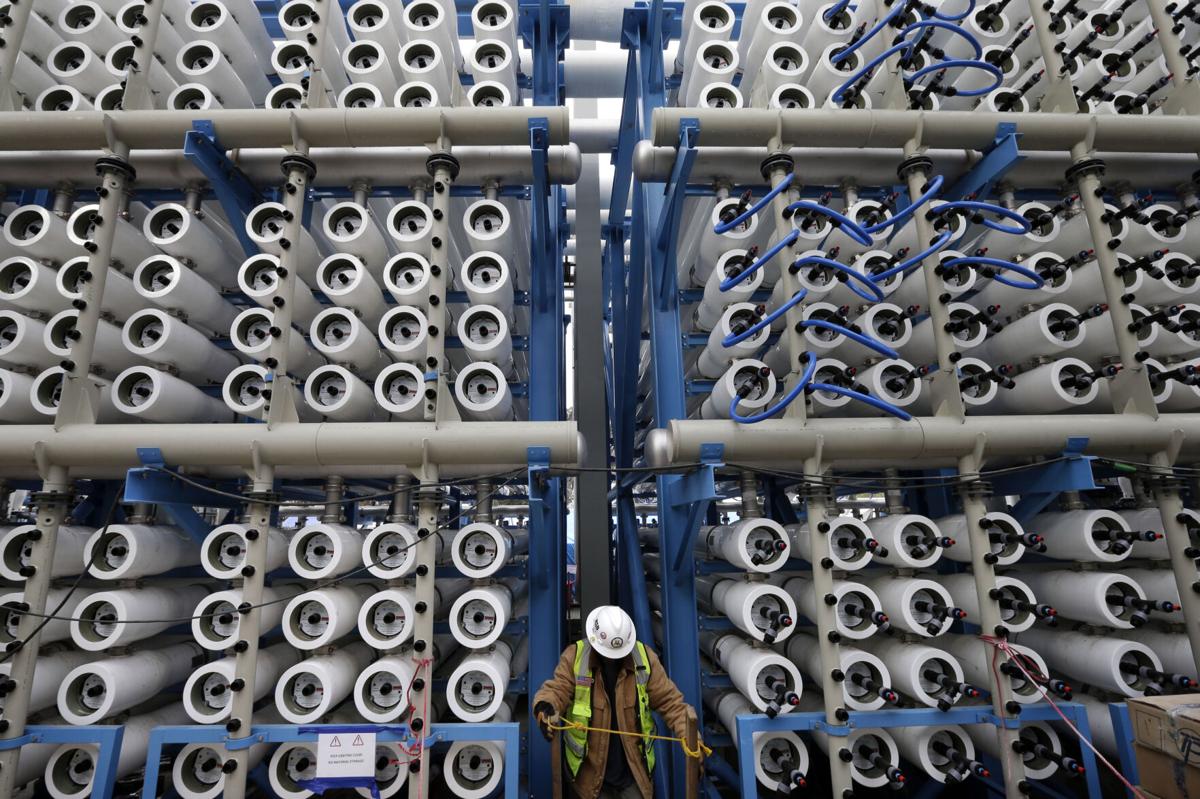
The seven proposed projects for importing water to Arizona include three desalination plants that would be built in Mexico and California. In this photo, an existing desalination plant in Carlsbad, California, is shown; it opened in 2015 and produces drinking water for the San Diego area.
While the authority can't say precisely how much the reviews will cost, it has budgeted $50 million to $75 million in case that much is necessary. Commonly called WIFA, the authority has budgeted another $35 million to $40 million to hire its own consultants to review the applications and for other tasks.
"The work that will be produced (by the reviews) is significant and will provide the due diligence necessary to determine if projects under consideration are right for Arizona, said Ben Alteneder, the authority's assistant external affairs director.
Precisely how much the authority pays teams employed by the companies proposing to build the projects for the reviews will be negotiated, Alteneder said.
"That work will be highly technical, extensive, and thorough, and therefore, costly," he said.
But Brooks Keenan, a longtime taxpayer watchdog and former transportation official for Tucson and Pima County, questioned the need for that much spending on these reviews and the consultants.
Since the companies have been determined to be experts at using such proposed technologies, "there is no need for fundamental scientific research" for these reviews, said Keenan. "And Arizona’s taxpayers should never have to pay for these firms’ scientific research," he added.
All that is needed, he said, is for each firm to prepare a design concept report that shows how the project applicants plan to adapt their companies' technologies to Arizona's needs, and to provide a preliminary cost estimate. He estimates that amount of work would cost a total taxpayer bill of about $1 million per project.
"The companies were vetted by authority staff and consultants, to determine if they have done similar projects in the past and been successful, and that their companies are financially sound. If that’s the case, they don’t need to do any fundamental scientific research," said Keenan. "They all have proven systems for doing these projects. They don’t have to invent a system."
Keenan spent 15 years, the last five as director, working for the Pima County Department of Transportation and Flood Control, and seven years working as engineering manager for Tucson's Department of Transportation. Since retiring from that job in 2008, he's worked as a private consultant for various engineering firms.
While he's never overseen construction of projects as expensive as the multi-billion-dollar desalination plants now proposed for Arizona, Keenan did oversee implementation of a $500 million road construction bond for Pima County and $4.5 billion worth of school construction projects while serving 10 years on Arizona's School Facilities Board, which he also left in 2008.
Responding to Keenan's concerns, Alteneder said, "Respectfully, we disagree with that assessment. Much due diligence remains, and not just of the scientific nature.
"Many of the questions all of us have identified simply cannot be answered through a basic design concept or a preliminary cost estimate. Phase 2 is not an academic exercise, it is the rigorous confirmation of facts that must be independently verified, documented, and withstand public, legal, financial, engineering, and environmental scrutiny," he said.
The individual project reviews will include detailed geotechnical work, route analysis, environmental surveys, the paths to permitting projects, the feasibility of desalination plants' intake and discharge pipes, long-range financial modeling, and extensive community and tribal engagement, Alteneder said.
"These are essential steps to ensure that any proposed project is technically feasible, environmentally responsible, financially sound, and publicly defensible."
As for the consultants, Alteneder said, "Given the complexity of these projects, including public and private contracting, financing, engineering, water rights, real estate, environmental review, community outreach, international coordination, and risk management, these consulting costs are consistent with those seen" in other large water infrastructure projects financed jointly by public agencies and private companies.
Here are some other questions, and answers provided by water authority officials, about the projects to bring water to Arizona:
Q. What's the significance of the state water board agreeing to move these seven projects forward into a second round of analyses?
A. Ted Cooke, who chairs the authority board's long-term water augmentation committee, said after Wednesday's vote, "This is a milestone for Arizona. We can certainly have cause for celebration. That being said, the experience we've been through on solicitation of proposals in the last year and a half has only been the warmup. We're just getting out of our landing craft on the beach. Our real battle is ahead."
Q. What will happen next with these projects?
A. Starting now, the water authority moves into what it calls Phase 2. During that phase, it will pay the companies proposing to do the projects money for carrying out the reviews on technical, engineering, environmental and economic issues, said authority spokesman Alteneder.
Q. How long will that take?
A. They'll last 18 to 24 months before the authority moves into Phase 3, during which the board will make a final selection for which projects it wants to finance using the state's long-term water augmentation fund, Alteneder said.
"Some projects will take less, some will take more. Many variables and factors. Some projects may be ready to enter Phase 3 much earlier than others, but the process allows for the board to make decisions on projects as they are ready to decide," Alteneder said.
Q. The board's augmentation committee spent 18 months behind closed doors working on soliciting and reviewing proposals for desal plants and other projects. When will the public have a role in this process?
A. Chelsea McGuire, the authority's executive director, said at Wednesday's board meeting, "We're inviting you to comment. We need this. We're ready to open up the intentional, structural, purposeful taking of comments. We're now saying that the ball is in your court. It is your responsibility to come in and tell us what you think about these projects."
Q. How can the public comment on these projects?
A. Go to ltwaf.azwifa.gov/importation and open the general public comment form on that page.
Q. Why will the authority pay the project proponents to conduct these reviews?
A. It's to protect the authority's right to own the information gained from the reviews, authority officials say. Cooke calls the information "intellectual property," saying that if something goes wrong during the reviews and the authority decides it can't continue with one project, it will at least retain the information it got from the reviews.
Q. Unlike some past desalination plant and other water augmentation proposals, only one of the seven projects now under review by the authority involves building a pipeline directly from a new augmentation project to the Central Arizona Project canal for delivery to Arizonans. The others involve exchanges of water, in which California, for instance, gets extra water created by capturing otherwise unused irrigation runoff and Arizona in return gets a proportionate share of California's Colorado River supply.
Why would these other states go for these exchange projects that will require them to give up some of their Colorado River water that they lobbied and went to court to gain the rights to use?
A. Cooke replied, "If I was them, I’d love to have a drought-proof water supply to supplement my Colorado River water. I'd be more than happy to exchange something variable for that."
Q. How could the ongoing, seven-state negotiations over prospective cuts in Colorado River water use affect these projects? Since we don’t know how much water Mexico will have from the Colorado River after the cuts go through, does that matter to this process here? Would Mexico be willing to give up even more Colorado River water through one of these proposed exchanges?
A. "Those are two separate issues," authority board chairman Jonathan Lines said at a press briefing following Wednesday's board meeting. "This gives us the ability to separate things out. Arizona is being asked to take additional cuts, and we're focusing on bringing additional water to the state."
Added board member Cooke at the briefing, "Even though those Colorado River negotiations probably will need to result in some pretty significant reductions in (water) use, there still will be millions of acre-feet available every year to the Lower Basin and Mexico. Will there be enough water (for these proposed exchange projects)? Yes, there will."
Q. Why not have the authority contact these states to make sure they're at least open to the idea of these exchanges before spending millions of dollars to conduct these reviews?
A. Not only will "regional collaboration" among the authority and other states and Mexico happen during the next phase of evaluating projects, "it's one of the purposes" of that phase, the authority said.
"Each of these proposals will need to provide a win-win scenario for regional partners."
Q. Why would another state or country want Arizona's authority to come in and build any of these projects (desal, wastewater reclamation, etc.) within their boundaries? Can't they do this for themselves?
A. These projects are all feasible, but capital for them is a limiting factor, Cooke told the briefing.
Specifically, he cited one project under consideration that calls for building infrastructure to store and ultimately recover runoff from California's Central Valley that would otherwise flow into the Pacific Ocean.
"Those communities are having severe issues ground subsidence," said Cooke, referring to the now-common problem of the sinking of land due to pumping of the groundwater lying beneath it.
"They will very much appreciate to have help in building facilities for storage of water that now goes into the ocean into their aquifers."
Q. The Arizona Legislature in 2022 pledged to appropriate $1 billion for a long-term water augmentation fund to be spent on building and designing future water importation projects. But due to budget crunches, the Legislature only ever appropriated $523 million, then later "swept" much of that money, leaving about $376 in the authority's hands as of today.
Now that the authority is reviewing specific projects, do you think your chances of getting more money will increase?
A. "That's a better question for the Legislature," McGuire told the media briefing. "What the Legislature has told us is that 'We want to know what the projects are.' Do I anticipate more public funding? I sure hope there will be but I'm not going to bank on it. We in no way are anticipating we will see more money in this (very tight) budget year."
Q. Is there a cost-sharing ratio the authority will have with the contractors as to how much each side will spend — the state agency and the private contractors?
A. That will "absolutely" be a part of the negotiations, McGuire said. ''What is the best role for WIFA to play in these projects?"
These projects are "public-private partnerships" in which the government agency and the private contractors are supposed to collaborate on projects, Cooke added.
"There’s not an exact formula for how you do a public-private partnership," he said. "There's lots of latitude in every aspect, there's lots of flexibility. ... We're just getting started. There's also lots of uncertainty. About the exactness of how do we split things up, we're a long way from that."
Q. When will the authority reach out to other states and countries about these projects?
A. "That starts now. WIFA will begin that outreach immediately. We're looking forward to the annual Colorado River Water Users Association conference (which runs Dec. 16-18 in Las Vegas). It's an opportunity for face-to-face negotiations."
Q. When will we know the costs of these projects?
A. "What is this going to cost? It's the question that will be the linchpin of what we do," McGuire said. "I think we'll have a better idea by this time next year."

