

Colorado River water is being given away or sold at rock-bottom wholesale prices to water districts serving farms and cities across the Southwest, creating a major disincentive to conservation as the river sits on the edge of crisis due to shrinking supplies, a new report says.
And generally, irrigation districts such as those serving the Yuma area of southwest Arizona and the Imperial Valley of southeast California are also paying far less to have water delivered to them after it’s been diverted from the river than is paid by water districts serving urban areas including Tucson, Phoenix and Los Angeles, the report finds. Those urban water districts include the Central Arizona Project, a 336-mile-long canal and pipelines system that delivers river water to Phoenix and Tucson.
Regardless of whether the river water is being diverted under contracts between districts and the federal government, or as a result of longstanding rights appropriated by farmers a century or more ago, "substantial volumes of water in the Colorado River Basin are being sold or diverted at little or no cost," says the report, prepared by researchers for UCLA and the environmentalist Natural Resources Defense Council.

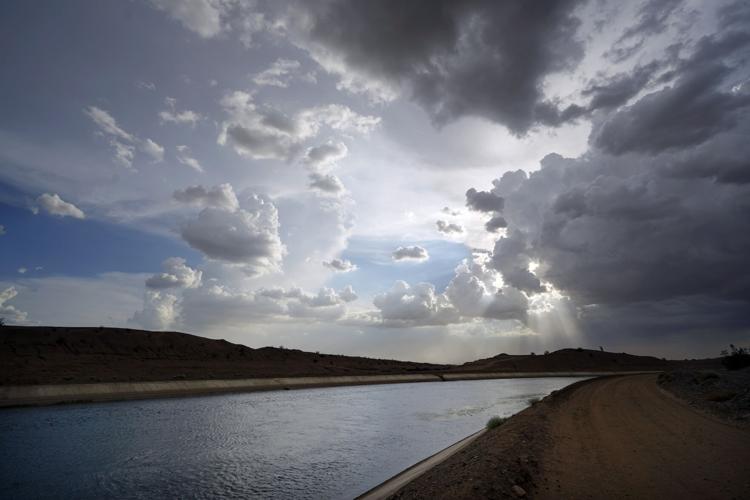
The All-American Canal conveys water from the Colorado River into the Imperial Valley farms in California. The way water is sold from the Colorado River essentially puts little or no value on the water itself — only on the pipelines, canals and other infrastructure used to deliver it, says a new report.
The way the water is sold from the Colorado River and from a federal water project serving California's agriculture-rich Central Valley essentially puts little or no value on the water itself — only on the pipelines, canals and other infrastructure used to deliver it, says the report, titled "Free water while it lasts."
But the low rates charged by the feds to various water users in the region don't even cover the U.S. government’s costs of operating and repairing the water infrastructure, meaning federal taxpayers are subsidizing those costs, it finds.
“It’s not free. All the taxpayers are paying for it,” said Mark Gold, a co-author of the report.
“The Colorado River system is heading to catastrophe and resilient management of the River requires the elimination of all wasteful and unreasonable use of shrinking supplies. When water supplies are essentially free, there are few incentives to use water sustainably,” Gold said.
While bargain-basement water-price systems have been around for up to a century or longer, they're not justifiable at a time when the seven Colorado River Basin states are searching for ways to curb their water use and prevent their big reservoirs from falling so low that it would be impossible to extract water from them, the researchers said.
"Anyone who gets water from the Colorado River gets it for essentially nothing," said Noah Garrison, a co-author of the report and a researcher for UCLA's Institute for the Environment and Sustainability. "Without action, we risk depleting this essential resource beyond recovery."
The U.S. Bureau of Reclamation, which operates the federally run dams, canals and other infrastructure that distribute river water across the Southwest, declined comment on the report, for now.
“We have nothing further to add at this time. Once our analysis is complete and there is additional information to share publicly, we will do so,” said Peter Soeth, acting Interior Department communications chief regarding Bureau of Reclamation issues, in an email to the Star. He declined to elaborate on what kind of analysis the bureau is conducting of the new report.

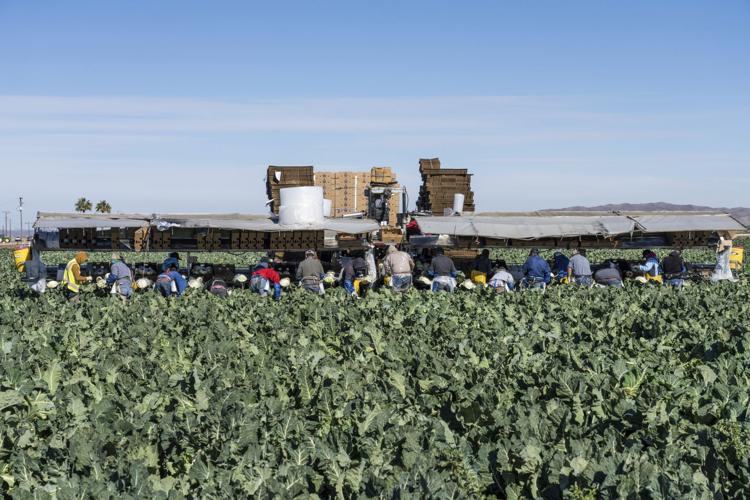
Farm workers harvest and package cauliflower on a farm near Yuma. Colorado River water is being given away or sold at rock-bottom wholesale prices to water districts serving farms and cities across the Southwest, creating a major disincentive to conservation as the river sits on the edge of crisis, a new report says.
Officials of three major irrigation districts operating along the river near Yuma and in Southern California took strong issue with the report and its recommendations, to encourage conservation, for a surcharge on the price of water sold by the feds. They said such a surcharge would only cause farmers to raise the prices they charge to sell their crops to distributors and retailers, thereby pushing up food prices for consumers.
Elston Grubaugh of the Wellton-Mohawk Irrigation District in southwest Arizona said most farmers and irrigation districts are unlikely to support modifications in their contracts to allow water price surcharges and would likely sue to prevent the U.S. government from raising water prices unilaterally through legislation or by regulation.
"I see no correlation between the cost of Colorado River water and shortages, and I disagree with these inflammatory statements, which appear to be an attempt to drive a wedge between agricultural and urban water users at a time when collaborative partnerships are more critical than ever," said Tina Shields, water manager for the Imperial Irrigation District in Southern California, which has the rights to by far the largest share of Colorado River water of any user.
The Imperial Irrigation District and its water users do fund all costs associated with the delivery of this water into the district, Shields said, including the long-term construction, operations, maintenance and replacement costs of both the federal infrastructure, which the district operates under contract with Reclamation, and of its own water distribution system.
Comparing ag to urban water costs is inappropriate, given differences in water distribution methods, water treatment functions, supply portfolios, and agency management decision-making, she said.
"Obviously, IID does not support a surcharge on water. In my opinion, a surcharge would be more appropriately assessed on hydropower customers" who buy electricity from the river's dams, said Shields, given the public interest in protecting reservoir levels so electricity can continue to be delivered to those customers.
Garrison said in reply, "I think that's an easy response to claim we're trying to drive a wedge between agricultural and municipal communities, but the report in no way does that. Objectively speaking, and for a complex and challenging set of factors, the report documents that cities pay more for water than do agricultural districts."
Hydropower customers are neither diverting flow nor using the water "resulting in the shortfall the river is facing," Garrison said, implying that they shouldn't face such a surcharge.
The report suggests a surcharge of at least $50 an acre-foot should be applied across the board to any entity that receives more than 10,000 acre-feet of federal water a year, whether it be serving cities or farms, he said. An acre-foot is enough to serve four Tucson families with water for a year.
The researchers spent more than a year combing through records of various federal, state, regional and local water agencies in the Colorado River Basin, the area served by the Central Valley Project in California and the area served by the State Water Project in California.
They examined wholesale prices charged to all entities purchasing 10,000 or more acre-feet of water a year.
Specifically, they found:
- Nearly a quarter, or 3.98 million acre-feet, of all water purchased from the federal government in the area researched is sold for nothing to five agricultural purchasers in three states. They include the Imperial Irrigation District, the Coachella Valley Water District near Palm Springs, the Truckee-Carson Irrigation District in northwestern Nevada, the Palo Verde Irrigation District in southeastern California and the Unit 5 Irrigation and Drainage District near Yuma.
- The two biggest suppliers of water to urban users in Arizona and Southern California — the Central Arizona Water Conservation District and the Metropolitan Water District — pay 25 cents an acre-foot.
- Three Yuma-area irrigation entities — the Wellton Mohawk and Yuma Mesa Irrigation Districts and the Yuma County Water Users Association — bought river water from the feds for 5 to 25 cents an acre-foot.
- Irrigation districts and other entities that directly receive river water from the federal government pay no more than 50 cents an acre-foot.
- By contrast, the Central Arizona Water Conservation District delivers CAP water to its customers for $295 an acre-foot — a tab that also includes costs of operating and maintaining the CAP canal and construction of other pipelines, canals and other infrastructure served by CAP water. The CAP cost above and beyond its wholesale cost of 25 cents an acre-foot is the most expensive charge for any federally supplied water in the Lower Colorado River Basin.
- On average, the cost of water purchased from the reclamation agency for both the Lower Basin projects and its Central Valley Project farther north in California is nearly 12 times cheaper than water purchased from California’s State Water Project and nearly 40 times cheaper than water purchased from other sources.
- For purposes of water conservation, the U.S. government has since 2022 been “buying back” river water supplies from various irrigation districts and municipalities for $400 acre-feet in most cases and for $775 an acre-foot from the Imperial Irrigation District. The water saved has been used to prop up Lake Mead and keep it from falling closer to “dead pool” levels at which it would be too low to remove from the reservoir. Those purchases were paid by federal taxpayers through money supplied by the Inflation Reduction Act.
“This means that the districts obtain water from the federal government at low or no cost, and the government then buys that water back from the districts at enormous cost to taxpayers,” the new report says. “The overall inequity and burden on the public is a clear example of how water delivery systems in the Lower Colorado River Basin states are outdated."
Report co-author Gold said this system of payments is “pretty perverse, but that’s the system we have.”
The low water prices charged to Colorado River users represent “the legacy of the federal policy of trying to put every acre of land that could be under the plow” when the U.S. was trying to encourage settlement of the West, said Sarah Porter, director of Arizona State University’s Kyl Center for Water Policy.
The pricing structure is “a reasonable outgrowth of 20th century policy that needs to be reconsidered now,” said Porter.
But partly because removing the agricultural price breaks could indeed raise food prices, raising water prices would be “kind of a blunt solution,” Porter added. “It would be better to fine tune and figure out where is the opportunity to increase efficiency.”
Porter and Bart Fisher of the Palo Verde Irrigation District in the Blythe, California area agreed that raising water prices to farmers would raise food prices to consumers.
“What happens is we do have contracts with retailers for food items and those contracts would be higher and retailers would charge more to the consumer,” said Fisher, a board member for the district and a former chairman of both the district’s board and the statewide Colorado River Board of California, which represents the state on regional and interstate water issues involving the river.
Saying that the feds charge too little for water they sell overlooks the fact that the Palo Verde district built a diversion dam to get its farmers water that spans the Colorado River, “built in the 1950s at a cost of millions of dollars,” Fisher said.
Wellton-Mohawk’s Grubaugh said the U.S. would be inviting lawsuits from contract holders to buy federal water if it tried unilaterally to change the terms of those contracts, which in many cases date back to the 1927 Boulder Canyon Project Act that approved construction of Hoover Dam.
“Our friends in academia have published many ideas to solve the Colorado River. Some of them are good and some not so much, but none can be implemented without consensus between the United States, the basin states and individual contract holders,” Grubaugh said. “That’s the reality we face on the ground. Our friends in academia, while well intended, do not always seem to face that same reality.”
However, David Wegner, a retired Reclamation official and former congressional staffer who worked on water issues, said federally supplied water is priced “exceedingly low” and he believes it’s time to raise water prices for farms so they cover at least some of the federal government’s cost to build, operate and maintain the river’s water delivery systems.
But the odds of that happening are “slim to none” without federal leadership to push for it, he added. Referring to the bureau spokesman’s statement that the agency will respond to the new study once it completes an analysis of it, Wegner said, “You and I will be long gone before they finish that analysis.”
Today, farmers in general are already living on a low profit margin, and unless one is "consistently subsidized by the feds, he can’t make it,” Wegner said.
If raising water prices makes food prices rise and makes a farmer’s operation non-economical, “they’ll move those cattle ranches to the Midwest where they don’t have to buy so much water and hay,” he said, referring to the intense use of Colorado River water in the West to grow alfalfa for cattle feed.
“It’s an economic reason they move out here,” Wegner said of farmers. “They have cheap water and cheap land.”

