


No matter which alternative the federal government picks to manage the depleted Colorado River, there's a very good chance of severely bad consequences — such as "dead pool" at reservoirs and a cutoff of electricity from big dams.
In some cases, these consequences can be avoided only if the seven river basin states agree to the worst possible water-use cuts under consideration — cuts that now would likely fall most heavily on Arizona, California and Nevada. And if climate conditions are dry enough, the worst-case scenario of not enough water being released downriver to meet century-old compact requirements probably can't be avoided at all.
Those are findings of the U.S. Bureau of Reclamation's new 1,600-page draft environmental impact statement that looks at alternative pathways for managing the river for the next 20 years.
The bureau proposed four possible alternatives for managing the river under increasingly dry conditions, plus an extremely unlikely "no action" option, to come up with cuts strong enough to avoid dire consequences such as "dead pool" in Lakes Mead and Powell, and a shutdown of electrical power generation at Hoover and Glen Canyon dams.

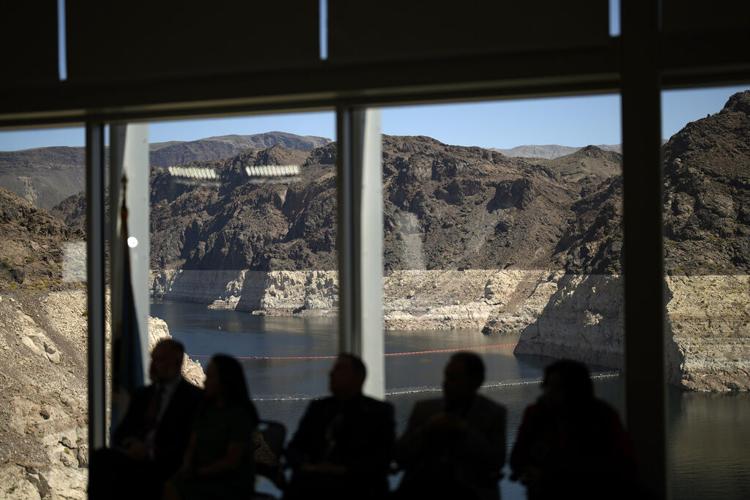
The bathtub ring showing how much Lake Mead has dropped its shown from inside Hoover Dam. No matter which alternative the U.S. government picks to manage the depleted Colorado River, there's a very good chance of severely bad consequences — such as "dead pool" at reservoirs and a cutoff of electricity from big dams, a new federal report shows.
But a one-page graphic tucked inside the report's executive summary shows that under continued or worsening dry weather, meeting those goals won't be possible without massive cuts in water use.
In addition, the bureau's graphic shows that under dry or "critically dry conditions," there's no way enough water will flow downriver from Lake Powell to meet the legal requirements of the 1922 Colorado River Compact for the river's Upper Basin states to deliver a fixed amount of river water to the Lower Basin over a decade. An inability to meet those obligations is almost certain to trigger prolonged litigation between the Lower and Upper Basin states over the compact.
The bureau released the statement about two weeks ago, partly in hopes of prodding the basin states into reaching a consensus on one alternative.
Its forecast is the harshest to date of any official forecast for the river's future under the twin pressures of continued drought and warming temperatures.
The graphic forecasts how various indicators of the river's health would behave, depending on how dry the climate is and what alternatives the federal government chooses — or the seven states can agree on — to manage the river and its reservoirs.
The report concludes, for instance, that under drier and the most dry conditions it studied, the only alternatives that can prevent "dead pool" at the reservoirs and insure that Glen Canyon and Hoover dams don't lose their ability to generate power are those that come with shortages in river water deliveries to the basin states of 3 million to 4 million acre-feet a year.
Longtime Arizona Daily Star reporter Tony Davis explains what "dead pool" means as water levels shrink along the Colorado River.
That's at least four to five times the size of cuts that were approved for the river's Lower Basin under the last major river agreement, reached in 2019.
Since the alternatives listed by the bureau generally don't cut much water use from the Upper Basin states, that means the big shortages will fall mainly upon the Lower Basin states of Arizona, California and Nevada. The Upper Basin states are Colorado, New Mexico, Utah and Wyoming.
The Upper Basin won't meet its legal requirements under the 1922 compact for water delivery either under critically dry or just plain dry conditions on the river, the new graphic shows. Only under average flow conditions — the likes of which haven't occurred the past five years — will there be enough water in the river to meet those obligations, the report found.
River compact 'no longer works'
Outside experts who reviewed the bureau's new forecasts call them "sobering," "shocking" and "grim."
Eric Kuhn, a longtime water researcher and former general manager of a northern Colorado water district, called the results "shocking but not surprising," given the low flows that the river has experienced, on average, over the past five years.
"What it means is that the (Colorado River) compact no longer works," Kuhn said. "There's a third less water in the river now than what the compact negotiators thought was available.
"It indicates they need to look at the whole foundation of Law of the River for a smaller river," said Kuhn, referring to the common phrase for the collection of laws, regulations, court cases and other legal precedents and guidelines that have governed how the river is managed for more than a century.
Brad Udall, a Colorado State University water researcher, has warned for 20 years that the river could suffer major shortages due to human-caused climate change. He said of the bureau's latest forecasting, "It’s actually a reasonable job in portraying the future, which is grim."
"There's a lot of interesting information in it, and that information is telling us we really need to change how we manage the river," said Udall.
Udall said he sees a very different future ahead for the basin and its residents than they've experienced, due to the "large reductions needed to keep us out of highly undesirable conditions. It makes sense, if you don’t have much water, that how you protect the water you have is to deliver less," he said.
His late father, U.S. Rep. Morris Udall of Tucson, played a major role in lining up federal funds to build the Central Arizona Project, a 336-mile-long canal delivering Colorado River water supplies to Tucson and Phoenix that are now threatened by the cuts proposed in many of the environmental report's alternatives.

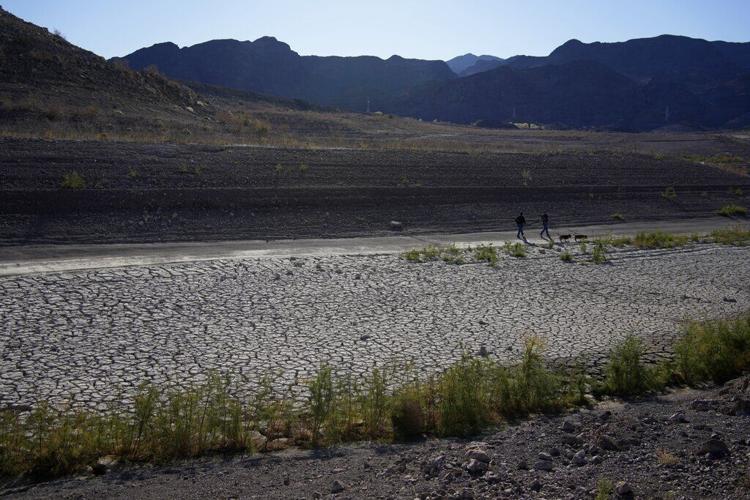
People walk by cracked earth in an area once under the water of Lake Mead near Boulder City, Nevada, in 2023. A graphic in a new federal report shows that under dry or "critically dry conditions," there's no way enough water will flow downriver from Lake Powell to meet the legal requirements of the 1922 Colorado River Compact for the river's Upper Basin states to deliver a fixed amount of river water to the Lower Basin over a decade.
Becky Mitchell, Colorado's lead negotiator in the ongoing, deadlocked 7-state negotiations over the river, offered this reaction to the new bureau forecasts:
"While Colorado continues to review" the draft environmental impact statement, "the Bureau of Reclamation’s own modeling shows that we must move to a supply-driven management framework that includes stabilizing and rebuilding Lake Powell and Lake Mead if we can.
"The system can no longer support demand-driven releases from the reservoirs," said Mitchell, referring to releases that have been based on how much water the states want as opposed to how much is available.
"Lake Powell was never meant to be drained so that hard decisions about how to live within the available supply could be postponed downstream. It was designed to stabilize the system, to smooth out highs and lows — not to prop up demands that no longer match supply. No amount of posturing will create more water," Mitchell said.
But Upper Basin states, including Colorado, have refused to accept any mandatory cuts in their river supplies, saying they're using far less than their legal allocation of river water, while the Lower Basin has, until very recently, used more.
The graphic is sobering because it shows there aren't any options that work well in both meeting compact obligations and avoiding loss of electric power-generating capacity under the two driest climate scenarios, said Kathy Jacobs, director of the University of Arizona's Center for Climate Adaptation and Solutions.
"Although different management alternatives have different impacts on Arizona's shortages, there is no question that these reductions will have a significant impact on Central Arizona Project deliveries and on the cost of water," Jacobs said. "An important question is how the reductions will be accomplished if there is not federal money to encourage conservation or pay for alternative supplies."
The Arizona Department of Water Resources, which is battling Colorado toe-to-toe in the seven-state talks, declined to comment on the bureau's forecasts.
"Our position is that ADWR will continue to evaluate all elements of the DEIS as a whole and not individual pieces," ADWR spokesman Doug MacEachern said. "As for Mr. U's (Udall's) observations, we will decline comment at this time."
ADWR Director Tom Buschatzke has made it clear, however, that he and other Lower Basin state officials don't support any of the alternatives now under study by the bureau.
He has also warned that under the worst-case cuts being discussed in the new environmental report, Arizona officials may be faced with difficult choices over what constitutes enough river water to meet public safety needs, whether that be enough for drinking and bathing purposes or for firefighting.
Detailed warning of bad outcomes
Certainly, many environmentalists, scientists, other researchers, and authors have issued dismal warnings for the river's future before.
But this is by far the most detailed set of bad outcomes predicted by the bureau, which manages the river's reservoirs. The bureau has warned for nearly 15 years in various reports that global warming and other aspects of climate change would reduce river flows — but never in such stark detail before.
Specifically, the graphic in the report's executive summary analyzed how the river and its two big reservoirs, Powell and Mead, would respond to all five alternatives that the bureau analyzed for the report.
The alternatives include a "no action" alternative in which no changes are made in river operations, and four others that require cuts of anywhere from 1 million to 4 million acre-feet a year in river water use.
The graphic also depicts how the river and reservoirs would behave under three different climate scenarios. One, called Average, assumes the river would carry 12 million to 14 million acre-feet a year — which it did during parts of the late 20th century and in parts of the 2000s and 2010s.

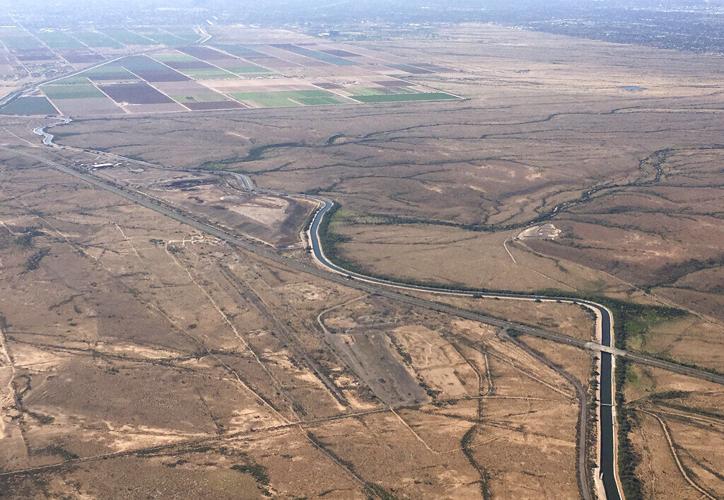
The Central Arizona Project canal carrying Colorado River water runs through rural desert near Phoenix. The 336-mile-long canal delivers water supplies to Tucson and Phoenix that are now threatened by the cuts proposed in many of a new federal report.
Another, called Dry, assumes the river carries 10 million to 12 million acre-feet a year — a very similar total to the last five years in which flows averaged 11 million acre-feet annually.
The third and grimmest scenario, called Critically Dry, assumes the river carries 8 million to 10 million acre-feet a year. That's still an uncommon pattern, but from 2002 to 2004 — an extremely dry period — the river carried an average of 9.5 million acre-feet per year.
The bureau concluded that:
- Under Critically Dry conditions, only one of the five alternatives under review would save enough water through shortage cutbacks to prevent what's known as "dead pool reductions" in water releases from Lake Mead. Such reductions occur when the reservoir is at "dead pool" levels, forcing the bureau to slash water deliveries to the states and cities to get the reservoir above that level.
- Under the Dry scenario, the outlook is a little brighter, with three of the five alternatives keeping Mead above dead pool levels at least 90% of the time.
- Under both the Dry and Critically Dry scenarios, the river would never carry enough water to meet the 1922 Colorado River Compact's requirements for minimum deliveries from the four Upper Colorado River Basin states to those in the Lower Basin.
The water releases under those conditions would be inadequate, whether you assume the Upper Basin is legally required to deliver 75 million acre-feet or 82.5 million acre-feet over a decade.
The higher figure comes into play if you assume — which the Lower Basin states do and the Upper Basin states do not — that the Upper Basin has a legal obligation to meet its share of the U.S. legal obligation to deliver 1.5 million acre-feet a year, or 150 million acre-feet over a decade, to Mexico.
The Upper Basin states also are refusing to accept responsibility for not meeting even the 75 million acre-foot requirement because it says it can't be held resonsible for river flow reductions triggered by climate change.
- Under Critically Dry conditions, one alternative studied in the environmental report offers a 90% chance of keeping Lake Powell at or above critical levels and a 60% chance of keeping Lake Mead above critical levels. The critical levels are those that would give the lakes a 10- to 25-foot-high buffer above levels at which all power from the reservoirs' respective dams would be shut off.
Another alternative offers an 80% chance of keeping Powell and about a 50% chance of keeping Mead above critical levels. None of the remaining alternatives studied offers more than a 40% chance of maintaining the buffer, and some have a much lower chance.
'Must focus on the worst-case scenarios'
The bureau's forecasts make no effort to determine which of the three climate conditions it believes is most likely to occur. In other parts of the executive summary, it says its approach to the entire river issue is what it calls "Decision-Making Under Deep Uncertainty."
Since 2000, drier conditions than those shown in past records have continued to occur on the river, "confounding efforts to manage system risk," the bureau wrote.
Since only limited improvements have occurred since 2004 in officials' ability to predict conditions on the river, "long-term planning in the basin must account for conditions of deep uncertainty, which occur when it is not possible to confidently assign probabilities to specific future conditions," the bureau said.
Risk projections used in previous planning efforts "did not convey the actual risks facing the system and contributed to insufficient protection against the ongoing drought," the bureau wrote.
Summing up the bureau's comments, Udall told the Star, "'Science is not advanced enough to give probabilities', is their answer."
Udall's comments about the need to change river management and use less water are key, said Sharon Megdal, director of the University of Arizona's Water Resources Research Center.
"We must deal with what nature provides us, and nature has not been generous since the turn of the century. Working to stabilize storage is a must. That means delivering less when inflow is low," Megdal said.
"Whether one wants to focus on the bad and worst case scenarios, we must," she said.

