December time machine: Headlines of history
From the Time machine special sections series
-
Johanna Eubank
Online producer
- Updated

News stories of note in Decembers past include the completion of the Washington Monument, the bombing of Pearl Harbor, a jet crash into a Tucson grocery store, Apollo 8 and the Pioneer Hotel fire.
December time machine
Updated
Today the Arizona Daily Star offers a look back at some front pages that appeared in Decembers throughout the newspaper’s history.
News stories of note in Decembers past include the completion of the Washington Monument, the bombing of Pearl Harbor, a jet crash into a Tucson grocery store, Apollo 8 and the Pioneer Hotel fire.
The Star began publishing in 1877. Most of the Star’s editions are available beginning in 1879 on Newspapers.com.
Time machine newsletter
The Star also has a throwback email newsletter, where we send snapshots of Tucson history to your inbox every Thursday. Sign up at tucson.com/timemachine
Dec. 7, 1884: The Washington Monument is completed
Updated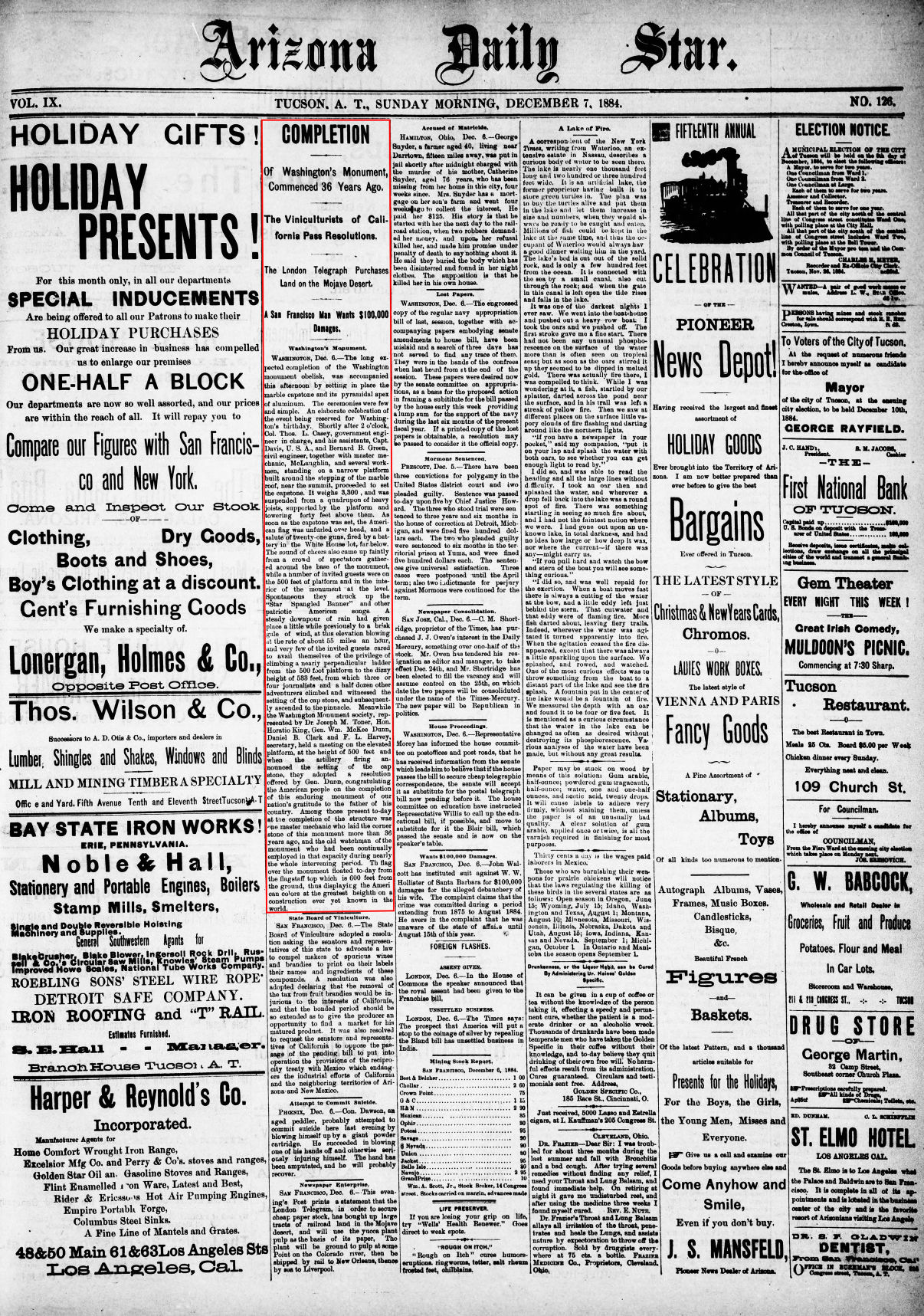
Download a PDF that you can enlarge for easier reading
Completion Of Washington's Monument, Commenced 36 Years Ago.
WASHINGTON, Dec. 6. ─ The long expected completion of the Washington monument obelisk, was accompanied this afternoon by setting in place the marble capstone and its pyramidal apex of aluminum. The ceremonies were few and simple. An elaborate celebration of the event being reserved for Washington's birthday. Shortly after 2 o'clock, Col. Thos. L. Casey, government engineer in charge, and his assistants, Capt. Davis, U.S.A., and Bernard B. Green, civil engineer, together with master mechanic, McLaughlin, and several workmen, standing on a narrow platform built around the stepping of the marble roof, near the summit, proceeded to set the capstone. It weighs 3,300, and was suspended from a quadrupon of heavy joists, supported by the platform and towering forty feet above them. As soon as the capstone was set, the American flag was unfurled over head, and a salute of twenty-one guns, fired by a battery in the White House lot, far below. The sound of cheers also came up faintly from a crowd of spectators gathered around the base of the monument, while a number of invited guests were on the 500 feet of platform and in the interior of the monument at the level. Spontaneous they struck up the "Star Spangled Banner" and other patriotic American songs. A steady downpour of rain had given place a little while previously to a brisk gale of wind, at this elevation blowing at the rate of about 55 miles an hour, and very few of the invited guests cared to avail themselves of the privilege of climbing a nearly perpendicular ladder from the 500 foot platform to the dizzy height of 533 feet, from which three or four journalists and a half dozen other adventurers climbed and witnessed the setting of the cap stone, and subsequently ascended to the pinnacle. Meanwhile the Washington Monument society, represented by Dr. Joseph M. Toner, Hon. Horatio King, Gen. Wm. McKee Dunn, Daniel B. Clark and F. L. Harvey, secretary, held a meeting on the elevated platform, at the height of 500 feet and when the artillery firing announced the setting of the cap stone, they adopted a resolution offered by Gen. Dunn, congratulating the American people on the completion of this enduring monument of our nation's gratitude to the father of his country. Among those present to-day at the completion of the structure was one master mechanic who laid the corner stone of this monument more than 36 years ago, and the old watchman of the monument who had been continually employed in that capacity during nearly the whole intervening period. The flag over the monument floated to-day from the flagstaff top which is 600 feet from the ground, thus displaying the American colors at the greatest heighth on a construction ever yet known in the world.
Dec. 25, 1923: President lights first national Christmas tree
Updated
Download a PDF that you can enlarge for easier reading
PRESIDENT TAKES ACTIVE PART IN WASHINGTON XMAS FESTIVAL
Touches Off Thousands of Electric Lights in Capital That Officially Opens Yuletide Celebration; Gates of White House Thrown Open to Public Last Night.
Washington, Dec. 24 ─ Christmas is Washington finds governmental activities almost entirely suspended, and President and Mrs. Coolidge participating actively in the capital's observance of the holiday.
The chief executive himself formally started the city's observance at 5 o'clock this evening by turning a switch which lighted thousands of lights on the big "national Christmas tree," erected on the ellipse directly south of the White House. Later, the president and Mrs. Coolidge threw open the gates of the White House grounds for thousands to gather there to sing Christmas carols. The Coolidges tomorrow will attend a union Christmas service of the city's churches.
Activities in the government departments ceased at noon. Cabinet members will not return to their offices until Wednesday morning.
President Coolidge, however, worked through the afternoon in the executive offices, leaving only when the time came to turn on the Christmas tree lights.
Only about half of the members of the cabinet will spend Christmas day in Washington. Those to remain at their homes here include Secretaries Hoover, Hughes, Weeks and Denby, Attorney General Daugherty and Postmaster General New.
Secretary Mellon has gone to his home in Pittsburgh; Secretary Davis to his father's home in Sharon, Pa., and Secretary Work to Evanston, Ill., to be with his daughter. Secretary Wallace will spend the day near Washington.
The "national Christmas tree" lighted by the president was sent to the executive by Middlebury College of Vermont, but President Coolidge decided to share it with the whole city and bought a small tree for the White House. This small tree was put up this afternoon in the blue room and trimmed by Mrs. Coolidge and the boys, John and Calvin, Jr. On it were placed the family gifts.
The "national tree," a fine 60 foot spruce, will be the center of celebrations to be held nightly during holiday week, and immediately upon its illumination tonight, the choir of Epiphany Episcopal church, accompanied by a brass quartet of the Marine band, began a program of Christmas carols. At its conclusion, the Marine band gave a Christmas concert.
The singing of Christmas carols at the White House took place at the north entrance, where several thousand persons joined with the choir of the president's church, the First Congregational, in the music. The plan was conceived by Mrs. Coolidge, who has expressed the hope that it will become an annual custom.
Mrs. Coolidge today attended Christmas exercises and distribution of toys and dinners to the poor by the Salvation Army.
Fifty shop girls from the store where Mrs. Coolidge buys many of her clothes received large bouquets of roses today from the White House conservatories, the gift of Mrs. Coolidge.
The president and his family will be accompanied to church tomorrow by Mr. and Mrs. Frank W. Stearns of Boston, the only guests at the White House for Christmas. The Christmas dinner will be served in the evening after a day quietly spent.
Dec. 6, 1933: Prohibition repealed
Updated
Download a PDF that you can enlarge for easier reading
ROOSEVELT PROCLAIMS REPEAL OF PROHIBITION
UTAH'S VOTE AT 3:31 P.M. ENDS DROUGHT
Washington Lets Down Bars to Canadian Liquor
18 STATES AFFECTED
Signing of Proclamation Is Marked With Little Ceremony
WASHINGTON, Dec. 5. ─ (AP) ─ With a dash of ceremony, Utah late today wrote an end to national prohibition in a decree that opened the doors of liquor shops in eighteen states.
Almost half a dozen other states were completing plans for legalizing sale under their own laws. The remainder of the nation remained dry.
Word that Utah ─ the thirty-sixth state ─ had ratified repeal was flashed to the capital a few hours after Pennsylvania and Ohio had taken similar action. A little later the final formalities were completed with the issuance of proclamations by the state department and President Roosevelt declaring prohibition at an end.
There was little ceremony at the signing of the presidential or the state department proclamation, but in wet states and some dry ones there were celebrations.
Nearly fourteen years of alcoholic drought, enforced by the eighteenth amendment of World War day inception, was ended by the Utah vote.
It found the federal government prepared to control the flow of liquor in wet states, through a virtual dictatorship over the industry, and to protect the arid ones. Several of the 18 states where liquor could be sold immediately, however, were without regulations.
Repeal celebrations, however, found liquor supplies for immediate consumption restricted in some sections.
Dec. 8, 1941: Pearl Harbor bombed
Updated
Download a PDF that you can enlarge for easier reading
JAP BOMBS SMASH AT HAWAII BEFORE TOKYO DECLARES WAR
HUNDREDS ARE KILLED AND DAMAGE IS HEAVY IN SURPRISE ASSAULT
U. S. Army Transport is Sunk in Action East of Honolulu and Wake Island is Reported Captured by Enemy Forces
By The Associated Press
Japanese warplanes made a deadly assault on Honolulu and Pearl Harbor Sunday in the foremost of a series of surprise attacks against American possessions throughout the Pacific.
Three hours later the Japanese government declared war on the United States and Great Britain.
Soon a second wave of Japanese bombers roared over shocked Honolulu.
The Japanese aggression, which the United States officially and unequivocally described as treacherous and utterly unprovoked, bore these first fruits for the empire, as summed up from official and unofficial sources:
Up to 350 U.S. soldiers killed and more than 300 wounded at Hickam field, Hawaiian islands;
The U.S. battleship Oklahoma set afire and two other U.S. ships at Pearl Harbor attacked;
Heavy damage to Honolulu residence districts, where there were unnumbered causalities;
Boat Is Sunk
Torpedoing of a lumber-laden U.S. army transport between Hawaii and San Francisco;
Bombing of the Philippine islands;
Capture of the U.S. Pacific islet of Wake and bombing og Guam;
Seizure of the international settlement at Shanghai;
Capture of the U.S. gunboat Wake at Shanghai and destruction of the British gunboat Peterel nearly.
There was little news of U.S. defensive actions, except the report that a number of the attacking planes at Honolulu had been shot down in dog-fights over the city; an unconfirmed report that a Japanese aircraft carrier had been sunk off Hawaii; and announcement that U.S. army and navy forces had started carrying out secret instructions long since issued to them in event of just such an emergency
A formal U.S. declaration of war could not come until today at the earliest, and Britain summoned her parliament to meet today for similar action. President Roosevelt, the cabinet and congressional leaders met Sunday night.
War Declarations
The Dutch government in London, the Dutch East Indies, Canada and the little Central American nation of Costa Rica, near the blacked-out canal zone, quickly declared war on Japan.
At the exact moment Japan was irrevocably embarking on her course of "conquer or die," her emissaries in Washington were seeking still another appointment to continue the peace talks with which they have consumed the time since last August, with every protestation of good faith.
Finally, when they saw Secretary of State Hull and gave him the latest statement of Japan's position, he told them he never had seen a document "so crowded with falsehoods and distortions."
With embarrassed smiles, the Japanese left.
Manilla Not Bombed
First announcement that the Japanese had attacked Manila in the Philippines appeared premature, but subsequently a pro-Axis radio station in Shanghai declared there had been an attack which caused great damage.
In both Manila and Honolulu, said the Shanghai broadcast, the Japanese used dive-bombers to cause terrific destruction and many deaths.
Germany, officially and gleefully, declared:
"As a result of constantly increasing warmongering of the American President Roosevelt in recent weeks, the first clashes between Japanese and United states forces occurred today."
MATHEWS CALLS TURN ON ATTACK
Star Editor on Nov. 28, Declares Attack Will Be Surprise
"When war comes with Japan, it will come without warning. The Japanese habitually strike first and then declare war."
This statement was made by William R. Mathews, editor and publisher of the Arizona Daily Star, in an editorial entitled, "The Meaning of Mr. Kurusu's Mission," published November 28.
The comment pertinent to yesterday's attack on Hawaii follows:
When war comes with Japan it will come without warning. The Japanese habitually strike first and then declare war. They did this in the case of Russia when after the failure of the Japanese minister in old St. Petersburg to reach an agreement, sailed into Port Arthur and sank part of the Russian fleet. Between that incident and the present situation there is a strong resemblance. America will know that there is war with Japan some fine morning when the people of the country wake up and find out that the Japanese have, without warning, seized Guam, surrounded our puny Asiatic fleet or sent submarines into Pearl Harbor and sunk a couple of our battleships. Very definitely Japan will choose her time.
Editor's note: According to visitpearlharbor.org, 2,403 people were killed at Pearl Harbor. These included 2,008 navy personnel, 109 marines, 218 army personnel and 68 civilians.
1,177 of the dead were from the USS Arizona, which was sunk during the attack and remains at the bottom of the harbor as a memorial.
Another memorial to the USS Arizona is at the University of Arizona mall, which is the perfect size to contain a full-sized outline of the ship.
Dec. 12, 1941: Germany declares war on U.S.
Updated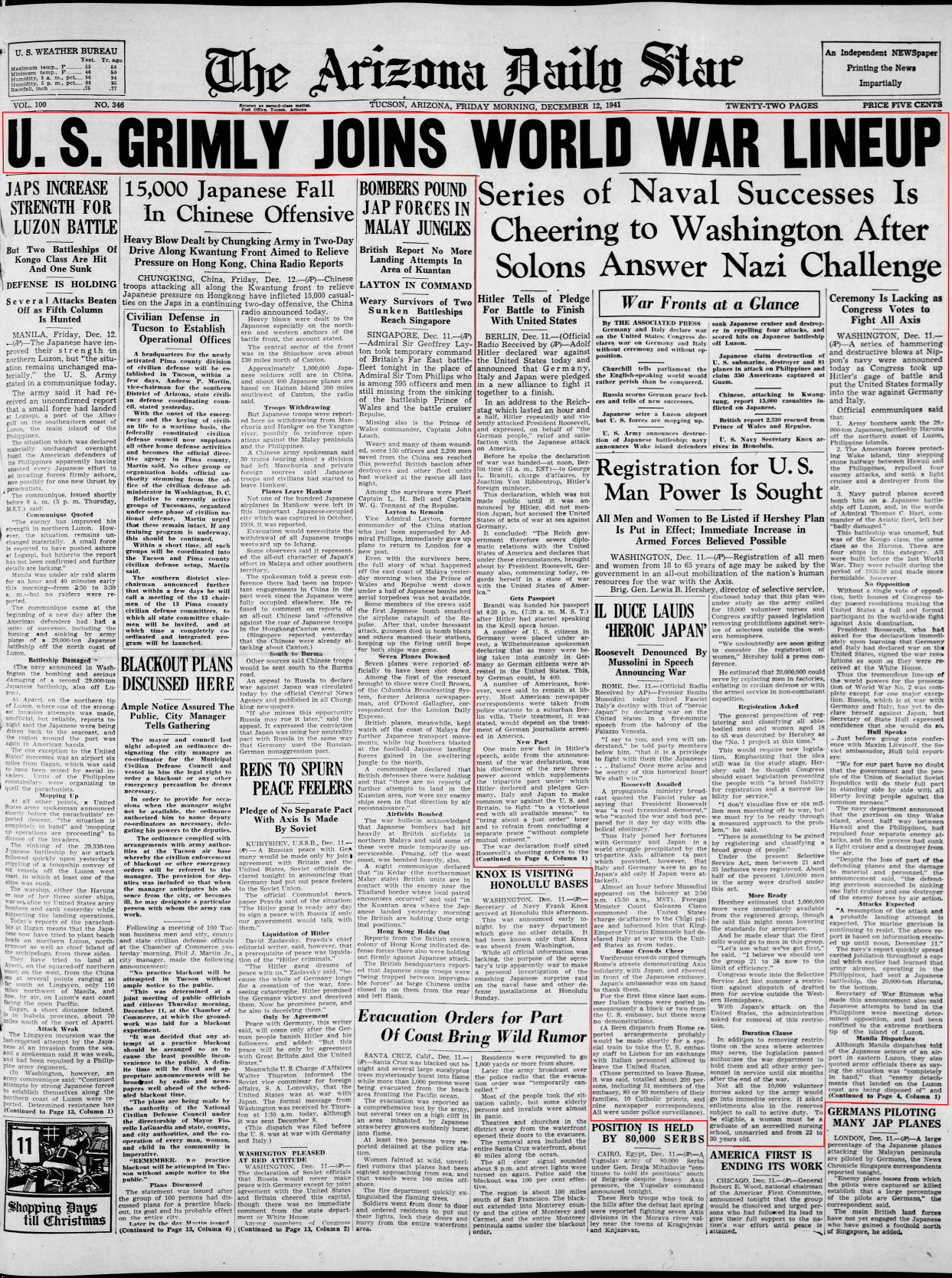
Download a PDF that you can enlarge for easier reading
U. S. GRIMLY JOINS WORLD WAR LINEUP
Series of Naval Successes Is Cheering to Washington After Solons Answer Nazi Challenge
Hitler Tells of Pledge For Battle to Finish With United States
BERLIN, Dec. 11. ─ (Official Radio Received by (AP) ─ Adolf Hitler declared war against the United States today and announced that Germany, Italy and Japan were pledged in a new alliance to fight it together to a finish.
In an address to the Reichstag which lasted an hour and a half, Hitler repeatedly and violently attacked President Roosevelt, and expressed, on behalf of "the German people," relief and satisfaction with the Japanese attack on America.
Before he spoke the declaration of war was handed ─ at noon, Berlin time (3 a.m., EST) ─ to George L. Brandt, charge d'affaires, by Joachim Von Ribbentrop, Hitler's foreign minister.
The declaration, which was not made public until it was announced by Hitler, did not mention Japan, but accused the United States of acts of war at sea against Germany.
It concluded: "The Reich government therefore severs diplomatic relations with the United States of America and declares that under these circumstances, brought about by President Roosevelt, Germany also, commencing today, regards herself in a state of war with the United States of America."
Gets Passport
Brandt was handed his passport at 4:20 p. m. (7:20 a. m. M. S. T.) after Hitler had started speaking in the Kroll opera house.
A number of U. S. citizens in Germany were placed under arrest, a Wilhelmstrasse spokesman declaring that as many were being taken into custody in Germany as German citizens were arrested in the United States. This, by German count, is 400.
A number of Americans, however, were said to remain at liberty. Most American newspaper correspondents were taken from police stations to a suburban Berlin villa. Their treatment, it was states, would depend on the treatment of German journalists arrested in America.
New Pack
One main new fact in Hitler's speech, aside from the announcement of the war declaration, was his disclosure of the new three-power accord which supplements the tripartite pact under which Hitler declared and pledges Germany, Italy and Japan to make common war against the U.S. and Britain, to fight "to a victorious end with all available means;" to "bring about a just order" later and to refrain from concluding a separate peace "without complete mutual consent."
Ceremony Is Lacking as Congress Votes to Fight All Axis
WASHINGTON, Dec. 11. ─ (AP) ─ A series of hammering and destructive blows at Nippon's navy were announced today as Congress took up Hitler's gage of battle and put the United States formally into the war against Germany and Italy.
Official communiques said that:
1. Army bombers sand the 20,000-ton Japanese battleship Haruna off the northern coast of Luzon, Philippine islands.
2. The American forces protecting Wake island, tiny stepping stone halfway between Hawaii and the Philippines, repulsed four enemy attacks, and sank a light cruiser and a destroyer from the air.
3. Navy patrol planes scored bomb hits on a Japanese battleship off Luzon, and, in the words of Admiral Thomas C. Hart, commander of the Asiatic fleet, left her "badly damaged."
This battleship was unnamed, but was of the Kongo class, the same class as the Haruna. There are four ships in this category. All were built before the last World War. They were rebuilt during the period of 1926-30 and made more formidable, however.
No Opposition
Without a single vote of opposition, both houses of Congress today passed resolutions making the United States a full and formal participant in the world-wide fight against Axis domination.
President Roosevelt, who had asked for the declaration immediately upon learning that Germany and Italy had declared war on the United States, signed the war resolutions as soon as they were received at the White House.
Thus the tremendous line-up of the world powers for the prosecution of World War No. 2 was complete except for one major exception. Russia, which is at war with Germany and Italy, has yet to declare herself against Japan, but Secretary of State Hull expressed confidence that she would do so.
Dec. 21, 1957: Elvis Presley is drafted
Updated
Download a PDF that you can enlarge for easier reading
Draft Calls Elvis, Studio Worried
HOLLYWOOD, Dec. 20 (AP) ─ Elvis Presley got his "greetings" from Uncle Sam Friday, but his studio said an eight-week deferment will be asked for the rock 'n' roll singer so he can make a movie.
Presley's draft board in Memphis ordered him to report for induction into the armed services Jan. 20.
"I'm kinda proud of it," the singer said in Memphis. "It's a duty I've got to fill and I'm going to do it."
However, Y. Frank Freeman, head of Paramount Pictures, said he will ask the draft board to delay Presley's induction eight weeks. The quiver-lipped singer is scheduled to start filming a picture Jan. 13. The film, "King Creole," formerly was titled "Sing, You Singers."
Freeman said that if the picture is canceled the studio will lose between $300,000 and $350,000 because of various commitments and investments already made.
Tom Parker of Nashville, the singer's manager, said the draft notice would cost Presley half a million dollars in gross income immediately. After that, he said, it would be hard to estimate.
On Jan. 20, Presley will report to his draft board along with others on the list for roll call. After physical examination, they will be sworn in. Then they travel by bus to Fort Chaffee, Ark.
Parker estimated drafting his prize client would cost the government at least half a million dollars in income taxes next year.
"Of course," he added, "that's not as important as having the government treat everybody the same."
The notice came in the usual official envelope containing the usual official message to "Presley, Elvis Aron."
He will spend Christmas home with his parents.
Dec. 2, 1959: Antarctic Pact is signed
Updated
Download a PDF that you can enlarge for easier reading
Antarctic Pact Is Signed
Frozen Continent To Be Kept At Peace
WASHINGTON, Dec. 1 (AP) ─ The Antarctic Pact ─ a pledge to keep the great frozen continent at peace ─ was signed Tuesday, and greeted as a sign of thaw in international relations.
Twelve nations, including the United States and Russia, signed the treaty that bans war bases, nuclear explosions and missile sites forever from a vast South Polar region covering five million square miles.
It dedicates Antarctica, where Russia and the United States have been the most active explorers, to peaceful uses.
President Eisenhower called the 2,500-word document "an inspiring example of what can be accomplished by international cooperation in the field of science and in the pursuit of peace."
For the Soviet, Deputy Foreign Minister Vasili V. Kuznetsov said it reflected "a definite improvement in international situations."
It is "additional evidence of the fact that states, if they are ready to cooperate, can successfully achieve through negotiations mutually acceptable solutions of internal problems in the interest of international peace and progress," the Russian representative added.
Australia's Ambassador Howard Beale saw the treaty as a possible model for other international agreements ─ not only relating to earth but "perhaps to the outer marches of space itself."
One of the pact's most significant aspects, U.S. officials said, is its provision for a revolutionary system of international inspection in Antarctica.
It gives each of the 12 nations the right, on mere advance notice, to check the other's installations, equipment, ships and planes in the Antarctic at any time.
Such an inspection system is one of the major items involved in disarmament and nuclear test ban negotiations between Russia and the Western powers.
How policing works out in the Antarctic may affect any future disarmament agreements between the major powers.
"The Antarctic Pact," negotiated in seven weeks, required U.S. Senate approval and similar ratification from governments or legislatures of the other 11 nations before it becomes official.
Any one of the 82 members of the United Nations can join later. But non-U.N. members, such as West Germany and Red China, must get the unanimous vote of the 12 original signers.
U.S. officials have made it clear already that they won't vote for inclusion of the Communist Chinese.
Note: The 12 nations that signed the treaty Dec. 1, 1959, include: Argentina, Australia, Belgium, Chile, France, Japan, New Zealand, Norway, South Africa, the United Kingdom, the United States and the Soviet Union.
Dec. 19, 1967: Jet crashes into Tucson grocery store
Updated
Download a PDF that you can enlarge for easier reading
15 FEARED DEAD IN FIERY CRASH
2 Homes Razed By Falling F4D Near Airbase
By Ken Burton
Fifteen persons were believed killed last night and at least a dozen injured when a U.S. Air Force F4D jet crashed into the rear of a Food Giant store at the Cactus Shopping Center at E. 29th St., and S. Alvernon Way.
Capt. Ellis Franklin of the Tucson Fire Dept. said at press time this morning that he feared the death toll might reach 15.
Eight of the deaths were confirmed as still more bodies were being removed from the gutted store and homes to the rear of the market.
At least two houses to the rear of the shopping center complex were also destroyed as a fireball of JP-4 aviation fuel engulfed the area, creating a holocaust.
Air Force officers said the two-man crew, Flight Lt. Jack R. Hamilton of the Royal Canadian Air Force (RCAF), the pilot, and U.S. Capt. Gary L. Hughes, the navigator, were able to parachute from the plane before it crashed.
Tim Oned, of 3810 E. 32nd St., was standing on S. Winstel Ave. when the plane hit the ground shortly after 5:30 p.m.
"I saw two planes heading north above me," said Oned. "They were flying side-by-side, when two objects shot out of the eastern aircraft . . . I realized later these were parachutes."
Witnesses, including Oned, said the aircraft then turned on its side and descended upside down. Oned said when it hit, "It exploded like a bomb you see on television."
Another witness, 15-year-old Roswell Burk, of 1802 S. Baxter Pl., said he was just blocks away from the supermarket when he saw the jet approaching.
"When the plane came over, it tipped a little and it looked like a wing caught on one wall ─ and it just blew up," Burk said, explaining how the craft slammed into an alley directly behind the store.
The plane was loaded with more than 16,000 pounds of volatile JP-4 aviation fuel, which it had taken on prior to leaving Davis Monthan AFB. The plane was based at Nellis AFB, Nev.
The fuel exploded across houses and ripped a fiery path through the grocery store, which was dotted with holiday shoppers and employes.
Ernest Sanchez, a Tucson Gas & Electric Co. employe who was driving by the store when the crash occurred, stopped his car and ran inside to help men, women and children escape.
Reports indicated that between 20 and 30 persons escaped before the fire completely engulfed the store's inside.
Aby Mogy, a self-employed truck driver who runs Mogy's Towing Service, was helping a stranded motorist some 300 yards from the supermarket when he saw the plane fall.
Mogy said he heard "a thud," saw "not more than 20 people" run out, and immediately got on his two-way radio in his wrecker and called for the fire department. He was credited with the first alarm.
More than 85 city firemen ─ 50 regulars, plus 35 off-duty men called back to work ─ responded to the three separate alarms that send a total of 10 pieces of fire and rescue equipment to the tragedy.
Firefighting teams also rushed to the blaze from Davis-Monthan and Air National Guard headquarters. D-M also sent several ambulances and teams of medics.
Some 100 city policemen and other officers from South Tucson, the Arizona Highway Patrol, the Pima County Sheriff's Office, plus Civil Defense teams, the Sheriff's Search & Rescue Unit and Red Cross ─ all rushed to the crash site.
"We've got every law enforcement and rescue agency in the city and county out here fighting this thing," said one city patrolman. "I don't think we've missed anyone."
Dec. 25, 1968: Apollo 8 orbits the moon
Updated
Download a PDF that you can enlarge for easier reading
Apollo 8 Crew Starts Journey Back To Earth
Astronauts Will Land Friday
By Paul Recer
AP Aerospace Writer
SPACE CENTER, Houston (AP) ─ The Apollo 8 spaceship and its crew blasted away from the neighborhood of the moon Christmas Day ─ and began the 235,000-mile trip home.
"Roger," said Apollo 8. "We've just been informed there is a Santa Claus."
There were six frightening minutes while Apollo Control tried repeatedly to get voice contact with the spacecraft.
Then it was there.
The rocket firing came at 11:00 a.m. Tucson time, and 10 minutes later Apollo wheeled out from behind the moon homeward bound at about 6,000 miles per hour.
The three-minute 18-second burn added enough speed to the 3.600 m.p.h. Apollo 8 was traveling to carry it was from the moon's primary gravitational influence, and send it into the pull of the earth.
"This gives you the sensation that you're climbing," Apollo 8 reported when confirmation of a good rocket burn was passed up to the spaceship.
Earlier, the "very tired crew" of the Apollo 8, with the first flush of their space victory behind them, cut down their Christmas Eve flight plan ─ but kept a television transmission in their moon-orbiting schedule.
Spacemen Face Loneliest Yule
By John Barbour
SPACE CENTER, Houston (AP) ─ Locked in a circle around a plaster of paris moon, three men from earth looked back at the blue planet called home and spent the loneliest, most distant Christmas Eve ever.
Before them like an endless front lawn covered with dirty, foot printed snow, the lunar landscape stretched on and on, blinding in the sunlight, forbidding and secret in shadow.
Beyond, like a warm promise, the world they'd left behind four days ago glowed royal blue, burnished with browns, wrapped with the soft white of clouds, a world of warm fires and tables spread for Christmas, and trees laden with snow, a haven of families and children playing, all of it at least three days and a risky voyage away.
The world was now the tight little cabin of their Apollo 8 spaceship, the ordered world of circuit breakers and display keyboards, control panels and warning lights, checklists and schedules, cold metal bulkheads and meals squeezed from plastic bags.
A small compromise was a Christmas dinner ration ─ a metal foil wrapped portion of sliced turkey, the only unfrozen, undehydrated food carried officially into space, not counting a corned beef sandwich smuggled aboard an early spaceship four short years ago.
The three astronauts, Air Force Col. Frank Borman, Navy Capt. James A. Lovell Jr. and Air Force Maj. William A. Anders, were linked to home and Christmas by the crisp voices of fellow astronauts 235,000 miles away, and the memories of Christmases past.
The Apollo 8 voices were coming in so clear, said one astronaut, that people said it "was like sitting in your living room listening to good hi-fi."
"Sounds like a good idea," answered a weary voice from space.
"If you haven't done your Christmas shopping yet, you might as well forget it," Apollo Control said. It drew no comment from the distant spaceship.
"Give us, O God, the vision which can see thy love in the world in spite of human failure," said the quick, sincere voice of Frank Borman reading a Christmas prayer he wrote for the members of his church. "Give us the faith to trust the goodness in spite of our ignorance and weakness. Give us the knowledge that we may continue to pray with understanding hearts, and show us what each one of us can do to set forward the coming of the day in universal peace. Amen"
Editor's note: Apollo 8 astronaut and commander, Air Force Col. Frank Borman, wasn't born in Tucson, but we consider him one of our own. He grew up in Tucson and went to high school here. In fact he made a name for himself playing football at Tucson High School.
Dec. 20, 1970: Pioneer Hotel fire
Updated
Download a PDF that you can enlarge for easier reading
TWO KILLED, 15 INJURED IN PIONEER HOTEL BLAZE
Guests Plunge From Windows
At least two deaths were verified and more than 15 injuries were reported in fire that swept through the 41-year-old Pioneer International Hotel early this morning. It was feared the death toll would be much higher.
Reporters on the scene said that four bodies were brought to the mezzanine level about 2 a.m. and the firemen had called for a resuscitator on the ninth floor. Several other sheet-fraped bodies were seen there. The fire broke out shortly after midnight.
Robert Trooper, hotel auditor, said he got a call from a guest who said she saw flames in the stairwell on the third floor.
An unidentified room clerk said the flames shot up the elevator shaft of the 250-room hotel, leaving a wake of smoke in the upper floors of the 11-story building.
At 1:45 a.m. St. Mary's Hospital had reported one person dead on arrival and 15 others injured. At that time it was not known whether any injured had been taken to other hospitals.
Those injured included person who jumped from the upper floors.
One witness said, "People were jumping from the windows and splattering on the sidewalk. It was awful. Firemen were screaming to people through their horns to stay on the floors for oxygen."
Witnesses said they saw bodies illuminated by floodlights, leaping from the rooms of the 10th floor and the roof.
Mrs. Lee Atkinson, who had just left the hotel when the fire broke out, said she heard young people screaming. "I wanted to go back in and help them. It was awful," she said.
"I'll never forget this as long as I live. People hanging on the ledges, yelling."
At 1:15 a.m. a man named "Bill" found his way to a balcony on the eighth floor overhanging Pennington Street. A friend on the street below, who had found his way out of the hotel, called to him to remain where he was, that he was safe where he was.
"Bill" disappeared and reappeared at another window on the east side of the hotel. A sheet rope from the floor above him dropped past the window. He grabbed at it and slid down to the fourth floor of an addition to the building. The dead person was later identified as a woman who jumped from the seventh floor, struck a balcony overlooking Stone Avenue and fell to the sidewalk. Her name was not available.
Firemen pleaded with hotel guests not to jump from the building. At first the message was given in English by Capt. Ellis Franklin. Later, an unidentified fireman spoke to the guests in Spanish.
With flames still out of control at 1:55 a.m. the fire department issued a "Yellow Alert" putting all emergency equipment in the city into action. "This is like a disaster situation," the department spokesman said.
Edwin Santschi, retired electrical inspector for the City of Chicago, said flames were biting through the door of his room on the fifth floor. He said he tried to douse the flames with water from an ice bucket. In the hallway he said he saw four other guests crowding at the window "ready to jump."
Father Cahelare, of St. Augustine Cathedral, arrived at the scene soon after midnight. He was seen giving the last rites to a guest on the second floor of the hotel.
Several hundred employes of the Hughes Aircraft Co. were at the company annual party. Some left, and others sped through the building leading guests, most of them elderly people, to safety.
"Many were doing brave things," a witness said.
One man stood on a window ledge on the fourth floor for 15 or 20 minutes before firemen could get a ladder to him.
Note: By the following day, headlines told readers that the fire had resulted in 28 dead and at least 35 injured. Eventually 29 deaths were attributed to the fire. Among those killed were Mr. and Mrs. Harold Steinfeld, permanent residents on the top floor of the hotel. The hotel had been built by Albert Steinfeld, Harold's father, in 1929. The family was best known for Steinfeld's department store.
 Pioneer Hotel Fire $2.99 Kindle Nook Free for Star subscribers |
Dec. 9, 1980: John Lennon shot
Updated
Download a PDF that you can enlarge for easier reading
Ex-Beatle John Lennon shot to death
'Local screwball' held in N.Y. slaying
NEW YORK (AP) ─ Former Beatle John Lennon, who with the long-haired British rock group was catapulted to stardom in the 1960s, was shot to death late yesterday outside his luxury apartment building on Manhattan's Upper West Side, police said.
Authorities said Lennon, 40, was taken in a police car to Roosevelt Hospital, where he was pronounced dead shortly after arrival.
Police said the shooting occurred outside the Dakota, the century-old luxury apartment house where Lennon and his wife, Yoko Ono, lived across the street from Central Park.
Police said they had a suspect and described him as "a local screwball" with no apparent motive for shooting Lennon.
Jack Douglas, Lennon's producer, said he and the Lennons had been at a studio called the Record Plant in midtown earlier in the evening and that Lennon left at 10:30 p.m. Lennon said he was going to get a bite to eat and go home, Douglas said.
A bystander, Sean Strub, said he was walking south near 72nd Street when he heard four shots. He said he came around the corner to Central Park West and saw Lennon being put into a police car.
"Some people said they heard six shots and said John was hit twice," Strub said. "Police said he was hit in the back."
He said others on the street told him the assailant had been "crouching in the archway of the Dakota . . . . Lennon arrived in the company of his wife, and the assailant fired."
He said the suspect, a "pudgy kind of man" 35 to 40 years old with brown hair, was put into another police car.
"He had a smirk on his face" when police took him away, Strub said.
Lennon rocketed to fame in the early 1960s when he and fellow Britons Paul McCartney, George Harrison and Ringo Starr introduced a new sound that changed the course of rock 'n' roll.
Lennon, who turned 40 on Oct. 9, was responsible for writing many of the songs that launched the Beatles in the early 1960s and heavily influenced rock music
After the Beatles broke up in 1970, Lennon continued writing songs and recording. But in 1975, he dropped out for five years, saying he wanted to be with his son, Sean, and his wife.
It was not until last summer that he returned to music, and his 14-song album "Double Fantasy" was released last month.
More in Time machine special sections (8 of 13)
January time machine: Historical headlines
Read moreJohanna Eubank
Online producer
In this Series
Time machine special sections
1
Updated collection
From the Arizona Daily Star archives: Printable movie star paper dolls
2
Updated collection
Historic June front pages from the Star's archives
3